The Relentless Dead, page 3


‘But for fear of what forces may have been unleashed here.’
The Vostroyan nodded. ‘With sufficient artillery and manpower,’ he continued, ‘I believe we can retake the tower in a matter of days.’
‘Ah,’ said Graven.
‘Hence I requested a Krieg siege regiment once I knew one was available.’
‘My regiment is not what it once was.’
‘Yes, so I am informed. An incident with orks and a nuclear device, I hear – clumsy, ignorant brutes, I’ve always found – and your old colonel perished alongside his Guardsmen?’ Graven nodded stiffly. ‘At least, then, we can say he died with honour, facing the consequences of his failure.’
Graven bristled. ‘Colonel Kleber did not fail us.’ He took a breath. ‘My point, Colonel Petrakov, is that our fighting strength is diminished to fewer than four hundred. We also lost much of our artillery to the firestorm.’
‘Which means?’
‘Certainly our tacticians can lend you their expertise. Since taking command of the Four Hundred and First, however, I have dissolved its companies. We operate as semi-autonomous ten-strong squads – kill teams when needed. I believe that is how we are best employed now – remaining apart from your main force, offering a swift response to incidents as they arise worldwide.’
‘Colonel Graven, an Attilan regiment already–’
Graven carried on talking, quietly but forcefully. ‘There have been incidents, I understand? You said yourself, the malignancy here runs deep, and we must excise its every tendril.’
‘Before they too can grow,’ his watchmaster added.
‘My methods,’ said Graven, ‘have thus far yielded positive results.’
‘I do not doubt it,’ said Petrakov with tight-lipped politeness. He took a long sip from his glass. ‘I hear that, among you Krieg, in a short time your regiment has earned quite the reputation – and a nickname to go with it.’
‘Yes,’ said the Krieg colonel. He had nothing more to add.
‘Do you think he will take note, sir?’ the watchmaster asked.
‘I believe so,’ said Colonel Graven, ‘though he’ll have more to say before we reach a compromise. His confidence in his own judgement is mostly affected.’
‘Perhaps a commissar could speak to him?’
The colonel ignored the suggestion.
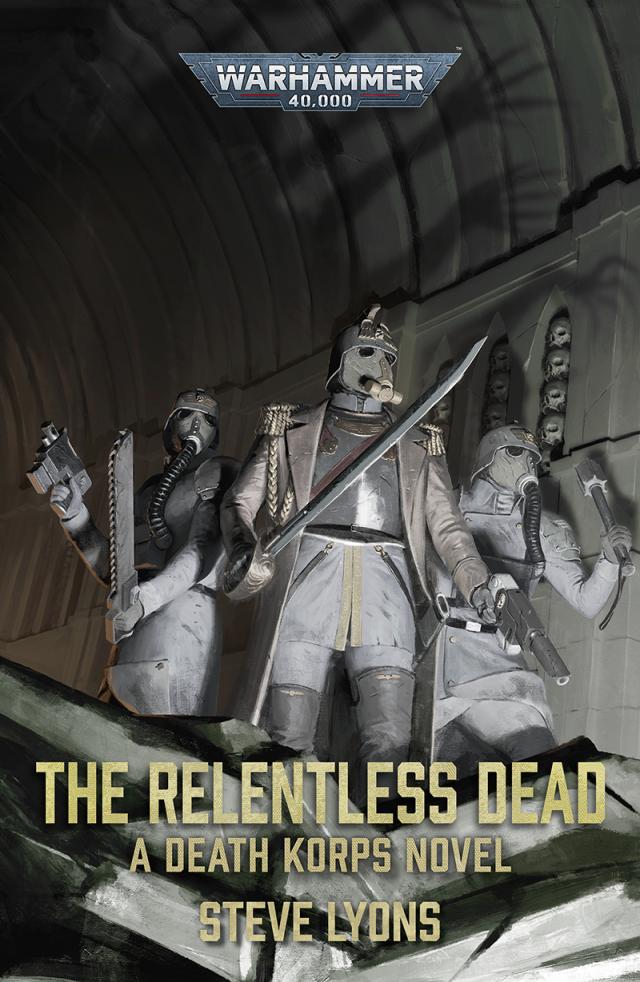
The rain had lessened but still pattered on their helmets as wet ground sucked at their boots. Vostroyans beetled about between the tin huts of the compound, the stark red of their uniforms the only splashes of colour in view. A junior officer, spying the winged skull on Graven’s helmet as he passed him, snapped to attention and threw up a smart salute, which he returned.
A drop-ship rose above the southern horizon with a scream of engines, returning to its orbiting berth. Behind them, some distance to the north, the brutalist edifice of the Ecclesiarchal Tower touched the clouds. Worked into its grey stone was the symbol of the Adeptus Ministorum, a skull glaring from the pillar of a giant ‘I’, encircled by a spiked crown. A reminder that the Emperor’s eyes were everywhere – for what that had been worth.
‘What did he mean,’ the watchmaster asked, ‘about our worlds being alike?’
‘Vostroya’s shame predates even Krieg’s,’ said Graven, ‘originating in the Age of Darkness. I don’t know the details, only that to this day each Vostroyan family sends its firstborn son or daughter to fight for the Emperor.’
‘Only their firstborn?’
‘They also maintain a rigid class system in which ranks are assigned by birthright, not earned through experience.’
Krieg Centaurs were starting to arrive, their spinning tracks throwing up mud, carrying the regiment’s command staff along with sundry aides and quartermasters. A smaller assemblage by far than it had been. Colonel Graven went to brief them and direct them to the hut allocated for their command centre.
The watchmaster was distracted by a sound, a familiar one, which caused him a melancholic twinge: a thundering of hooves as five horses swept through the gates in the vehicles’ wake. Atop them were five squat figures, clad in leather. Each wore a leather greatcoat, boots and gloves, and a wide-brimmed, spiked riding helmet, with leather straps swaddling their ears and chins. All carried a hunting lance, while most had lasguns slung beside their saddles.
Attilan Rough Riders. A long way from their feudal home world. At the orders of their sergeant – distinguished by her stripes and her helmet’s fine plume – they halted by a dirty metal trough, well filled by rain. They loosened their horses’ barding, removing the chamfrons from their heads, and let them drink. A couple of riders dipped mugs in the water for themselves.
Approaching, the watchmaster exchanged a nod with the Attilan sergeant, acknowledging each other’s equivalent ranks. ‘He seems a sturdy beast,’ he said.
‘He is, but ill-tempered. Keep your distance.’
Undeterred, he stroked the horse’s mane, kneaded its shoulder. It turned its head to size him up, harrumphed and returned to its water. He noted the variant of the winged-skull symbol branded into its hindquarters.
The Attilan looked impressed. ‘I rode one a little like him,’ the watchmaster explained. ‘On Krieg too, our steeds are bred for strength and aggression and require a firm hand on the reins, but there is no more loyal creature in the galaxy once they have accepted a master.’
‘My people say only the bravest take horses to a tank fight.’
‘And must take the bravest horses.’
A grin broke across her brown, weather-beaten face. Removing her headgear, she allowed matted black hair only partly tamed by braids to unfold down her back. The white scars on her cheeks were symmetrical enough to suggest deliberate cuts. The watchmaster saw the same scars on the sergeant’s comrades, the same unkempt black hair.
She extended a gloved hand towards him. ‘Batu.’
He took the sergeant’s hand. She didn’t seem fazed by his mask as many were. She was expecting a name from him. He had once chosen one in case of need, when he had become a ridemaster. Never had it been formally recorded. He had almost forgotten it.
‘You’ve been out fighting?’ he asked.
‘Searching,’ Batu grunted in her guttural, thickly accented voice.
‘For witches?’
‘And witch hunters.’ The watchmaster frowned – which of course the Attilan couldn’t see, but she took his silence as a prompt. ‘Idelax?’
‘The Vostroyan mentioned him. I assumed he had died with the priests.’
‘Maybe, but no sign of his body in the tower. Eat with us?’
‘Thank you,’ he said, ‘I am on duty.’ As a Korpsman, rarely was he off-duty. Life was duty. ‘Maybe we’ll chance to meet again.’
Sergeant Batu shrugged. ‘Maybe.’
Her comrades had tied up their horses and had gathered, waiting for her. They were chattering raucously and laughing, a far less familiar sound to the Krieg watchmaster. Batu joined them and they disappeared into a hut.
The watchmaster nuzzled the horse that reminded him so much of his own. The one lost to a radiation sickness that had almost killed him too. The last of the 401st Krieg Regiment’s mounts to die, leaving him a ridemaster no longer. Having been spared for a reason, he hoped one day to find out what it was.
With a sigh, he turned to find his new colonel again.
Colonel Petrakov outlined his battle plan in his war room.
With a polished swagger stick, he pointed out details on a tactical hololith, around which the command staffs of three regiments crowded. The Krieg colonel asked him several questions as if testing him.
The Attilan Colonel Tegana spoke less, but neither did he seem to listen much, drawing his own conclusions. Petrakov considered him, his regiment, too casual by far in their approach to their duties. Given a chance, he would have drilled some discipline into them.
His prime concern remained the siege of the occupied tower. He had stubbornly assigned most of the Krieg Korpsmen to this task, though he had left Graven a few to employ elsewhere as he chose. Most were already headed to the front lines with entrenching tools in hand. The flimsy walls around him rattled with the passing of huge artillery platforms, bearing powerful Earthshaker cannons.
According to Petrakov’s scouts, the tower was still dark and silent. The last firing of its defensive guns had been three days ago. Its small stockpile of ammunition might have run dry or been close to so doing. The guns, however, were not the primary threat. Not when dealing with rogue psykers, whose strength remained unknown, whose profane powers could manifest in almost any form.
The witches, he had to assume, were waiting. Waiting in their stronghold for their enemies to walk into their clutches. Waiting to employ those profane powers at close range. A few days’ bombardment of their walls would soften their resolve, and might bury some of them in rubble.
He had almost finished talking when he heard a commotion outside. The war room door burst open and in marched two imposing figures in black power armour. Their crimson robes and headdresses were festooned with holy symbols, notably the fleur-de-lys. Their appearance was greeted by awed intakes of breath, even from the hardened veterans present, as heads were reverently bowed.
The shorter, more wiry of the pair appeared to be the one in charge. She had short snow-white hair and angular features. ‘Colonel Petrakov,’ her clear, commanding voice rang out, ‘we must speak.’
‘Sister Superior, of course. My office may be more suitable?’
‘There has been another incident.’
‘The mausoleum?’ asked Petrakov, fearing the worst. ‘An attack?’
‘No attack, but more than one of my Battle Sisters has noticed a… nocturnal presence of late.’ Such reticence was unlike her, and Petrakov wondered what she was reluctant to reveal. On firmer ground, she said accusingly, ‘You assured me that you had the wretched witches confined within the tower.’
‘I am certain of it. Most of them.’
‘Be that as it may, we cannot overlook the chance that others may be plotting to defile our sacred shrine. I require that you provide additional protection.’
Colonel Graven cleared his throat. ‘Sister Superior, the Krieg would be honoured to oblige you however we are able. We can spare as many Korpsmen from the trenches as you deem sufficient to the task.’
The Vostroyan bit his tongue. He had no wish to disappoint this ordained holy warrior, nor incur her wrath, though technically he outranked her. Her brawnier colleague stood scowling at her shoulder, a hand resting on her holstered boltgun. So, he made the required introductions.
‘Sister Superior – Colonel Graven of the Death Korps of Krieg, whose siege regiment joined us today. Colonel, may I present Sister Superior Serafina of the Adepta Sororitas, who maintain an honour guard around the sainted Josefina’s place of rest.’
‘My privilege,’ said Graven. ‘I suggest we set up watch points on every approach to the area, maintaining a respectful distance, of course.’
He earned himself an approving nod, making Colonel Petrakov’s heart sink. He supposed his plans would have to be redrawn again.
That night, Graven slept more soundly.
Though he had a room to himself, it adjoined the large mess hall in which some eighty Korpsmen – those he had succeeded in keeping back from the trenches – bedded down. They needed nothing more than this, as they were moving out at dawn. He heard their soft snores through his door.
He was not spared the dreams entirely.
He was underground, captain of an engineer company again, leading his command squad through pitch-black tunnels. He was trying to reach his colonel with a warning, but the tunnels turned and twisted and kept bringing him back to where he had started. He was growing more frustrated as the labyrinth shifted around him. Stumbling into dead ends, he would turn to find the passageway behind him also closed. He had a growing sense of dread. He feared that time was running out.
Time skipped, and Captain Graven was attacking a rock wall with a pickaxe, blasting at it with a shotgun, screaming for a breaching drill, and it was all too late.
His chrono woke him with its tinny fanfare and the dream receded as he lay on his bedroll, on his back, but he knew it would not have gone far.
Graven lowered himself into the turret of an idling Chimera.
His watchmaster took the gunner’s seat beside him, a driver below him in front. The remainder of his handpicked command squad, his readymade kill team – seven more veterans, rendered all but indistinguishable by their uniform masks – dropped into the passenger compartment.
More vehicles were starting up around them, wreathed in morning mist: three more Chimeras, two Centaurs and even a venerable Ragnarok, tired and battered remnants of a once-mighty fleet. His repeated requests for more resources had been refused. Krieg high command was winding his regiment down.
A familiar sound reached Graven’s ears, even over the grumbling of engines – a distant booming of Earthshaker cannons. The siege of the Ecclesiarchal Tower had begun under Petrakov’s direction. A part of him wished he could be there, back in the trenches, back in the world he knew, but that was not his path now.
He bellowed the order to move out, and the transports crawled through the compound gates in convoy. His was among the first to peel away. As they bumped along muddy tracks, Graven stood in the open turret, surveying his surroundings. He followed his progress on a map provided for him by Colonel Tegana, whom he had found more agreeable than the Vostroyan.
He had noted that they would pass close to the mausoleum. Soon enough, its ornate spires rose above the flat terrain. He saw no sign of the Korpsmen he had sent out here last night, though they must have been concealed nearby. The Sister Superior had approved the plans he had submitted to her.
Graven felt she approved of him too. He wondered if, when all of this was over, she might deign to take his confession. Might it even stop the nightmares?
They ploughed on through field after endless field of crumbling headstones. Occasionally they saw grimy workers tending to these, but the dead of this world vastly outnumbered its living. Graven tried to read names from the nearest stones, but erosion had faded them. ‘Too many,’ he muttered to himself. ‘Too many names to be remembered, so none will be.’
Few Krieg lived long enough to need a name. Others, such as Graven, chose honoured names of the past from the walls of the many mausolea that rose in grim defiance from their home world’s ashes. When had a new name last been inscribed upon those walls? He didn’t know.
Like many of his comrades, he carried an ossuary box. Inside, wrapped in velvet, was a bone from the finger of a Korpsman killed during Graven’s first engagement. He had not known the man. That was the point. The bone represented every nameless comrade, every sacrifice. This was how he remembered them, every one of them. That was what he told himself.
His mind returned to Serafina, to her Sisters of Battle, skilled and ferocious warriors. Any witch would have quailed at the sight of them, but they stood sentry over desiccated bones instead of fighting for the living. An unworthy thought, which he quickly suppressed.
He thought about his regiment instead. When its end came, as soon it must, how would it be remembered? For a lapse of judgement leading to annihilation? Not if Colonel Graven could help it. His goal was to stave off that end for as long as he could, long enough to atone for past mistakes. The memories of his dead comrades demanded it. Their lives had to matter.
Colonel Petrakov had spoken of reputation. He had heard of the name attached by some to Graven’s regiment. That ought to have pleased him, but the proffered honour had still felt unearned. Soon, he swore to himself.
Soon, the 401st Krieg Regiment would be known not for its failures, but because its survivors had walked through nuclear fire and only been tempered by it. They had refused to lie down when their time had come.
Soon, they would deserve their soubriquet of the Relentless Dead.
Oleris’ grave workers subsisted in tiny, squalid hamlets, clusters of ramshackle huts squeezed into the few spaces reserved for the living. Perhaps it was this, each hamlet’s isolation, that had made close oversight impossible, allowing heresies to take root in the cracks.
The Chimera passed several such settlements, headed for one in particular. Graven had held one detail back from Petrakov, from everyone. Before arriving on Oleris III, before even receiving his assignment, he had been contacted by a grey-faced Imperial emissary with impeccable credentials but no name to share. The agency she represented was eager to locate the missing Idelax, keener still that, were he to have been ‘compromised’, as few eyes as possible should see him. The inquisitor’s last report to his superiors had included a list of coordinates, locations that he planned to visit.
The first of those now loomed ahead of Graven. After driving for three hours, he looked forward to stretching his limbs. He tapped his driver’s shoulder with his foot, a prearranged signal for him to pull up.
According to his dataslate, forty-seven workers and sundry dependants occupied this hamlet. Despite this, no one walked its tracks and the surrounding fields were empty. No one came from the huts to greet them, no faces appeared at their dark windows. All was still and, once the echoes of the Chimera’s engine had died down and the rain had let up for a moment, deathly silent.
‘Emperor grant we have not reached this world too late,’ Graven muttered as he clambered out onto the sponson, then dropped down into the mud.
He didn’t catch his watchmaster’s soft reply.
He turned to ask him to repeat it, but his comrade was not standing by his ear as he had thought. Confused, he raised his eyes to the turret, in which the watchmaster was still seated, looking down at him.