

Memories of the Future, page 25


Witchcraft as therapy, I thought. Gus really is right.
“Where’s Sarah?” I said, looking around. “And, and,” I had forgotten his name, “her husband?”
“Her husband!” Moth shrieked. “That’s funny. Martin would hate that. He’s such a fucking blowhard. Patty, I never understood why you put up with him.”
“He leavens me,” Patty said in a dark voice. “He’s good for me. He can be sharp even though we don’t agree. I’ve known him for a long time.”
“He’s good-looking,” Lucy said.
Moth made a face at Lucy and continued, “Martin and Sarah left when you were coming to. She was furious at him. She dragged him out of here because you were so mad. She called him a pompous ass. I was proud of her.”
“Was I so mad?” I felt guilty. The guilt had a strangling quality. Why had I been so mad? Why had I made a scene? I had a confused thought about the hamster and the little piece of paper and then about the mother, philosophy’s hidden whale swimming under the surface of the ocean.
“Don’t you remember being mad?” Gorse said. I hoped she wouldn’t adjust her glasses, but she did, and then made the tiny sound.
“No, I do,” I said. “The problem of other minds.”
“You spoke German!” Moth said. “Patty knows German.”
“Are they witches? Sarah and Martin?” I asked.
“Good heavens, no,” Gorse said. “We think we might do Sarah some good, you see. We keep an eye on her. We send good spells in her direction. She needs some propping up. We’ve tried binding Martin, but so far it hasn’t had much effect. I think we need more energy.”
Gorse gave Patty an accusatory glance.
There was chatter then about calling it a night. Alistair helped me to my feet. Moth patted my arms and straightened my sweater, as if she were putting me in order for my exit. I didn’t mind. Her fussing felt maternal. Patty noted that it had been a long evening and far more eventful than anyone had expected, much wine had been consumed, et cetera.
When Lucy and I were at the door, Patty shook my hand warmly. I realized I was both a little bit afraid of her and drawn to her at the same time. She leaned close to me and looked up into my face. I inhaled the herbs. She spoke just above a whisper. “Don’t turn away from your gifts. Don’t apologize for them. Don’t fear your anger either. It can be useful. And remember this: the world loves powerful men and hates powerful women. I know. Believe me, I know. The world will punish you, but you must hold fast.”
Every word has remained inside me as if my consciousness were glass, and the words had been cut into it, but last night I just nodded. I was tired and all I knew was that what she was telling me had a generous tone; that was all that mattered then.
Before we left, I looked over at Alice, who was sleeping near the table, and had an urge to run over and say goodbye to her, but I suppressed it. Gorse remained with Patty and Moth, and Alistair accompanied us out into the cool night. He insisted on walking the few blocks north with us because it wasn’t far, and I felt grateful. Lucy whistled a pretty tune I didn’t know. I do believe she is the most changeable person I have ever met. I didn’t speak. There was a slight wind and a moon. I wondered how I would recount the evening to Whitney, and Fanny, too, but Whitney above all. I could hear myself telling the story: I had dinner with witches. Did you know that a grimoire is a book of magic? And, oh yes, there was this man at the party that I liked and then, all of a sudden, I couldn’t stand him. Other minds. It was all about other minds. I got pretty angry, and after I told him off I fainted. I stood up too fast. That would be my explanation. I stood up too fast. Yes, that’s how I would tell it. It made perfect sense. But when I talked to Whitney today on the phone, I left out both my fury and my faint.
When we turned onto 109th, I could see the lights from Broadway and the dark figures of pedestrians moving up and down. I remember a pale piece of litter, a flyer perhaps, hop down the street as the breeze from the river pushed it forward. Alistair said he would wait until we were safely inside and then flag a cab going downtown. I used my key, and while I was turning it I heard someone run behind us, and a man’s voice shout “Son!” and then, “Son of a bitch!” I pushed the door open and glanced at Lucy. She looked dreadful. She had frozen beside me—her eyes fixed and her mouth open in an expression of terror. Alistair patted her arm. “It was nothing,” he said. “Just some idiot.”
“I’ve got her,” I said, suddenly heroic. “I’ll make sure she’s okay.”
Alistair left us somewhat reluctantly, mumbling in Latin—I thought I heard “venire ventus”—and I helped a wobbly Lucy up the stairs and wondered if the wine had hit her hard all at once. She had seemed well enough whistling on Riverside Drive. I pulled her key out of her purse and opened 2C. I guided her inside and flicked on the light. Speechless and staring, Lucy let me pull her jacket down over her arms. I laid it carefully over one of her two dining chairs. Then I asked her if she didn’t want to sit down. She looked to her left, to her right, and then straight ahead. Without warning, she lunged toward the upholstered chair beside the sofa and reached out for it as if she were a blind person, her hands fumbling over its striped arms. As I stood and watched her, she said in a soft, high, choked voice, “Come back. Come back, my darling. You have to tell me, don’t you see? You have to tell me. All you have to do is nod. That’s all. Come back. Please come back!”
In a fit of compassion, I walked over to Lucy, put my arms around her, and felt her collapse into my neck. I expected her to cry, but she didn’t. She let me hold her for about half a minute, and then she pushed me away, declaring she was okay now and that I should go to sleep. I told her I was happy to stay, but she insisted that I leave. As I lay awake with my scattered thoughts, I felt an ache inside me. “All you have to do is nod.” I can’t say why, but I thought of the passage in the magic book about quiet weather. No, the clouds should not be running hither and thither across the face of the sky. The winds must die down before the spell can be cast. A hush must fall across the landscape. And then I thought about the sky at home and its vastness, and after that I remember nothing, not even my dreams.
CHAPTER FOURTEEN
A letter is slipped under a door. A knife is sent through the mail in a plain brown box addressed to 309 West 109th Street, Apt. #2B. An artist is bent over a piece of paper in a tiny flat in Paris writing to her friend in hope that the book of poems will not be abandoned. “Djuna, it is so desperately necessary for me!” Years after she is dead, a man’s tongue will begin to move, and he will claim her work as his own, and her punster wit and her big laugh that rumbles deep in her diaphragm will be metamorphosed into his dry quips and frigid ironies and will be sanctified by museum curators and art historians who commemorate his name, which reverberates with GREATNESS. And even after busy scholars dig into archives and make their formidable case that it is SHE, not HE, who is the author of Fountain, they believe in the Great Man. But she wouldn’t live long enough to know that Time’s joke is on HER. There is more to come, Reader, about this fracas over a urinal, this transubstantiation of pisspot into God the Father of Modern Art. But now the package has arrived in the mailbox, and inside the package is a note:
Dear Dearest, Darling Chum,
This is a 51/2-inch Brazilian stiletto switchblade flick-knife. Picklock closing. It was made just around the time you were born. May it and the memory of the Baroness protect you.
Fat, sloppy tongue kisses,
Fanny
I discovered the folded piece of lined paper tucked into Mead the same day I found the notebook among my mother’s things, and when I opened it and read the message in the guest room of the retirement center, I recovered for the briefest of instants what had been wholly lost to me, a feeling I had long ago, a feeling bound up with Fanny and the knife and air and light, not as I have recalled it on hindsight but as it once was—a wild, raw, dangerous happiness. The memory was excruciatingly immediate. I stopped breathing, and then the relived past was gone so swiftly I stood amazed for minutes afterward clutching the letter in my hand.
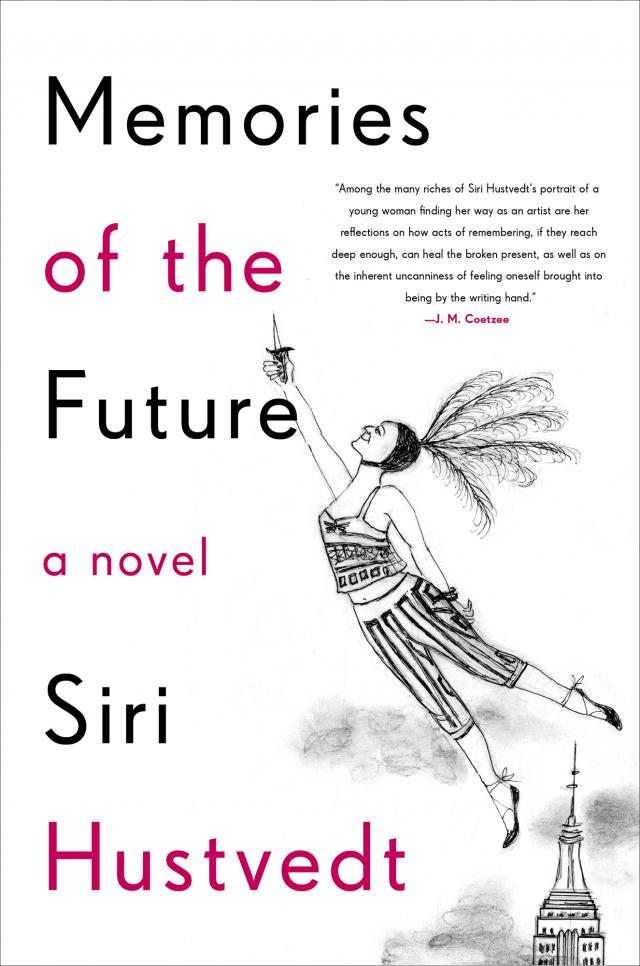
Do I remember lifting the knife out of its paper towel wrapping? It’s possible that I do, but it’s also possible that I am writing the memory into being from the stories I have told myself about the knife I would soon come to call the Baroness. The blade must have been locked and folded into its sheaf. In the memory, I let my finger run along its dull side, and I turn the thing over in my hands. Its handle is made of dark horn, and I test its weight in my open palm. Did I pop open the blade then? Did I release it? I don’t know, but when I did, perhaps the next day or the day after, it was marked with tiny letters: EIG CUTLERY, ITALY.
I had forgotten that my former self was so rattled by the gift that when she wrote about it in the notebook, she did not even refer to it as a knife. She avoided the noun completely: “Fanny has sent me a present in honor of Elsa. I’m afraid of it. First, I put it behind some books on the shelf in the other room. That made me nervous, so I brought it into the bedroom and hid it behind Don Quixote, but that seemed wrong. It’s now behind Wuthering Heights, which is where it should be.”
Which is where it should be. Yes, she understood implicitly what she couldn’t say explicitly. I can say it now. When she opened the box and took out the knife, she felt exhilarated for reasons she could not articulate, but the thing she held in her hands arrived as a rush of dizzying truth. For months she had been listening to Lucy’s rants, had heard her neighbor’s abject self-pity transform itself into murderous wishes. The eavesdropping had affected her, not because she had been privy to a woman’s unhinged chatter but because Lucy’s story had cracked open a door to a secret that belonged to her own story. “Did you ever want to kill someone?” The young woman had shaken her head, had insisted that she never had. She had not been lying, but with the knife she would begin to cast her own spell, not one to bind, but one to unbind.
In 1979 she couldn’t name the shadow, to borrow the language of the witches, and that is why the knife would rise up and out from behind Emily Brontë’s beast of a book, a book that was well suited to conceal an illegal weapon because in its pages brutality and beauty are bound up with wind and weather and Eros and reading. The knife wouldn’t leave her alone. The thing would find its way out of its hiding place and into the bedroom and then into the second room, as if the dead thing made of horn and steel and nickel had a volition all its own. It would draw the young woman to it over and over again because it burned hot behind the green hardcover volume, and she couldn’t ignore it, and before long she had mastered the simple mechanism of the knife that released its deadly blade into open air, and she had figured out how to close it with the picklock, but she didn’t record any of these operations in Mead. Her attraction frightened her far too much to write it down.
But I know that she practiced removing the knife from her purse as swiftly as possible, a gesture, at first slow and awkward, that soon improved. She experimented with the knife tucked into the pockets of her jackets and jeans, and she stood in front of the mirror to examine the bulge the knife inevitably made when it was resting in those pockets. She disguised the lump by placing pens or the thin case for her sunglasses over it and, when she felt satisfied the knife had been well hidden, she shuddered with a perverse excitement. And she leaned close to her own reflected face, and she smiled at it sweetly. No one, she thought, will suspect this baby face. No one.
And while she rehearsed the simple gesture of removing the knife from purse or pocket and springing its deadly blade open again and again, she stabbed the would-be rapist, whom she had stopped naming even in her own mind. But she played out the short story again, the waiting and the taxi and the sound of his feet behind her, and she felt him against her and his fingers in her hair and his hands sliding down her arms, and she saw his thin, ugly prick, but this time she had the Baroness with her. This time she backed him against the wall, knifepoint at his Adam’s apple just as if she were Errol Flynn, light-footed movie hero in a swashbuckler with his narrow sword, and she did it long before the nameless creep had a chance to take out his dwarfish member, and she watched the tall man shake with terror, and his fear filled her with happiness. And this time she slashed him right along his ugly shaving cut to scare the daylights out of him, yes, the daylights. Whatever daylights are, she wanted them out of him.
Did she know that there were others, other figures, both vaguely and more clearly defined, more or less hidden villains, more and less guilty, with whom she fought in the bare front room of 2B where she leapt and stabbed the air with her knife, cutting them down one by one? When I survey the scene from my narrator’s perch, I look down at my former self beset by an imaginary crowd of evildoers, and I wonder if the knife didn’t belong behind Don Quixote after all. “We don’t do harm,” said the witch. “You know that.” The only harm Minnesota did as she enacted her crazed vengeance on disembodied phantoms from her past was to cut her own hand while pushing the knife back into place, a clean slice that bled profusely, soaking paper towels and turning the sink red.
* * *
I never left 2B without the Baroness. She was always on me or near me, a dense little weight at my hip or a pressure on my buttock at the back of my jeans or a lump in the breast pocket of the man’s suit jacket I picked up at the Salvation Army especially for her. She was my mentor, protector, my pòete maudit, my femme fatale ready to leap and bite hard at a moment’s notice.
When I was
young—foolish—
I loved Marcel Dushit
He behaved mulish—
(A quit.)
Before I read what I had written in my long-lost notebook, I remembered my clandestine rapport with the Baroness. I remembered that I thanked Fanny for the gift but didn’t tell her that I kept it close to me, and I didn’t tell Whitney either until much later. I could have recited the sequence of what happened in late May and June of 1979 because I had told the story to myself, and discrete events are suffused with powerful emotion, but there was amnesia, too, encounters and conversations that had disappeared in the wilds of memory with poor Wanda and her mother.
May 28, 1979
Dear Page, old friend,
Recent updates:
1. Ian and Isadora are paralyzed.
2. The Dear Ones are spouting one witch joke after another.
3. Fanny is dying to meet “the evil sisters” and has been croaking out “Double, double, toil and trouble” ever since Lucy’s “true identity” was revealed. She loves the idea of flying babies like kites on strings.
4. Whitney scolded me for not asking more about the crippled gardener and has made up a list of enemies she wants the ladies “to fix” for her.
5. Jacob prays to the goddess nightly for inspiration to guide him. His goddess looks a lot like Hedy Lamarr. He mentioned in lieu of Solomon’s Key that the physics version of the clavis universalis is “The Theory of Everything.” Many such theories on the horizon. He mentioned strings, but nothing conclusive yet.
6. When I gave Gus the news by phone, he volunteered that the Latin word cultus means “worship.” He called back two days ago to inform me that there’s been “a flurry” of pagan revivals in the Bay Area among a group of California feminists. He also mentioned a recently published book called The Spiral Dance on the new witchcraft.
7. I wish I knew how to explain to them that the word witch, a word that seems to answer the question—who are they?—doesn’t really answer it at all. When I told Whitney the other day about Lucy pleading with the empty chair, she smiled. Maybe Lucy’s desperation sounds funny from downtown, but it wasn’t funny when I was looking at her uptown. Whit’s smile made me feel lonely.
8. I’ve been thinking about the second turn of the key. It’s so silly, really, but I’m unable to shake what Patty said, high-flying hokum, yes, but there’s something in it that disturbs me. I can’t really articulate it. “Remember this: The world loves powerful men and hates powerful women.” Is it true? Why did she say it to me?
9. How did Lindy die? I think about it, Page. What does Lucy really believe happened to her daughter? What happened to her son?
May 29, 1979
This afternoon at the Hungarian Pastry Shop, Whitney read me her poem “Fart” in honor of the Baroness and in dishonor of Allen Ginsberg. She is sick of “the Big G” swanning around town like a demigod, worshipers in tow, cameras rolling. “I saw the best butts of my generation erupt in farts, gaseous odiferous blasting.” She’s hardly the first person to parody “Howl.” Maybe I didn’t laugh loudly enough. Maybe I never cared enough about Ginsberg to begin with. I was always a heretic. The truth is I would have laughed harder a few weeks ago. Everything is going haywire, Page, and I don’t know what to do. Whitney said, “What’s wrong with you, Minnesota? You’re not yourself.”
I asked Whitney what she meant by “not myself.” Maybe a self is just a bunch of little stories glued together in some haphazard way that we use to comfort ourselves. Maybe it’s Hume’s tattered fragments, and how could I possibly know what she was talking about? I was doing the best I could. And then I let it out: I admitted to her for the first time that I don’t know how to write my novel. I told her I’ve come to several dead ends. I don’t even know what’s wrong with it. I’ve failed.
And she said, “It’s not the book.” I turned my head away and didn’t answer. I felt hard. The Baroness was in my purse under Kleenex, and I could feel her fiery presence just inches away from my elbow. Whitney said it again in a softer voice, “It’s not the book.” I stared at the pale brown foam in my cup.
“It’s me. Remember me? Your old friend Whitney Tilt? We met many years ago at the Ear Inn.”
I didn’t want to look at her. I sat there, a stone, and then I had a thought that scared me: “I’ll never get her back. I’ll never get back the person who met Whitney at the Ear Inn.”


