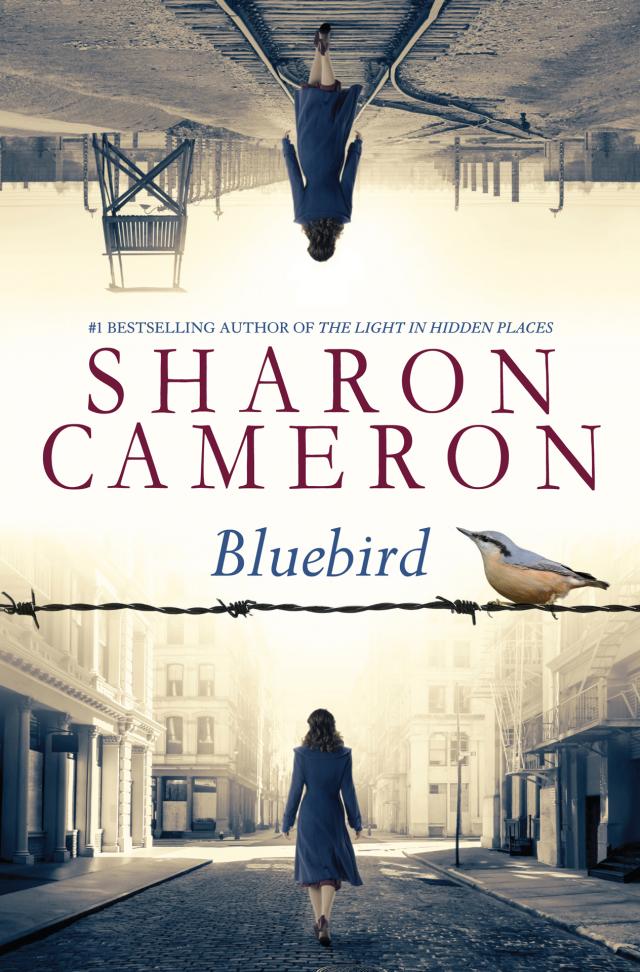
Bluebird, page 18


Eva wishes she had a camera. If the first Mr. Cruickshanks could see this, he’d never believe that Anna Ptaszynska was a killer. Even if she had hit him with a paperweight.
If she was, it wasn’t her fault.
Then the kitchen door opens and Martha bustles in, adjusting her glasses, a file and a stack of papers crushed against her chest.
“Miss Gerst?” she says. “I have not met thee properly. I am Mrs. Balderston, though thee may call me Martha, or Mother Martha, since that is what everyone else seems to do.”
Eva blinks, confused. Martha pulls out a chair, offering Eva the one opposite.
“I was raised a Quaker, Miss Gerst, and that was a long time ago. We stuck to the old way of speaking. Replace ‘thee’ with ‘you’ and all will become clear.” She reaches out and pats Eva’s hand. “Don’t worry. It will drive thee mad at first.”
She turns to Brigit. “What a lovely spoon, Miss Heidelmann.”
Eva looks down. Brigit is rubbing a spoon with the end of her blouse. She isn’t sure where the kitten has gotten to.
“We haven’t had the usual chat, which is entirely my fault. I’m afraid thee caught us at a busy time. But we would like to know how Powell House can help thee most. Tell me, what goals would thee like to accomplish in America?”
Eva grabs one of The Powell House Criers, still in stacks on the table, and folds it neatly in three. Martha would be horrified by what she’d like to accomplish. So she only says, “I do not know.”
“That is understandable. But I would like for thee to begin thinking. We are so happy to have thee here. And Miss Heidelmann. Very happy, indeed. But Powell House is only a temporary solution. Are thee interested in a course of study? Training?”
Eva folds a second paper. Carefully. Life after justice is a tall, blank wall. Like the one around Sachsenhausen. She can’t see the other side of it. She has no reason to think the other side exists.
And then Olive’s head pops in. “The doctor is upstairs.”
“Oh, psssht,” says Martha. “Thank thee, Olive.” She turns back to Eva. “That was to be the second part of our chat. Dr. Holtz rang and told me he had arranged for a Dr. Forrester, a neurosurgeon, to examine Miss Heidelmann, and I suggested that should happen here, if possible, to avoid strain. On her and thee. And now he is very early …”
Brigit has slowed the rubbing of her spoon. She’s listening, Eva realizes. How much does she understand?
“Is this plan acceptable to thee, Miss Gerst? Or no? Would the blue room be best?”
Eva looks up. “Do you play the harmonica?”
“I do!” says Olive, her head still in the door. “I mean, I can make it make noise.”
And that is exactly what Olive does. She makes the harmonica make noise while Brigit screams and screams. It does help a little, giving temporary pauses, seconds of indrawn breath. But even though Bets scurried to shut the windows, Mother Martha is at the front door, having her second chat of the morning, this time with the neighborhood policeman.
Dr. Forrester is a small man, pale and precise, who does his job efficiently no matter what sort of clamor Brigit and Olive are making, and no matter how Brigit wriggles. He takes her pulse and her blood pressure. He asks about all her functions. He presses his fingers along every inch of her head. He’s also very good at avoiding Brigit’s flailing arms when her hands escape Eva’s. And then he steps back, observing.
As soon as he stops touching her, Brigit stops shrieking. She’s breathing hard, gasping, eyes closed while Olive blares with enthusiasm.
“Let her hold it,” Eva whispers, taking the harmonica from Olive. She wraps Brigit’s fingers around it, and the room is suddenly more peaceful.
“I’ve read Dr. Holtz’s notes,” says Dr. Forrester, “and I understand the source of the psychiatric trouble is believed to be abuse by soldiers …”
Eva winces. She wishes Bets and Olive hadn’t heard that.
“… but there was an injury to her head that has healed. The butt of a gun or a rifle perhaps?”
Eva nods. It could have been. “She had a cut here, behind the ear …”
“Was she unconscious? How long?”
Eva struggles to think while Brigit whimpers. How long had they been in that car? “For two days? She spoke at first, and then … she did not.”
Dr. Forrester unwinds the stethoscope from his neck. “I want Miss Heidelmann to have an X-ray.”
Eva looks to Bets. “Taking a picture,” Bets explains, “the kind that looks inside your body.”
“The trauma could be purely psychological, or physical, or both put together, of course,” Dr. Forrester says. “But this type of X-ray will rule some things out. Miss Heidelmann will need to be injected with iodine, to see the blood flow to her brain. It’s not dangerous but will require a hospital stay, and I understand that is going to be a difficulty.”
He digs around in his bag, coming up with a blue pad of paper to scribble on. Brigit gasps, in and out, turning the harmonica over and over in her hands. Eva lays one of the bathroom towels over her head, so she can’t see anyone else.
“A prescription for a mild sedative,” the doctor says, tearing off a page and handing it to Bets. “A half dose to get her to the hospital, so she can still walk, the rest when she gets there, so she falls asleep. I’ll see what arrangements need to be made. There are some funds for these kinds of situations. Take the prescription to Clancy’s and he’ll put it on my tab …”
Eva straightens. “Why would you do that?” She’d learned “put it on my tab” from the second mate.
Dr. Forrester looks surprised. “It’s an interesting case. And Dr. Holtz is a good man who’s done me a helpful turn or two.”
And Dr. Holtz had been helped by Powell House. The strange, foreign cycle of fairness.
“But you think Brigit could be … better?”
“Certainly. One way or another. Though I can’t say how much, and it may be up to Dr. Holtz. Now if you’ll excuse me, I’m late to the office. My nurse will ring …”
Eva stays in the blue room and brushes Brigit’s hair after the others have left. Brigit likes getting her hair brushed now. They’d worked on it every day until she did in Biberach. Like they’d worked on her new name. Away from the others, so Brigit wouldn’t frighten them. Her father called people like Brigit “useless eaters.” Unworthy of life. But no one in Powell House had ever treated her that way.
No one was afraid of her here.
She plaits Brigit’s hair into one long braid down the back, like she’d always worn it, then takes the leftover crusts from breakfast and shows her how to spread them along the open windowsill. It doesn’t take long for a pigeon to come, and then two, cooing as they peck. Brigit makes a noise that sounds like “dak.”
Eva smiles. Maybe she would like to feed the ducks. She watches Brigit watch the pigeons.
When she gets that address, when justice finally happens, even with a plan—a good plan—it could all go wrong. It probably will go wrong. She’ll be arrested. Or a Cruickshanks will take his revenge. And there will be no one to know. No one to believe her. She doesn’t even know if they hang criminals in America.
But just because Eva’s future is a blank wall, it doesn’t mean Brigit’s has to be. The doctor said that she could be better. Brigit could have a life ahead of her.
Eva gets the notepad from the bedside table and writes a messy version of a letter, correcting her spelling, her grammar, recopying it neatly when she’s done. Then she goes to her suitcase in the wardrobe, carefully sliding the handle loose from its slot. The handle is hollow. And it rattles. And when she shakes it, her ruby and diamond earrings fall out onto her palm.
She pushes the stud of each earring through the paper of the letter, screwing on the gold backs. The letter looks fancy. Decorated. And it asks that in the absence of Eva Gerst, any decisions for the care of Brigit Heidelmann should be shared between Martha Balderston, Elizabeth Whittlesby, and Happy Angel.
It’s not legal. But she thinks those three will treat it as if it was. And the earrings should be worth something.
Then the kitten appears from nowhere and tries to pounce on the pigeons. They fly away, snapping their wings, and Brigit is startled. And then delighted. And Eva backs up, behind the curtain.
The man with the shiny shoes is outside, smoking in his rusty car.
And he’s still there the next afternoon, when Bets knocks on the door, hair tied up in a red bandanna. She digs an envelope out of an apron pocket.
“Jake sent Larry by with that for you a little while ago.” She raises her voice. Brigit has learned to blow the harmonica. Not Eva’s first choice for a new skill. “It was something you need, he said?”
The envelope has her name on the front in handwriting that is small, very neat. “Thank you,” Eva says, setting it on the table. As if it’s unimportant.
“Larry says Jake says to tell you that his mother says he probably won’t come by tonight. He has a final paper for his summer class, or something like that, but he’ll swing by tomorrow.” She glances curiously at the envelope but doesn’t pry. Then Eva sees that her nose is wrinkled.
“Is something wrong?”
“Just an unpleasant job. There’s a dead bird in the music room. Its neck is broken, poor thing …”
“How did it get in the music room?”
“And inside the piano, too,” Bets says. “I didn’t think we’d had the windows open. Sorry to be a grump. I don’t like dead things.”
She waves her way out the door, and Eva waits for the silence after her footsteps. Then Eva tears open the envelope and takes out the paper.
There’s a drawing of a bluebird at the top. Not crude, like the one on Mr. Cruickshanks’s card. This one is in flight, with big eyes and fluttering feathers. She smiles.
She doesn’t mind so much when Jake calls her Bluebird.
And Jake has written a name, Kenneth Lutz. An address, days of the week, and times. Rolf’s new name and his work schedule. She studies it, thinking. It says Rolf has a night shift three nights a week. Which means if her father is at this address, that’s when he’s likely to be alone. And Rolf’s first night shift of the week is … tonight.
She breathes. She should go tonight. Break her deal and be done. Before Cruickshanks comes back, demanding to know what she’s been doing. Before he finds her father himself. Because Cruickshanks had Dr. Schneider’s name, too.
Last time, she hadn’t been ready. This time, she has to be.
And she cannot—must not—be seen.
The sun is slanting when she catches Bets on her way up the stairs.
“I … think I am … beginning a headache.”
Bets’s face registers instant concern.
“And Brigit is tired. She will do better with quiet. I was thinking we might lie down early, if …”
“Oh, sure!” says Bets. “Could I bring up a couple of plates? You shouldn’t skip a meal, you know. There’s barely any of you there. And I’ll tell the crew to hold it down, so you two can rest. It takes a lot, coming to a new place.”
Eva smiles through her guilt. “You are …”
What does she want to say to Bets? You are sweet? Naive? You would have had your shoes stolen in Berlin? Or would Bets have given them away, the first time someone asked?
“I mean to say thank you. Very much.”
Bets smiles like she’s been given a prize. “Be back in a bit.”
Eva shuts the door and gets to work. She folds up Rolf’s schedule, Jake’s bluebird fluttering at its top, tucks it back into the envelope, and puts it inside the lining of her purse, beside the bread knife and Mr. Cruickshanks’s card. Then she pulls a chair up to the wardrobe, reaching past her paper crown, and from the very back of the top shelf fishes out the bottle of pills Olive brought from Clancy’s. Two pills go into her palm, then into her pocket. The bottle goes back to the top shelf where Brigit won’t find it. Then Eva gets on her knees and unfolds the map of New York City she’d snagged from the foyer, spreading it out across the floor.
She makes notes. Brigit helps by crawling on them. Eva finds the kitten underneath the bed to distract her. Then she shoves everything beneath the bed when Bets knocks and says, “Room service!” leaving a tray of apples and cheese, rolls and butter, and two glasses of milk on the little table by the window. When Bets has gone, Eva gets the map back out again, finishes her notes, and puts them in her purse.
She coaxes Brigit into eating. Takes her to the toilet. Pulls her nightgown over her head. Gets two pills and pops them into the back of Brigit’s throat, following quickly with the last of the milk. Eva knows how to get Brigit to take a pill. Brigit sits down and plays with her spoon.
And Eva waits. While the shadows disappear into the twilight and someone has a conversation across the street. While air that smells like a city moves the curtains. While a man in the street sits smoking in his rusty car.
She closes her eyes. She says the twenty-seven names. She says who she is.
And looks for her anger. Her anger is still Inge to her. Inge pulls Annemarie through the ruined house. Inge looks over walls and does not accept what she sees. Inge is a blaze. Inge is a fire wind.
Eva opens her eyes. And someone has shut the window. She opens it again.
Brigit’s eyes are heavy-lidded. She drops her spoon. The kitten plays with its tail. Eva puts them both in the bed, adjusts the blankets, and switches off the lamp.
She doesn’t feel afraid. Not yet.
She will. But it doesn’t matter. She’ll choose anger. And justice.
She’ll make sure that none of this can ever happen again.
Brigit’s breathing is slow. Regular. She shakes her shoulder, but Brigit doesn’t stir. And then Eva moves. She grabs her purse and slips out the door. But she doesn’t lock it. Not this time.
So they can take care of her. The letter with the earrings is in Brigit’s suitcase, her name on the outside. Where they will find it. If Eva doesn’t come back.
They will take care of her.
Eva tiptoes across the landing to the bathroom, shutting the door slowly, slowly, until the latch gives the softest click. She puts the lid down on the toilet seat and steps up, balancing. She gets a knee on the sill.
And climbs out the open window.
“TELL PAPA, MY Vögelchen. What does the bird feel like?”
The bird wriggles, cupped gently in her hands, opening and closing its beak. “Soft,” she whispers, and gives a little gasp. “And I can feel its heart! So fast …”
“Yes. The heart beats, because the bird is alive. Now, tell your Papa why we must obey.”
Her smile is gone. But she recites, “If authority is not obeyed, there is no order.”
“And only the weak live without order. Do you want to be weak, my Vögelchen?”
She shakes her head. A tiny shake.
“And to whom do you belong? Who is your authority?”
“Papa,” she whispers.
“And you want to be good and strong so that Papa will love you, isn’t that right?”
She nods. A tiny nod.
“Then Papa says you must squeeze the bird.”
The bird looks up at her with bright black eyes. “I don’t want to,” she whispers.
“Does it matter what you want? Does it matter what you feel, when you have been asked to obey?”
“No, Papa. Please …” She’s frightened now. She is shaking inside.
“Then you know what you have been told to do. Obey your Papa, and squeeze the little bird.”
She closes her eyes. And her fingers tighten.
THE FIRE ESCAPE outside the bathroom window is rusty iron and loud beneath her shoes. She goes down slowly, toe to heel, and at the second-floor window, she pauses. There’s music on the other side of the glass. She leans forward, just enough to get one eye beyond the bricks.
Jake is in the music room. By himself. Playing the guitar. He must have come to Powell House anyway, or finished whatever needed to be done. He came, she thinks, to see her. He’s rumpled and scruffy and not playing anything like what she thought he would. Just picking out a melody of single notes. The corner of his mouth goes up when he finds what he wants. Brows down when he doesn’t. It sounds like he’s playing Bach.
He’s still difficult to look away from. Because he’s rather beautiful.
She wishes she was that other girl. The one who plays Ping-Pong in a crown. But she isn’t. She’s the girl with a bread knife in her purse.
The girl Jake would despise if he knew her.
He would be right to.
And she would be wrong to let herself forget it.
Eva slips past the window, going quietly down the fire escape. And discovers that the fire escape doesn’t go all the way down. There’s a ladder for the last part, pulled up into sections. If she tries to let it down, there’s going to be a racket. She’ll have to climb down it, as far as she can, and drop the rest of the way to the ground. Eva turns around backward, purse tight in her hand, and steps out onto the first rung.
And the ladder slides down on its own. Suddenly. Violently. With a swoop in her stomach. Jangling and rattling like she’s just set off every fire alarm in the city. She hangs on; the ladder hits its full extension and throws her onto her backside in the bushes.
A light switches on inside Powell House.
Eva scrambles up, finds her purse, dashes through a little gate, and she’s out of the backyard, picking her way down a dark, narrow strip of weeds and trees growing where the back fences don’t quite meet in the middle. There’s an iron gate at the end. It’s not even locked. A little alley, and then Eva is around the corner on Lexington with the streetlights and cars and NEIL’S COFFEE SHOP lit in neon down the block.
She smooths her skirt. Pulls a twig or two from her hair. Hooks her purse over an arm and walks. Away from Powell House. Away from the man with shiny shoes, watching its front door. Making a beeline for the subway station, where she breaks one of her precious American bills and gets some change.