

The Keeper of Stories, page 1


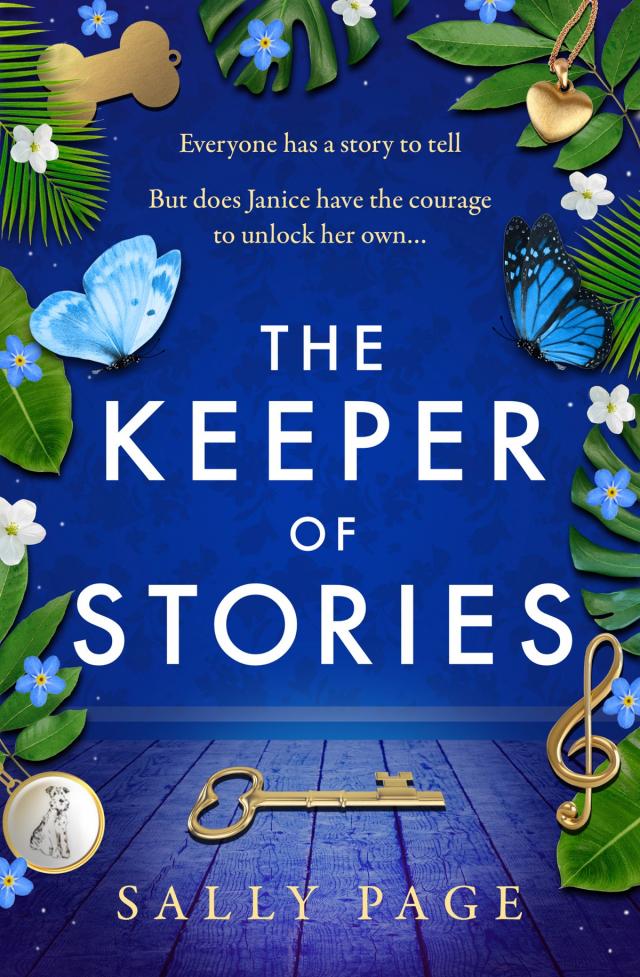
The Keeper of Stories
Sally Page
One More Chapter
a division of HarperCollinsPublishers Ltd
1 London Bridge Street
London SE1 9GF
www.harpercollins.co.uk
* * *
First published in Great Britain by HarperCollinsPublishers 2022
* * *
Copyright © Sally Page 2022
* * *
Cover design by Ellie Game © HarperCollinsPublishers Ltd 2022
Cover images © Shutterstock.com
* * *
Sally Page asserts the moral right to be identified as the author of this work
* * *
A catalogue record of this book is available from the British Library
* * *
This novel is entirely a work of fiction. The names, characters and incidents portrayed in it are the work of the author’s imagination. Any resemblance to actual persons, living or dead, events or localities is entirely coincidental.
* * *
All rights reserved under International and Pan-American Copyright Conventions. By payment of the required fees, you have been granted the non-exclusive, non-transferable right to access and read the text of this e-book on screen. No part of this text may be reproduced, transmitted, down-loaded, decompiled, reverse engineered, or stored in or introduced into any information storage and retrieval system, in any form or by any means, whether electronic or mechanical, now known or hereinafter invented, without the express written permission of HarperCollins.
* * *
Source ISBN: 9780008453510
Ebook Edition © February 2022 ISBN: 9780008453503
Version: 2021-12-10
Contents
Prologue
1. The start of the story
2. Family stories
3. Stories within storeys
4. Everyone has a song to sing
5. A husband’s story
6. Every story needs a villain
7. A shaggy dog story
8. Never judge a book by the cover
9. In search of a heroine
10. Every man should leave a story better than he found it
11. Choosing your own story
12. Every story has a beginning
13. Every story ends in death
14. One perfect moment
15. The oldest story in the world
16. There may be trouble ahead
17. Stories have to be told or they die
18. Home is where the heart is
19. Never tell a story to a deaf man
20. The thick and the thin of it
21. When push comes to shove
22. A traveller’s tale
23. In search of Scheherazade
24. An island of books
25. Reading between the lines
26. The foreign prince
27. A drink precedes a story
28. Never write anything down
29. The quiet voices
30. The end of a story
31. The untold story
32. Grief is not as heavy as guilt
33. Two sides to every story
34. The boy and the dog
35. Words written on paper
36. End of an era
37. We are all storytellers
Author’s Note
Acknowledgments
Thank you for reading…
About the Author
One More Chapter...
About the Publisher
For my Dad
With all my love
Prologue
Everyone has a story to tell.
But what if you don’t have a story? What then?
If you are Janice, you become a collector of other people’s stories.
She once watched the Academy Awards acceptance speech of a famous English actor – a National Treasure. In it, the National Treasure described her early life as a cleaner and how, as a young hopeful, she had stood in front of other people’s bathroom mirrors holding the toilet cleaner as if it was an Oscar statue. Janice wonders what would have happened if the National Treasure hadn’t made it as an actor. Would she still be a cleaner, like her? They are about the same age – late forties – and she thinks they even look a bit alike. Well, (she has to smile) perhaps not that similar, but with the same short build that hints of a stocky future. She wonders if the National Treasure would have ended up as a collector of other people’s stories too.
She can’t recall what started her collection. Maybe it was a life glimpsed as she rode the bus through the Cambridge countryside to work? Or something in a fragment of conversation overheard as she cleaned a sink? Before long (as she dusted a sitting room or defrosted a fridge) she noticed people were telling her their stories. Perhaps they always had done, but now it is different, now the stories are reaching out and she gathers them to her. She knows she is a receptive vessel. As she listens to the stories, the small nod she gives acknowledges what she knows to be true: that for many, she is a simple, homely bowl into which they can pour their confidences.
Often the stories are unexpected; at times they are funny and engaging. Sometimes they are steeped in regret and sometimes they are life-affirming. She thinks maybe people talk to her because she believes in their stories. She delights in the unexpected and swallows their exaggerations whole. At home at night, with a husband who swamps her with speeches rather than stories, she thinks about her favourites, savouring each of them in turn.
One
The start of the story
Monday has a very particular order: laughter to begin with; sadness towards the end of the day. Like mismatched bookends, these are the things that prop up her Monday. She has arranged it this way on purpose as the prospect of laughter helps get her out of bed and strengthens her for what comes later.
Janice has discovered that a good cleaner can pretty much dictate their days and hours – and importantly, for the balance of her Monday, the order in which they do their cleaning on a particular day. Everyone knows reliable cleaners are hard to come by and a surprising number of people in Cambridge seem to have discovered that Janice is an exceptional cleaner. She is unsure about the accolade ‘exceptional’ (overheard when one of her employers had a friend in for coffee). She knows she is not an exceptional woman. But is she a good cleaner? Yes, she thinks she is that. She has certainly had enough practice. She just hopes this isn’t going to be the sum story of her life: “she cleaned well”. As she gets off the bus she nods at the driver to distract herself from this increasingly recurring thought. He nods back and she has the fleeting impression that he is going to say something, but then the bus doors sigh as if exhaling and shudder closed.
As the bus pulls away she is left looking across the road to a long, leafy avenue of detached houses. Some of the windows of the houses gleam with light; others are shaded and dark. She imagines there are many stories hidden behind all those windows, but this morning she is only interested in one. It is the story of the man who lives in the rambling Edwardian house on the corner: Geordie Bowman. She doesn’t think her other clients have ever met Geordie, and she knows they are unlikely to meet through her (that is not how Janice thinks her world should work). But, of course, they have heard of Geordie Bowman. Everyone has heard of Geordie Bowman.
Geordie has lived in the same house for over forty years. First, he took a room as a lodger – the rents in Cambridge being considerably cheaper than they were in London, where he was working. Then, eventually, when he married, he ended up buying the house from his landlady. He and his wife could not bear to throw the other tenants out so his growing family lived alongside a mixture of painters, academics, and students, until, one by one, they moved out of their own accord. That was when the fight for the newly vacant room would start.
“John, now he was the canniest,” Geordie often recalls, with pride, “he just moved his stuff in before they had finished packing.”
John is Geordie’s eldest and now lives in Yorkshire with a family of his own. The rest of Geordie’s brood are scattered around the world but visit whenever they can. His beloved wife, Annie, has been dead for several years but nothing has changed in the house since she left it. Each week Janice waters her plants – some now as big as small bushes – and she flicks the dust from her collection of novels by American writers. Geordie encourages Janice to borrow these and occasionally she takes Harper Lee or Mark Twain home with her, to join her selection of comfort reading.
Geordie has the door open before she can reach for her key.
“They say timing is everything,” he booms at her. Geordie is built on magnificent lines, with a voice to match. “Get yourself in and we’ll start with a coffee.”
This is her cue to make strong coffee for them – with lots of hot milk, just the way Geordie likes it and exactly how Annie used to make it. She doesn’t mind. Most of the time Geordie fends for himself (when he is not in London, overseas, or in the pub) and she feels Annie would approve of her spoiling him now and again.
Geordie’s story is one of her favourites. It reminds her of the fortitude within people. There is definitely something in there too about using your talents but she does not like to dwell on this. It is too close to the Bible stories of her childhood and leads her back to her own lack of talent. So, she pushes these thoughts away and concentrates on fortitude, as demonstrated by the boy who was to become Geordie Bowman.
Geordie (unsurprisingly) grew up in Newcastle. She thinks
In the concert hall, Geordie climbed up high into the gods where it was warm and he was unlikely to be spotted. And this is where he was, tucked behind a lighting unit (extra warmth) eating a bar of chocolate he had pinched from the kiosk, when the singing started. The first soaring note tore like a javelin into Geordie’s chest, rooting him to the spot. He had never heard of opera, let alone listened to it, yet the music spoke directly to him. Later, in television interviews, Geordie would say that when he died and they opened him up they would find the score for La Bohème wrapped around his heart.
He returned home for a few days, a few weeks – he barely noticed how long. In that time, he came up with a plan. He had never heard of opera in the North East so his assumption was that this was not the place to be. It must be London. Surely that was the home of opera? The home of anything posh. He needed to get to London. But without any money, the train or bus was out of the question. So the answer was that he would have to walk. And that is exactly what he did. He filled a rucksack with what food he could carry and a bottle stolen from the gondola and headed south. Along the way he met a tramp who joined him for much of the walk. During this time, the tramp taught him things that he might find useful in the city and showed him how to keep his clothes clean on their journey. This involved taking clean clothes from one washing line and replacing the stolen clothes with the dirty ones they had been wearing. This was repeated at the next suitable washing line, and so on.
Once in London, Geordie made his way around the various concert halls (the tramp having given him a list of places to try) and eventually he secured a job as a props boy. The rest is history.
Janice’s husband, Mike, has never met Geordie. This does not stop him talking about him in the pub like he is an old friend. Janice doesn’t contradict him in public – not that Mike is grateful for this; in his mind he has chatted to Geordie many times. As he talks about the world-famous tenor (‘Was the Queen’s favourite, you know’) she holds on to the thought that this meeting is never, ever going to happen. Occasionally when he has ‘nipped to the john’ and left her to pay the bill (again), she thinks about Geordie singing her one of her favourite arias as she cleans his oven. These days, Geordie’s singing is louder than ever before, and this has started to worry her as she has also noticed that sometimes she has to shout to get his attention and he misses some of what she is saying.
Coffee over, Geordie cannot resist following Janice around the house. He loiters in the doorway as she cleans the wood burner and re-lays it with kindling and logs. It seems he needs coaxing. For such a big man, he can be surprisingly coy about putting himself forward.
“Have you been away?” Janice asks, hoping this might lead him to what he clearly wants to tell her.
She hits gold first time and he beams at her. “Just a bit of a stretch in London. Ay, you get some right tossers there, pet.”
“I imagine you do.” She hopes this is enough encouragement.
It is.
“I was on the tube and there was this right knob. It was crowded but not that bad. You know, we were all making the best of it, like. This posh twat pushed on at the last minute before the door closed and starts really mouthing off…”
Here Geordie does a pretty good imitation of the posh tosser, making Janice grin. She had been right; she knew Geordie was the place to start her day, her week.
Geordie’s posh twat is in mid-flow. “Oh come on now. Just move on up a bit. I’m sure there’s plenty of room if only people make way a tad. There is plenty of room. Really! Come on now, move down the train.”
Geordie pauses to make sure he has her attention. “That’s when I heard a voice from down the carriage. Another lad, a Londoner, I’d say. Anyway, he calls out, ‘Open up your gob a bit more, mate. I reckon we could get a couple in there’.”
Janice laughs out loud.
“That shut him up.” Geordie is delighted by her response.
She is not fooled. She knows it was Geordie who called that out on the tube. He was the one who took the shine out of the tosser’s eye. He is too modest to say it, but she knows. She can almost hear his voice booming down the carriage and the eruption of appreciative laughter all around him.
Pleased with her response, he leaves her to get on with her work. She reaches for her duster. Perhaps being with people like Geordie should be enough for her? Many of the people she cleans for do bring something special to her life and she hopes, in some small way, that she contributes to theirs. She pauses with her duster halfway up a bookshelf. The truth is that she is unconvinced, uneasy. These are other people’s stories. If she does have a part to play in them she knows she is a bit part, an extra. She thinks again of the National Treasure and tries to picture her in Geordie’s music room, duster held aloft above his shelves of musical scores. Would this be enough for the National Treasure? Would she settle for this? She continues dusting, embarrassed she even asked.
Janice sees Geordie again when she’s heading off for an early lunch and then on to her next cleaning job. It is grey outside and she can feel the bitter February air seeping through the crack in the door. Geordie helps her into her coat. “Thanks, I’m going to need that. It’s getting cold out.”
“You want to look after yourself if you’re getting a cold,” he suggests.
“No, I’m fine,” she tries again, this time at full volume. “It’s just it’s a cold day.”
He hands her her scarf. “Well, see you next week, and you look after that cold.”
She gives up.
“I’m feeling better already,” she tells him, with perfect truth.
As he closes the door behind her, she wonders if the story of life is a tragic comedy or a comic tragedy.
Two
Family stories
“Of course all libraries have ghosts. Everyone knows ghosts like to read.”
The young man coming down the steps of the library is talking earnestly to his companion – a girl of about twenty-five. Janice wishes she had time to follow them, to hear more of their conversation and find out about the ghosts. He sounds so completely sure of himself, as if he were telling his friend that there are birds in the air and clouds in the sky. Janice is fascinated by the thought of the ghosts in the library and wonders if she will meet any today. She often pops into the library at lunchtime to change a book and surreptitiously eat a sandwich at a table tucked at the back between the shelves.


