

Abhaya, page 16
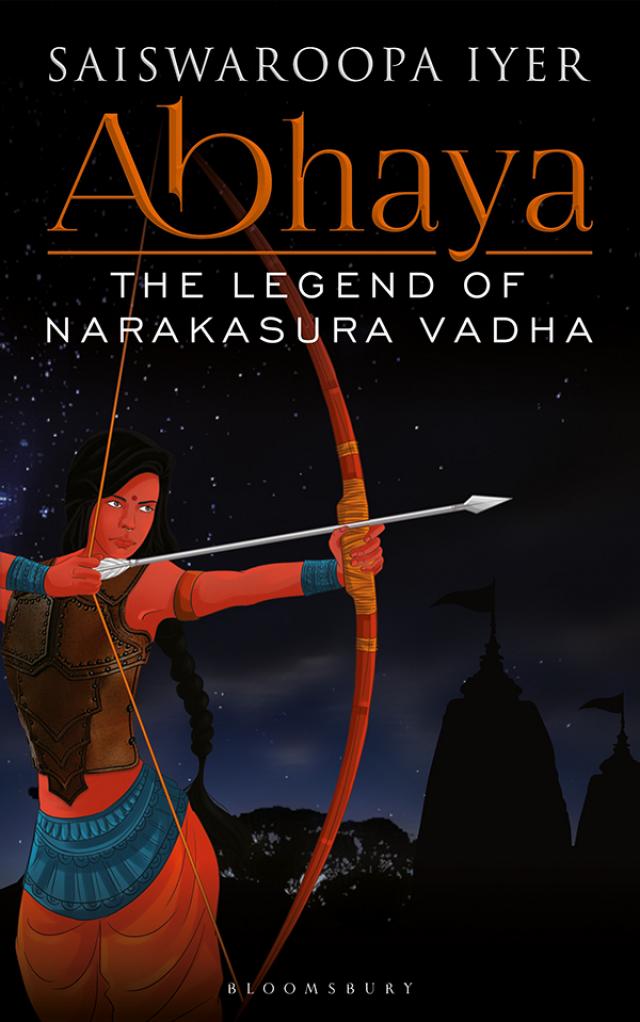


“Devi, let me wash your hair today.” Abhaya looked up and saw the female attendant Subhadra had assigned to attend to her. The woman was in her fifties and looked familiar. Abhaya recognised her as one of the older maids at Dwaraka who had accompanied Subhadra to Indraprastha. The woman introduced herself as Mrinalini. Abhaya was about to follow her to the adjoining bath when another voice caught her attention.
Speak not, words of empty love, Dark God
Play your flute, cure my fatigue, Dark God
Like one enchanted, Abhaya moved to the window. A woman was milking cows in the backyard. She sang as she worked, occasionally caressing and kissing the calf that waited its turn for the milk.
You now move, in the attire of a prince,
Don’t you remember the grove, even once?
She sang of longing and separation but her tone, as she went about her work, tapping her foot to keep the rhythm, was far from sorrowful.
Your smile, not Spring, makes flowers bloom
Your gaze, not the sun melts the gloom
What of your words of unending Joy and Love?
Won’t you return to me in your Vrinda Grove?
“Now what?” she said to the cow. “I can’t sing new songs for you every day!”
Abhaya found herself smiling involuntarily. “Who is that?”
“That woman? She is a gopika, a milkmaid from the village across the Yamuna,” replied the maid who had made herself busy making the bed and removing the flowers on the bedside table that had withered overnight. “These cows were also brought from the village. Devi Subhadra was so particular about them. That gopika comes from the village to milk them every day. She has a way with them.”
“Yes, my love, my queen! A little more milk, Amba, for your children. We are all your children, like this calf,” the gopika went on, negotiating with the cow. Abhaya could not help chuckling. “Alright, this is the last one. I shall not sing further.”
Did you see him, the dark-hued one?
Did you see him, the Lotus eyed one
The one from whom grace and beauty flow;
The one for whom the plumes of peacock glow
Smile bewitching never leaves his face;
To the call of his flute, our hearts race
Bushes of the Vrinda Grove, Speak well;
Is that one hiding among you? Do tell
“Sunanda!” The maid called out to the gopika.
Sunanda turned towards the window. She smiled and waved to indicate she was coming. Before long, Abhaya heard the tinkle of anklets in the passage outside.
“Is Govinda here?” Sunanda entered the room, the pot balanced on her waist. The beaded jewellery around her neck swayed to and fro as she walked.
“No,” Mrinalini replied, unplaiting Abhaya’s hair. “This is…”
“His wife?” Sunanda interrupted as she came closer to pat Abhaya on the cheek.
Irreverent, but charming. Abhaya looked up at Mrinalini.
Mrinalini frowned at Sunanda. “Where are your manners? She is Abhaya … Dhaarmaseni, a princess from our Saurashtra. A friend of Devi Subhadra.”
Sunanda’s lips flattened. “I thought he had come. I had brought the piyusha for him. My queen, Saurabhaa, gave birth to a calf.”
“They call Vaasudeva Govinda. He was brought up in their village, Vrindavan,” Mrinalini explained.
Sunanda, her disappointment visible, turned to leave.
Abhaya chuckled. “Will you not give me the piyusha? Is it reserved for your Govinda?”
Sunanda stopped and turned around. “You like it?”
“Keep the pot there,” Mrinalini signalled.
Sunanda was about to place the pot on a wooden stool. She then looked at Abhaya. “My Saurabhaa’s piyusha is only for those who have never slaughtered a cow.”
“Sunanda!” Mrinalini exclaimed, throwing an unsure glance at Abhaya.
“That is alright. I have never slaughtered a cow, by Mahakala,” Abhaya said. She was not sure what in Sunanda was more endearing, her boisterous chatter or her complete disregard for protocol.
Sunanda nodded, her eyes twinkling. She put the pot of piyusha down on the stool and left, promising to bring more the next day.
“Someone needs to teach her how to behave,” Mrinalini said, apologetically. “But I’m sure you’ll like her. Devi Subhadra has a special affection for that village. Their sacrifice, of course, is something that can’t be forgotten.”
Abhaya looked up. Mrinalini collected the bath oils and led Abhaya into the adjoining bath chamber.
“The Vaasudeva we know … his birth was full of intrigues. Let me just say that death chased him even before he was born. His father and mother were kept prisoners by his uncle Kamsa. He, Kamsa, the paranoid tyrant, wanted to kill Vaasudeva as soon as he was born. This was when the head of the gopas, the cowherds, stepped in.”
Abhaya nodded as Mrinalini paused. “I did hear in detail about what happened after Vaasudeva killed Kamsa from Subhadra herself.” The fragrance of the sandalwood paste that Mrinalini was applying to her arms and shoulders soothed her and, feeling lighter, she closed her eyes to rest.
“Devi Subhadra reveres these gopas, and not without a reason. To ensure Vaasudeva’s safety, the gopa headman left his newborn daughter in Krishna’s place.”
“And?” Abhaya looked up at Mrinalini in horror.
The maid shook her head, dipping a bronze pot into the large container of warm water. “I hear many stories. They say she turned into a goddess. They say she disappeared into the air. The truth is, she is…”
Water drenched Abhaya’s frame and, in the sound, she could not hear the rest of the sentence.
“What?”
Mrinalini shook her head. “We will never know the truth. But the sacrifice of Nanda and Yashoda…” The maid brought her hands together in devotion.
Abhaya nodded, rubbing the sandalwood paste off her limbs. The rest of the bath happened in companionable silence.
“I’m sorry for causing you such melancholy, Princess. Cheer up! Anyway, all that is in the past,” Mrinalini concluded in a more cheerful tone, covering her with a long dry shawl.
“But a burden enough for life,” Abhaya murmured. She shook her head when Mrinalini returned with clothes and jewellery.
“No, I don’t want the jewels.”
“But my mistress insisted you should wear these, Devi. Your mourning period concluded a fortnight ago.”
“They aren’t mine, Mrinalini. I cannot wear them.”
“I heard from my mistress, Devi, that you gave up all your jewellery to secure provisions for your people during the journey. Devi Subhadra has made it clear that the expenses throughout the journey were the responsibility of Indraprastha. These jewels now belong to you.”
The words annoyed Abhaya. But she knew that Mrinalini was not the right target for her anger. “I shall talk to Subhadra, Mrinalini. Don’t worry, I shall make sure that she does not chastise you for not wearing any jewellery.”
Mrinalini sighed. “You are a princess. But do heed my advice, Devi. Given all that you have faced, I know jewels and such are of least interest to you. You might even scorn and spurn them as luxuries. But this is Indraprastha, the capital of western Kuru, and not our Saurashtra. The royal family might be friendly and even humble. But the zillions of people who work in the palace are used to seeing royalty in a certain way. Your attire will bring you immediate authority and respect. It will give you unquestioned access to every part of the palace and the city. I hope you understand, Devi.”
Abhaya heard her words with a neutral expression. “I understand, Mrinalini. I shall send for you if I want to leave these chambers and go anywhere. But, for now, I beg of you, don’t force me. I shall speak to Subhadra myself and sort this out.” Mrinalini bowed. She turned to the task of tying Abhaya’s hair and, once finished, turned to leave. “Wait.” Abhaya held her hand. “Why did Sunanda come here and ask for Krishna ... Vaasudeva?”
“These chambers are usually where he resides when he is at Indraprastha. For now, he is staying in the emperor’s mansion. Some of his belongings are still here. When you came yesterday, Devi Subhadra sensed you seemed to be at peace here and decided to give you this room.” She smiled at Abhaya’s consternation and hurriedly reassured her. “Please don’t worry! I am sure it was no trouble.”
As she left, another maid walked in carrying the morning meal. She informed Abhaya that Subhadra would come to her later in the day.
When Subhadra arrived in her chambers, she gave her a scroll detailing the housing arrangements that had been made for the citizens of Anagha and the facilities that had been provided to them.
Abhaya accepted the scroll, forcing a smile.
“Don’t hide your sorrow, Abhaya, not from me,” Subhadra implored.
Abhaya shook her head. “Subhadra, I accepted your brother’s assurance that we would receive asylum here and did not even think of asking you or the king of Indraprastha even once. Are we being a burden? I ... I don’t want to…” The lump in her throat did not allow her to speak further.
Subhadra shook her by the arm. “Firstly, take that word ‘asylum’ out of your head. Secondly, if coming to the aid of a friend is considered a burden, then what is the use of such friends? Didn’t your city receive us with open arms that night when we were en route to the shores of Saurashtra?”
The memory did affect Abhaya and her frown evened out.
“Take your time and go easy on yourself.” Subhadra smiled. “The scrolls will convince you that neither you nor the citizens of Anagha are a burden on Indraprastha.”
Abhaya nodded and Subhadra left, informing her that she could meet the Pandava royal family the next day once she had recovered from the fatigue of travel.
Abhaya turned to examine the details in the scrolls. The soldiers were invited to join the army of Indraprastha once they were ready. Abhaya signed her consent as that would provide them and their families a legitimate livelihood and they would not remain dependent. It was the same with the artists, performers and the women who had worked in the palace of Anagha. It was a matter of time before one of her own would start attending to her. She went through the details, deliberating where to cast her seal and where not to. Uncertainty was faced mainly by the traders who were left with little wealth to start a trade of their choice. The guild of traders at Indraprastha had proposed a discussion with them. Abhaya knew she would have to preside over the meeting to see that her people were treated fairly. She mulled over the terms till she was interrupted by a polite query by another maid. Abhaya nodded and gazed out of the window. To her surprise, it was twilight.
Abhaya’s eyes fell on the closet in which Mrinalini had said Krishna’s belongings were kept.
Should I have them sent to him? she wondered and walked to the closet. It contained mostly weapons and garments. Abhaya’s eyes fell on the sharpening stone. She took it and began to sharpen her sword. After she was done, she leaned against the backrest of the luxurious cot and closed her eyes. It seemed like only a short while but when she awoke, it was dark. There was no sound of activity from the corridors and Abhaya wondered what time it was. A sound of breathing behind her made her whirl around.
“Krishna!”
Abhaya’s sight blurred as his hands cupped her cheeks. She had thought that her suppressed sorrow would break its bounds when she met him. But, on the contrary, she felt it melt away in a single teardrop that fell upon Krishna’s palm.
“You made it, fearless Princess. Your people are safe now.”
Abhaya nodded, her gaze still locked with his. “All those deaths, Krishna. The burden still…”
“The burden of death,” Krishna said, his gaze moving across the room to halt at the window before he looked back at her, “isn’t in our hands, Dhaarmaseni. But we can repay their sacrifice by the way we live the rest of our lives.”
“Is that how we combat guilt?”
“Guilt is when you see yourself as the reason for their deaths. But if you see in yourself what they saw in you as they gave up their lives for you, they become not your burden but your strength…”
Abhaya sighed and nodded. Krishna’s eyes fell on the scrolls.
“You must be concerned about the traders,” Krishna replied.
Abhaya nodded, reaching out for the scrolls. “I have to think about the terms and conditions that the guild offers my traders.”
“I spoke to the traders from Anagha,” Krishna said.
She looked up, surprised. “You spoke to them? When?”
“This evening. I heard out the terms they decided on and told them to consult you. Then they sought my opinion, which I gave.”
“No!” Abhaya protested, the sudden hiss in her voice startling Krishna. “I cannot be a mute approver, Krishna. It is my duty to ensure that they are treated with fairness.”
“When did royalty start deciding the terms between two trade guilds, Dhaarmaseni? Aren’t they supposed to have the freedom to decide on a mutually agreeable ground?”
Abhaya sighed at the obvious. “I meant, I should have been the one to speak to my traders, not you, Vaasudeva. Did they approach you or…”
Krishna nodded, his lips curved in amusement as he saw the disappointment in her eyes.
“Krishna, is this just the beginning of the consequences of admitting to my people that we, the rulers of Anagha, could not protect them? They trust you over me now. No, I am not jealous. Everyone knows that it was you who saved us from the midnight massacre. But is it my gender that made them approach you instead of me?”
“Relax, they only came to me because they felt you needed your time to recover before they bothered you with their queries. Besides, we cannot deny biases.” Krishna smiled, knowing where the conversation would wander to. “But have you pondered the cause behind the bias, as narrow as that sounds?”
“It is a lethargy of intellect,” Abhaya said, in a quiet voice. “It is the unwillingness to think beyond what they’ve always seen and been told that makes them assume that women don’t make as good counsellors or rulers or warriors as men do.”
“Intellect is never asleep, Dhaarmaseni. But it does get clouded.”
“By fear?” Abhaya asked.
Krishna’s smile told her that he concurred. “I was expecting you to say masculine arrogance, a chauvinist mindset, patriarchy and other things, Abhaya.”
“My intellect isn’t yet clouded enough to mistake the effect for the cause.” Abhaya found herself chuckling.
“We face the weakness of people behind these facades of rigidity. Can we combat fear with faith?”
Abhaya nodded. “Maybe, yes. I want to believe we can. That is a thought I would like to reserve for later. But for now,” she paused, taking the scrolls back, “if they continue to dissociate themselves from me and subsequently their home city, should I stand as a mute spectator? What do I exist for?”
“Mute spectator,” Krishna repeated and said, “Aren’t you writing yourself off too soon, Dhaarmaseni? And as far as your existence is concerned...” Krishna’s eyes toured the room and met hers again, “it is a question everyone needs to introspect on, to find his or her answers. Even the seers and philosophers struggle in that quest.”
“Philosophy and metaphysics are not my areas of expertise, Krishna. I only know that one lives to fulfil a purpose. I had always thought that mine was to ensure the well-being of my city.”
“If you only cared about the well-being of your city, Dhaarmaseni, you would not have come to me two years ago, pressing me to save Mitravinda from a forced wedding.”
“I have faced enough blame for that. Even from ... those dearest to me.”
“Blame,” Krishna sighed. His smile had vanished and his eyes conveyed a knowing camaraderie. “Blame is the first thing that accosts us when we defy certain constraints, Abhaya. And it is a long-term companion when we continue on the path of that defiance. It is easier if we make peace with it, or even start liking it.”
“Start liking blame? Stop joking.” Abhaya shot him an annoyed glance. He winked. She turned away, fighting an unexplainable girlish urge to giggle. “For someone with four wives, and Mahakala knows how many more in waiting, you are the one who needs to accept blame as an eternal spouse, not me.”
Chapter Twenty-Six
Gomantaka
From his mountain abode, the lord of the Garudas looked at the expanse of land running to the western shores. The sight of the setting sun seen from the Gomantaka mountain had been a treat to his eyes since his boyhood days and, to this day, he retained that same awe for the setting red ball that bathed the skies in an orange hue that gradually gave way to the greyish blue of the night. It would be some time before he could watch this again, Vainateya knew, filling his lungs with the mountain air as he turned back to face the Garuda settlement. The place was in a hustle, as people hurried in and out of their homes with last-minute chores. They were getting ready for a long journey—a journey to the north with their beloved king and leader.
“Bhrata!” Shyeni walked up to him, carrying a newly woven cape of feathers that was a feature of the Garuda attire. Vainateya smiled his gratitude as he held the cape, then handed it back to her so she could pin it to his shoulders.
“I must say the cape makes you look more regal! And more Garuda, when you visit other lands,” Shyeni chuckled, stepping back to give him an appraising look. The feathers fluttered in a sudden whiff of wind but her weaving kept them in place. The cape was much lighter than it looked, given the layers of multicoloured feathers. It made Vainateya’s already broad shoulders look even broader and then tapered gradually down his torso, thinning down to a single large feather at his knees.
“How about our meal, Shyeni?” Vainateya asked, removing the cape from his shoulders after her scrutiny. Shyeni nodded and walked towards their home, a home that did not boast of any extra grandeur over other Garuda homes except for the higher pedestal from which Vainateya would publicly address his people. The Garudas liked to eat, drink and make merry in the open courtyards of their houses where stone seats were installed for that very purpose.


