

The Moon and the Desert, page 39


It was time for Shep’s big news.
Nik and Sheila brought a bottle of sparkling white wine, and Shep raised his glass in toast. “To the ladies who make our lives worth living!”
“Hear, hear,” Nik said. Sheila blushed, and Jen said nothing.
“Okay, so here it is. Marsbase is expanding. Starting with Marsbase Four, they’ll rotate crews more often, but only part of the crew at a time. They’ll send out twenty, bring back ten. Next, they’ll send thirty and bring back fifteen. Over a five-year period, they want to grow Marsbase into one hundred people—real colonists—and put in an orbital habitat. This one will be called Burroughs Station.”
“Sounds good, so what’s got you so excited?”
“They want me for Mission Lead—not CMO—but Director of Marsbase. I’ll also temporarily command the contingent that will be constructing the Space Force orbital facility—Burroughs Station!”
“Whoa, command! Who let you out of the cage, flyboy?” Nik held out his hand to shake Shep’s. “Congratulations, buddy.”
Shep and Nik were all grins. Sheila was smiling, and Jen forced a pleased expression, too, but inside, her heart sank.
He’s going away again.
Shep was still speaking. “It’s going to be hard, though. After the mistakes made with Marsbase One, we’ve got to handle information flow a lot better than has been done in the past. With a larger civilian population, we also need to manage internal information delivery. That’s why I’m getting a dedicated communications and media section.” He paused, and cocked an eyebrow at her.
Her wristcomm pinged, despite the fact she’d set it to Do Not Disturb for the evening. She checked the screen and her eyes widened.
“That’s why Major Butler has been assigned to assist me. Honey, we’re going to Mars.”
“Hold on, Shep, aren’t you forgetting something?” Nik looked at Glenn and waggled his eyebrows.
“Oh, yeah, thanks, buddy.” Shep got up from his chair, set it aside, and got down on one knee. He pulled a small black box out of his pocket, opened it, and held it out to Jen.
Her heart melted. Before he could even say a word, she gave him her answer.
“Yes.”
It was a small affair held near the town of Lahaina on Maui. Glenn had argued for Kailua-Kona, on the Big Island where they’d first met, but Jen successfully argued that their best memories were from Maui. There were a few guests, Marty and Aaliyah Spruce, Jen’s publisher Leo and Dana, Mila Katou, Gavin Taketani, and Jeff Ling, newly returned from the Moon. Several of the regular HI-SLOPE and Pohakuloa staff from the high elevations of the island who’d worked closely with Glenn or Jen during training had come over on an interisland flyer. Colonel Richardson was there, directing an honor guard of Space Force officers waiting to form the ceremonial arch.
Nik was the best man, and Sheila was maid of honor. Aunt Sally was present as mother of the groom, but Jen had no family to attend. She’d considered asking Leo, but then she received an offer from an unexpected source.
Glenn looked nervous, and yet utterly fierce in his midnight-blue dress uniform with all of his medals. He was outdone only by the two figures coming down the aisle. Jen was simply stunning in a cream-colored dress that perfectly accented her dark skin. She gave General Boatright a quick peck on the cheek, and then a big hug, as he handed her off at the front of the chapel. Boatright smiled broadly at Glenn and then winked. Everything was obviously proceeding exactly as the general had planned.
The chapel faced the ocean, and the ceremony had been timed to end at sunset. So much of it was a blur—Glenn knew he’d recited vows, said “I do,” and kissed the bride. That was about all he could remember—that and the fact that his breath caught every time he looked at Jen.
He’d turned off the heads-up display in his left eye for the duration of the ceremony. Jen had teased him that he was not allowed to read his vows off a teleprompter. He could memorize them—or not—like anyone else. The display activated though, with an alert just at the end of the ceremony.
Glenn squeezed Jen’s hand and cocked his head to call her attention to the sun just disappearing from view. For just a second, the western horizon flashed brilliant green.
EPILOGUE
“Hey, thanks for coming, Shep. I’m sure the patients will appreciate the visit and I know that Jakob and Victoria are really eager to see you.” Nik greeted Glenn and Jen as they entered the new rehabilitation hospital. “And by the way, the staff told me to convey their congratulations to you two again. Of course, now you’ve got Sheila thinking about getting married. I’m not quite sure I’m ready for that leap. So, should I thank you, or be angry with you?”
Glenn laughed. “I think in the long run you’ll probably thank us. I know Jen and Sheila have been talking a lot.”
“Yes, she said something about making an honest man out of you, Nik,” Jen said.
Nik made a face, but then laughed. “I suppose it could be worse, although it’ll probably be better to wait until after my surgery.”
“Yes, I heard about that. You’re due to get a spinal stimulator, right?”
“Uh huh. It’s supposed to halt the degeneration and restore lower limb strength. It’s been so long since my original injury, that I really hadn’t hoped to be free of crutches and wheelchair. The exoskeleton is okay, but it will be nice to be able to walk without the extra support. This is all thanks to you, you know, Glenn. This hospital wouldn’t exist without you.”
“I don’t know about that. On paper, they may credit me, but it was really Marty Spruce’s work that led to this. I’m really surprised that they didn’t name it for him.”
“Well, the original plan was to call it the ‘Spruce Center for Neurorehabilitation,’ but he just wouldn’t go for it.”
“At least they didn’t call it the ‘Shepard Center . . .’” Jen said.
“Or worse, ‘Shepard’s Flock,’” Glenn replied with a grimace. “I will say that ‘The Jack Steele Center for Bionics’ does have a nice ring to it.”
Nik took his two friends on a tour through the new rehab facility. It was larger than the one where Glenn had met Nik, while he learned to use his new bionic capabilities. The site was located at a decommissioned Air Force base in southeast San Antonio, Texas, not far from the San Antonio Military Medical Center.
The hospital was quite large, and most of the patient facilities were on a single floor. There were the usual patient rooms, configured as studio and efficiency apartments rather than hospital rooms. They allowed the patients to have a measure of privacy and feel more like they were in a residence than a rehabilitation center. There were clinical offices, exam rooms, physical therapy facilities, several therapy pools, and gymnasiums with different equipment to support lower versus upper limb (or combination) rehabilitation. The few upper-level rooms included physician and administrative offices as well as support services.
Nik also showed them classrooms, meeting rooms, and social interaction areas spread through the entire campus. In fact, that’s exactly how he described it to his guests. This was the campus of the “university of knuckle down and heal yourself.” It didn’t have the stigma of a hospital or physical therapy center, but rather a place where someone could live and learn and heal.
“Hey Shep, great to see you again!” Jakob had been one of Glenn’s fellow patients during rehabilitation. In fact, it was Jakob that he’d been racing the day Marty Spruce chastised Glenn for inappropriate use of his exoskeleton. It was only Nik’s presence racing—and beating—both of them, that had interrupted Marty’s tirade. Many years ago, he had been recovering from traumatic amputation of both legs. Today, however, the former patient turned trainer stood tall and moved well on his own bionic leg replacements. “Have I got something to show you! Take a look at this.”
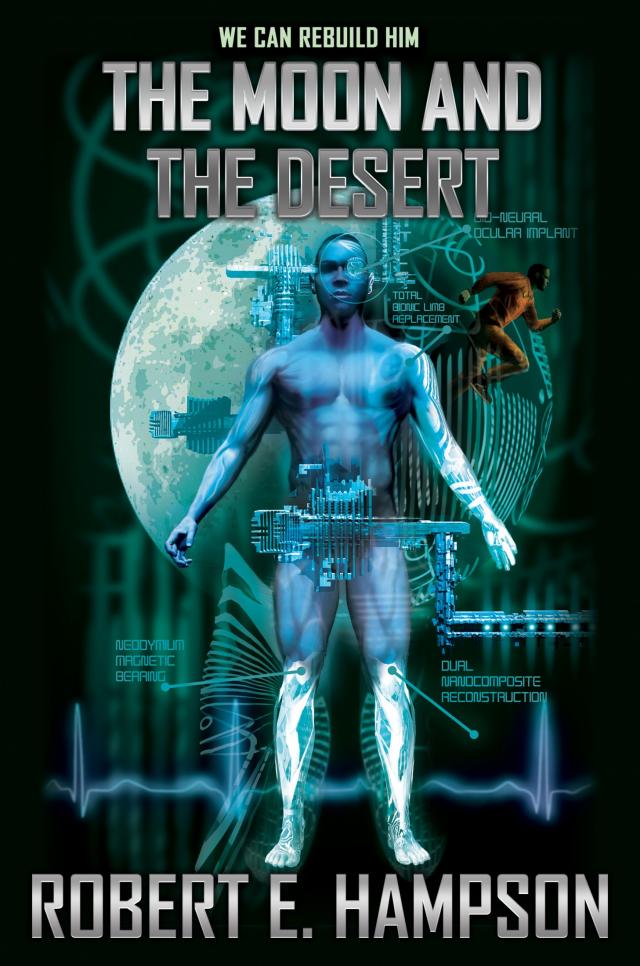
Jakob held up a pair of bionic limbs that looked like legs, but with considerable modifications. Nik had already seen them—he’d helped write up the justification and specifications, after all—but he watched as Glenn took a limb and examined it. It had the usual magnetic bearing at the knee, but the lower leg appeared slender, with a less pronounced heel and longer, more flexible toes.
“Those look almost like hands,” Glenn said wonderingly.
“Got it in one. We’re calling those ‘tingers.’ The whole structure is a ‘foothand’ although some of the techs shorten that to ‘fands,’” Jakob told Glenn. “They’re for use in zero-gee environments. I’m taking a job up in O’Neill station with the construction crew for the Clydesdale, the third-generation Helicity-drive ship that will start a circuit of Mars and Ceres bases. Since I’ll be operating in the absence of gravity most of the time, I don’t really need feet—what I do need is an extra set of hands, or something like hands. These are modular and I can switch them out as needed. I’ve been practicing with them in the neutral buoyancy pool, although they support my weight just fine in full gee. They’re a little awkward down here in the well, though—especially trying to find shoes. In orbit though? Four hands will be an advantage.”
Nik took over at a nod. “We read about something like this in an old science fiction novel. Jakob was browsing my collection and called it to my attention. In the story, humans had been genetically altered to have four limbs that were essentially arms and hands. It seemed a bit excessive to me, but he convinced the developers that with modular bionics, he could easily swap out limbs for specific purposes.”
“That’s amazing,” Glenn said. “No one should ever again question whether an amputee can be an effective contributor to operations in space.”
“Hey, if you think this is something, take a look at what Vicky has over there.” Jakob motioned to the other person who had come to talk with them in the social center.
Victoria was a short woman with natural legs, but rather obvious prosthetics replacing both of her arms. They were obvious because her left arm was artificial from the shoulder down and was bulky, more than twice the diameter of a flesh-and-blood arm. While her shoulders weren’t completely asymmetric, it was clear that the bionic rebuild on that side extended into her shoulder and back. The right arm was only artificial from the elbow down, and ended not in fingers, but in many fine tools.
“These are my working arms,” Victoria said, “and yes, I do have normal looking ones—for clubbing and dates. Unlike Jakob, though, I figured I’d actually wear mine and show you how they work.” She held up the small prosthetic and demonstrated the powered drivers, wrenches, cutters, welders, and various tips that she could utilize in place of fingers. It could also divide in half to position tools at two different angles or serve as a clamp to work on any object in her grasp. “I have a bionic eye with telescopic and microscopic functions as well. I can trace a circuit, cut it, replace it, weld it, or even completely rewire it one-handed.
“As for the other hand . . .” She reached down and wrapped her left arm around Jakob’s legs. He steadied himself with one hand on her shoulder as she lifted him off the ground. “This one’s rigged for strength and leverage. My damage went all the way into the shoulder, so they replaced the shoulder socket and reinforced my collarbone and spine to give me additional leverage and increased lifting capacity. Between the two of these, I’m your ideal mechanic. I can lift a Moon buggy and perform all of the necessary repairs to put it back in service faster than the you can go find a jack just to get underneath.”
“Shouldn’t that be . . . ‘on the one hand . . . on the other hand . . . on the gripping hand’?” Glenn asked, and was met by grins from Nik, Jakob, and Vic. Jen looked confused until Nik explained that it was a reference to a science fiction novel in which the aliens had three arms—one large one for lifting, and two smaller ones on the opposite side for finer work.
“Thanks to you, they’ve both been reactivated to active duty,” Nik told Glenn. “As he said, Jakob is going to O’Neill as part of the Clydesdale construction team. Vic’s going to the Moon—for training. She won’t be using that superstrength yet.”
Victoria gave a wide grin. “I will when I go to Mars. It’s at least a year until Augeron leaves, so I’ve got enough time to get trained up. In one-third gee, I’ll be able to do absolutely anything the colony needs me to do. I plan to be the commander’s number one technical specialist.”
Nik and Glenn laughed.
“Hmm, I wonder who that commander might be?” Nik mused.
Victoria looked back and forth at the two of them grinning at her, and realization slowly dawned. “Awesome!”
The tour ended in the recreation center. It was the Steele Center’s largest area dedicated to relaxation. The walls sported many plaques and portraits commemorating key developments in neuro-rehabilitation and prosthetics. Three portraits were separated from the rest and placed at the focal point of the room—Jack Steele, Marty Spruce, and Glenn. An interactive touch screen exhibit next to the portraits was currently playing a history of DARPA’s bionic research from the leadership of Director Tony Tether and continuing on for many years with the development of the first fully articulated, neurally controlled “DEKA” arm.
Nik had been consulted on the content of the presentation, and he was a bit afraid of the reaction once it drew Glenn’s attention. That particular loop ended with Nik talking about how his friend Shep was a shining example of someone who had gone through fire and come back to be the person he was always meant to be.
Nik stood by those words, even as he knew how much it would embarrass Shep. His friend had such a hard time with the concept of “hero.”
“I’m just an ordinary guy in extraordinary situations.”
“And that’s what makes you a hero, hon,” said Jen as she pulled him tighter.
ACKNOWLEDGEMENTS
In 1959, Dr. Jack Steele coined the term “bionic” to reference “bio-like” or “life-like” biologically inspired engineering.
Steele started off studying engineering in 1942, but the small matter of a war got in the way. After four years in the U.S. Army during World War II, he returned to college to study pre-medicine, and earned his M.D. in 1950. After a year as a teaching fellow, Steele returned to the military and served twenty years in the Air Force until retirement. He joined the Aerospace Medical Research Laboratory (AMRL) at Wright-Patterson Air Force Base in Dayton, Ohio; and in 1960, led a three-day symposium using his new term “bionics,” to discuss uses of biology to solve engineering problems.
The AMRL helped prepare America’s first astronauts, and also engaged in some of the first research to propose augmenting living organisms with artificial technology. The first mention of cybernetic organisms, or “cyborgs,” was also in 1960, by Australian inventor Manfred Clynes and American scientist Nathan Kline, who proposed the integration of technology to assist in human exploration of space. The association of Steele’s bionics and AMRLs research into cyborgs cemented the popular science fiction pairing of bionics with high-technology prosthetics, as exemplified by author and aviation expert Martin Caidin’s 1972 novel Cyborg.
This has been a fun story to write. I hope many of my readers have heard of Caidin’s book—or perhaps you’ve heard of the TV show The Six Million Dollar Man. The book and the series were quite influential in my choice of career. I entered graduate school in 1979, intending to study “bionics” only to find that the field didn’t really exist. In 1982, I started a Ph.D. in physiology and pharmacology, and eventually specialized in Neuroscience. Computerized methods for studying the brain led to means to detect brain patterns in rats to study memory and detect behavioral choices based on memory. That led to more memory studies in rats, monkeys, and eventually humans. In 2019, I attended an annual conference in which the Defense Advanced Research Projects Agency reviewed progress across all of its funded research in neurotechnology. It was there that I met my first authentic bionic man, Johnny Matheny. Books, TV, movies all like to paint DARPA as the bad guy—but I’m here to tell you that they are truly good people doing good things. Johnny’s advanced forearm and hand prosthetic were products of DARPA’s Revolutionizing Prosthetics program under the direction of Colonel Geoffrey Ling, M.D. (US Army, retired) and Justin Sanchez, Ph.D. I looked around at the people attending that meeting, and realized that forty years after learning that “bionics” didn’t exist the way I’d imagined it, these researchers and visionaries had created the field, after all, and DARPA was a major part of it.
Those two gentlemen were also program managers for the projects in which I participated, so my first acknowledgement is to Geoff and Justin at DARPA for seeing the potential in the science—and in me, as a not-so-young researcher who dreamed of turning science fiction into science. To my colleagues, including long-time mentor, collaborator and friend, Sam Deadwyler—it’s been a wild ride and we finally made it. My one regret is no longer having long Friday afternoon conversations to daydream about “what’s next?” To Mitch Riley and Brent Roeder, who represent my legacy in research, I give to you the Moon—take it and make it yours.
My publisher, Toni Weisskopf, and (former) editor, Tony Daniel, have been highly encouraging, reviewing the outline and early concepts for this book. Then, when it was all done, Toni sat me down and showed me how to make it better! This is a story I’ve wanted to tell for some time—my heartfelt thanks for the opportunity to do so.
Several authors have encouraged me in my development as a writer. Let’s start with the classics referenced in the story: Robert Heinlein, Arthur C. Clarke, Isaac Asimov, and Martin Caidin, of course. More recent influences—and folks I’ve also had the honor to meet—include Lois McMaster Bujold, James Hogan, and Ben Bova. Several author friends have provided suggestions, guidance and even a sandbox of anthologies and collections to practice the writing craft—John Ringo, Tom Kratman, Mike Williamson, Sarah and Dan Hoyt, Chuck Gannon, Larry Correia, Les Johnson, Kevin J. Anderson, Chris Kennedy, Mark Wandrey, Kevin Steverson, Kevin Ikenberry, and Bill Webb. Several good friends who are “no-longer-newbie” authors from that sandbox also deserve special mention for their encouragement, notably Mike Massa, Kacey Ezell, and Chris Smith. Thanks for putting up with half-baked ideas and too much exposition! I owe you all a debt, as does every author who walks in the footprints of Those Who Have Gone Before.


