

The Revolutionary Temper, page 55


A street singer draws a crowd with a canticle.
The publication of the peace in 1763, which officially informed Parisians that the Seven Years’ War had come to an end. At one of its fourteen ceremonial stops, the parade saluted the new statue of Louis XV erected on the Place Louis XV (today, Place de la Concorde).
A pro-Jansenist depiction of miracles being performed among the convulsionaries at the slab over the grave of François de Pâris in the cemetery of the Church of Saint-Médard.
The disaster at the fireworks to celebrate the marriage of Marie-Antoinette and the dauphin. At least 132 people were killed when the crowd stampeded.
An engraving of Madame de Pompadour after a portrait by Maurice-Quentin de La Tour. The volume on the table to the right is from the Encyclopédie.
Madame du Barry. Unlike Madame de Pompadour, she took no interest in politics, but she was reviled as a former prostitute in libels like Anecdotes sur Mme la comtesse du Barry, a great best seller.
Rousseau and Voltaire exuding light.
A condemned man being broken on the wheel by the public executioner.
In this scene from Le Mariage de Figaro, the lovesick page looks longingly at the Countess Almaviva while Figaro’s fiancée Suzanne strums a song.
Pierre Calas reads the judicial memoir by Elie de Beaumont for the rehabilitation of his father to his mother and two sisters. The engraving after a drawing by Louis de Carmontelle was sold to raise money for the bereaved and impoverished family.
Louis XV.
Chancellor Maupeou.
Louis XVI.
Marie-Antoinette.
The second manned flight of a balloon, performed by Jacques Alexandre César Charles and Nicolas-Louis Robert from the Tuileries Gardens on December 1, 1783.
A print illustrating the contemporary faith in science. Its caption reads, “The man of Nature is a feeble animal / But Philosophy makes him the equal of the Gods.”
A satirical print showing Mesmer treating fashionable women at his tub. The woman on the right is undergoing a salutary “crisis,” and the one in the background is being carried into the “crisis room.”
A purportedly accurate representation of the diamond necklace, which was rumored to be worth 1,600,000 livres. The cardinal de Rohan hoped to ingratiate himself with Marie-Antoinette by giving her this extravagant present.
Cagliostro, an adventurer who was reputed to be 300 or perhaps even 2,000 years old, fascinated Parisians during the Diamond Necklace Affair. Although he had bamboozled the cardinal de Rohan and was imprisoned with Rohan in the Bastille, he played no part in the theft of the diamonds.
The official celebration of the peace after the American war on December 14, 1783. The Halle au bled had been converted for the occasion into a gigantic ballroom, where the common people danced the night away while gentlefolk watched them from above.
An English caricature by Isaac Cruikshank that shows Louis XVI protesting to Calonne that the treasury is empty. Calonne replies that he had left it full, while two of his henchmen haul it off.
An anti-Necker print that shows him performing a conjuring trick before Louis XVI. A copy of Necker’s Compte rendu, which indicates his greatest trick, lies on a footstool, and a table on the wall lists seven loans that he floated, creating an enormous deficit, although the Compte rendu claimed there was a healthy surplus.
The Assembly of Notables, which opened on February 22, 1787. Calonne, pictured as the cook of the Court, asks the Notables, depicted as barnyard animals, “By what sauce do you want to be eaten?” Different versions of this caricature circulated widely in Paris.
The Lit de justice of August 6, 1787, in which the king summoned the Parlement to Versailles and forced it to register the land and stamp taxes. In such ceremonies the canopy over the throne was known as a lit (bed).
The arrest of d’Éprémesnil and Goislard on May 6, 1788. After surrendering to d’Agoult’s troops at the dramatic “siege” of the Parlement, they are shown outside the Palais de justice being forced into a carriage, which will carry them off to exile.
The burning of a guardhouse on the Pont Neuf during the uprising of August 29, 1788. The buildings on the right open onto the Place Dauphine, a gathering place for agitation in 1788. In August and September, rioters paraded with mannequins of the ministers Brienne and Lamoignon and forced them to confess their crimes before the equestrian statue of Henri IV, who was idolized as a champion of the common people.
A contemporary print depicts Camille Desmoulins standing on a table outside the Café de Foy, urging the crowd to seize arms after news arrived of Necker’s dismissal on July 12, 1789. According to some reports, Desmoulins’s call to arms precipitated the uprising that led to the storming of the Invalides and the taking of the Bastille.
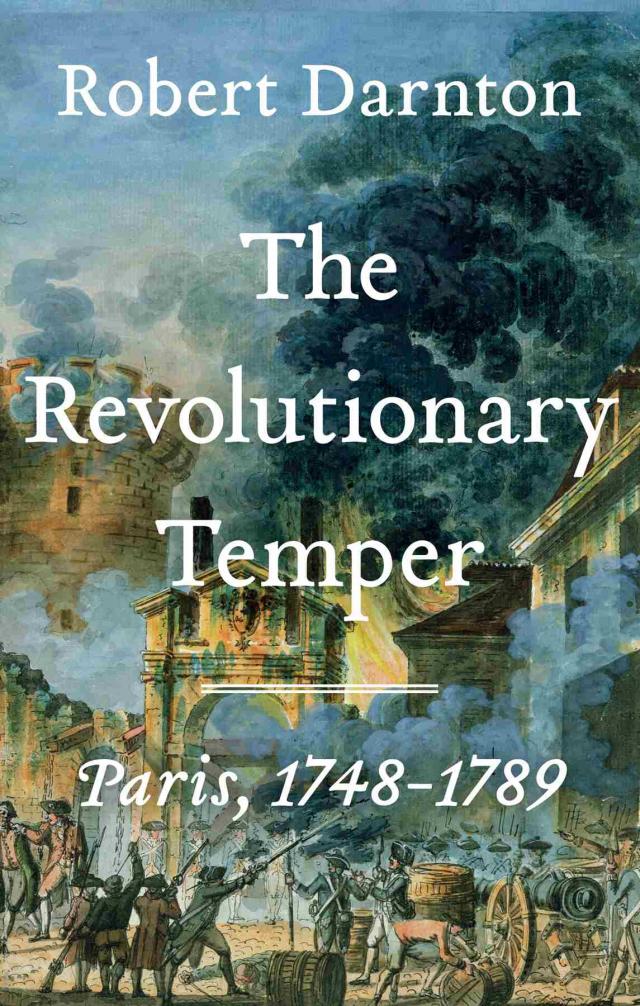
The storming of the Bastille as depicted in a painting by Jean-Pierre-Louis-Laurent Houel.
The crowd in the Place de Grève before the Hôtel de Ville on July 14, 1789, parading the heads of de Launay and Puget at the end of pikes.
BIBLIOGRAPHICAL NOTE AND ACKNOWLEDGMENTS
BECAUSE THIS BOOK IS based on contemporary reports about events, it does not deal extensively with secondary literature. Yet I have relied on the work of many historians who have cleared the way for a new view of the primary sources, and I would like to acknowledge my debts to them.
Eighteenth-century France, the Enlightenment, and the Revolution have inspired an enormous literature, larger than any other historical field of study and too vast to be surveyed here. I have used this book to synthesize my own work, which goes back to my unpublished Oxford dissertation of 1964, but I owe a great deal to others. First, I would like to thank Roger Chartier and Daniel Roche, friends and collaborators over many years. Chartier’s publications on the history of books and reading—notably Histoire de l’édition française (Paris, 1984), vol. 2, which he coedited with Henri-Jean Martin—have contributed greatly to the argument in the preceding pages about the power of the printed word. Roche’s research is fundamental to the understanding of everyday life among Parisians, especially the common people and the material setting of their lives: Le Peuple de Paris: essai sur la culture populaire au XVIIIe siècle (Paris, 1981) and Histoire des choses banales: naissance de la consommation dans les sociétés traditionnelles (XVIIe–XVIIIe siècle) (Paris, 1997).
Expanding on Roche’s work, David Garrioch has published a rich history of eighteenth-century Paris: The Making of Revolutionary Paris (Berkeley, 2002) and a fine-grained study of the city’s complexion, Neighbourhood and Community in Paris, 1740–1790 (Cambridge, 1986). Colin Jones has also supplemented Roche’s views in two important articles about the emergence of a consumer culture: “The Great Chain of Buying: Medical Adverisement, the Bourgeois Public Sphere, and the Origins of the French Revolution,” American Historical Review (1996): CIII, 13–40 and, with Rebecca L. Spang, “Sans-culottes, sans café, sans tabac: Shifting Realms of Necessity and Luxury in Eighteenth-Century France,” in Consumers and Luxury: Consumer Culture in Europe, 1650–1850, ed. Maxine Berg and Helen Clifford (Manchester, 1999), 37–62. I have also benefited from Michael Sonenscher’s deeply researched study of work and political concepts, Work and Wages: Natural Law, Politics, and the Eighteenth-Century French Trades (Cambridge, 1989).
Arlette Farge has studied Parisians up close in several excellent books, notably Dire et mal dire: l’opinion publique au XVIIIe siècle (Paris, 1992) and, with Jacques Revel, Logiques de la foule: l’affaire des enlèvements d’enfants à Paris 1750 (Paris, 1988). Having worked in many of the same sources, particularly the archives of the Bastille, I have learned a great deal from her research and agree with her conclusions, which prove that vibrant strains of public opinion existed at street level, not merely in the world of the salons. That world is explored by Antoine Lilti in Le monde des salons: sociabilité et mondanité à Paris au XVIIIe siècle (Paris, 2005). I have also profited from his other publications, particularly Figures publiques: l’invention de la célébrité 1750–1850 (Paris, 2014). And my discussion of bread crises and popular mentality relies on the fundamental work of Steven L. Kaplan, Bread, Politics, and Political Economy in the Reign of Louis XV (The Hague, 1976), 2 vols.
Among the studies of finance and administration, I owe a great deal to Herbert Lüthy, La Banque protestante en France de la révocation de l’Édit de Nantes à la Révolution (Paris, 1961), 2 vols., and John Bosher, French Finances 1770–1795: From Business to Bureaucracy (Cambridge, 1970). I also have benefited from Michael Kwass, Privilege and the Politics of Taxation in Eighteenth-Century France: Liberté, Égalité, Fiscalité (Cambridge, 2000). It successfully revises the standard view of taxation and politics in Marcel Marion, Histoire financière de la France depuis 1715 (Paris, 1919). Connections between finance and political history can be traced through the entire century, culminating in the ministries of Necker, which provoked enormous waves of pamphleteering, as discussed astutely by Léonard Burnand: Necker et l’opinion publique (Paris, 2004) and Les pamphlets contre Necker. Médias et imaginaire politique au XVIIIe siècle (Paris, 2009).
I have indicated my debts to monographs and biographies in footnotes to the chapters on ministers, public figures, and episodes such as the abduction of “Prince Édouard” Stuart and the Diamond Necklace Affair, but I should acknowledge studies on the erosion of the Crown’s legitimacy and the desacralization of the monarchy: Jeffrey W. Merrick, The Desacralization of the French Monarchy in the Eighteenth Century (Baton Rouge, 1990) and the excellent series of articles by Thomas E. Kaiser, notably “Madame de Pompadour and the Theaters of Power,” French Historical Studies XIX (1996), 1025–44. I also have profited from Sarah Maza’s superb study of judicial affairs, Private Lives and Public Affairs: The Causes Célèbres of Prerevolutionary France (Berkeley, 1993).
I need not repeat my acknowledgment in the Introduction to the fine work on eighteenth-century journalism by Pierre Rétat, Jean Sgard, François Moureau, Jack Censer, Jeremy Popkin, Gilles Feyel, and Elizabeth Bond; but I should stress its importance for the understanding of politics, because the monarchy, although absolute in principle, became increasingly vulnerable to the pressure of public opinion during the second half of the century. Two key essays on public opinion are: Keith Michael Baker, “Politics and Public Opinion under the Old Regime: Some Reflections,” in Press and Politics in Pre-Revolutionary France, ed. Jack Censer and Jeremy Popkin (Berkeley, 1987), 204–46, and Mona Ozouf, “L’Opinion publique” in The Political Culture of the Old Regime, ed. Keith Michael Baker (Oxford, 1987), 419–34.
In interpreting political history, I have relied on the masterful work of Michel Antoine, particuarly Louis XV (Paris, 1989). For the prerevolutionary reign of Louis XVI, John Hardman has supplied a close analysis of ministerial rivalries: French Politics, 1774–1789. From the Accession of Louis XVI to the Fall of the Bastille (London, 1995). British historians have also done excellent research on the relations between the Crown and the parlements, a main ingredient of politics under the Ancien Régime, and I have especially profited from the work of William Doyle, beginning with The Parlement of Bordeaux and the End of the Old Regime, 1771–1790 (New York, 1974). I have also drawn on Julian Swann, Politics and the Parlement of Paris under Louis XV, 1754–1774 (Cambridge, 1995) and the vivid and thoroughly researched account of the legal profession in David Bell, Lawyers and Citizens: The Making of a Political Elite in Old Regime France (Oxford, 1994).
I have profited greatly from work on the ideological dimension of politics under the Ancien Régime. In several articles and books—my favorite is The Damiens Affair and the Unraveling of the Ancien Régime 1750–1770 (Princeton, 1984)—Dale Van Kley has demonstrated the importance of Jansenism as a political force in eighteenth-century politics. Although he has corrected the secular bias in much historical writing, I remain convinced that anticlericalism, reinforced by the works of the philosophes, was a powerful ingredient in political culture, particularly during the last two decades of the Ancien Régime. I also owe a great deal to the work of Keith Baker, who with Van Kley, has transformed our understanding of political culture in the eighteenth century. I find the essays in Inventing the French Revolution: Essays on French Political Culture in the Eighteenth Century (Cambridge, 1990) persuasive, particularly those on relatively unknown figures such as Jacob-Nicolas Moreau and Guillaume-Joseph Saige. In contrast to historians like Jonathan Israel, who treats ideas as autonomous, self-sufficient forces (notably in Radical Enlightenment: Philosophy and the Making of Modernity, 1650–1750 [Oxford, 2001]), Baker successfully dissects the competing claims of thinkers as elements in an ongoing political discourse. While admiring his approach to political culture, I do not accept his argument that the course of the Revolution was determined by a Rousseauistic discourse of will as opposed to a discourse of reason and that the turning point came when the Constituent Assembly voted for a suspensive royal veto on September 11, 1789. My own view coincides with that of Timothy Tackett, who sees many turning points in the Revolution and allows for the importance of contingency as well as ideology: Tackett, Becoming a Revolutionary: The Deputies of the French National Assembly and the Emergence of a Revolutionary Political Culture (1789–1790) (Princeton, 1996). After demolishing Marxist interpretations of the Revolution, François Furet shifted the interpretation of it to the transfer of legitimacy by means of the “magistère de la communication”: Penser la Révolution française (Paris, 1978), 81. My own emphasis on communication is compatible with his, although I disagree with his view that “l’imaginaire démocratique” (p. 79) determined the course of the Revolution from 1788 to 1794.
The ideological issues stand out in the literature on the “Pre-Revolution” of 1787–1788. According to classical histories of the Revolution by Albert Mathiez, Georges Lefebvre, and Albert Soboul published from 1922 to 1962, the Revolution was triggered by a “révolte nobiliaire” of the privileged orders, who opposed the reforms of Calonne and Brienne. Alfred Cobban, an anti-Marxist, also subscribed to that interpretation, making the opposition of reform and privilege the central theme of France’s history in the eighteenth century. Although I do not dispute the importance of reforms, I have found that Parisians rose in revolt against what they construed as ministerial despotism. If that is true, how is one to explain the disparity between their views and those of the historians? It was not, I think, that Parisians failed to perceive what in retrospect appears as political reality but rather that they constructed reality in line with their experience of events during the previous forty years. In fact, I do not believe that a “révolte nobiliaire” took place.
Jean Egret exposed deficiencies in the “révolte nobiliaire” argument in La Pré-Révolution française 1787–1788 (Paris, 1962), and Vivian Gruder dispatched with it entirely in an excellent monograph, The Notables and the Nation: The Political Schooling of the French, 1787–1788 (Cambridge, MA, 2007). My research confirms Gruder’s and profits from the recent revival of interest in political history. Although I have uncovered plenty of evidence about resentment against aristocratic privileges, I believe that the hostility to the nobility was directed primarily against les grands—that is, the court aristocracy, power brokers, and government ministers.
As to the relevance of social science theory to interpretations of the Revolution, I have learned a great deal from the work of William H. Sewell Jr., particularly Logics of History: Social Theory and Social Transformations (Chicago, 2005). I also admire Sewell’s synthesis of the secondary literature in Capitalism and the Emergence of Civic Equality in Eighteenth-Century France (Chicago, 2021). But I cannot accept his argument that the concept of civic equality derived from the experience of commercial capitalism and did so somehow by a process of abstraction that made persons analogous to commodities.
Finally, I would like to acknowledge the help of friends and editors who gave critical readings to several drafts of this text. Steve Forman, my longtime editor at W. W. Norton, made many helpful suggestions. Stuart Proffitt at Penguin Books in London nurtured the book since its incubation many years ago, when our common tutor, Harry Pitt of Worcester College, Oxford, encouraged me to write it and to adopt The Revolutionary Temper as its title. David Bell generously went over a first draft, which I modified according to his recommendations, although I alone am responsible for its shortcomings. Pascal Bastien kindly made available prepublication transcripts from Hardy’s journal, and Marie Suzanne Fleur Prunières provided valuable help in the preparation of the illustrations and the map of Paris.
NOTES
Abbreviated References for Frequently Cited Sources
I have relied only on sources written soon after events occurred, not on memoirs written long afterward. Because works like the Mémoires secrets appeared in several different editions, quotations are identified by the date rather than by the page, except in the case of Grimm’s Correspondance littéraire, which has monthly rather than daily installments.
Arsenal: Bibliothèque de l’Arsenal
Barbier, Chronique: Edmond-Jean François Barbier, Chronique de la Régence et du règne de Louis XV (1718–1763) (Paris, 1857–1885), 8 vols.
Bibliothèque historique: Bibliothèque historique de la ville de Paris





