The Crow Chronicles, page 1


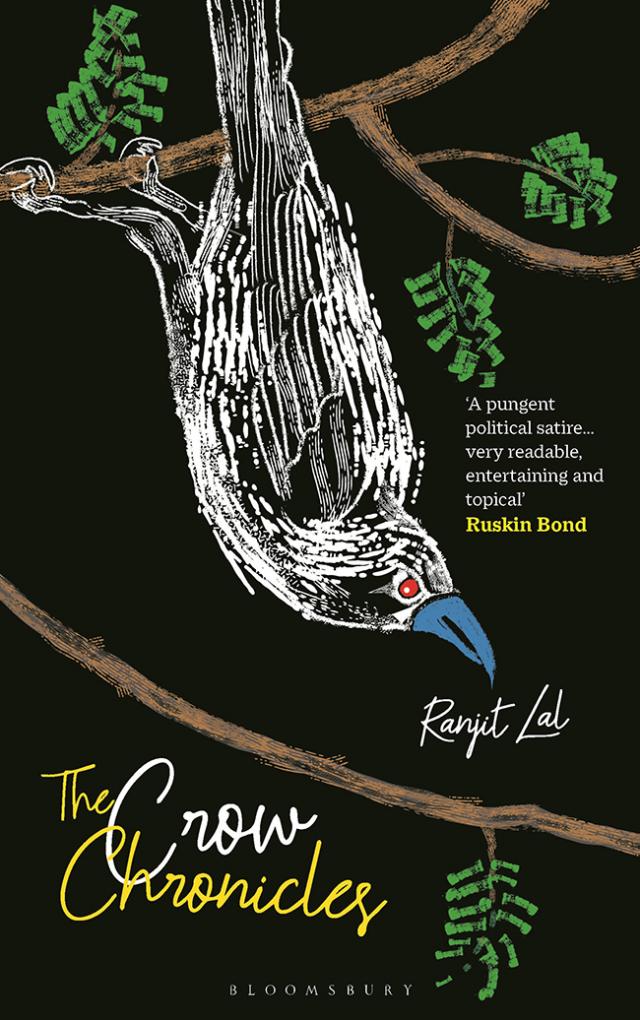
THE CROW CHRONICLES
Praise for The Crow Chronicles
‘A brilliant political satire . . . extremely funny and very good’
The Literary Gentleman
‘A deliciously wicked book’
The Book Review
‘A stingingly funny satire’
Sunday
‘Absolutely marvellous . . . keenly observant, brilliantly plotted novel’
India Magazine
‘Magnificent and unique . . . no review can do justice to the rich detail of [this] often frightening, often hilarious novel’
The Hindu
‘An astonishingly interesting book . . . a good strong tale with interesting characters’
Indian Express
‘A pungent political satire in the tradition of Animal Farm and Watership Down. Very readable, entertaining and topical’
Ruskin Bond
THE CROW CHRONICLES
RANJIT LAL
BLOOMSBURY INDIA
Bloomsbury Publishing India Pvt. Ltd
Second Floor, LSC Building No. 4, DDA Complex, Pocket C – 6 & 7,
Vasant Kunj, New Delhi, 110070
BLOOMSBURY, BLOOMSBURY INDIA and the Diana logo are trademarks of Bloomsbury Publishing Plc
First published in India by Penguin Books India 1996
This edition published 2023
Copyright © Ranjit Lal, 1996, 2023
Ranjit Lal has asserted his right under the Indian Copyright Act to be identified as the Author of this work
This is a work of fiction. Names and characters are the product of the author’s imagination and any resemblance to actual persons, living or dead, is entirely coincidental
All rights reserved. No part of this publication may be reproduced or transmitted in any form or by any means, electronic or mechanical, including photocopying, recording or any information storage or retrieval system, without the prior permission in writing from the publishers
This book is solely the responsibility of the author and the publisher has had no role in the creation of the content and does not have responsibility for anything defamatory or libellous or objectionable
ISBN: PB: 978-93-56408-78-4; eBook: 978-93-56408-79-1
Created by Manipal Technologies Limited
To find out more about our authors and books visit www.bloomsbury.com and sign up for our newsletters
For Indira
Contents
A Brief Note on the Text
PART I
1 Achaanak Is Worried
2 Meeting at Stinky Tops
3 The Festival of Birds
4 The Defeathering of Doodhraj
PART II
1 Early Days
2 He Came in through the Bathroom Window
3 The Takeover
4 Poolside Plunder
5 Identity Crisis
6 Over the Rainbow
7 Collective Chaos
8 Keeping Faith
PART III
1 Overture to Keoladeo
2 In the Company of Thieves
3 Winning Friends and Influencing Birds
4 Brainstorming at Stinky Tops
5 The Press Conference
6 The Grand Reception
7 Settling Down
8 The Ghana Ghouls Ghonsla
9 Baiting the Traps
10 Kaw D’Etat
PART IV
1 The Morning After
2 Rallying Round
3 Meetings in the Marshes
4 Operation Broken Bird
5 Post-Operation Broken Bird
6 ‘Kawe Ka Adda’
7 Grim Days at the Ghonsla
8 Matchmaking and More
9 Pomp and Circumstances
10 When Generals Fall Out
11 Four Aces for Kaw
12 The Best Laid Plans
13 In Dreadful Anticipation
14 The Night of the Kala Talwars
15 Izzat Ka Faluda
Epilogue
Acknowledgements
About the Author
A Brief Note on the Text
While some of the places described in the book do indeed exist in the Keoladeo National Park (also known as the ‘Ghana’) and in Bombay (Mumbai now) most are imaginary. Thus while the Mansarovar, Shanti Kutir Resthouse, Forest Lodge, Keoladeo Temple complex and Python Point (there are more than just one) can be visited, Stinky Tops, the Jumiz Bagh Palace and the Ghana Ghouls Ghonsla are not to be found there.
Birding has gained in popularity exponentially since this book was first published in 1996. Back then, birders were usually regarded with wryly raised eyebrows and rotating forefingers; today it has become a pastime many have taken up with enthusiasm, dedication and fervour! May the breed thrive!
PART I
1
Achaanak Is Worried
Achaanak the shikra was worried. He had got into the habit of listening to rumours and gossip, and, what was worse, getting upset by them. Time and again he would come across some disastrous piece of news and then brood over it for hours, making himself so thoroughly depressed that he would nearly fall off his perch. Then he would shake his head rapidly, ruffle his feathers, and tell himself sternly: ‘But that’s not the end of the world!’ and feel better. So far, not one of the disasters he had worried about had actually occurred, but Achaanak never realized that because there was always something new for him to be worried about. And there were many birds in the Keoladeo National Park (better known as Bharatpur or the ‘Ghana’) where Achaanak lived, who, in order to tease him, would deliberately whisper something wicked to him, and then sit back and laugh as poor Achaanak flew off to brood over it.
He was a lightly built hawk dressed in a bluish-grey suit that looked a trifle tatty, with specks of white showing here and there like stuffing from a cushion. His beak was hooked and fierce, and his eyes, with their large yellow rings, could glare at you quite menacingly. When he was hunting, most of the smaller birds kept out of his way, and the frogs plopped into the water when they heard his challenging ‘Ki-keee!’ cry.
But now, as he sat brooding on a branch overhanging the water, the frogs weren’t scared at all, and they continued to hop and plop in full view. One of them, more cheeky than the rest, raised himself up and winked.
‘Achaanak’s worried again!’ he croaked, and all his friends laughed loudly, but quickly plopped out of sight just in case Achaanak dived at them. There was a flash of blue as Phuljari, the white-breasted kingfisher, landed on the branch, his feathers fiery as sparks.
‘What are you worried about this time, Achaanak?’ he asked innocently. ‘Last time we met you thought they were going to convert the park into a bird factory, wasn’t it?’ Then he cocked his head to one side and asked: ‘What is a bird factory, Achaanak?’ and gave a cackle of laughter.
‘It’s nothing,’ Achaanak muttered, and turned his back moodily on the kingfisher.
‘How can a bird factory be nothing? A bird factory is a place where they pickle and can birds and export them for badly needed foreign exchange!’ Phuljari gave another cackling laugh and then streaked off after a fish swimming foolishly near the surface.
‘Bah!’ said Achaanak to himself. ‘If only he knew what was going to happen he wouldn’t be cackling like this. It’s birds like him that are responsible for the state of things today. Don’t care at all about the future.’
He wished there was some other bird in the park who took things seriously as he did—most of them seemed more interested in eating, fighting amongst themselves and posing for photographs. Silly lot. Even Baadshah, the giant tawny eagle and Sovereign of the Royal House of Ghana, spent most of his time with his head in the clouds trying to see how high he could fly. He didn’t know a thing about the murky goings-on at ground level—what his Prime Minister, Shri Pinky Stink Tainted Storkji, the painted stork, was getting up to.
There was a sudden jerk on the branch and a loud squawk. Tooiram Totaram, the tall blossom-headed parakeet, had settled next to him. He was rolling his eyes drunkenly, obviously having just partaken of too much mahua.
‘Hello, Achaanak, what are you doing here? Haven’t you heard?’ Now Tooiram, with his fondness for fermented fruit, was one of the most notorious story-tellers in the park, and even the journalists working for Did-He-Do-It?, the park’s most nosy newspaper, dealt carefully with his stories.
‘Heard what?’ asked Achaanak, trying to look disinterested, but with every sense alert.
‘About that shtrange bird that’s been seen near the Taj Mahal?’ The Taj was about 55 km away from the Keoladeo, about an hour’s flight away if the wind was right, and certainly close enough to get worried about.
‘What strange bird?’
‘God knows what it is, only it’s bigger than Baadshah, pure silver from beak to tail, and has horrible red eyes that can kill you if you look into them. And its beak! They say he can crush stones with it.’ Tooiram cracked his own rather powerful beak.
‘Who says?’
‘Oh, they—everyone.’ Tooiram shrugged his shoulders vaguely. ‘All the mynas are talking about it—one of them actually saw the bird!’
‘And where are these mynas?’ Achaanak thought it might be wiser to hear it from the mynas themselves.
‘They must be somewhere. I don’t know.’ Tooiram plucked a berry off the branch and ate it noisily. ‘I heard this bird-devil has a bodyguard of a hundred black ravens flapping all around it.’
‘So what if this bird wants to see the Taj?’ Achaa
‘Haven’t you heard? This bird’s been kicked out of wherever he was previously staying. They say he wants to make Bharatpur his new home. Can you imagine what he and his hoodlums will do out here? As it is the situation is bad enough, with egg-stealing and chick-bashing happening every day and that fat Kotwal able to do nothing.’ Tooiram lowered his voice.
‘And did you know that he has been invited here? And by guess whom?’
Achaanak shook his head dumbly. This was getting worse and worse.
‘By our beloved Prime Minister, that’s who.’ Achaanak was so surprised, he nearly fell off his branch.
‘If you aksh me, there’s more to it than meets the eye . . .’ Tooiram whispered hoarsely.
It did seem so, and it made poor Achaanak more worried than he had ever been. True, Tooiram was not one of the most reliable sources of news, but whatever he had said made sense. He decided to seek out the mynas who had seen this new bird.
He found them after considerable trouble, in a huge chattering group of birds in a babul copse. As with flocks of mynas everywhere, each bird seemed to be screeching at the top of his or her voice, regardless of whether anybody was listening. The din was considerable and in order to be heard, Achaanak had to give his shrill, piping, hunting cry. Immediately the screeching subsided. While the mynas knew that Achaanak would never dare to hunt one of them when there were so many of them together, they wondered for a second whether to take off en masse.
‘Hold it,’ yelled Achaanak, sensing their rising panic. ‘Which one of you saw that silver bird at the Taj Mahal?’
Immediately there was uproar.
‘He did!’
‘She did!’
‘I did!’
‘He wasn’t silver, he was gold!’
‘He had terrible red eyes!’
‘Green eyes!’
‘One red and one green eye!’
‘There were a thousand black eagles flying all around him!’
‘Shut up!’ screeched Achaanak. ‘You sound like Pinky Stink’s cabinet in session.’ And repeated his question. ‘Will the bird who claimed to have seen this monster please step forward?’
There was more screeching and scrawing. Then, from the middle of the group a dirty looking bank myna was pushed forward by the others.
‘I did,’ he said, obviously the hero of the moment.
‘Well, what was he like?’
Immediately bedlam broke out again.
‘I didn’t ask you all . . . I asked him!’ Achaanak yelled, wondering how these mynas had been brought up. They were a disgrace to the park.
‘Actually he was white. Pure white.’
‘How big was he?’
The myna rolled his eyes and opened his beak wide.
‘He was huge . . . bigger than Maharaj Baadshah. And there were a hundred big black birds flapping all around him making horrible guttural caws.’
‘How do you know there were a hundred?’
‘They had numbers painted on their wings.’
Achaanak ruffled his feathers and looked sternly at the myna. ‘I hope you’re speaking the truth.’
The myna, still quite a juvenile, quailed.
‘Oh yes, sir! You see, sir, my parents had a nest near the Taj which they’ve now abandoned because of this bird. I was learning to fly when they all arrived and caused panic. I was so scared when I saw them that I fell out of my nest and flew for the first time! But they left the Taj soon after, and I’m told they were heading for Fatehpur Sikri, where this white bird wants to set up his capital . . .’
The mynas broke in again:
‘Actually they’re coming here, to Bharatpur!’
‘They’re going to raid us, and kill us all!’
‘They’re terrorists!’
‘Let’s move out of Keoladeo . . .’
Achaanak flew off to one of his favourite perches to digest the information. So, for once, it seemed that Tooiram had been right. If this hoodlum bird was going to make the park his home . . . The familiar feeling of approaching doom began to come over him again. He had better do something about it. But what? Well, for a start, see the Prime Minister about it anyway. Maybe things were not as bad as they had been made out to be. But probably they were. This goonda bird would arrive in Bharatpur and start creating havoc. There would be mass emigration. Even the winter visitors who flew in from Siberia would seek safer pastures. And that would be the end of the famous sanctuary.
Achaanak shook himself. ‘That will never happen,’ he said firmly. And flew off towards Stinky Tops, the office of the Prime Minister, Shri Pinky Stink Tainted Storkji.
2
Meeting at Stinky Tops
Shri Pinky Stink Tainted Storkji, Prime Minister of the Keoladeo National Park, was a painted stork of impressive stature and sheen. His large wings were black, shot through with metallic green, and banded and filigreed with white. The tuft of rose pink on his shoulders and wings looked like freshly spun candy floss, and his great domed head (which bespoke great wisdom according to his flatterers, and made him look like an oaf according to his detractors) was the colour of a used cricket ball. Now he clattered his huge yellow bill and waited for his personal secretary, Budhu Basant, the large green barbet, to enter.
‘You clattered, sir?’ inquired Budhu, hopping clumsily onto the huge platform of polished twigs and sticks that made up the Prime Minister’s office. Located in a thick and thorny acacia copse near the Nil Tal east of the road leading to the Keoladeo Temple, Stinky Tops was a complex of several large interlinked twiggy edifices that housed the offices and residence of the Prime Minister. It was said that special sandalwood, rosewood and mahogany had been imported at enormous expense for the construction of the edifice.
Pinky Stink peered over his spectacles and all the way down his beak at Budhu. Hunched and stocky, the barbet was clad in forest-green and merged beautifully and very properly into the background at Stinky Tops. He had a bristly yellow face, slightly bulging eyes and an earnest if bumbling manner that suggested the village idiot.
‘Have the others arrived?’ the Prime Minister asked.
‘Yes, sir. Shri Billaji and Budhbooji have just arrived and are in their office. Shri Kotwalji has sent word that he is on his way. Shri Tandoori Totaji and Shri Guturgooji are having a discussion in the annexe.’
‘Very good. Ask Budhboo and Billa to see me immediately and send the other two in ten minutes. Kotwalji can attend as soon as he arrives. Has there been any word from Maharaj Baadshah?’
‘Yes, sir—a courier pigeon was sent to us this morning. The message is that His Highness will only be too pleased to inaugurate the Festival of Birds, and is especially appreciative that special efforts were made on his behalf to ensure that the world-famous “Peregrine Princes” will be performing their “Stooping to Conquer” routine at the festival.’
‘Very good—we have to keep the Maharaja happy. Now send in the others, please.’
The Festival of Birds was being organized by the Keoladeo Kala Samiti in order to encourage more birds and birdwatchers to visit the park, and so boost its popularity. Various spellbinding bird displays and performances were to be held in different locations in the park over the next several months which were sure to enthral birdwatchers. The grand inaugural programme was to be held that afternoon near the Shanti Kutir boating jetty and the Prime Minister himself had taken on the responsibility for assuring the success of the show. It was exceedingly important that the inaugural went off without a hitch, especially in view of the unprecedented rise in criminal and terrorist acts in the park in the recent past. Also, the Keoladeo police suspected that a terrorist outfit called the Pakshi Virudh Samiti planned to create trouble during the inauguration ceremony. Pinky Stink, already under considerable pressure to resign in view of the deteriorating law and order situation, was determined that nothing untoward should happen that afternoon. Now he clattered his beak impatiently and waited for his staff to report.
The first to enter, as he had desired, were his two henchmen.
Chakumar Jungli Billa, Chief of Security to the Prime Minister, was a huge, tiger-striped feral tomcat whose baleful stone-coloured eyes had frozen many a bird into submission and whose vicious temper was legendary.