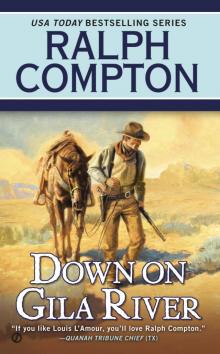
Down on Gila River, page 3


The Apache had Sam on edge. “You mind your ma, girl,” he said.
Perhaps intimidated by a male voice, Lori said, “Nobody lets me see anything.” But she walked away, accusing eyes on Sam. “I’m going to tell Dolly,” she said.
Sam waited until the child was occupied with her doll. Then he said to Hannah, “Time I spoke with that Apache, tell him to move on and quit bothering white folks.”
“Do you think it’s wise?” the woman said.
“No, it’s not wise,” Sam said. “But maybe I can talk him into gettin’ me my horse back.”
Chapter 5
Sam Sawyer stepped out, his Colt up and ready.
Darkness didn’t yet crowd him close and the cottonwoods remained visible in stark relief against a scarlet and jade sky. The desert was quiet and the hollow call of a coyote served only to make it quieter still.
Sam’s eyesight had been burned out by hard years of driving herds through sun, wind, rain, and snow. Staring across the vast distances of plains that began where he was at and ended where he was yet to be had also taken its toll.
Now he saw the trees well enough, but not the Apache on the gray pony.
He’d have to get closer. A lot closer.
Sam walked on, his booted feet making little noise. Above him a hawk glided and made a kee-kee-kee sound as it rode the high wind currents. The hawk, a black, angular silhouette against the sky, troubled Sam, but for the life of him he didn’t know why.
Then the hair rose on the back of his neck. Hell, he’d walked too far. The Indian was behind him on his right, not ten yards away. The Apache sat his pony under an ancient, spreading oak that had no right to be there.
Sam turned and said, “Stay right where you’re at, Injun.” He fought to keep his voice calm. “I can drill you dead center from here.”
Now he was near enough to the Apache to notice a couple of things: The man was painted for war and he sat his horse as still as a statue of a Civil War general in a town square. The Apache remained motionless and didn’t glance in Sam’s direction.
All right, Sam decided, maybe the Indian couldn’t understand good ol’ American.
He thumbed back the hammer of his Colt, the triple click loud in the silence, and said, “Bajese de su caballo o yo le matare.” His threat in Mexican to shoot the Apache off his horse didn’t work either.
The warrior stayed where he was, his eyes fixed on a distance Sam couldn’t see, man and horse an unmoving pillar of alabaster in the mother-of-pearl dusk.
His confidence waning as fast as the light, Sam grew desperate. His chin jutting, he stepped toward the Apache. “All right, we’ll play it your way,” he said. “I’m pulling you off’n that danged pony.”
The Indian’s horse tossed its head, then moved forward at an unhurried walk. Then the hawk dived low, its talons raking the top of Sam’s hat. Cussing, Sam waved off the swooping hawk, then took a step to the side and let the horse and rider pass.
The Apache didn’t look at him, his lusterless black eyes fixed on an invisible horizon many miles distant.
It was then that Sam saw a bullet hole in the middle of the warrior’s forehead, crusted with dried-black blood. His breath stilled in his chest, Sam’s eyes widened and he felt fear like ice water in his belly.
As the Apache rode past, his pony’s hooves making no sound, Sam smelled sage and pine . . . and something else . . . something he half remembered . . . the sweet, acrid stench of a decaying body.
The American cowboy was, and remains, the most superstitious creature on earth, and Sam had all the puncher’s inborn fears of ha’nts and ghosts and shadowed places where eyes glow in the gloom like sparks of fire.
He watched the Apache clear the trees and slowly melt into the dim hall of the night so that no trace of man or horse remained. Then, as fast as bad knees and aching feet allowed, Sam turned and sprinted for the cabin, as scared as he’d ever been in his life.
Hannah met Sam at the door, the shotgun in her hands. “What happened?” she said. “I heard you running.”
“I wanted to make sure you were all right,” Sam said, blinking. His breath came in shallow, quick gasps.
“The Apache?” Hannah said.
“I moved him on.”
Hannah lowered the Greener. Her eyes sought Sam’s in the darkness, probing with that uncanny ability a woman has that tells her when a man is lying. “Now let me know what really happened,” she said.
“Are we going to talk all night on the doorstep?” Sam said, glancing quickly over his shoulder.
“Come in,” Hannah said. “The coffee is still hot.”
She waited until Sam drank coffee and built his second cigarette with unsteady hands. Then she said, “I didn’t hear a gunshot. I didn’t hear anything, though I thought I heard the cry of a hawk.”
Sam shook his head. “No, there was no shooting and danged little talking.”
A silence stretched between them, grew taut.
“What happened, Sam?” Hannah said finally.
It was the first time the woman had used his given name, and Sam took pleasure in it. But it was a long time before he answered. Then he said, “The Apache is riding a different trail from the rest of us.” He sought a way to express himself, then: “I reckon he’s looking for a place where only dead Indians go.”
He saw the confused expression on the woman’s face, the crease that appeared between her eyes.
“Where’s Lori?” he said.
“Asleep. She and Dolly dozed off in the chair.”
“The Apache is dead, Hannah.”
“You killed him?”
“Somebody killed him, but it wasn’t me. And it was a long time ago.”
“Sam, I don’t understand.”
“Like I said, the Injun’s been dead for a long time.”
“But how . . . I mean . . .”
“Hannah, he ain’t a living man and he ain’t a dead one either.”
“A ghost? Do you mean he’s a ghost?”
“Something like that.” Sam drew deep on his cigarette. “Call him what you want, but he ain’t alive no more.”
“How do you know?”
“Do you want me to draw you a picture?”
“How do you know?”
Sam pointed to the middle of his forehead. “He’s got a bullet hole right there, and it happened months, maybe years ago.”
Hannah sat in stunned silence for a few moments, then said, “Is it an omen?”
“Could be,” Sam said. “But is it a good omen or a bad one? And who is it for? It ain’t for me or you. Leastways, I don’t think so.”
Hannah didn’t answer. Finally she crossed her arms and rubbed her shoulders and said, “Gosh, all of a sudden it’s cold in here.”
“Yeah, it sure is,” Sam said. “All of a sudden.”
A moment later someone hammered on the cabin door.
Chapter 6
Startled, Sam Sawyer jumped to his feet and drew his Colt. He put a finger to his lips and hushed Hannah into silence, then stepped to the door.
“Who’s there?” Sam said, his mouth to the door’s rough timber. “I warn you, I ain’t sittin’ on my gun hand here, so if’n you’re a dead Injun, you’re gonna be a sight deader.”
There was a moment’s silence. Then a man’s voice said, “I’m an honest traveler, seeking food and shelter.”
“What are you doing out there at this time of night?” Sam said. He was aware that Hannah had taken down her shotgun and had stepped into shadow.
“I’m afraid I’ve lost my way,” the man outside said.
“Where you from, mister?” Sam said.
“Silver City. I was headed for a town called Lost Mine, but I seem to have mislaid the place.”
“It’s south of here,” Sam said.
“Yes, but can I find it in this Stygian gloom?”
Sam thumbed back the hammer of his revolver, the triple click loud in the silence. “State your intentions,” he said.
“As I said earlier, I seek shelter for the night and perhaps a light repast. I mean, if that’s not too much trouble.”
“Hell, it is too—”
“Sam, let him in,” Hannah said.
“You sure?” Sam said. “He might be another dead Injun.”
Hannah smiled. “I’m sure he’s not.”
Sam spoke through the door again. “What’s your name, mister? An’ don’t say Sittin’ Bull or I’ll shoot ya.”
“My name is Jasper Perry, of the Oldham County, Texas, Perrys.”
“Are you a true-blue white man?” Sam said.
“I’m the product of ten centuries of Anglo-Saxon inbreeding, yes.”
“Please let the gentleman in, Sam,” Hannah said. “It’s getting cold out.”
Sam lifted the latch on the door and opened it wide. “All right, come inside,” he said.
And all seven feet of Jasper Perry walked into the cabin, bending low to clear the top of the doorway.
He saw Hannah immediately and doffed his top hat. “Thank you for your hospitality, ma’am,” he said. “There’s a most singular strangeness in the night that’s greatly disturbing.”
“See any dead Apaches, pilgrim?” Sam said, refusing to be friendly.
“No.” Perry smiled, his teeth as long and yellow as piano keys. “But they might well be out there.”
“Can I get you a cup of coffee, Mr. Perry?” Hannah said.
“That would be much appreciated,” Perry said, smiling again.
The tall man was dressed in a claw-hammer black coat and tight pants of the same shade. He wore a boiled white shirt with a four-in-hand tie and elastic-sided boots.
“Sam, would you fetch a chair from the table for Mr. Perry and put it close to the fire,” Hannah said.
Sam studied the man from the soles of his shoes to the top of his bald head and said, “Can you sit in a chair for normal folks?”
“I’m sure I can manage, Mr. . . . uh . . .”
“Sawyer, as ever was,” Sam said.
Perry folded his lanky body into a sitting position on the chair and said, “Much obliged, Mr. Sawyer.” He spread his long, thin hands to the fire. “This is indeed cozy,” he said.
Sam doubted that Perry was comfortable, on account of how his bent knees were level with his shoulders, but the man seemed at ease, as though he were in his own home.
And that irritated Sam.
“State your business in Lost Mine,” he said.
Perry took time to accept coffee from Hannah and smile his thanks before he answered, “I’m to hang three men there at three o’clock sharp tomorrow afternoon.”
“Are you some kind of a lawman?” Sam said.
“No, Mr. Sawyer, I’m a hangman. That is my profession.”
Even to a talking man like Sam, that statement was a conversation stopper, and he sat staring at Perry in what he would later describe as “a strangled silence.”
Hannah recovered from her shock more quickly. “Lost Mine is Sheriff Vic Moseley’s town,” she said. “He’s a . . . friend of mine.”
“And that is the very gentlemen who summoned me by wire,” Perry said. “He stated that his last hanging was bungled and this time he wanted a professional job done of it.”
“Don’t take much training to hang a man,” Sam said, scowling. He was irritated at Hannah’s mention of Vic Moseley.
“Oh, but you’re wrong, Mr. Sawyer,” Perry said. He laid his cup by his side and clasped his bony knees as he warmed to his subject. “It’s the drop, you see.”
“You mean you need to get the drop on a man afore you string him up?” Sam said.
“Oh dear, no,” Perry said. “After the gallows trapdoor opens, the drop is how far the condemned must fall before the noose tightens and breaks his neck.”
If Perry heard Hannah’s sharp intake of breath and the quickening pace of her knitting needles, he ignored it.
“Now,” he said, “the distance of the drop depends on a man’s weight, and, yes, his height.” The hangman fished in an inside pocket and produced a scrap of paper. “This is a follow-up wire I requested from Sheriff Moseley.” He settled a pair of pince-nez glasses at the end of his long, bony nose, scanned the wire, and said, “Yes . . . Now, where are we? Ah yes, here it is, the condemned are as follows . . .
“‘Key Felts, white, aged thirty-six, height five foot six, weight one hundred and thirty pounds.’”
Perry paused for effect, then read, “‘Isaiah Walker, Negro, aged nineteen, height five foot ten, weight one hundred and seventy pounds.
“‘And Lucius Noftsinger, white, age unknown, height five foot seven, weight one hundred and twenty pounds.’”
Hannah rose and refilled Perry’s cup, and the hangman nodded his thanks. “So you see, Mr. Sawyer,” he said, “the differences in the weight and stature of the condemned means that I must calculate a different drop for each one. That”—Perry smiled—“is where my professional expertise comes in. We don’t want to bungle the thing and tear the condemned’s head off, now, do we?”
Sam opened his mouth to speak, but Hannah got there before he did. “I suppose the three men are murderers, Mr. Perry?” she said. “And that’s why Vic, I mean Sheriff Moseley, is hanging them.”
“Bless your heart, ma’am, no,” the hangman said. “All three are petty thieves, drunks, and dance hall loungers. In his wire, the sheriff calls them ‘damned nuisances.’ That’s rather funny in a way.”
Hannah looked stricken. “Mr. Perry, I can’t believe that Vic would hang men for so little reason. Surely you’re mistaken.”
The hangman shook his head. “No mistake, ma’am.” He held the wire out to Hannah, pointed at it with a thin forefinger, and said, “See, down there. All three are described as petty thieves.”
“That ain’t much reason to hang a man,” Sam said.
“I assume that a circuit judge thought differently,” Perry said.
Hannah shook her head. “I can’t believe it. I won’t believe it. There must be something else. There’s only so much Vic could explain to you in a wire.”
“Perhaps, ma’am,” Perry said. “But when I report to the United States Marshal in Silver City, I will give the reason for the executions as petty thievery.”
“Mr. Perry, Vic Moseley is a fine man and an upstanding law officer,” Hannah said. “I can’t believe he’d be a party to a . . . a judicial murder.”
The hangman sat in thought for a few moments, then said, “If it’s any consolation, ma’am, a sheriff’s duty is to carry out the commands of the court. He does not sit in judgment.”
“Then that must be the case,” Hannah said. “Vic would not condemn three men for such trifling crimes.”
“Indeed, ma’am,” Perry said. “That must be the case indeed.”
But the hangman’s voice carried little conviction, a thing Sam Sawyer noticed but Hannah didn’t.
Chapter 7
Sam Sawyer and Jasper Perry slept on the cabin floor that night. Hannah, upset by all the talk about dead Apaches and hangings, insisted that the barn had lain empty for a long time and was full of rats. In reality she needed the company of men close by.
“I’ll give you each a blanket and a pillow,” she’d said. “They’re clean and you’ll be warm enough.”
“Suits me just fine, ma’am,” Sam said. “I’ve slept in a lot worse places.”
He was glad of the offer. Spooked by the dead Apache and the presence of a hangman, he needed the woman close.
Come morning after breakfast, Perry mounted his mule and headed for Lost Mine. After the hangman was gone, Sam began to take his leave of Hannah Stewart and her daughter.
“I reckon I’ll head fer Lost Mine my own self,” he said, “and see if I can find some temporary work. I’m pretty much down on my uppers.”
“You’ll be in time for the hangings,” Hannah said, her voice flat.
“I seen a hanging once afore, Hannah, a rustler up in the Spur Lake Basin country,” Sam said. “I ain’t much inclined to see another.”
“There’s a restaurant in town, but I think it already has a cook,” Hannah said.
“Well, I’ll jes’ have to see how the pickle squirts, like,” Sam said. “Sometimes a man can see his trail ahead real clear. Sometimes he can’t.”
The woman stretched out her hand. “It was real nice to meet you, Sam.”
Sam took the proffered hand. “And you too, Hannah.”
“Don’t be a stranger, now, you hear? Stop by sometime. There’s always coffee in the pot.”
“I surely will,” Sam said. “And give my regards to the little one when she wakes. She’s going to break hearts one day.”
“Take care, Sam.”
“And you too, Hannah. An’ don’t worry none about that Injun. He don’t mean any harm.”
Sam walked away from the cabin toward the rise. The morning light was fresh and clear as the new day came in bright, and birds sang in the piñon trees.
“Sam!”
He turned and saw Hannah at the cabin door.
“You will come back and see us, now,” she said. “Set for a spell.”
Sam waved, smiled, and walked on.
He had nothing to say because he didn’t know how he felt, about Hannah, about anything.
* * *
“Good beer,” Sam Sawyer said. “Nice and cold.”
“Enjoy it while you can,” the bartender said. “The winter ice is all but gone.”
Outside, dust devils danced along Lost Mine’s only street, a wide enough thoroughfare bookended by a row of buildings on the east side, only four to the west, a livery stable, a warehouse, a barbershop, and the Lone Star Saloon. Stock corrals marked the southern limit of the town, and near those a huddle of small shacks where the girls who worked the line lived when the drovers were in town.