Down on Gila River, page 19


He thought about the man and his killers. They had been the first sign of humans he’d had in several days, how many he did not know. Finally he tapped Gracie with his heels and she walked forward, eager, he figured, to sample the green grass before them.
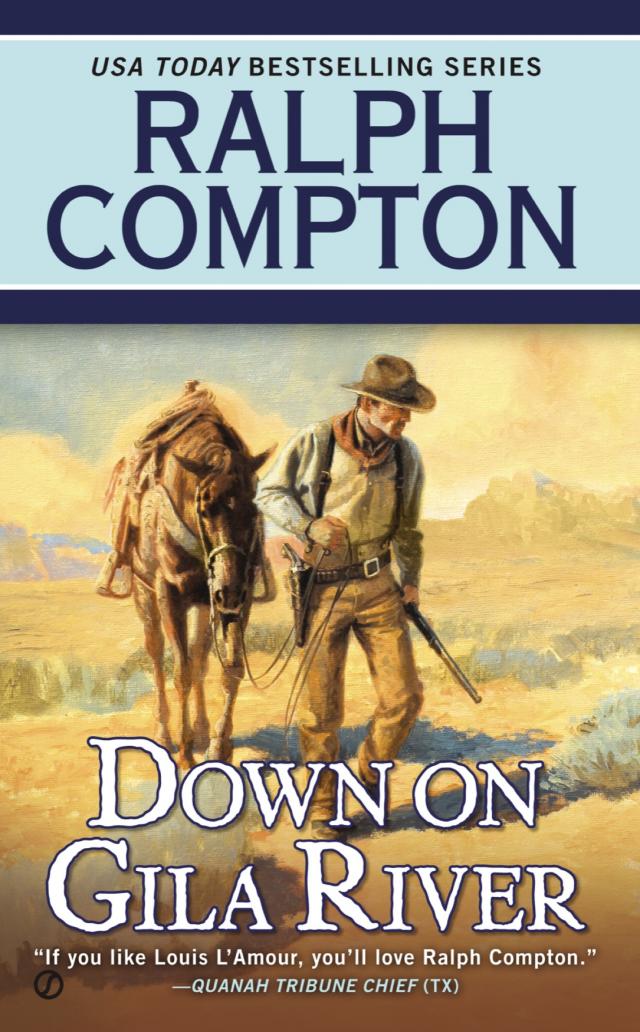
A meadow such as this, bound to be a ranch nearby. Maybe they would know who the man was. As he approached the body, Tucker’s shivering increased. He knew it was for more than just the cold creeping in between his thready clothes and the goose-bumped skin beneath. When he was some yards from the body, Tucker reined up and slid off the horse, who grunted and dipped her head to the grass and began nosing and cropping with gusto. He let the hackamore reins trail. He had long ago given up worrying if Gracie would wander off—he fancied she was as tired and as uncaring as he.
If that man’s coat had been gray, he thought, stepping carefully, shifting his glance up toward the direction ahead where he’d last seen the two riders recede into the landscape, it might well be mistaken for a great rock marring this otherwise cleared meadow. He ventured forward another step, realized he had the bottle clutched tight in his hand, and held on to it. Not much of a weapon, but it would be better than nothing should those shooters decide to double back to admire their handiwork.
He drew closer, tried to stop the thoughts occurring to him—how, despite the blood and the hole in the back, warm that coat would be. If not for the man’s wide shoulders and obvious girth, Tucker suspected he was of similar height. Any bulk and muscle he had once had—and it had been enough to fill out and keep solid his thick frame—had in the past couple of years of wandering dissipated till he was a tall, gaunt man, unshaven and sunken-eyed. But try as he might he could not think of anything other than that warm coat now.
He cut wide around the body and looked down at the man. He saw no breath rise from the mouth, saw no movement of the chest. What he did see was a man lying on his left shoulder, large hands gripping a belly glistening with blood. The shirt’s belly had once been a checkerboard pattern of white and sky blue checks, but now was a knot of bloody hands and sopping red cloth.
Tucker turned his back on the direction he’d been so cautious about looking, and knelt before the hunched form. Seeing that big white-haired head, clean-shaven face, a nose that had been broken a time or two, the jutting brow and windburned cheeks—it all reminded him of his father, dead long years ago, and buried by Tucker’s own hand back in Texas. He’d laid him to rest beside the woman he’d pined for all of Samuel’s life, the mother Samuel never knew, lost to them both from a fevered sickness.
Tucker cut loose any stray thoughts he had for his own safety and decided that since he had watched the man die, the least he could do was figure out who he was, maybe let his kin know, provided there were any. Barring that, he could try for the nearest town. He looked up at Gracie, who had not moved but a step or two as she dined on the toothsome grasses.
He wasn’t sure he could hoist the man aboard her. But even if he could, he wasn’t so sure the old horse could carry the dead man. Tucker set down the empty bottle and knelt close before the man, his face tightening as he reached for the blood-specked lapels. First things first, he told himself. Have to see if I can find something on him that might identify him. He looked around again, half hoping he’d see the man’s buckskin headed his way. Nothing moved except Gracie’s mouth.
Tucker looked back to the man, reached to part the coat, and a puffed and bloodied hand, the palm cored and oozing gore, snatched Tucker’s left wrist and held on with a surprising grip.
Tucker yelped and toppled backward. He landed raggedly, his eyes wide as they met the hard stare of the gut-shot dead man.
The big hand, though mangled, held him fast. A sound like a sigh came from him. Then a blood bubble rose from his mouth and popped, and he spoke in a voice as strong as his grip, “Tell Emma . . . heart . . .”
His blue-gray eyes seemed to brighten as if lit from within. Then his eyelids fluttered and closed. The sighing sound came again, then leaked out with his breath, and the man was finally dead.
The bloody hand remained gripped on to Tucker’s own thin wrist. He pried loose the work-thick fingers, lowered the hand to the grass. “I didn’t . . . I wasn’t thieving from you,” he whispered. “I would not do that. I . . .”
What was the use? The man was dead and he had a woman in his life with the name of Emma. How do I find such a person? Is there a town along here somewhere? A river town, he thought. That would make sense. And there was bound to be a ranch close by. Maybe it was this man’s place.
But no matter what, he couldn’t bring himself to feeling again in the man’s coat for something to identify him by. It seemed too big a violation now. He’d just have to do his best, knowing there was no way on earth he was going to be able to hoist the man up onto Gracie—neither of them had the strength for such an undertaking.
Tucker stood, his hands on his waist and his breath hissing out of him. Just have to leave him, take a chance that something might get him. He looked down at him again. There wasn’t even anything he could do to cover him up. He had no blanket of his own, and the man’s coat was on him tight. Then he remembered that the big man’s hat had pinwheeled away. He looked around and to his surprise located it not far off. He fitted it tight to the man’s head and tugged it down low and snug, covering the man’s face.
Other than not wanting to lift her head from what she obviously considered a sweet meal, Gracie proved no trouble for him to catch. He was amazed each morning to find he still had her. Something about the sad old brown-eyed horse, her faithfulness to him even through these lean times, warmed and shamed him, for he knew she deserved better. He was on a fast slide downhill and she seemed content to be along for the ride, a last, bittersweet link with his old life.
He led her around the man and she gave the body a suspicious sidelong stare. They hadn’t walked but a few yards when his boot stubbed something in the grass. There lay the dead man’s pistol, a Colt Navy. Tucker looked back to the dead man. Still dead. He hefted the pistol. He could tuck it into the man’s holster, but he didn’t warm to the idea of disrupting the body all over again.
Then it occurred to him that he might be able to use it to identify the man. He dropped the reins and turned the pistol over in his hands. Gracie resumed grazing.
The ebony handles shone from long use. He could pick out no other discerning marks, but as he tipped it up, he noted, etched into the butt, deeply gouged letters.
“P.F.,” he said.
Gracie kept eating.
“Bound to help.” The pistol slid too easily into his waistband. Finally he pulled it free and kept a grip on it, lest it slip down his pant leg.
It took him three tries to remount. He straddled Gracie’s bony spine, his eyes half-shut, dizziness and pinprick blackness crowding his vision. Finally he kneed her forward, and she resumed her walk. He didn’t have the heart to urge her to move faster. He knew better than anyone how much effort it took to keep on moving forward, from nothing, toward nothing.
His saddle was long gone. Even the blanket he’d managed to hang on to since he’d sold the saddle had also disappeared a month or more back, maybe in that harsh little Mormon-infested town, though he couldn’t be sure.
As they walked, the way became recognizable as a trail. Tucker followed it, and his thoughts soon turned over and over the man’s last words: “Tell Emma . . . heart . . .”
“I wonder what that means,” he said out loud, and sighed. “Guess we better find this Emma and break the sad news, Gracie. Maybe she’ll have a charitable side and feed us.” After suitable grieving, of course. It had been his experience that most people got a leg up and over their heartsickness sooner than later.
Only you have never crawled out of yours, have you, Samuel Tucker? You’ve been weak as water for a long time now, boy. But the good news is that your weak ways are almost at an end. You can’t hold out much longer this way. The very center of your sagging self will give way, Tucker, and that, as someone once said, will be that.
He frowned at the thought. The bitterness of self-doubt parched his tongue and left a dry, sandy feeling in his mouth. He kept his eyes closed as Gracie walked right on past another lane that angled sharply to the right.
Ralph Compton, Down on Gila River