

Barksdale's Charge, page 1


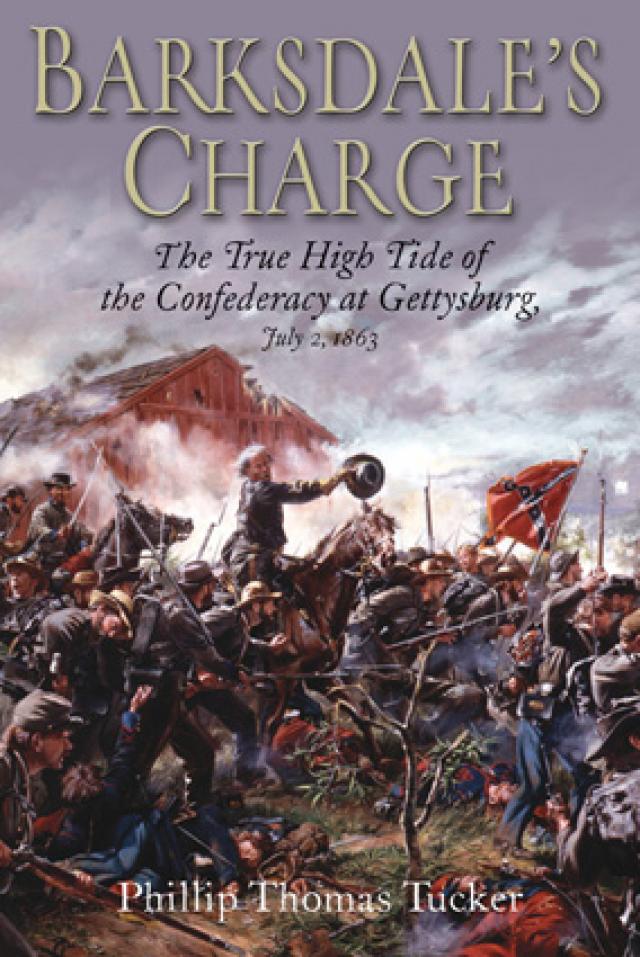
Published in the United States of America and Great Britain in 2013 by
CASEMATE PUBLISHERS
908 Darby Road, Havertown, PA 19083
and
10 Hythe Bridge Street, Oxford, OX1 2EW
Copyright 2013 © Phillip Thomas Tucker
ISBN 978-1-61200-179-1
Digital Edition: ISBN 978-1-61200-180-7
The maps in this book are courtesy of Bradley M. Gottfried from his work
The Maps of Gettysburg, Savas-Beatie Publishers, 2007.
Cataloging-in-publication data is available from the Library of Congress
and the British Library.
All rights reserved. No part of this book may be reproduced or transmitted in
any form or by any means, electronic or mechanical including photocopying,
recording or by any information storage and retrieval system, without
permission from the Publisher in writing.
10 9 8 7 6 5 4 3 2 1
Printed and bound in the United States of America.
For a complete list of Casemate titles please contact:
CASEMATE PUBLISHERS (US)
Telephone (610) 853-9131, Fax (610) 853-9146
E-mail: casemate@casematepublishing.com
CASEMATE PUBLISHERS (UK)
Telephone (01865) 241249, Fax (01865) 794449
E-mail: casemate-uk@casematepublishing.co.uk
Contents
Introduction
1: “We have never been whipped and we never can be!”
2: “To lay my life on the altar of my country”
3: “We are going into Yankey land”
4: “Exceedingly impatient for the order to advance”
5: “The grandest charge ever seen by mortal man!”
6: “We want those guns!”
7: “The guiding spirit of the battle”
8: “On to Cemetery Ridge!”
9: “It seemed as if nothing could live an instant”
10: Death in the Gloaming
11: “Great God! Have we got the universe to whip?”
12: When Glory Was Out of Date
Epilogue
Notes
Bibliography
Index
Introduction
ACCORDING TO CONVENTIONAL wisdom, “Pickett’s Charge” has been long seen as the climax of Gettysburg, the largest and most important battle fought on American soil. But contrary to traditional assumptions, the failure of “Pickett’s Charge,” despite all its tragic majesty and heroic grandeur, was not the decisive event that condemned the Army of Northern Virginia and the Confederacy to an early death. In truth, Gettysburg was decided not on the famous third day of the battle, but on the previous afternoon. Indeed, Thursday, July 2, 1863 was the most important day in the Confederacy’s short lifetime and the most decisive of the three days at Gettysburg. And the defining moment of that Second Day was the repulse of the most successful Confederate attack, which came closer to toppling the Army of the Potomac than any other Rebel offensive effort of the war. It was the charge of General William Barksdale and his 1,600-man Mississippi Brigade on the afternoon of July 2, which one Union observer described as “the grandest charge that was ever made by mortal man.”
Unfortunately, the mythical qualities and romantic dimensions of the most famous assault in American history, “Pickett’s Charge,” has left a far more successful Southern attack—one that swept through and routed much of a veteran Union Corps, captured nearly 20 artillery pieces, and penetrated more than a mile to drive a deep wedge into the Union army’s left-center—in the historical shadows, and often only in obscure footnotes of books about the Battle of Gettysburg. In truth, however, Barksdale’s attack—as the foremost spearhead of Longstreet’s offensive on July 2—came closer to achieving decisive success and winning it all for the Confederacy than any other assault of the battle.
In America’s fabled national Iliad, the relatively slight, ever-so-brief penetration of the Union center by the courageous attackers of GeneralGeorge Edward Pickett’s Virginia Division on July 3 has been long celebrated as the “High Water Mark” of Gettysburg and the Confederacy. But only a relatively few men of a depleted band of attackers ever reached the little copse of trees on the Union right-center along Cemetery Ridge, and once there could only fall to Union fire or be captured. In terms of achieving the greatest gains and coming closer to achieving decisive success, the “High Water Mark” of Gettysburg has long been located in the wrong place.
After the war, United States government historian John Bachelder “officially” established—or rather invented—the “High Water Mark” at the copse of trees along Cemetery Ridge. Influenced by powerful veteran groups from both sides, especially Pickett’s Virginians, Bachelder’s designation became the established “High Water Mark” that has forever commemorated the geographical and military zenith of Confederate fortunes during the four years of war. Therefore, “Pickett’s Charge” has been widely seen as Lee’s best chance to have won the battle, which was not the case. Propelled by the tide of popular history based upon the much embellished Virginia version of the story, generations of historians and popular writers have long celebrated the Rebel zenith on the incorrect day and place.
The true “High Water Mark” of the Battle of Gettysburg took place farther south of the famous clump of trees, near Cemetery Ridge’s southern end on the Union left-center, where Barksdale struck with his brigade. In terms of its overall success, gains reaped, and closeness to achieving a decisive victory, “Pickett’s Charge” was neither the most successful nor most important Confederate attack at Gettysburg. In fact, it never came close to achieving what had been accomplished and gained by the Mississippi Brigade’s sweeping attack the day before.
Unlike when Barksdale’s men smashed through the Union left-center, at a time when it was most vulnerable, General Robert E. Lee’s decision to target the Federal right-center on July 3 was made when it was far too strong—in terms of the number of defenders, both front-line and reserve, excellent elevated defensive terrain, and high-quality Union commanders—to overcome. Quite unlike Barksdale’s Charge on July 2 when the fate of the American nation was decided, “Pickett’s Charge” never really had a chance of succeeding.
Seldom before and afterward would Lee and his Army of Northern Virginia come closer to achieving decisive victory than when Barksdale’s Charge came so tantalizing close to cracking the Union line on the late afternoon of July 2. Under Barksdale’s inspired leadership, the Mississippi Brigade’s success in smashing everything in its path, including the Peach Orchard salient and the Emmitsburg Road defensive line, was remarkable by any measure. A single regiment of Barksdale’s Brigade (the 21st Mississippi) captured more artillery pieces than any regiment on either side at Gettysburg. As never before, Barksdale went for broke in personally leading his brigade’s onslaught in an attempt to win the war in a single afternoon. And he nearly succeeded.
But in one of the great inequities of American history, Barksdale’s Charge has long remained in the shadow of “Pickett’s Charge,” thanks largely to the dominance of the Virginia School of history. The general obscurity of Barksdale’s effort, despite its tactical success, has resulted from the sheer power of myth, traditionalism, and romance in both popular and academic history. As fate would have it, the Mississippians’ attack was never promoted, embellished, or celebrated by generations of historians after the Civil War. Southern writers favored the gallant effort of the Virginians, while Northern writers preferred to celebrate their clear triumph over Pickett’s men rather than the moment when their line was barely hanging by a thread, and elements of four corps were forced to converge to stop the onslaught of Barksdale’s Mississippians.
Pro-Virginia propagandists early rewrote the dramatic story of Gettysburg’s Third Day to conform to a chivalric and heroic tale dominated by layers of Victorian Era values and romance. They succeeded in transforming the folly of “Pickett’s Charge” into the most romanticized saga of the Civil War. The aggressive advocates and prolific writers of the Virginia School, which glorified Virginian leaders, troops, and accomplishments, decisively influenced generations of latter-day historians, popular writers (ironically including Mississippi’s own William Faulkner), documentaries, and films for generations to come. Unlike Pickett, whose enduring romantic image was largely the product of the writings of his well-connected Virginia wife, the Deep South general, William Barksdale, who led the far more successful charge at Gettysburg, was forgotten.
Unlike Barksdale, who fell to rise on more on July 2, Pickett ideally fit the overwrought image of a romantic Virginia cavalier in the popular imagination. In the historical memory, the enduring image of the West Point-trained Pickett cast a giant shadow over the more homespun, less attractive Barksdale, an outspoken Mississippi politician, newspaper editor, and self-made leader. Barksdale’s death on the field likewise contributed to the obscurity of his attack, so that the authentic “High Tide” at Gettysburg has been generally overlooked.
Unlike the soldiers of Pickett’s Virginia Division, which was not a battle-hardened command, Barksdale’s veterans possessed an early and well-deserved reputation for repeatedly achieving the impossible during some of the war’s most important battles. In fact, reaping dramatic battlefield gains was the hallmark of Barksdale’s rough-hewn brigade of combat troops by the time of the battle of Gettysburg. In key roles the Mississippi Brigade had repeatedly fought against great odds in vital battlefield situat
While Pickett was neither in command of the overall July 3 assault (only his Virginia Division) nor led the charge all the way to Cemetery Ridge, and his men were not the majority of attackers, Barksdale personally led Lee’s most successful attack in terms of coming closer to achieving a decisive victory at Gettysburg. Ironically, the widely celebrated twin dramas of “Pickett’s Charge” (primarily a romanticized product of the Nineteenth Century) and the battle’s most famous small-unit action, when the 20th Maine garnered recognition in the struggle for Little Round Top (primarily an equally romanticized product of the Twentieth Century) have together obscured the real “High Water Mark” of Gettysburg.”
Compared to Pickett’s men, Mississippi’s veterans, mostly illiterate farm boys from a remote frontier-like region located far from leading eastern centers of population and influence, possessed little clout, political connections, and literary machinery to garner recognition for their supreme effort at Gettysburg. Therefore, despite the importance of Barksdale’s steamrolling attack in nearly winning it all, this remarkable story of the most successful offensive effort at Gettysburg has been a forgotten chapter of history.
Most of all, the Mississippi Brigade’s unsurpassed success on July 2 marked the true zenith of the Confederate offensive effort during the three days of Gettysburg. The closest that the Army of Northern Virginia ever came in its long storied history to reaping a truly decisive success in vanquishing the Army of the Potomac was when Barksdale’s assault overran nearly twenty field pieces and demolished one brigade after another, while gaining hundreds of yards during the relentless push to gain Cemetery Ridge’s strategic crest at any cost.
In an attempt to finally set the historical record straight and to overturn a host of longstanding assumptions and myths about Gettysburg, this is the first time that the full story of the most successful Confederate offensive effort at Gettysburg has been told to reveal just how close Barksdale’s crack Mississippi Brigade nearly came to winning the most decisive success of the Civil War. Clearly, Barksdale and his Mississippi soldiers saw their finest hour on Thursday July 2, rising to the supreme challenge by almost winning the war in a single afternoon.
But more important, Barksdale’s Charge should be remembered today as one of the most dramatic and memorable chapters of not only the battle of Gettysburg but also the Civil War. Few examples in the annals of American military history have more thoroughly revealed the courage, fighting prowess, and heroics of the American fighting man than the unforgettable story of Barksdale’s Charge. When the shattered remains of the Mississippi Brigade, after having lost half its strength, retired along the bloody path they had made and fell back in the fading light of July 2, Barksdale’s repulse also marked the Confederacy’s sunset: the South was now on the road to extinction and there was no detour or exit.
For the millions of people from around the world who have toured Gettysburg’s hallowed ground each year to marvel at the majesty of the stately Virginia Monument, where the Old Dominion men of “Pickett’s Charge” began their lengthy march from Seminary Ridge, over the open fields toward the famous copse of trees on Cemetery Ridge, where the doomed attack finally ended in its inevitable bloody climax, has long drawn the greatest gatherings of any spot on the Gettysburg battlefield. In a classic irony and in striking contrast, relatively few visitors of Gettysburg today are even aware of Barksdale’s Charge or how the Mississippians’ sweeping attack of more than a mile actually came closer to achieving victory. Consequently, almost all visitors to the pastoral fields and seemingly haunted hills of the battlefield drive by the forgotten but true “High Water Mark” of the Confederacy, oblivious to its importance.
Therefore, it is now time to take a fresh new look at the truths, myths, and realities of the battle of Gettysburg and its relatively forgotten culminating moment, beyond the romantic stereotypes and unchallenged conventional wisdom that that have flourished for the last 150 years. It is now time to tell the story of the true Confederate High Tide, Barksdale’s Charge, when the fate of the American nation was decided.
Dr. Phillip Thomas Tucker
Washington, D.C.
May 23, 2013
“We have never been whipped and we never can be!"
DURING THE THIRTEEN months after General Robert E. Lee took command on the first day of June 1862, the Army of Northern Virginia compiled a record of battlefield successes second to none in the annals of American military history. The names of victories at the Seven Days, Cedar Mountain, Second Manassas, Fredericksburg, and Chancellorsville now adorned Southern battle-flags. This is even as it can plausibly be said that Antietam (Sharpsburg), where the army fought a Federal force twice its size to a standstill, might have been the Rebels’ most impressive fight.By the summer of 1863, the Army of Northern Virginia, characterized by its “very democratic equality,” in one Georgia soldier’s words, represented the aspirations of not only its seemingly invincible commander and the fighting men in the ranks but also the infant Southern nation.1
These Confederate successes stemmed from Lee’s aggressive and skillful employment of the army’s most highly efficient combat unit: the brigade. The best of these tactically flexible, hard-hitting brigades possessed the capability to function independently to achieve victory on their own on the battlefield. And one of the foremost of these crack units by the time of the Gettysburg campaign was General William Barksdale’s Mississippi Brigade, which was composed of some of Lee’s hardest fighting veterans.
Earning a well-deserved reputation for hard-hitting offensive capabilities since the war’s early days, the 13th, 17th, 18th, and 21st Mississippi Infantry Regiments of Barksdale’s Brigade played prominent roles in each of their battles. Most Magnolia State soldiers had received their baptismal fire at First Bull Run on July 21, 1861, contributing to that rout of Union forces. Then, barely three months later, at Ball’s Bluff, the Mississippi Rebels reaped a one-sided success with a fierce bayonet charge that annihilated a sizeable task force under a close friend of President Abraham Lincoln, Colonel Edward D. Baker, who had made the fatal mistake of crossing the Potomac from Maryland to Virginia on a bloody October 21, 1861.
Lincoln had named his son, Edward Baker Lincoln, in his friend’shonor. Having introduced president-elect Lincoln during his inaugural address, the handsome, gentlemanly Baker, a U.S. Senator from Oregon, whose political ambitions and flowery quotations of classical poetry were limitless, led his men recklessly into a Confederate trap. He was killed when a Mississippi bullet tore through his brain, just before the Rebels’bayonet charge literally drove the Yankees off the 100-foot-high river bluff and into the Potomac. Private Ezekiel Armstrong, 17th Mississippi, penned in his diary how the Mississippians “whipped five times our number in a fair fight.”
With early successes like these, Barksdale’s Mississippi Brigade early became the pride of the Magnolia State and well known across the Confederacy. Lee consistently relied upon the brigade as one of his shock units that could be depended upon in a crisis situation. One aristocratic officer of the Richmond Howitzers, Lieutenant Robert Stiles, emphasized that “Barksdale … was my general, commanding the infantry brigade I knew and loved best of all in Lee’s army.”2
Presenting insight into those key qualities that made them elite fighting men, Lieutenant Stiles explained how his artillerymen from the Confederacy’s capital “were closely associated with these sturdy fellows and became strongly attached to them. This Mississippi brigade was, in many respects, the finest body of men I ever saw. They were almost giants in size and power. In the color company of the 17th Regiment, when we first met them, there were thirty-five men more than six feet one inch high [when the average height of a Civil War soldier was around five foot, five inches ], and in the 21st there was one man six feet seven inches in height, and superbly formed, except that his shoulders were a trifle too square and too broad in proportion. They were healthy and hardy, even ruddy, which was surprising, coming as they did from a region generally regarded as full of malarial poison. They were bear hunters from the swamps and canebrakes and, naturally enough, almost without exception fine shots … as a body, they were very young men and brimful of irrepressible enthusiasm, equally for play and for fight. The laugh, the song, the yell of the rebel charge burst indifferently from their lips; but in any and every case the volume of sound was tremendous…. At times they seemed about as rough as the bears they had hunted, yet they were withal simple -minded and tender-hearted boys … how could I help loving these simple, brave, great-hearted fellows?"3


