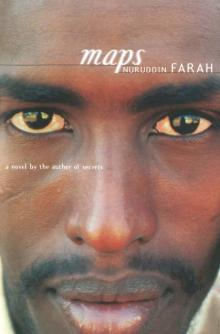
Secrets: a Novel, page 33


“But where are the lice?” he asked. “Could they be the cause of your itch?” He looked terribly pleased with himself.
I changed the subject. “Won’t you offer us a drink?”
The kitchen became too small for him as he moved about, opening the fridge, emptying the cupboards of half their contents, and putting all manner of labeled and unlabeled bottles on the table right in front of me. “What would you like?”
“I am in the mood to celebrate,” I said.
“That’s wonderful,” he said. His hand reached for a bottle of Italian wine, which must have cost him a great deal if he bought it in Mogadiscio, where alcohol is inordinately expensive. He took Talaado’s hand in his free one and he kissed it.
“Why don’t you ask what I am celebrating?”
I watched him look for a corkscrew.
Things were building to a thunderhead which I felt would explode sooner or later. I could sense that. However, I was decided not to let him determine when the storm might break and over whose head.
“Only in spirit am I pleased to join you in celebrating whatever it is that you are celebrating,” he said, “and I won’t begrudge you a bottle of Italian wine, which I should’ve offered to you on the day you first insinuated yourself into my apartment and my affairs.”
I looked in Talaado’s direction, unsure if she would join us, wondering if she drank wine or did not touch liquor at all. But I must say I was surprised to hear him say, “I’m afraid I am not having any wine, though.”
“You are a bore!” I said.
“I’m planning to have an early night,” he explained, “and red wine tends to afflict me with a hangover and a grogginess the following morning.”
“Why, what’s happening early tomorrow?”
“Maybe you’ve forgotten,” he said, “that Timir is getting married tomorrow morning?” Kalaman is such a sweet guy, he wouldn’t rub more salt in the wound he had helped to open.
“I had no idea he had found a woman,” I said.
“The things you forget!” said Talaado sarcastically.
“I haven’t forgotten, for instance,” I said, “that this young man’s parents have never married, and that he is not Yaqut’s biological son.” No dice, no eyes rolling either!
He was in terrible humor. “What’re you celebrating?”
I was getting a bad deal out of my exchanges with him.
I said, “I’ve just come back from Nonno’s.”
“How was he?”
“We’ve enjoyed ourselves,” I said.
He beamed a smile of complacency. “The trouble with Nonno,” he said, “is that everyone enjoys themselves when they are with him, rain or sunshine. I am glad he entertained you.”
Here I reminded myself to play this particular trump card by the secret code as established of old and in the tradition of Nonno’s family. In other words, I wouldn’t divulge the secret to be cherished or suffered in private, even if we talked of other things that may or may not be pertinent to the topic at hand.
“We had a great time, Nonno and I,” I said.
He looked surprised. “You did?”
“We did so until some impediment or other began to impose a blind man’s burden on his vision,” I said. “I would describe the impediments as untoward inconveniences. It’s terrible to be ancient and blind too.”
Then I dripped most savagely.
A worrying thought, meanwhile, stalked Kalaman’s partly shadowed features. I suspect he understood what I was talking about, for he was up on his feet and ready to go to Afgoi right away.
“He was handsome too, and heavy below.” I spoke these taunts with a view to further torturing him and to making him realize that I had had my way with Nonno, that I had made love to him when he, Kalaman, wouldn’t acquiesce to my request to give me a baby.
Clearly overwhelmed with worries, Kalaman sat down in the very chair his mother had sat in when her knees had gone suddenly weak. He put me in mind of his mother, his body inclined to one side, like a lean-to with which a recent storm has tampered. He was charmingly frightened. Then he got up so abruptly that he upset the table at which we sat, the bottle of wine tilting forward. But I caught it in time.
“Kalaman?” Talaado said, getting involved.
“Yes?”
“You’ve forgotten to mention the rumor about Timir,” she said, looking from him to me, mischievous, like a little girl refusing to part with a girlish secret.
“What about him?” I asked anxiously.
“A man whose description matches Timir’s,” Kalaman said, “has been blown up sky-high as he drove his rental car. The rumor is that he is dead.”
I sat silently for a short while, and then spoke bitterly about my half brother. “Why does he have to die today? Why couldn’t he wait until I am gone?”
“I wish you never came,” Kalaman stammered at last and lurched clumsily forward as though he might strike me in the face. He was out of the kitchen, perhaps hoping that he was out of my life forever. Talaado followed him as a foolish woman in love follows the man she loves.
“I may not be here when you get back,” I told them. “I am leaving first thing tomorrow morning, remember. Thanks for having me, and thank Nonno for me too.”
Kalaman was back in the kitchen doorway. He spaced his words in an effort not to stutter. “Perhaps you could tell me something.”
“What?” I said, eager to let them know I had it off with the old fart.
I was shocked to hear Kalaman say, “How did you get into my apartment the first day, without a key, and with no one letting you in?”
“You are a bore!” I said.
He and Talaado left without saying good-bye.
I itched. I was alone.
Epilogue
Dressed in a loose silk robe, Nonno is facing Mecca.
He is praying, the first time I’ve ever seen him perform this most important of Islamic rituals. The room is awash with blazing light, as though Nonno means to prove himself worthy of the devotions passing through his lips, in suspirious communication with the Supreme. As he prays, his gesticulations are expansive, his execution of the praying ritual putting me in mind of a blind man reacquainting himself with his surroundings, given his new condition. Standing just outside the door, and seeing without being seen, I am a fly on the wall. I watch him with earthy fascination.
As I take in the significance of what is happening, I recall Nonno saying not long ago that it is in the nature of knots to come undone, and in the nature of buried things to be dug up by Time. Are we to deduce from these dicta that it is in the nature of humans to countenance humility in worshipful self-expression in moments of personal and national crisis, when we are on the verge of death, our nation is on the precipice of collapse, the country in turmoil, and the entire continent being taken to a land of virtual ruin, a land without memories? Do we prostrate ourselves before our Creator in a tardy expectation of being pardoned, saved, our lives put right, when for years we have spoken in the periphrastics of self-delusion, speaking of family allegiances while advancing our personal interests?
The awesomeness of lighting on Nonno in his valedictory cast of mind so overwhelms me that I feel terribly unbalanced. I am tempted to join him. But I hesitate, replaying Sholoongo’s demonic voice in my memory I ask myself if the thought of seeing him in worshipful gesture upset her impish character. I may never find out what did happen between the two of them, given Nonno’s penchant for privacy and Sholoongo’s predilection for trafficking in falsehoods and scandals.
Waiting for him to absolve himself of all the sins of all his years, I step outside into the night. I listen to the night as it speaks to itself in the multiplicity of nature’s tongues: trees dancing in the lush splendor of their greenness; mammals howling in the language in which mammals mate; the river doing what it is best at, going where the tide is taking it; the moon watching its reflection in the placidity of the water. I decide on the basis of what I see, what I hear, and what I sense that all is well with Nonno, and there is no cause for worry.
I pick my name off the nocturnal wind, clear as a camel bell. Nonno is calling out my name. I gargle my response. I wonder if something is after all the matter with him. The timbre of his voice worries me. It is dry. It cracks like wood in the jaws of fire. His voice, I remark to myself, has lost its woodpecker quality. Reentering, I find him waiting for me. He is standing erect, not praying. In fact his prayer mat is leaning against the wall.
He moves toward me with the quietness of an electric float. Only there is something not right with the way he carries himself, a little to the side, like a float that can’t sit upright. We hug. As we do so, I look more closely: his eyes are bothering him. He strikes me as having at best a peripheral vision. I deduce this from the way he inclines his whole body in the posture of someone suffering from a stiff neck. I am convinced of this, but I continue to pay attention to him. Yes, it is the angle at which he holds his head. It is as though he wishes not to keep shifting if he wants me to be in his view.
Letting go of him, I walk away. We sit down.
The room, now that it has been prayed in, feels different. It takes me a bit of time to work out why. The furniture has been shifted so as to accommodate Nonno’s worshipful disposition. I also remark how he now stands apart from the furniture around him, as the unsighted tend to do, giving room in order for them to be rewarded with larger space. He is alone in his isolation, prominent in his physicalness. I have always known Nonno to be physically outgoing when in his withdrawn state of mind. Today he is no extrovert.
“Come,” I say. I lead him to the farthest corner, where his bed is. He pushes away my hand the moment his knee comes into contact with the frame of the bed. I discern in his movements a secret mindfulness of the partially sighted, his mouth making munching sounds of nervous chewing, like a baby’s. His clumsiness dispossesses him of his rosary. I retrieve it for him. I tell him that I’ve had pleasant talks with my parents. I tell him not to worry. All is well.
He asks, “Have you seen Sholoongo?
“Yes,” I say.
Nonno nods his head, then he says “Bless the day!” I think that is a new one. He is not in his “Curse the day” mood. After all, he prays nowadays, and means not to offend the sensibilities of the Scribes, two angels, one on either side of a person, who are assigned the job of noting down the activities of every individual. Bless the day, indeed!
“Has anything happened?” I ask.
“My eyes have happened!” he says.
I pull up a chair, placing myself within reach of his bed. He talks. I listen. His voice, however, hasn’t a bounce in it, more like a plank of wood that has been in the rain all day. There is no resonance to it, only thuds flat. His stare is as soft as sawdust. It is as if Berbera, the Somali coastal city of his birth, has somehow insinuated itself into him, causing the natural flair of the southern lilt, which he has picked up, to vanish in a vaporous denial. His speech pattern has slowed down very significantly. The press of my inner anxiety prevents me from asking questions or demanding explanations. His face is swollen, his breathing is arrhythmic. The veins on the back of his hand stand out, wiggly. They are as prominent as the sweat beads of a runner in a marathon competition.
He says, “I hurt badly in the eyes.”
I take his large right hand in mine. I touch pain in his farmer’s calluses, which dominate the fleshy boundaries of his once soft palm. Examining them closely, I conclude that there are no squiggly mysteries of what you might call life-, heart-, and head-lines. Nor are there divine digitals totaling ninety-nine, Allah’s honorific designations.
“You’ll be all right,” I assure him.
“Bless the day,” he says, “for I am no child.”
“Of course not.”
He whispers secrets to the Almighty, showering blessings on the day, his thumb busy going up and down, pausing as it counts the rosary on the joints of the forefinger. He looks, shades spread across his cheeks horizontally, stepladders leading him, nowadays a praying man, upwards, toward the heavens of a recent self-appraisal. “I conduct well,” he says, “in case you have forgotten.”
In my memory of how he conducts well, I remember my father telling me about Nonno’s late wife, who nagged him that he had better not keep altering his name. How, at any rate, he had better not answer to his nickname Ma-tukade, a descriptive provocation meaning the one who does not say his prayers. She wondered, what if the angels, Munkar and Nakir, who sit in wait for the recently departed in the darkness of the tomb with a list of questions, what if they asked him what his name was, and what if he replied, Ma-tukade? Or worse still, what if they inquired as to why he was nicknamed Ma-tukade? What would his response be? Tongue in cheek, Nonno retorted that he would tell the good angels that he had been grounded against his will.
“How come you conduct well?” I ask.
“My deeds are wrapped in thunder and lightning,” he says, sounding like his usual self, not the cowed, cautious, do-not-sin-at-any-cost born-again Muslim fundamentalists. “All my life,” he goes on, “I have made sure that my deeds are charged with the extraordinary static of secrecy, in celebratory deference to higher powers.”
I call on another memory, one in which Nonno speaks of feeling almost ungrounded! This was in reference to when he spent half a year in a National Security detention center where he was tortured. He wouldn’t break, despite the heavy-handed treatment administered to him in the presence of high officials. (A rumor attributed to Arbaco had it that Nonno was hauled in because he had won a manhood competition between himself and a highly placed official in the National Security Service. Nonno had won it “penis flaccid,” as Arbaco put it.) Released, the old man was asked to explain why the electric shock treatment did not break his will whereas it broke the will of all the others. Nonno retorted that he had withstood the Security’s methods because he was grounded.
“Sooner or later I won’t be all right,” he says.
It is curious how off-course our exchanges are starting to sound to me. I think: if his eyes are the center of his hurt, why, that can be dealt with! But what precisely is he suffering from, an identity crisis, considering that he has mislaid the only ID card issued to him in his name?
He gathers his robe of silk around himself. He gets to his feet, slowly and painstakingly. Looming large, he leans a little to the side, tower of Pisan proclivity. He looks away from me in a very abrupt manner. I think, have I offended him? Or is he responding to an edict with a source which he cannot locate, a source within himself, or without, a edict which boasts a diabolical association with Sholoongo, or one blessed with a divine backing? Walking away, he sways like a washing-line blowing in the breeze. He takes a step forward, then another, every step more of an effort than the one preceding it. I ask if I can help. He says no. I get up and reach for him in spite of what he has said, and in spite of myself. This time he doesn’t tell me to let go of him. I hold him in my grasp in much the same manner you hold a child full of play, to restrain him.
“I hate the idea of pain,” he says.
I remain silent with a demure air of empathy.
“I hate the hurt in the eyes,” he says. “Bless the day!”
He moves away with the exhausted slowness of a man wading through a swamp. He lifts his feet off the ground one at a time, then puts them down as though he might not be able to pick them up again. I go with him to the lavatory. As he prepares his body effortfully to sit, he pushes my hand away, demanding that I let go of him. I oblige. He pushes me away. I wonder if I should stick around. He insists that I leave him alone in the toilet. I do so, leaving the door ajar, just in case. I go back to the sitting room, waiting for a sign or a sound from him. He is back with me in ten minutes. He prays for long. He says his devotions. He takes a break from his praying, and we talk some more.
“My eyes happened! May Allah bless the day,” he says.
“Your eyes happened? How?”
“Because of a piece of ruled white paper, yellow with old age, a paper which had, fringing it, humidity stains curling its corners. I had preserved it for sixty-odd years, not knowing what value it might have one day. I had it with me when I fled southwards, to come here. At first it felt bone dry. I opened it with tremendous care, not wishing to break it into triangular pieces. And there I was remembering the sequences of the letters I had copied down so very many, many years ago. There I was breaking a vow. There I was hearing my Koranic instructor’s edict in my memory, hearing his curse, ‘May the memory of your felony lodge in your partial blindness!’”
“What had you done to earn the curse?”
“My instructor believed that I had tampered with magical scrawls when I worked with them,” he said, “but I don’t recall much of what he had accused me of!” He fell silent, obviously dejected.
“Did you tamper with a magical text?” I asked.
He disregarded my question. “I can’t recall much. Except there was suddenly an explosion inside my head, fragments of blazing brightness after a detonation. Then in a moment or so, total darkness. More like a bulb that bursts, with wires sticking out any which way. Or like the darkness coming after a searchlight has been turned off. And then . . . !”
We touch. I commiserate with him.
“I was sure,” he says, “I saw a hand in the corner of the good side of my vision, as it moved away after it had switched off a light inside my head. Then came a susurration of termites in their march toward destruction. This was replaced by a din of noises, a drone of bees. On the heel of the drone came a piercing pain emanating from somewhere in my brain. It was as though a vein in my brain had snapped, there had been a hemorrhage, a pain that, within a matter of seconds, penetrated to all the nerves leading to and from my eye sockets. A tunnel of darkness drilled through my head. This affected my sight in a decisive way before another, final earth-shattering explosion of brightness occurred. All was light, the cosmos analogous with light. Then total darkness. I woke up finally to several realities at once. I had more or less lost my sight, in the precise manner in which my Koranic instructor had predicted it would happen. My eyes! What a malediction!”