The Seaside Corpse, page 7
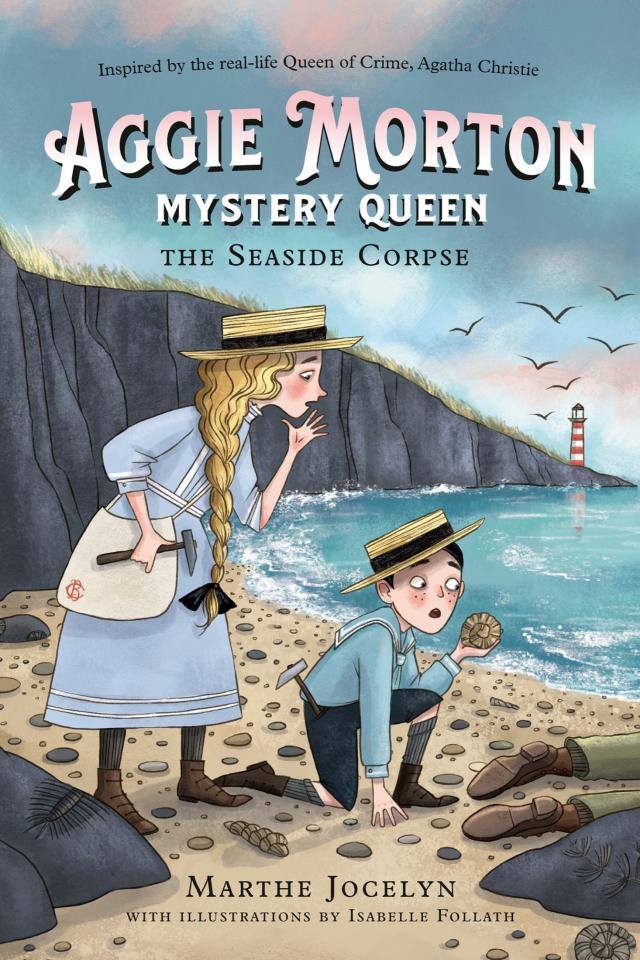


“Low tide is before nine today,” said Helen. “I expect Everett will have you lot down there early for your fossil-hunting expedition.”
Spud poked his head out to peer around, and then again two minutes later. Was he on watch for the professor?
“Is Mr. B-C so afraid of your father that he’s skipping breakfast?” I whispered to Helen.
“Dad’s been practicing how he’ll say he’s sorry,” she whispered back. “But I expect Mister is sleeping late, if he…well, if whiskey were involved.”
I saw Everett raise his eyebrows at Nina as she waited for the tea to steep. She gave her head the faintest shake. The missing husband had not arrived home in the middle of the night. Mr. Jarvis and Mr. Volkov, at the small side table, seemed to be having a competition to see who could eat a bigger bowl of oatmeal and how quickly.
“I’m going out to the site,” Nina told them. “I’ll come to see how you’re getting on with the Izzy-barrow when I get back. We’ll need to test it with as much weight as we can load on.”
“Aye, Missus,” they said, and kept eating.
Miss Spinns arrived, with a fistful of envelopes. “Post for the professor,” she said.
“I’ll look at letters later this morning,” said Nina. “Howard will have other things on his mind.” She gave us all a wave and set out toward the waiting ichthyosaur. Miss Spinns poured tea for herself, holding her mug as carefully as if it were a baby chick. But then she abruptly dropped a letter on the table beside my plate.
“From Grannie Jane!” I tore it open and read. “She arrives on Friday, as planned,” I told Hector. “That’s tomorrow already! She reminds us that we’re to spend the night with her at the Royal Lion.”
Hector beamed. “A pillow! Perhaps even a bath!”
Oscar appeared, with just enough time to snatch up a piece of toast before Helen cleared the table.
“Well, team?” Everett carried his dishes to the bin. “The seashore awaits, but the tide does not. Let’s head down, shall we?” The clouds were puffy white meringues in a pale blue sky. It was warm and breezy, but the sea—on its way to low tide—was calm.
Hector’s shirt was nearly the color of the sky, and my dress two shades paler, a faded delphinium. We both wore sturdy boots and wide-brimmed hats, and carried collecting sacks. Everett and the other boys, behind us, stopped at every rock pool. Oscar was on the lookout for crabs. Arthur was delighted to have a new—if uninterested—listener for his vast store of information about limpets and sea urchins. The flat slabs of limestone forming the seabed along this part of the shoreline, Arthur said, were called Broad Ledge. Way out, Nina circled and poked her ichthyosaur.
And I was finally alone with Hector.
But Hector was itchy. He’d been bitten by a mosquito exactly where his collar met his neck, and the chafing was unbearable. His new boots were causing blisters on the outside edges of his baby toes. Arthur had dreamt very noisily last night, but not so noisily as to drown out the relentless peeping of an inconsiderate insect. The one mouthful he had tasted of this morning’s porridge still sat like a stone halfway down his—
“Excuse me for interrupting,” I said. “My dearest Hector. I have devised a new rule. For your own good, really. You may name five things each day—but only five things—to express your unhappiness with out-of-doors living. This way, I will know what worries you most, as you will be forced to choose among the dozens, and you will not feel ignored. Is that agreed?”
My edict was met with a silence so extended that I stood still and put hands to hips like a stern nanny. He finally allowed his eyes to meet mine.
“I am abashed,” he said. “I agree to your new rule. Let us find something more compelling to discuss than my woes.”
“We’ll keep our eyes wide open,” I said, “for surprises.”
It was rough walking over black, knobby rocks and chunks of shale on the beach. We didn’t know quite what to look for, but we didn’t quite care.
“Surely there are enough lumps and bumps on tables in the work tent to keep a person occupied for weeks, and that doesn’t include Izzy,” I said. “Need we collect more? Though I suppose it is nice to find one’s own.”
Some yards farther on, I said, “Hullo, what’s that?” A shape like a collapsed tent lay on the pebbles, a large waterlogged brown thing. “Is it a fish? It doesn’t look like a…Or…goodness…could it be—?”
Hector sucked in his breath. The sound confirmed my guess. Not a fish, nor a shark, nor a dolphin.
A body was stretched out upon the ground ahead. The form became more defined—and more human—with every step we took. Skittering over slippery stones and swaths of kelp, we came close enough to see a person lying facedown and apparently drowned, one arm above the head—his head, for he was wearing trousers.
“Is it—?” said Hector.
“I think it is.”
How awfully, gruesomely dreadful. His putty-colored safari clothes were drenched and dark. His hat was missing, and a circle of balding scalp gleamed on the back of his head.
Professor Howard Blenningham-Crewe.
He was on his belly with his face turned to one side, puffy and bruised. The eye we could see was more like a jellyfish resting in the socket. Sand and strands of seaweed matted the thinning hair, as if the professor wore a crown. I’d not ever seen a drowned person, despite living for all my twelve years near the sea. I had not known quite how a body might expand like a sponge, taking in water and changing its shape.
Everett and the other boys were still beyond shouting distance. They’d stopped by a rock pool, where Oscar poked at something with a stick. Way out on the ledges, where the sea would be when the tide came in, Nina was hunched low next to her big find. But what Hector and I had found—this still and sodden man—seemed even bigger. How many more minutes before she knew? How many steps across shale and seaweed? How to measure the distance between not knowing and knowing? The distance between the moments before you learn something and a lifetime of not being able to forget?
There was no mistaking that he was dead. No head that held a living brain could look so battered. Hector knew what to do when faced with a corpse. A point of honor. He knelt and touched his fingers to Mr. B-C’s neck, beneath the soggy collar.
“No pulse,” he said.
I laid a palm on the shoulder of Mr. B-C’s shirt, where the sun had dried the cloth to its normal beige color. “His shirt is warm,” I said.
“His skin is not,” said Hector. “Does he get trapped by the tide? Lose his footing? Bump his head? And then the sea, it catches him?”
I waved at Everett, a please-come-quickly sort of a wave. He waved back, not understanding. Arthur tossed away the stone he’d held and started toward us. Everett summoned the lagging Oscar and followed along.
“Do you suppose”—I’d best say it while we still had privacy—“that this is something other than what it looks like?”
“What do you think it looks like?” said Hector.
“It looks as if he stumbled, trying to outrun the tide,” I said. “Exactly what Everett warned us against doing.”
“But…” Hector looked around. “Why is he on the beach, far from one of the paths to the top?”
“Do you suppose,” I whispered, “that we’ll be so lucky as to have another murder?”
“Hallo!” called Arthur.
Hector stepped in front of the body. Was he protecting Arthur from the sight for one more minute?
“What have you got?” Arthur took antelope leaps and arrived in a skid of pebbles. “Oh, horrible,” he said, making sense of what lay at our feet. He rubbed his own arms, perhaps suddenly chilled. “Everett! Hurry!” he called out. “It’s the professor!” Then, in a whisper, “He’s dead, isn’t he?”
“Yes,” said Hector.
Everett arrived. He knelt at once beside the body to check the pulse, as Hector had.
“Is he dead?” cried Oscar. “Oh my God, he’s dead! It’s, it’s, he’s…oh, that’s awful!” He backed away, tripped over a rock and caught himself before falling. “What’s he doing here?” He glanced at the face of the cliff towering above us on one side of the beach, and at the draining sea on the other. “It can’t be! It can’t!”
Everett took charge. “You’ll be quickest, Arthur. You know the way.” He glanced toward the steep, narrow path that led up from the beach to the church, high on the cliff. “Can you run to the village for a doctor?”
“Do you mean the police?” said Arthur. “My cousin Ronnie is a constable.”
“I suppose the police would be more useful,” said Everett. He stared out across the ledges. “Oh, poor Nina!”
“Shall I go now?” said Arthur.
“At once,” said Everett. “There is the matter of the tide. He must be moved before it comes back in.” Arthur beetled away over the stones to fetch the police.
“I’ll help Arthur,” said Oscar, licking dry lips. “I don’t like being here.”
“Right. Off you go, then,” said Everett.
Arthur’s long legs had already taken him far beyond catching. Oscar started after him, but then paused beside a boulder, leaned over and was sick.
“Poor chap,” said Everett. We pretended not to watch as Oscar wiped his mouth with a shirttail and glanced our way. Instead of pursuing Arthur, he abruptly turned and headed to the other end of the beach and the path that led up to Camp Crewe.
Everett took in a deep breath. “I must go and tell Nina.”
“We’ll stay with him,” I said. “Won’t we, Hector?”
“Certainement,” said Hector. “Many times we meet the dead bodies.”
“Three times,” I said, “to be exact.”
“That’s three more than I’ve met,” said Everett.
We assured him that we would keep company with the corpse.
“James would be horrified,” said Everett, “that I’m leaving you with a—”
“James will understand,” I said. Everett bowed his head in thanks and began the walk toward his unwelcome task. He cut across the wet, uneven seabed at an angle, hopping over the cracks between the ledges, skirting the rock pools. Nina stood still as he approached. After many minutes, he reached her and put his hands on her shoulders. He leaned in so close that the brims of their hats bumped, dislodging hers. Everett leapt to catch it and put it back on her head. He then must have delivered the news, for they both turned to where he was pointing, the deathbed that we guarded.
Nina’s small figure swayed, and Everett’s arm held her up. They were, for a moment, one bulky form as the new widow leaned briefly against her friend.
Hector and I were quiet for a long while, contemplating Mr. B-C. It would not be such a dreadful place to die, I thought, with clouds blowing over and the distant tumble of waves. If we humans really had souls, was his fluttering nearby, like one of the curious seagulls hovering above our heads? Or was that soul on its way to an afterlife? Perhaps the gulls were only waiting for us to straighten our strange bundled blanket and bring out a picnic.
“Madame Nina, she is coming now,” said Hector.
“Very slowly,” I said. Everett was still holding her arm, pausing as she occasionally stumbled. “Not so sure-footed as usual.”
A shout behind us, and here was Arthur bounding along the beach. He’d summoned help in good time! Three policemen followed, not so agile as Arthur, who arrived in another spray of pebbles.
“The taller one, that’s my cousin Ronnie. Police Constable Guff.”
Clearly the lowest-ranking man among them, P.C. Guff swung a large pack down from his back with a grateful grunt. The doctor was delivering Mrs. Brewster’s baby, Arthur explained, but the coroner was coming shortly. “The body being dead and all.”
A sergeant was apparently the most senior officer that Lyme Regis had to offer. This one was tall and very handsome, even I could see that. Two eyes, a nose and a mouth, as most men possessed, but mysteriously arranged in a way that made him look like a historic portrait or an actor in the theater. The serious eyes were brown, the fine nose straight, the mouth barely visible.
“What a splendid mustache,” murmured Hector. In this case, accompanied by broad shoulders and shiny boots.
“I am Sergeant Harley. These are my constables, Sackett and Guff.”
“P.C. Guff is my cousin,” said Arthur, “on account of being married to my cousin Bess.”
“You’ve mentioned that,” said Sergeant Harley. “Thank you.”
P.C. Guff began to assemble a stretcher from parts he drew out of the pack. P.C. Sackett leaned over for a closer look at the corpse, and then glanced out at the water.
“The waves must’ve rolled him a few times,” he said. “He might be landed here, but he went in near Church Cliff, I reckon. The drift brung him along this far.”
“Sackett likes to fish on his day off,” said Sergeant Harley. “Thinks he knows everything about the sea. Are you children alone here?”
We pointed to Everett and Nina, who now were nearly to the beach.
“Your parents?” asked the sergeant. Perhaps he needed spectacles. Everett was the age of a brother, and Nina not much older than that.
“No, no,” said Hector. “Madame is the wife of the…” He looked down at the corpse.
Sergeant Harley heard only that we were attending a dead body without our parents present.
“You’d best step away,” he said. “This is no place for young eyes. Constable Guff, take them elsewhere.”
“Taking is not necessary,” said Hector. “We will go. We wish to assure the widow of our—”
“Can’t we watch for a bit?” said Arthur.
“Guff.” The sergeant’s voice said plenty more than one word. Remove the boy with the eager smile. We’ve got a corpse here and the fellow’s wife is a mere minute away. “Guff, take your cousin and have your wife wrap some sandwiches. And if you see Mr. Pallid, tell him to hurry!” Arthur and P.C. Guff obediently headed off, up the path to town. The body must urgently be examined and then moved to make way for the tide. Hector and I reluctantly backed up two steps.
“Who found the body?” the sergeant thought to ask.
“We did.” Hector and I pointed at each other.
Sergeant Harley’s brown eyes crinkled ever so slightly at the edges. “Pretty plucky, eh?”
We nodded.
“I’ll want to speak with you later. But, later. You see?” He nodded toward Nina, who had wrenched herself from Everett’s protective arm and now ran clumsily over the stones toward us.
Hector clasped my arm and we hurried along the beach, heading to the cliffs beneath St. Michael’s church, instead of in the direction of camp—or anywhere near Nina.
“By going this way,” said Hector, “we must again pass the body on our return.”
“Clever!”
We stomped along for a few yards and then Hector stopped short.
“Police Constable Sackett, he says…” He waved a hand toward the sea. “It makes sense, yes? The ‘drift’?”
“It sounds right,” I said. “The tide and the current would move him, the way it does when you’re bathing.”
Hector shuddered. He had never bathed in the sea, and never intended to.
“When I’m bathing,” I corrected myself. “Let’s think. P.C. Sackett said he likely went in near Church Cliff. But what was he doing there?”
“Does he walk home from the pub along the beach?” said Hector.
“He walks home drunk along the beach?” I said.
“He walks home so drunk along the beach that he falls down—oof!—in a stupor?”
“Falls down—oof—in a stupor,” I echoed, “and the tide rolls in to drown him?” Hector shuddered again, and this time so did I. Imagine going to sleep and waking up in a dark, angry sea!
We were nearly as far as we could go. The base of Church Cliff, jutting distinctly into the sea, rose straight from the water with no beach even now at low tide.
“Why would he come along here in the dark?” I said. “It’s the wrong direction, if he meant to end up in camp.”
“There is no moon,” said Hector. “Does he get confused?”
“It was pretty dark,” I said. “Remember when Oscar arrived at the bonfire? But the professor would know the water should be on his right…You can’t really get lost at the seashore! Wait! What’s that?” My eye had snagged on something dangling above our heads on the face of the cliff. “There. Caught on a bramble?”
“The yellow hat,” said Hector.
“How did it get all the way up there?” I said.
“Too high for even the biggest wave,” said Hector.
Stones crunched behind us.
“What have you found this time?” said Everett. We’d been too absorbed in our scrutiny of the scene to notice him coming along. “Well spotted!” he said. “If you two ever decide to look for fossils instead of bodies, you’ll do a super job. Eyes like hawks.” He tipped his head back to examine the rock face. “Was it so dashed windy last night that the hat blew way up there?”
Hector and I looked at each other. We looked at the hat. We looked to where Mr. Blenningham-Crewe lay ignobly on a bumpy bed of stone. A fourth man had joined the police and knelt closely over the corpse. Nina paced between boulders and kept her face averted from her husband’s body. Two beach umbrellas now sheltered the professor, as if he were sunbathing and getting too pink in the noon heat.
“I came to say that Mr. Pallid has arrived,” said Everett. “He’s the coroner. Sergeant Harley suggests that I take Nina back to camp. You both need to come too. The tide will soon be in to cover the beach.” He looked again at the hat halfway up the cliff face…or was it halfway down?