The Seaside Corpse, page 18
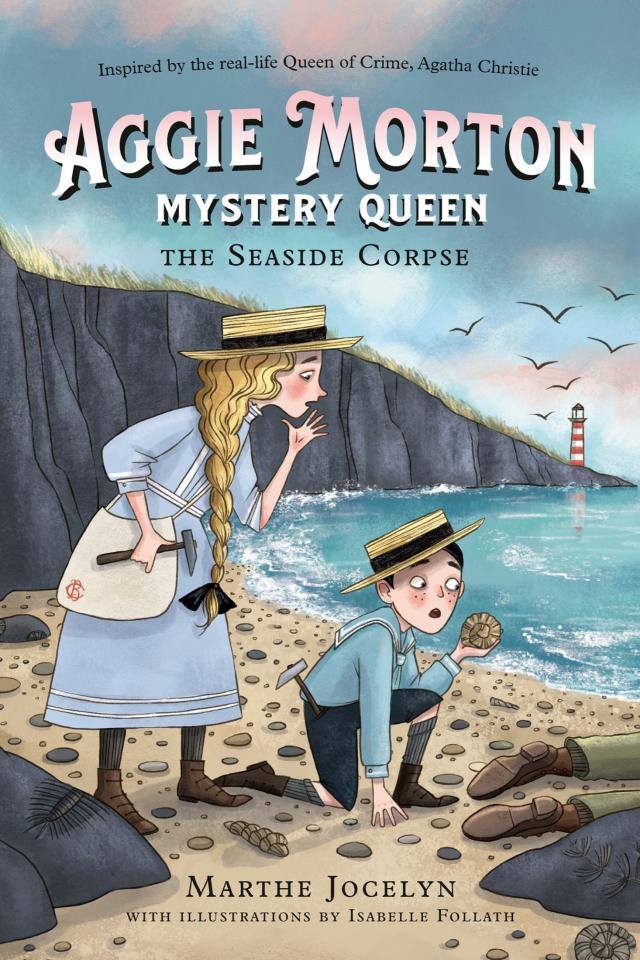


“You’re meant to keep the bite below the heart,” said Arthur. “Slows down the venom.”
“V-v-venom,” Hector repeated, with a slight tremor.
“Lie with your head farther up the slope for now.” Arthur’s calm, and his skill as a nurse, was admirable.
“Should you be sucking out the poison?” I whispered.
“My dad says not,” said Arthur. “He says if you don’t know how, you shouldn’t try. You’ll end up poisoning yourself.”
“What do we do now?” I said.
“The main task,” said Arthur, “is to keep the ankle still. The best thing would be to wrap it and make a splint, so that the venom in the blood can’t—” Arthur raised his voice, as if a snakebite caused deafness. “Just don’t move, old chap!”
“I feel sick,” said Hector.
“Wrap it how?” I said.
“If we had bandages,” said Arthur. “But we used all the linen strips on the fossil.”
“Do you have the penknife?” I said.
“Well, yes, but—”
I snatched it from him and jabbed the knifepoint through the linen of my skirt. One slice was enough, about three inches above the hem. I tore the fabric the rest of the way around and soon had a length of perfectly good bandage—and a somewhat shorter skirt. For a splint we used my notebook, nearly dry by now. Its cover was soft leather and bent easily enough. Arthur swiftly and carefully bound the book as a brace around the ankle…while Hector moaned. I dribbled water from the flask over his lips, making him splutter.
“Hard luck we haven’t got B-C’s flask,” said Arthur. “My dad would say whiskey is the best antidote for an adder bite.” His grin was not entirely happy. “Of course, he’d say whiskey is the antidote for everything else too.”
“No whiskey,” said Hector. “Already my head is…” He made a stirring motion with his hand.
“You’re dizzy?” I said. “Is that normal?” I whispered to Arthur.
He nodded and leaned in close. “Pray he doesn’t faint,” he said. “We’ve got to get him back to camp. As soon as we possibly can.” We turned to look at the water. Surely it was lower than before? The waves weren’t crashing anymore, but only swelling up and back.
“How deep do you suppose it is, where we’d be climbing into it?” I said.
Arthur inched his way down the slope to make a closer inspection. “About up to my thigh,” he called. “My legs are longer than yours.”
“That’s not so bad,” I said. “I’ve already been as wet as a person could be.” I’d hold my skirt up around my waist so it couldn’t tangle around my legs this time.
“We could wade,” said Arthur, coming back, “except…” He nodded toward Hector, who lay utterly still with his eyes closed. “Except that he can’t walk, and I’d hate to drop him into the sea.”
My gaze went from Arthur’s earnest face to the swirling water, to the top of the cliff where Grannie Jane and Helen had reappeared to stand vigil. They must have been wondering why Hector was lying down. I took off my hat and waved again. Helen waved back a bit frantically, and Grannie spun her parasol. Hector groaned. Arthur held Hector’s hat as a sunshade, slowly fanning the pale face. We counted to one thousand, Arthur and I taking turns every other hundred. Hector tried to join us in French, but he got only to trois cent seize before fading. His lips were parched and cracked.
“Is there any water left in the flask?” I said.
Arthur dribbled the last mouthful between Hector’s lips.
“This is about to get dire,” I said.
“I’ll look at the water again.” Arthur made his way back down the slope.
“Hector?” I whispered. “Are you still here? I know it must hurt horribly.”
He nodded, eyes shut, but with a single tear leaking out on each side. I brushed them away with my fingertips, though by now I trusted Arthur not to be a ninny about a boy crying when bitten by a snake.
“I think we can get started,” said Arthur, coming back. “This first bit will be tricky. It’s awfully steep. We’ll have to hold him across our laps and edge down on our bottoms. Do you think we can do that?”
We had no choice. I crammed my shoes and stockings into the collecting sack with the empty water flasks. Arthur and I sat side by side and slowly nudged our legs under Hector, ignoring his moaning for now. His face was as white as bone. Arthur held Hector’s head and I was in charge of the feet. The leg above the ankle wrapping was quite red by now, and swollen. I repeatedly bumped it, despite my care. I must have apologized twenty times in the many minutes it took us to shimmy down to the water’s edge.
“I’ll carry him piggyback,” said Arthur. “Can you keep his foot steady at the same time?”
Steady Hector’s foot, carry the collecting sack out of the way and hold up my skirt to prevent it tangling around my legs. Arthur would be looking ahead and Hector was practically unconscious, so I needn’t worry about my knickers showing. Also, it was a dire emergency. Grannie must understand that. Once started, we got through the water pretty smoothly, though the person with a poisonous snakebite may have felt differently. Hector did his best not to whimper, but with an ankle so horribly puffy and the vivid pink of a geranium, I’d have been howling.
“Hellooooo!” Helen was halfway down the cliff path, waving with both hands! “Agg-eeee! What’s happened?” she hollered. The waves turned over, with a great scraping of pebbles every time.
“Adder!” called Arthur, but the effort of carrying a boy on his back choked his voice.
“Don’t waste your breath,” I said. “She’ll know soon enough. How’s your back?”
“Truthfully? I would never have guessed someone so small could be so heavy,” said Arthur.
“It’s his brain,” I said. “It weighs twice what yours or mine does.”
Hector, who might have been delirious, began to giggle.
“Don’t laugh!” cried Arthur. “I’ll drop you!”
Helen had got to the beach and was trying to splash toward us across the wet and slippery stones. Her hair floated about her head like sunshine, pins lost to the wind. Cheeks flushed pink, blue eyes frantic with worry, she looked nothing like a murderess. And yet, did she carry the weight of guilt, even heavier than the one Arthur bore on his back?
Chapter 26
A Signature in Question
More surprising than Helen being here was the man who lumbered behind her. Thickset and dressed in his cook’s striped trousers and white jacket, Spud was unexpectedly agile as he navigated the steep path.
“Adder,” said Arthur again, grunting a little.
Spud took Hector into his arms and set off straight back up the hill. One of his hands braced Hector’s ankle in its make-do splint. Arthur staggered slightly, leaning into Helen’s friendly embrace.
“You did it!” I said. “You saved his life, Arthur.”
“I can’t believe how strong you are!” Helen teased, poking his arm where the muscle must be—though it looked nothing like that of Mr. Cavalier Jones!
“Where’s your dad taking him?” said Arthur.
“To a doctor, I hope?” I said.
“Your Grannie wanted us to summon a doctor when we saw he must be hurt. We didn’t know if he’d broken something or twisted his ankle or—” She paused. “I didn’t think of an adder. Poor lad. That hurts something terrible. Goodness, Aggie, what’s happened to your dress?”
“It’s around Hector’s leg,” I said. “Did someone go to fetch a doctor from town?”
“Well, it’s Sunday,” said Helen. “And my dad were a medic in the army, so he’s as good as.”
But Hector needed help right away! “They didn’t have snakes in the army,” I said.
“They did in Africa,” said Helen. “The Brits were fighting in Zululand when Dad was young. They had snakes and scorpions and spiders the size of pancakes.”
Once back in camp, I raced to change my torn, damp dress and underthings, and then raced to hug my grandmother as tightly as I ever had. She gave us the news that the fossil team had not yet returned.
“But shouldn’t they have been here ages ago?” I said. “Do we know if Oscar got all the way? Please don’t tell me that the boat tipped over!”
“The boat did not tip over,” said Grannie. “Constable Guff was sent along to report on a series of mishaps. Spring tide made unloading difficult, and the vehicle they’d arranged for was not sturdy enough, which meant waiting for suitable transport. Goodness, Aggie, I didn’t listen. I was rather more concerned with you and Hector. Are you hungry, pet?”
Helen would find us something to eat while I checked on Hector. His cot had been hastily moved, Grannie said, because the boys’ quarters were too crowded for Spud to fit into. The work tent was a temporary solution, where Spud now tended to the wound.
“You did right, washing it with salt water,” he said. “And you hobbled together an excellent splint with what you’d got. Clever as can be. Too bad about your dress, Miss Morton. I’m reusing the strips now, see? Along with a couple of napkins.” He’d rewrapped the ankle and the leg right up to the knee, firmly but not so tight as to squeeze or confine.
“Is there a medicine for snakebites?” I said, reclaiming my notebook.
“Now, I’ve heard,” said Spud, rocking back on his heels for a moment, “that in India they treat a cobra bite with venom from the cobra itself—but there’s nothing like that here in England. Salt water and good luck, that’s what we’ve got to be thankful for.”
“You were a hero today, young man,” Grannie Jane told a blushing Arthur. “I should now like to move the boy to a hospital—or to the comfort of my hotel, at the very least.”
Spud looked up. “He can’t be moved another inch, ma’am. Can’t have his limbs shook any further. Not today, anyway.”
This news disheartened Grannie. That we must stay put at Camp Crewe was the opposite of her wishes. But Spud was adamant. Hector must remain where he was.
“Should I not have carried him?” said Arthur. “It seemed urgent to get him here.”
“We did our best to prevent jiggling,” I said, “but—”
“You did just fine,” said Spud. “Better than fine.” He patted Hector’s shoulder, making Hector startle and his eyes pop open. “Ssh.” Another pat. “You’ll live.”
He waved us out of the tent so he could finish his nursing duties. Hector would live! Tears filled my eyes and a lump closed my throat. Helen waited outside in the fading sunshine, with packets of quickly assembled cheddar and chive sandwiches. Arthur ate four in under a minute. I’d thought I was famished but now could not swallow. With my worry about Hector subsiding, the matter of Helen pricked like a pin left in a seam. Did she know about what happened on Wednesday night? And if so, why hadn’t she told us already?
“The sergeant’s shown up.” Helen tipped her head at the approaching officer. “As if we needed more bad news.”
Where had he come from? When he spotted my grandmother, he squared his shoulders. She was the only adult among us, so it was she whom he addressed, though he had not met her.
“I am Sergeant Harley,” he said. “I wish to consult with Mrs. Blenningham-Crewe.”
“She is not yet returned from this morning’s scientific endeavor, Sergeant,” said Grannie. “May I be of assistance? I am Mrs. Morton. Agatha’s grandmother.”
“When will she be here?” he asked. “No one else will do.”
“Has something happened with Everett?” I said. “Grannie, this is Sergeant Harley, who put Everett in jail.”
“With very little reason, as I understand the matter.” Grannie lifted a superior eyebrow. I vowed to tell Hector that the sergeant flinched.
Spud came out of the work tent.
“Dad?” said Helen. “What news? We’re going mad!”
“He’ll live,” said Spud, again. It was all that mattered, after all. Then he caught sight of the policeman. “What now?”
“He won’t tell us,” I said.
“Bah,” said Spud with a disgusted shake of his head.
“May I sit with Hector?” I said.
“He’ll like that,” said the cook. Arthur perked up, but Spud waved him back. “One at a time, mind. And don’t expect much. He’ll be low for days.”
Inside, I knelt next to Hector’s cot. “Hello,” I said, clasping his pale, limp hand. The leg wrapping was now enhanced by long wooden spoons strapped to both sides for stability. “Where did you get such nice fat pillows?”
Hector’s eyes fluttered open, and he gave me a half smile. “Helen brings to me from the bed of the professor.”
His voice was a thin whisper.
“You’re lying on a dead man’s pillows?”
“He is not dead at the time of using them.”
“Spud says you won’t be dead either.” I squeezed his hand. “Not for one hundred and five years.”
“Ninety-three years,” said Hector, so I knew his brain was working. “You and Arthur save me,” he added. “Thank you.”
“Arthur was an excellent man in a crisis,” I said. “He did exactly what was needed.” I had torn strips from my skirt and managed not to be sick. “I’ve had a thought about the murder,” I said. “It’s a wretched thought, but what do you think—”
Hector closed his eyes. Was he too sick to listen? I wanted to tell him about Helen. But he was clammy and dozy and—
Clattering wheels and shouting voices from outside, and was that the loud purr of a motorcar?
“It’s Nina and the others!” I hopped to my feet. “They’re back with Izzy!”
Hector struggled to sit up. “Will you assist me to—”
“No! Hector, you mustn’t move, not for hours and hours. Not for all night. Spud was very strict on that point because, you know, leaking venom and so on. Even Grannie agrees.”
He made a noise of frustration and fell back. I gave him no time for further complaint.
“I promise to tell you everything.”
The motorcar was Mr. Osteda’s red Vauxhall, with a farm wagon hitched to its back end using the iron chain from the circus. But some miracle had occurred while we’d been trapped on the landslip! Oscar’s father, behind the wheel of his fancy car, had the Strongest Man in the World next to him in the front seat. They looked to be entirely friendly! Even Mr. Osteda’s black eye seemed jaunty rather than menacing.
Nina and Oscar stood on the bed of the farm wagon, grinning widely enough to split open their cheeks. Mr. Jarvis and Mr. Volkov were already assembling a sturdy ramp, to make moving Izzy a little easier. Woolen horse blankets covered the lumps of stone, as if hiding a dead body from prying eyes. Arthur climbed up to join Oscar and jump about with him as if they’d won a tournament. I had a moment’s qualm on Hector’s behalf, for both these boys had performed heroic deeds today, rowing a fossil-laden boat and rescuing a wounded comrade. Poor Hector had succeeded only in getting himself envenomed and put to bed!
Oscar hopped down from the wagon to let the men do their work.
“Arthur says Hector was bitten by a snake! Is he—?”
“Spud says he’ll live. He’ll be wild to hear about your boat ride.”
“You’re all right?” said Oscar. “You made it to shore!”
I laughed. “And you? You’re all right? You made it to shore!”
“The boat got pretty banged up inside,” said Oscar. “A ton of stone will do that. But my father agreed to pay for all repairs.” He grinned. “It may have helped that your reporter friend was taking photographs of me with the constable’s arm over my shoulder. Dad could hardly ignore the owner of the boat while a reporter was carefully spelling out Sackett.”
Spud and Helen appeared with a tray of cups, offering fizzy lemonade to a thirsty, happy party. We drank a jubilant toast to Nina and her team. Mr. Jarvis and Mr. Volkov took their leave—but not before nudging each other and turning to us.
“Please tell Master Hector our wishes for swift healing,” said Mr. Jarvis.
“We pray for him,” said Mr. Volkov. He and his friend bowed deeply, in tribute to Hector’s habit, and then backed away with solemn nods. We did not expect to see these men again, as the next day was to be a holiday for them.
That’s when Sergeant Harley decided to end the fun.
“Attention!” He raised a hand, looking grim. “Mrs. Blenningham-Crewe?”
Nina’s smile slipped a little. “Sergeant? Do you have news of Everett?”
“You are required,” said the sergeant, “to verify a document.”
“Now?” said Nina. Our merriment faded quickly.
“That pest of a reporter came to the station yesterday, demanding an interview with our prisoner. I permitted them to speak for five minutes. I do not believe in coddling killers.”
“Everett Tobie killed no one,” said Nina. The light in her eyes shifted from sunny to thunderous.
“That is for the police to decide,” said Sergeant Harley. “The same reporter turned up again today, this time delivering a letter addressed to me that he claimed was from your secretary.” He pulled an envelope from the pocket of his jacket and held it up in front of Nina’s face. “Before I tell you what she says—or take any action that might result—I wish you to confirm that the handwriting on the envelope matches that of a Miss Sylvia Spinns.”
Nina hesitated. How could she make a declaration without knowing the contents of the letter? What if Miss Spinns had accused Everett yet again?
“Excuse me,” I said, rather boldly, as no one had addressed me. “Where did the reporter encounter Miss Spinns?” Other than in the mirror, I did not say.
“I understood that she came to his lodging house,” said Sergeant Harley. “She put the letter straight into his hands. If she’d delivered it to the police, she might have excited our interest—and did not wish to do so.” The sergeant plucked at the collar of his jacket, looking overheated.