

State of Siege, page 1


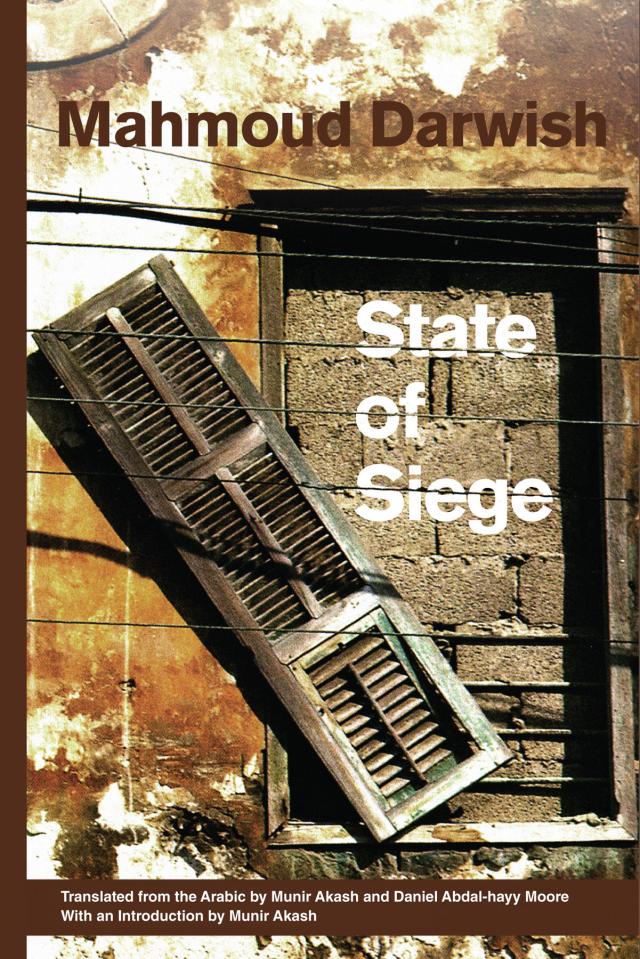
STATE OF SIEGE
MAHMOUD DARWISH
State of Siege
حالة حصار
Translated from the Arabic by Munir Akash
and Daniel Abdal-hayy Moore
with an Introduction by Munir Akash
Jusoor and Syracuse University Press
Copyright © 2010 by Syracuse University Press
Syracuse, New York 13244-5290
All Rights Reserved
First Copublication Edition 2010
10 11 12 13 14 156 5 4 3 2 1
Jusoor
Syracuse University Press
The paper used in this publication meets the minimum requirements of the American National Standard for Information Sciences—Permanence of Paper for Printed Library Materials, ANSI Z39.48-1992.
Cover art by George Azar
Back cover picture by Jamal Assaf
Cover design by Kinda Akash
ISBN 978-0-8156-0923-0
For a listing of books published and distributed by Syracuse University Press, visit our Web site at SyracuseUniversityPress.syr.edu.
Library of Congress Cataloging-in-Publication Data available on request from the publisher.
This book is available to bookstores through
Longleaf Services, INC.
Post Office Box 8895
Chapel Hill, NC 27515-8895
800-848-6224
Manufactured in the United States of America
For Fred Marchant, Kenneth Greenberg
and my wonderful family
at Suffolk University
CONTENTS
Acknowledgments
Icons of Pain
Introduction by Munir Akash
State of Siege
ACKNOWLEDGMENTS
The seeds of this work were planted seven years ago by the late Mahmoud Darwish. Mahmoud was to be presented with the Cultural Freedom Award by the Lannan Foundation in April 2002, and he wanted the translation of The State of Siege to be read at the ceremony. When he sent me The State of Siege, the latest of his work at the time, he also asked me to consult with an award-winning poet, Naomi Shihab Nye, for whom Mahmoud and I share great respect and admiration. On the 28th of April 2002 these two acclaimed poets of Palestinian origins, Naomi and Mahmoud, stood next to each other on the stage of Lang Performing Arts Center at Swarthmore College and read The State of Siege in both Arabic and English. To Naomi I extend my heartfelt gratitude for giving this work its very first bloom.
I need also to acknowledge the debt of the great work in this translation to my dear friend Daniel Abdal-hayy Moore. Daniel is perhaps the American poet most familiar with the work of Mahmoud Darwish. He has worked with me on Mahmoud’s translations since the early nineties. Together we produced the first serious translation of Darwish in English, The Adam of Two Edens. He also worked with me on Unfortunately, It Was Paradise. When we finally decided to publish The State of Siege, Daniel painstakingly devoted himself to polishing the gem. It is perhaps his history as a poet in American English alone that has given him a certain sense of the heft and music of lines of poetry and their imagery when “bringing over” my translation into a more vivid, concise and, well, poetic one. I would also like to thank the editor of Salamander in which some of this translation first appeared.
Special thanks are due to a few of Darwish’s zealous fans who kept insisting that I publish this work to remedy the great harm done to The State of Siege in English.
Munir Akash
ICONS OF PAIN
Introduction by
Munir Akash
Is there a sword that hasn’t yet been sheathed in our flesh?
— Mahmoud Darwish
Once, while we were dining in the French restaurant, La Chaumière (Washington DC, June 1997), Mahmoud Darwish noted that the first Golgotha (juljula) in history occurred in his country of Palestine and that, in Palestinian folk tradition, Job’s trial, the symbol of patience and long suffering, took place in a Palestinian village called Aljourah. “That sharpens my memory,” he added, “and arms me with a great moral power to tame pain. Man always holds the power to rise above himself. By so doing, he finds meaning even in pain. Like love, pain belongs to the most basic human experiences that make me what I am.”
Darwish was very young when he wrote “Identity Card,” the impulsive expression of a young man living under inhumane conditions. From the very first, he found himself alone and lost and stripped of everything that made life worth living. But he also sensed that he had a value, and more importantly, that there was something crucial for him to say. Ever since that passionate outcry, “Record: I am an Arab,” his challenge was to express a poet’s particular way of being, not just his dimensionless presence in the world. Only a poem can shape such a meaning, vary its modes and allow its creator to utter a litany by which the old passionate cry resonates so deeply: “I am I.”
Even as a child, he recited a “poem” in his school festival. In order to adjust his language and memory and bring it into line with the language and memory of the “strangers,” an officer threatened him and spoke to him with extreme anger and vulgarity, and, later, a military judge severely punished him. Naturally, this early experience made a difference to his existence as a whole and influenced the formation of the profoundest meaning of his being. From that moment, Darwish wanted just one thing: to identify with his language — to be.
Now he knows where that being lies hidden — that being exists within the word alone for which he longs, the world of his own soul that he seeks.
Who am I? This is a question that others ask, but it has no answer.
I am my language; I am an ode, two odes, ten. This is my language.
I am my language. I am words’ writ: Be! Be my body!
And I become an embodiment of their timbre.
I am what I have said to the words: Be the place where
my body joins the eternity of the desert.
Be, so that I may become my words.
No land on earth bears me. Only my words bear me.
In his struggle to reach the truth of his being, he transformed overwhelming pain into brilliant creation. His impulse to tame pain, to transcend wounds, and to reconcile hope with a life terrorized by cruelty makes our very being shine. Pain was his pen, as words were his wounds. The saga of his life demonstrates that perpetual tormenting relationship between pain and creativity. In every line of the present poem, State of Siege, we hear the rain and the wailing wind of pain that knits together the hearts of his people. But pain did not keep him centered in the flesh, but rather it empowered him with visions beyond pain and allowed him to transcend the world and the flesh, to transform his words into a necklace of stars around the neck of every beloved wandering Palestinian — the tortured soul of modern Job:
I stood on a wind, and my long night was without end.
…This is my language, a necklace of stars around the necks
Of my loved ones. They emigrated.
They carried the place and emigrated, they carried time and emigrated.
Job’s trial, which armed Darwish with the great moral power to tame his and his people’s pain, is perhaps one of the most compelling narratives in the human quest to make sense of our mortal existence. Job’s increasing pain is bitterly reflected in the entire landscape of the State of Siege.
According to the myth, Satan’s assaults created something akin to a ritual of dispossession, as Satan relentlessly stripped away all of Job’s substance until “the greatest [and richest] man among all the people of the East” ended up a piteous beggar sitting in misery on a dunghill. Savagely, Job was robbed of his herds, his servants were slaughtered, his sons and daughters killed by a whirlwind, and he himself smitten with an illness that carried him to the brink of the grave. But his justified complaint found no hearing with the judge. Job’s right was refused in order that Satan not be disturbed in his play.
Like every refugee’s tragic experience, Job’s trial is not about patience in the abstract, nor a patient man. It’s about an innocent, upright man who loses everything, suffers terribly, and demands to know why. Why does Job’s God, suddenly and unpredictably deliver him to the spirit of evil and let him fall without compunction or obvious remorse into the abyss of pain? This absurd cruelty is meant to penetrate his vitals, to force him to succumb. The myth pictures a sacred executioner who knows no limit in his savage rage, and manifests himself precisely in the limitlessness of his rage. For the mythmaker, pain is Satan’s weapon to turn Job against God. For Darwish, pain is the medium of divine ascension:
We do as those who ascend into heaven do:
we ignore pain
In the mythical narrative of Job’s dreadful experience, the Swiss psychologist of cosmic consciousness, Karl Jung, sees it as just one example of the stark reality of Yahweh, and not of Satan at all. His Answer to Job is in fact the question that occurs to every Job: What power does Satan possess that his rival doesn’t? And then, what hope is left for humankind?
Ever since those verses penned by Job,
we wait here for no one.
From the outset, the glue that binds Darwish’s “I am I” is pain. It is the bitter encounter between being and pain that lies at the heart of Darwish’s words. In them he mirrors all the turbulence and various flavors of pain experienced by his people. For him, pain is an outlet of the imagination, a medium of the visionary realm. “Pain is to my poetic inspiration as beauty is to visual stimulus,” he once said. And it is pain that has often impelled him to forge visions that can only be called utopian:
Peace, the victory of natural beauty over swords —
iron shattered by dewdrops.
When he was only six years old, his mother saved his life from the indiscriminate massacres on the Palestinians, and they migrated together to Lebanon. Echoing with an eerie similarity the saga of Hölderlin’s trip to Bordeaux and the Native Cherokee’s Trail of Tears, they fled in the dead of an ice-cold night, fearing for their lives. One night sleeping by the filthy pool of Rmeish, the next night among pigs and cows, walking in pitch-dark woods in the middle of wild storms, they crossed fearsome snow-covered heights and rugged mountains, sometimes running, sometimes taking cover or creeping on their bellies. Add to that the memory of his entire village of Berweh being set on fire, demolished and obliterated, and its 224 houses eradicated soon after the creation of the State of Israel, together with those of 650 other Palestinian villages, and we can easily see the origin of Darwish’s lifetime of pain.
The Israeli film-maker Simone Bitton went to Berweh, which was once teeming with life, to film whatever ruins of Darwish’s childhood landscape remained, what might be left of intimate relics and personal traces that are evoked in his poems: a certain well, for example, catching the moon’s reflection, the yellow inula flower blooming by its edge… a certain mulberry tree under which the Parish priest played checkers… the enchanting natural landscape overlooking the seashore of `Akka (Acre) that helped form one of its sons into a great poet. But when the Israeli settlers tried to prevent her from filming and started to show their muscle, she called the police. She told them she didn’t want to quarrel with anyone and that all she wanted to do was film the village ruins. “What ruins are you talking about?” the police answered, “the region is full of ruins!”
In order to survive the ongoing massacre, the young boy fled his beloved country, ending up in a miserable refugee camp. “There, and later in my own country,” he told me, “at the slightest disagreement with any one, I was hatefully labeled refugee.”
From then on, Darwish’s language memorialized and responded to the ache for home that tortures every Palestinian soul. It responded to the appeal of his being a mortal among mortals and a human in an authentic relationship with the earth and the heavens, to things and plants and animals, to all thoughts, all passions and all delights. Pain makes his language reflect the palpable presence of each of these things in the full appropriateness of their nature and holds them open to their manifestation, in the same way that being-Palestinian takes root, growing and blooming to its full potential. To understand how this language flows to achieve the truth of being, the world of Darwish’s own soul, we must understand his existential identification with language — language as being and being as language.
I am my language
I am my words
In all its forms, language that flows to achieve the truth of being is by nature poetic. But contrary to his early poetry, Darwish’s prose always gave the impression of walking on water — contrary to many of his first and most popular poems, which were written with a kind of brutal directness — more slogan-like than poetic, hardly qualifying as poems at all. Like the great Arab poet of the eighth century, Abu Nuwas, the young Mahmoud “Kept on prating, gabbling and babbling, until he finally produced poetry.” But from first to last, Darwish’s purest prose is as poetic as his most refined poem. In Letters, Farewell to War, Farewell to Peace or in Memory for Forgetfulness, for example, his prose has all the purity, sensibility, elegance, fineness and vision of poetry. Every word in his prose resonates; every sentence is pregnant with poetry. Anyone who has read his editorials in his journal, Al-Karmel (1981-2009), will realize that, like his later poetry, Darwish’s prose subtly flows to arrive at the truth of being concealed in oblivion.
In an historical time of such cruel and mute oppression, it is the task of language to memorialize, and the poet to nurse memory and bring to bear the bright possibility of an authentic relationship with a real world.
In May 1983, Mahmoud and I met in Rome for the first time in six years, a few months after the Israeli invasion of Lebanon, the siege and destruction of Beirut and, consequently, his forcible removal to Tunisia along with thousands of his people. Late that night, following the Targa Europa Award ceremony, we sat in the hotel coffee bar with Uri Avnery, a life-long peace activist. Jabra Ibrahim Jabra, one of the foremost Arab modernists, was supposed to join us in Rome, but unfortunately he couldn’t leave Baghdad due to its tragic war with Iran. In the dim lights of the coffee bar, surrounded by thick smoke and loud music, I heard Darwish for the first time refer to the conflict in historic Palestine as a conflict between two memories… “an historical memory and a negative mythical memory that blocks our access to true history.” The mythical memory haunts Israeli lives, their culture, their politics and their guns.
Like a persistent dream, this mythical memory identifies and articulates the qualities of their association and attachment to the land, and shapes their discourse’s claim over the present. “But at the end of the day, the whole structure of this memory is illusory mind-play,” as he explained later (August 2001) in his Amman apartment.
Myths in this instance are an unquestioned belief held in common by those who laid the siege, the present-day occupiers. And the “state of siege” lived in its symbols before it was carried out to inflict such racking pain on an entire nation. “They were treated like animals,” as President Jimmy Carter said regarding the siege of Gaza (The Washington Post, June 17, 2009). Mythical narrative was at its most powerful in its “adjustment” of the undesirable reality, and its consequent rationalization of the siege. And this mythical narrative is an onion made up of countless layers, one of which is to turn geography into myth:
Your tents are a guitar for the old conqueror’s horses
who attack to turn a place into myth.
Another is to uproot the indigenous people from their country, which was turned into a mythical place, and then make them feel nothing but a void beneath their feet,
And we are forced to return to the inhospitable myths
where we have no place.
What flickers through Darwish’s heart, then, is the constant fear of exile and fate imposed on him by myths. What power do myths have to turn a man against his brother?
She has a small moon, a servant combing
her shadow, and flickering through our hearts
is the fear of exile and fate imposed on us by myths.
This painful despair we sense throughout State of Siege mirrors a gloomy vision of men as both products and victims of the blind operation of myths that haunt their collective memory. The mythical memory of those who are laying vigorous siege to Darwish and his people is blind and irrational, and the source of all his distress and despair. But visionary pain seems to require conflict between two radically opposed memories, which vividly explains Darwish’s despair and frustration about the bitter conflict between mythic memory (literally armed to the teeth) and helpless reality.
Mythical memory includes deterministic, imagined assumptions that give historical events a particular meaning. These assumptions act to displace from human consciousness all that is not related to them, therefore making them difficult to verify. They explain the past, present and future, confusing history with mythology, and presenting instead a history that is comprised of false narratives whose mythic ends simply imply distortion. Thus, whatever human sacrifice is entailed in preserving the myth — expulsion, spoliation, massacres, enslavement, genocidal siege — are all excusably worth every life lost and every drop of blood spilled. And brute force must then play a pivotal role in adjusting “the undesirable reality”:
Myths refuse to adjust their plots.
They might mesh, for just a moment, with a certain flaw.
Ships might drift towards land, towards a bewildered land,
and the imaginary might afflict the real.
But they refuse to adjust their plots.
To confront an undesirable reality they simply


