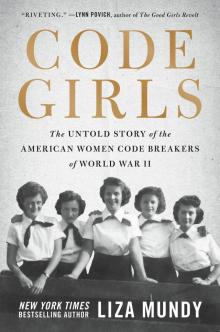
Code Girls, page 45


He was under terrible pressure: DeBrosse and Burke, Secret in Building 26, 86, describe Meader as a hard taskmaster, as did Deborah Anderson in an interview with the author.
“The design of the Bombe eventually required”: RG 38, Box 109, “CNSG Report of Supplementary Research Operations in WWII.”
“The first two experimental bombes were under preliminary tests”: The saga of the bombes’ first summer is in RG 38, Boxes 38 and 39, “Watch Officer’s Log, 26 June–9 August 1943.”
Commander Meader had ejected a number of: RG 38, Box 2, “CNSG, Assignment/Transfers, (Enlisted Pers), (1 of 5).”
Back in 1942, when the WAVES were formed: The policy of what to do about pregnancy and abortion is discussed in “Women in the Military Box 7,” in the folder marked “Bureau of Naval Personnel Women’s Reserve, First Draft Narrative Prepared by the Historical Section, Bureau of Naval Personnel” in the Ready Reference Section of the Naval History and Heritage Command in Washington, D.C.
Once, when a sloppy (or tired): Jennifer Wilcox, Sharing the Burden: Women in Cryptology During World War II (Washington, DC: Center for Cryptologic History, National Security Agency, 2013), 10.
“He had nightmares for years about men dying”: Deborah Anderson, daughter of Joseph Desch, interview with the author.
The people working on the Enigma project: DeBrosse and Burke, Secret in Building 26, make this point very well.
One of the women in charge of maintaining: Graham Cameron, son of Charlotte McLeod Cameron, interview with the author.
A daily log on February 25, 1944: RG 38, Box 40, “Watch Officers Log, 2 Feb–4 March 1944.”
Another was reprimanded for coming in: RG 38, Box 39, “Watch Officers Log 26 September–26 November 1943.”
After two months at Smith: Pearsall’s return date as an officer is in RG 38, Box 1, “COMNAVSECGRU-OP-20G Headquarters Personnel Rosters & Statistics (3 of 4)”.
Jimmie Lee by now had married: Jimmie Lee’s reflections here and elsewhere are taken from transcripts of her interviews with Curt Dalton, author of Keeping the Secret; letters of reminiscence she wrote Deborah Anderson; and her NSA oral history interview, Jimmie Lee Hutchison Power Long, on June 30, 2010, OH-2010-46.
As Jimmie Lee and the other women: Jennifer Wilcox pointed out the all-female nature of the operation in an interview with the author.
Promoted to watch officer, Fran had access: Jed Suddeth, son of Fran Steen Suddeth Josephson, interview with the author.
The effect of the U.S. bombes on solving the Atlantic U-boat cipher: RG 38, Box 141, “Brief Resume of Op-20-G and British Activities vis-à-vis German Machine Ciphers,” in folder marked “Photograph of Bombe Machine, about 1943.”
Once they were broken, the messages would pass to: Janice Martin Benario, interviews with the author. She also describes the tracking room in Janice M. Benario, “Top Secret Ultra,” Classical Bulletin 74, no. 1 (1998): 31–33; and Robert Edward Lewand, “Secret Keeping 101: Dr. Janice Martin Benario and the Women’s College Connection to ULTRA,” Cryptologia 35, no. 1 (2010): 42–46.
There, a commander named Kenneth Knowles: David Kohnen, Commanders Winn and Knowles: Winning the U-Boat War with Intelligence, 1939–1943 (Krakow: Enigma Press, 1999), describes the tracking room. The working together of submarine tracking rooms in the UK and United States is described in Kahn, Seizing the Enigma, 191.
One male officer said the WAVES did a better job: Kahn, Seizing the Enigma, 242–244.
After the carnage of 1942 and early 1943: Good descriptions of the innovations in the first six months of 1943—HF/DF, hunter-killers, and so on—are in DeBrosse and Burke, Secret in Building 26, 117; and Richard Overy, Why the Allies Won (New York: Norton, 1996), 45–62.
These refuelers were known as milch cows: Kahn, Seizing the Enigma, 274–275.
In October 1943, the U-Boats reappeared: RG 0457, 9002 (A1), Box 95, SRH 367, “A Preliminary Analysis of the Role of Decryption Intelligence in the Operational Phase of the Battle of the Atlantic.”
“Congratulations from Hut six”: RG 38, Box 4, “COMNAVSECGRU Commendations Received by the COMINT Organization, Jan 1942–8 July 1948.”
These were long and desperate sea journeys: RG 0457, 9002 (A1), Box 84, SRH 306, “OP-20-G Exploits and Communications World War II.”
“The attack against the U-boat cipher has been so successful”: RG 38, Box 141, “Brief Resume of Op-20-G and British Activities vis-à-vis German Machine Ciphers,” in folder marked “Photograph of Bombe Machine, about 1943.”
Chapter Twelve: “All My Love, Jim”
“I don’t have anything exciting to write you, Dot”: Jim Bruce to Dorothy Braden, April 21, 1944.
“I get treated worse than anyone I know”: Jim Bruce to Dorothy Braden, April 30, 1944.
“The plane went every way but the right way”: Jim Bruce to Dorothy Braden, May 26, 1944.
“I was just sitting here in bed, waiting for Carolyn”: Dot Braden, April 3, 1944.
“I enjoy very much reading your letters, Dot”: Jim Bruce to Dorothy Braden, August 7, 1944.
“I guess you are still having a good time with your friends”: Jim Bruce to Dorothy Braden, October 28, 1944.
“The weather situations are rather interesting here”: Jim Bruce to Dorothy Braden, November 28, 1944.
“That is a long ways, in fact it is six thousand miles”: Jim Bruce to Dorothy Braden, December 1, 1944.
“In a letter from you that I received yesterday”: Jim Bruce to Dorothy Braden, December 19, 1944.
“I love you and am looking forward with great anxiety”: Jim Bruce to Dorothy Braden, January 9, 1945.
“It stopped raining and cleared up when I predicted”: Jim Bruce to Dorothy Braden, January 14, 1945.
“The letter that I received from you today is the one”: Jim Bruce to Dorothy Braden, February 21, 1945.
Chapter Thirteen: “Enemy Landing at the Mouth of the Seine”
In November 1943, the Purple machine: RG 0457, 9002 (A1), Box 17, “Achievements of U.S. Signal Intelligence During WWII.”
Raven and his crew called him Honest Abe: The Coral team’s monitoring of Abe, and his message about coastal fortifications, are in RG 38, Box 116, “CNSG-OP20-GYP History for WWII Era (3 of 3).”
At Bletchley, code breakers broke a long message: Arthur J. Levenson, oral history interview on November 25, 1980, NSA-OH-40-80, https://www.nsa.gov/news-features/declassified-documents/oral-history-interviews/assets/files/nsa-oh-40-08-levenson.pdf.
“So great were the chances of all the traffic”: RG 0457, 9032 (A1), Box 763, “Cover Plan in Operation Overlord.” A good description of Operation Fortitude North and South is in Thaddeus Holt, The Deceivers: Allied Military Deception in the Second World War (New York: Scribner, 2004), 510–584.
“The ploughman homeward plods his weary way”: RG 0457, 9032 (A1), Box 833, “Security Posters and Miscellaneous Documents.”
A whole section of Arlington Hall was devoted: The role of women in the protective security branch, and their involvement in planning and implementing a number of deception programs, including at Yalta and Normandy, is in RG 0457, 9032 (A1), Box 980, “Pictorial History of the SSA Security Division Protective Security Branch Communications Security Branch.”
“No invasion tonight,” thought Wellesley’s Ann White: Ann White Kurtz, in “From WomenatWarto ForeignAffairsScholar,” American Diplomacy (June2006), http://www.unc.edu/depts/diplomat/item/2006/0406/kurt/kurtz_women.html, describes the receipt of the D-Day messages, bolting up and down the stairs, the first and second messages, and then “sporadic bulletins followed.”
“At 0130, messages on coastal circuits”: RG 38, Box 113, “CNSG-OP-20-GM-6/GM-1-C-3/GM-1/GE-1/GY-A-1 Daily War Diary.”
At 1:40 in the morning they were warned: RG 38, Box 30, “OP-20-GM Watch Office Logs, 22 June 1943–31 Dec 1943.”
Going to church was the only way: Carpenter and Dowse, “Wellesley Codebreakers,” 30, and Mary Carpenter, underlying notes for Mary Carpenter and Betty Paul Dowse, “The Code Breakers of 1942,” Wellesley (Winter 2000): 26–30.
Ann would remember the Normandy invasion: Ibid.
“A great quantity of administrative traffic”: RG 38, Box 113, “CNSG-OP-20-GM-6/GM-1-C-3/GM-1/GE-1/GY-A-1 Daily War Diary.”
At the Naval Annex, Georgia O’Connor: Georgia O’Connor Ludington, oral history interview on September 5, 1996, NSA-OH-1996-09. The extensive nature of the code rooms devoted to communications intelligence coming in from the Atlantic and Pacific theaters is in RG 38, Box 111, “CNSG-OP-20GC War Diary, 1941–1943.”
“There were many signs the enemy was disintegrating”: Elizabeth Bigelow Stewart, essay of reminiscence, shared with the author by her daughter Cam Weber.
Others were not so lucky: Stewart, essay of reminiscence.
Donna Doe Southall was one of: Donna Doe Southall, interview, undated, Library of Congress Veterans History Project.
Chapter Fourteen: Teedy
Teedy Braden finished high school on a Friday: Here and throughout this chapter reminiscences are from John “Teedy” Braden, interview with the author in Good Hope, Georgia, on December 1, 2015.
“I sure do hope that you won’t [be] too busy”: Teedy Braden to Dot Braden, June 26, 1944.
“How’s everything, gal?”: Teedy Braden to Dot Braden, July 20, 1944.
“If I do go it’ll mean that it’s the first step”: Teedy Braden to Dot Braden, July 31, 1944.
He was one of thousands of very young men: Antony Beevor, Ardennes 1944: The Battle of the Bulge (New York: Viking, 2015), 50–53.
Teedy’s unit, the 112th Infantry, suffered: Ibid., 68, 151–156.
And it was one of the war’s worst: Arthur J. Levenson, a U.S. Army cryptanalyst sent to work at Bletchley Park, said, “Battle of the Bulge took us a little by surprise and we were a little ashamed of the intelligence dearth because they had put on a silence and I remember just before there was no traffic.… They had imposed a silence and that should have been a real indicator.” Oral history interview on November 25, 1980, NSA-OH-40-80, 38.
“I suppose that you’ve been kinda worried:” Teedy Braden to Dot Braden, January 1, 1945.
Admiral Dönitz—the new head of state in Germany—ordered: Richard Overy, Why the Allies Won (New York: Norton, 1996), 62.
“You have fought like lions:” RG 0457, 9032 (A1), Box 623, “COMINCH File of Memoranda Concerning U-Boat Tracking Room Operations.”
“My Dear Teedy,” she wrote, “Hope everything”: Virginia Braden to Teedy Braden, June 7, 1945.
Chapter Fifteen: The Surrender Message
Not long after, Alethea Chamberlain: Karen Kovach, “Breaking Codes, Breaking Barriers: The WACs of the Signal Security Agency, World War II” (Fort Belvoir, VA: History Office, U.S. Army Intelligence and Security Command, 2001), 41.
The minute Ann Caracristi set foot in Arlington Hall: Ann Caracristi, interview, undated, Library of Congress Veterans History Project, https://memory.loc.gov/diglib/vhp-stories/loc.natlib.afc2001001.30844/transcript?ID=mv0001.
JAH “theoretically was restricted to low grade traffic”: RG 0457, 9032 (A1), Box 1115, “History of the Language Branch, Army Security Agency.”
She owned that code: That Virginia Aderholdt attended Bethany College is in RG 0457, 9032 (A1), Box 1007, “Personnel Organization.” That she “scanned and translated JAH and related texts” and that the Japanese translators followed the war by monitoring the diplomatic messages is in RG 0457, 9032 (A1), Box 1115, “History of the Language Branch, Army Security Agency.”
She “had worked on that code and loved”: Frank Rowlett, oral history interview in 1976, NSA-OH-1976-1-10, 189–192.
At Arlington Hall, the rule was: Solomon Kullback recalls that though Arlington Hall knew the Japanese surrender message was coming twenty-four hours in advance, “no word leaked out.” Oral history interview on August 26, 1982, NSA-OH-17-82.
Chapter Sixteen: Good-Bye to Crow
“I went down town yesterday to do some shopping”: Virginia Braden to Dot Braden, December 10, 1945.
“I think I enjoyed them more than any letters I received”: Jim Bruce to Dot Braden Bruce, January 16, 1946.
Epilogue: The Mitten
Hugh Erskine, a younger relative: Hugh Erskine, interview with the author.
In an interview before her death: Ann Caracristi, interviews with the author.
Polly Budenbach, a Smith College graduate: Mary H. “Polly” Budenbach, oral history interview on June 19, 2001, NSA-OH-2001-27. Budenbach also discusses the difficulty of having an NSA career and having a spouse.
In the very early days of 1943, an ex-schoolteacher: Robert L. Benson, “The Venona Story,” https://www.nsa.gov/about/cryptologic-heritage/historical-figures-publications/publications/coldwar/assets/files/venona_story.pdf.
“Gene was just an independent person”: Eleanor Grabeel, interview with the author.
“In every case the response was the same”: Elizabeth Bigelow Stewart, essay of reminiscence, shared with the author by her daughter Cam Weber.
Janice Martin Benario, the Goucher Latin major: Janice Martin Benario, interviews with the author.
Dorothy Ramale, the aspiring math teacher: Dorothy Ramale, interviews with the author.
Betty Bemis, the champion swimmer: Betty Bemis Robarts, naval code breaker, interview with the author in Georgia on December 2, 2015.
Louise Pearsall, who worked on Enigma: “Interview with Louise Pearsall Canby,” oral history taken by her daughter, Sarah Jackson, May 17, 1997, University of North Texas Oral History Collection Number 1163; Sarah Jackson, interviews with the author; William Pearsall, interview with the author.
Betty Allen, one of the group of friends: Elizabeth Allen Butler, Navy Waves (Charlottesville, VA: Wayside Press, 1988).
Here is how the round-robin letter worked: Ruth Schoen Mirsky, interviews with the author.
“We hadn’t won any battles and didn’t feel”: Edith Reynolds White, interviews with the author.
Fran Steen, the Goucher biology major: Fran Josephson, SCETV interview; Jed Suddeth, interview with the author; David Shimp, interview with the author.
“There were Japanese that went down with that ship”: Jeuel Bannister Esmacher, interview with the author.
“I had always done everything I was told”: Jane Case Tuttle, interview with the author.
“Oh golly, did I miss it”: Mary Carpenter and Betty Paul Dowse, “The Code Breakers of 1942,” Wellesley (Winter 2000): 26–30.
“A lot of people don’t bother to learn their names”: Dorothy Braden Bruce, interviews with the author.
Thank you for buying this ebook, published by Hachette Digital.
To receive special offers, bonus content, and news about our latest ebooks and apps, sign up for our newsletters.
Sign Up
Or visit us at hachettebookgroup.com/newsletters
Liza Mundy, Code Girls