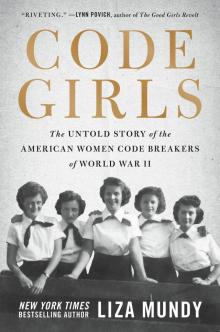
Code Girls, page 17


To do this, Anne had to master the same “false math” the Japanese used—only in reverse. She and her colleagues had to start with the enciphered numbers and work backward to find the underlying code group. And they had to do it fast. Looking down a vertical column, Anne was tasked with finding the lone additive used to encipher all the code groups in that column. Aside from her own wits, she had one thing to help her: a quirky feature designed to cope with radio garble. Garbling was a huge problem in radio transmissions, so the Japanese developed clever “garble checks” so the person at the receiving end could do a bit of math to be sure the message had transmitted correctly. It was a sensible enough tactic, except that it also was an insecure one: Many of these checks—and the ghostly patterns they left—helped with breaking the messages.
One such JN-25 garble check was the rule that a valid code group was always divisible by three. Looking at her work sheet, Anne would conjecture a possible additive, then go down the vertical column, quickly, in her head, stripping the hypothesized additive out of each group she saw, and looking to see if the remainder was divisible by three. If she conjectured an additive, stripped it, looked at the row of code groups, and saw that all were divisible by three—17436, say, or 23823—then she knew she had gotten down to valid code groups and had therefore conjectured a viable additive. It took all this work to get one single additive, which would be recorded in the book they were building. Whenever the Japanese changed the JN-25 cipher books, the unit would start all over again. It was truly like sweeping the sand from a beach.
Anne, like the other women in her room, learned to look for common enemy mistakes. More than seventy years later she would remember them clearly. In such a massive fleet system, it would sometimes happen that an oblivious radioman would send a message in the clear—plain Japanese—that others were sending in code. The women could use the plain Japanese as a crib. The Japanese, like the Germans, also tended to send out fleet messages that were formulaic and patterned. Japanese merchant ship captains often sent a shoo-goichi message, stating what their exact position would be at noon. Anne learned the code groups for “noon position,” and she learned where the phrase was likely to appear. When she saw an enciphered group in that place, she could subtract the code group and obtain the additive.
Many things the Japanese did with the intention of making the code harder to break made it easier. Sometimes, enemy cryptographers liked to begin a message in the middle. When they did this, they would include a code group that stood for “begin message here” to show where the message started. The women learned the code groups for “begin message here”—there were several—and gained another point of entry. There also was something called “tailing.” Japanese encoders were told not to end a message at a certain point in an additive book and then begin the next message at the next additive number—they were supposed to choose another random starting point—but often, they were lazy or harried, and they did. The women mastered these ins and outs and quirks. Whenever they saw a mistake, they pounced. The shoo-goichi messages did more than help recover additives; the noon position would be swiftly radioed to an American submarine captain, who would be waiting for the Japanese ship when it appeared on the horizon.
It was boring, tedious work, except when it wasn’t. Elizabeth Bigelow, an aspiring architect recruited from Vassar, also began working on JN-25 when she came in with a later university-trained cohort. She at one point was given an urgent but badly garbled cipher and asked to decipher it, which she did, within a matter of hours. It told of a convoy sailing later that day. When she was told that her work had helped to sink the convoy, she said later, “I felt terribly pleased.”
The operation developed the swiftness and efficiency of an assembly line. To the extent that space provided, the women were assigned to groups, or “rooms.” The write-up room would prepare work sheets. The “key” room placed the messages; the classification room salvaged garbled intercepts; a priority room with “expert additive workers” attacked “hot or priority messages.” Hotlines were set up to convey additives to translators. Some messages were tagged “routine,” others “urgent.” There was a special category marked “frantic.” As the number of messages increased, the ranks of people solving them grew steadily more female. By the fourth quarter of 1943, 183 men and 473 women were working on JN-25 in Washington—more than twice as many women as men. One memo noted that it was impossible to keep the women in the dark as to what the messages said. The memo added that the most important secret was the fact that JN-25 was being worked at all, and this secret was at the “mercy of the humblest worker who ever glanced at a work book.”
The women kept that secret and became integral to the operation. And they shared the outrage when the truth about Midway’s success made its way into the press. On June 7, 1942—while the battle was still going on—the Chicago Tribune published a blockbuster story in its Sunday edition, headed: JAP FLEET SMASHED BY U.S. 2 CARRIERS SUNK AT MIDWAY: NAVY HAD WORD OF JAP PLAN TO STRIKE AT SEA; KNEW DUTCH HARBOR WAS A FEINT. The article noted that the makeup of the Japanese forces “was well known in American naval circles several days before the battle began.” The article appeared in several other Tribune -connected papers but was hushed up by the office of censorship out of fear that the Japanese would take note.
Then the syndicated gossip columnist Walter Winchell compounded the risk, saying in a July 5 radio broadcast that “twice the fate of the civilized world was changed by intercepted and decoded messages”—meaning Coral Sea and Midway. Two days later he wrote in his “On Broadway” column, which ran in the New York Daily Mirror, that Washington was abuzz over the Tribune’s item, which, he argued, “tossed safety out the windows—and allegedly printed the lowdown on why we won at Midway.” Of course, he had done the same thing.
The Navy was so apoplectic that it ended up making things worse. When it emerged that a reporter aboard the USS Lexington, Stanley Johnston, was the source of the Midway story, the Navy decided to go after Johnston. The hearings resulted in more publicity, and the code breakers worried that there was no way the Japanese could ignore it. The Japanese made another major overhaul of JN-25 not long after, and many code breakers were convinced this new changeover was the result of the Johnston investigation. “Our crucial battles in the Solomons were conducted without the aid of enemy information that had been available up to this moment,” wrote Laurance Safford bitterly.
Whether the Japanese did take notice is a matter of dispute. The Japanese periodically changed JN-25 books anyway, and their mid-August change most likely had been planned for some time. Regardless, it occurred just as the U.S. Navy began to press its new advantage in the Pacific, taking the offensive and launching an invasion to retake the Solomon Islands. This brave push began with the Battle of Guadalcanal, an amphibious invasion that went well, at first, then bogged down into a bloody months-long quagmire. During the battle, U.S. Marines came upon a cache of codebooks buried six feet in the ground; gallingly, they were in a version of JN-25 that was no longer in use.
Fortunately—given how often JN-25 changed over—the U.S. Navy had made the wise decision to set up a smaller unit to tackle what were called “minor ciphers.” The minor ciphers were lesser systems, but they were anything but unimportant. In the vast Pacific Ocean, not every message could travel in the main fleet code. The Japanese used scores of auxiliary systems, some brief and temporary, to communicate between captured islands, or between weather lookouts and rice ships, or even just to broadcast water levels and fishing conditions. They also devised temporary “contact codes” for use in battle. The ability to read some of these systems had been useful during Midway; the Japanese changed their JN-25 cipher on May 28, just before the battle, so all through that actual engagement, the Americans were able to follow the conversations of Japanese combatants only thanks to contact codes and other minor systems.
As luck would have it, the minor-cipher unit was under the charge of Frank Raven, the very code breaker who destroyed what remained of the career of Agnes Driscoll. His “German Navy miscellaneous” team was now working “Japanese miscellaneous,” plucking intercepts out of random piles in the Navy building that were accumulating in a junk box marked “W.” The crew was a good one—according to Raven, they broke at least one system per week beginning in March 1942—and now the men on that crew were replaced by women. In May 1942 Raven had twenty-three male sailors working under him, and by June, just one month later, “approximately ten civil service girls” came on to form the nucleus of the new team.
Among these were Bea Norton and Bets Colby, both members of the first Wellesley cohort. Fortunately, Raven was not as unpleasant toward them as he had been toward Agnes Driscoll; he later described his new crew as “damn good gals,” though he did also see fit to point out that they were “damn pretty gals.” The unit’s main ongoing task was deciphering something the women called the “inter-island cipher,” which was known in most official documents as JN-20, and, like many minor systems, was far more important than it ever got credit for. “The Navy never mentions the inter-island cipher,” wrote Bea Norton many years later, saying that it was in fact the inter-island cipher that had carried the no-water-at-Midway message. “The plain text of the water shortage was picked up by a Japanese island operator, wired in the inter-island cipher to fleet headquarters and thence to the main Japanese fleet,” she asserted, saying that the reason Raven’s team never got credit was because the Navy was “traditionally of the view that all meaningful accomplishment was strictly by Regular Naval personnel, and along with this, distrusted any civilian, even Naval Reserve, results.”
Her assertion is plausible, and at any rate, there is no doubt about this: During the many times when the big fleet code went dark—meaning the JN-25 books changed and the code breakers could not read it—the island cipher proved a rich alternative source of intelligence. “Whenever the main code was not being read, a feeling of frustration and exasperation permeated the radio intelligence organization and spurred them on to each new success,” noted one internal history. “Even during these periods the darkness was not complete. Minor ciphers were usually being read. Frequently the information gained from the minor ciphers rivaled in importance that gained from the main naval code.”
For the women working in Raven’s unit, the inter-island ciphers gave vivid glimpses of the warfare unfolding on volcanic beaches and in thick island jungles thousands of miles away, as the Navy commenced its post-Midway Pacific pushback. When U.S. Marines hit the beaches of Guadalcanal in August 1942, Raven’s crew began to work a cipher set up by the Japanese as an emergency form of communication between the island occupiers and the fleet at sea. As the U.S. Marines pursued them, a small band of Japanese retreated into the jungle, sending twenty or thirty messages a day in the tiny makeshift cipher. It gave the women a plaintive image of what it felt like to face certain death. “I have not seen the sea for two weeks,” said one message. “I have not seen the sky for three weeks. It is time for me to die for the Emperor.” This band of Japanese resisters eventually shifted to the inter-island cipher; their numbers dwindled until, as Raven put it, the “three or four men who were left got into a motor-boat; we followed them daily in JN-20 as they described the bad conditions, etc. We sank the boat.”
When she started working on Raven’s team, Bea Norton was assigned the tedious job of taking frequency counts of individual letters. The messages arrived on Western Union tapes. Armed Marine guards stood outside her door, and she was forbidden to keep photos or anything personal on her desk. Her college training course did come in handy, as this cipher was a “substitution transposition” cipher, which involved changing letters to new ones by using a table, then switching some of the new ones to further scramble the cipher. Once Raven’s team constructed the table—that is, once they figured out how the alphabets were stacked—the table didn’t change. The only thing that did change was the monthly key telling how some of the letters were mixed up.
The changing of the key imbued the minor-cipher unit with a curious work rhythm. The women would race to break a new key and got so expert (“JN-20 ciphers were broken with increasing speed and exploited with increasing efficiency,” noted one memo) that they could then enjoy lulls of inactivity. They took advantage of the downtime: Bets Colby, a math major from Wellesley, was a favorite of Raven, who described her as a “real brilliant gal” and fondly remembered that she liked to throw epic parties, which stopped just short of being orgies. “One of the standing orders on the boards was that she had to get approval from me before she had a party because she’d take the crew out of action for ten days. She’d come and say she wanted to throw a party, what dates were available?” Raven later remembered.
There was a wall calendar in Raven’s office, pinpointing when the island cipher would change its key. He would select a date ten days before the key change. “You can have your party in there,” he would tell Bets Colby. That way, the women would have ten days to recover from their hangovers before they had to apply their minds to a new key.
Despite the bureaucratic wars raging all around them, the women loved their work. “I felt so lucky to be in this small interesting unit,” said Bea Norton later, “and to feel my work had some value.” Many felt they had been preparing for this all their lives. “Never in my life since have I felt as challenged as during that period,” reflected Ann White. “Like Hegel’s idea about when the needs of society and the needs of an individual come together, we were fulfilled.”
The only hitch was the heat. From time to time the minor-cipher unit would get instructions to cover their desks because workmen were coming to install air-conditioning. Their hopes would be dashed when Frank Raven would tell them the air-conditioning was for the top officers’ private offices, not for them.
They were doing such valuable work that Donald Menzel—the Harvard astronomy professor who helped recruit them—wrote Ada Comstock about the good things he was hearing from their bosses. “The women are arriving in great numbers and… they are proving very successful. Those who have written me are delighted with the work and find it interesting and exciting beyond all expectation.” Preparations were made for the next cohort of female trainees, from the same schools plus Vassar and Wheaton. There was less attrition as instructors began to master the material and everybody settled in. Of the 247 seniors in the class of 1943 who took the course, 222 would finish. The Radcliffe women of ’43 had been meeting on Friday afternoons on the fourth floor in a Harvard building, and toward the end, a dramatic show was made of burning their training materials, to impress the women. Even given this new influx, the Navy began to perceive that ever more girls would be needed to get the job done.
CHAPTER SIX
“Q for Communications”
July 1942
Women were proving so useful to the war effort that a new field opened to them: military service. By 1942, allies such as England and Canada had admitted women into their military, and key U.S. women’s groups began pushing for America to do the same. There were only a few women in the U.S. Congress, but one—Massachusetts Republican Edith Nourse Rogers—made women in the military her passion project. As early as 1941, Nourse Rogers met with General George Marshall, informing him that she was introducing a bill creating a Women’s Army Auxiliary Corps. Nobody took her seriously, at least not until Pearl Harbor.
But even once planners grasped the difficulty of fighting a two-ocean war using only men, the idea of putting women in uniform remained controversial. “Who will then do the cooking, the washing, the mending, the humble homey tasks to which every woman has devoted herself; who will nurture the children?” thundered one congressman. People worried that military service would imperil women’s femininity and render them unmarriageable. Many believed servicewomen would be, in effect, fully embedded “camp followers,” a euphemism for prostitutes and hangers-on who followed soldiers from post to post.
But General Marshall did see the advantage of having women doing clerical and encoding work. Like so many, Marshall believed women were well suited to telecommunications, being dexterous and willing to do work that was boring and routine, and he felt they would make fewer mistakes than men did. President Roosevelt signed the WAAC bill into law in May 1942, a mixed victory in that women were allowed into the Army on an “auxiliary,” or inferior, basis. WAACs were paid less than men and did not hold the same ranks or receive the benefits. Some of this disparity would be rectified when “auxiliary” was dropped in 1943 and the WAACs became WACs, but women were by no means equal. The WAACs, coming first, bore the brunt of negative publicity, enduring gibes about their chastity and criticism of their morals and motivation for joining.
Even so, they fell over themselves to enlist. 10,000 WOMEN IN U.S. RUSH TO JOIN NEW ARMY CORPS, wrote the New York Times on May 28, 1942, noting that at a single recruiting office in New York, fourteen hundred women put in requests for applications in person by the end of the first day, and another twelve hundred by mail. “Mild brute strength was used to combat the feminine forces,” the reporter noted with a flourish of purple prose. “A guard’s broad shoulders held back the tidal wave of patriotic pulchritude.” The Army women were barred from serving as combatants but did fill important ancillary posts. They served as drivers, accountants, draftsmen, cooks, occupational therapists, encoders. They dispelled stereotypes. Despite fears that women would become hysterical in emergencies or that female voices were too soft to be heard, WACs worked in airplane control towers and did well.