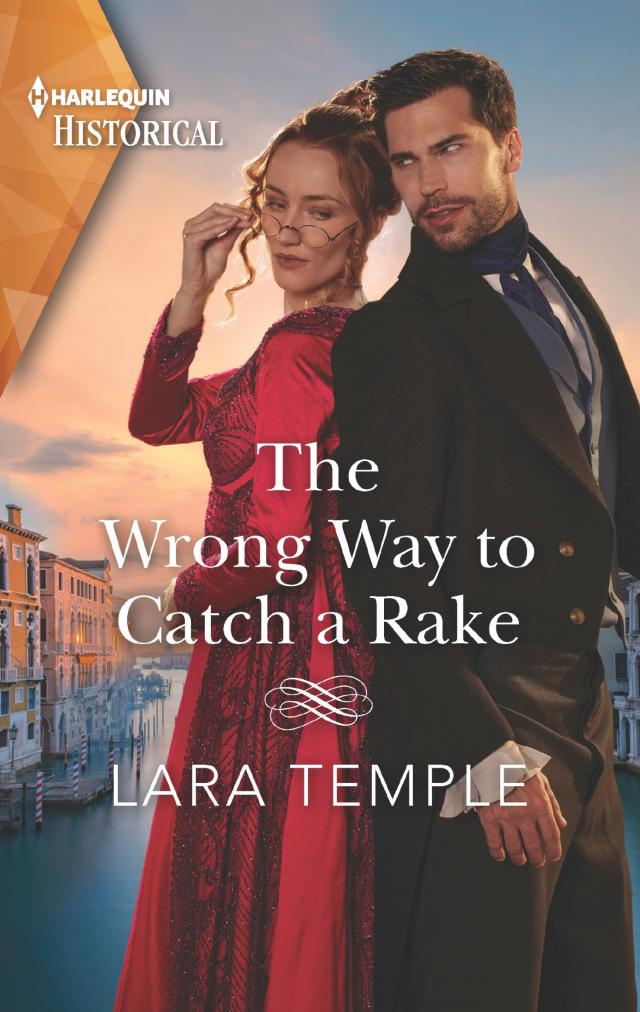
The Wrong Way to Catch a Rake, page 1


“I wish you would stop trying to reform me.”
“I am not trying to reform you. Nor do I have any hopes of you or of anyone reforming. But so long as you continue following me about and interfering with me, I shall continue to share my opinion that you are an idiot as freely as I wish. You can of course remove both our objections by leaving me alone.”
Dominic had a magnificent glare. Phoebe folded her arms. She had dealt with much, much worse than the glare of a spoiled pretty boy...man. Very much a man. And pretty was an insult to the power of his face and physique. It was very annoying he could have such an effect without even trying.
She tightened her arms. It was time to put an end to this strange...what? Friendship? Connection? If they’d been sixteen, she might even have thought it flirting, just as a boy tweaks a girl’s braid. Except someone like him had no need to flirt with someone like her.
LARA TEMPLE
The Wrong Way to Catch a Rake
Lara Temple was three years old when she begged her mother to take dictation of her first adventure story. Since then she has led a double life: by day an investment and high-tech professional who has lived and worked on three continents, but when darkness falls, she loses herself in history and romance—at least on the page. Luckily her husband and two beautiful and very energetic children help weave it all together.
Books by Lara Temple
Harlequin Historical
Lord Crayle’s Secret World
The Reluctant Viscount
The Duke’s Unexpected Bride
The Earl She Should Never Desire
The Wrong Way to Catch a Rake
The Return of the Rogues
The Return of the Disappearing Duke
A Match for the Rebellious Earl
The Sinful Sinclairs
The Earl’s Irresistible Challenge
The Rake’s Enticing Proposal
The Lord’s Inconvenient Vow
The Lochmore Legacy
Unlaced by the Highland Duke
Wild Lords and Innocent Ladies
Lord Hunter’s Cinderella Heiress
Lord Ravenscar’s Inconvenient Betrothal
Lord Stanton’s Last Mistress
Visit the Author Profile page
at Harlequin.com for more titles.
Contents
Chapter One
Chapter Two
Chapter Three
Chapter Four
Chapter Five
Chapter Six
Chapter Seven
Chapter Eight
Chapter Nine
Chapter Ten
Chapter Eleven
Chapter Twelve
Chapter Thirteen
Chapter Fourteen
Chapter Fifteen
Chapter Sixteen
Chapter Seventeen
Chapter Eighteen
Chapter Nineteen
Chapter Twenty
Chapter Twenty-One
Chapter Twenty-Two
Chapter Twenty-Three
Chapter Twenty-Four
Chapter Twenty-Five
Chapter Twenty-Six
Epilogue
Excerpt from One Night with Her Viking Warrior by Sarah Rodi
Chapter One
Palazzo Gioconda, Venice, September 1822
‘I disagree.’ Lord Wrexham’s deep voice was slightly slurred, but it still carried easily across the main salon of the Hotel Gioconda. ‘Not all love songs are about fornication. One of the best was written about a tree, but I doubt King Xerxes wanted to penetrate it with anything but his axe.’
The silence that followed his pronouncement was broken only by the warbling song of a gondolier passing in the canal below. Phoebe Brimford suppressed a sigh and tried to concentrate on her book. After a fortnight at the hotel, she was no longer surprised by Lord Wrexham’s wine-soaked mischief.
The responses of the other residents of the hotel were just as typical. Mr George Clapton, son of the British Consul in Venice, was watching Lord Wrexham as if a slug had crawled out of his soup, and poor Mr Arthur Hibbert, Lord Wrexham’s only ally at the hotel, was tugging at his cravat, a bad habit that intensified the more his friend drank. Since Lord Wrexham drank often and a lot, Mr Hibbert’s cravats were rarely in good order.
Other than Phoebe and her aunt, the only other residents were Mrs Banister and Mr Rupert Banister, a wealthy widow and her shy son. Poor Rupert’s ears had turned an interesting shade of pink at Lord Wrexham’s pronouncement, but Phoebe very much hoped Mrs Banister’s poor hearing meant she’d missed this latest provocation. That faint hope went up in smoke as Mrs Banister prodded Phoebe’s knee with her fan, demanding loudly, ‘What was that about a tree?’
Phoebe set down her book and smiled politely. ‘Lord Wrexham mentioned an aria by Handel, Mrs Banister. Ombra mai fu. Where King Xerxes sings of his admiration of the plane tree. It is a lovely song.’
‘A song to a tree? What will those foreigners think of next?’
‘Mama!’ Rupert Banister whispered, now flushed to the roots of his flaxen hair.
Phoebe considered pointing out that, as an Englishwoman in Venice, Mrs Banister was herself firmly in that scorned category. However, her position as companion to Lady Grafton made such directness inadvisable. If she’d had any thought about crossing that line, it was chased away by her employer, who was eyeing her with a glint of amused warning in her dark brown eyes from the sofa opposite. Instead she said, ‘To be fair, Handel did spend most of his life in London.’
‘That’s right,’ said Lord Wrexham, sauntering over to their corner of the salon. ‘He was just as English as our dear first King George, and far nicer if the stories are true. He didn’t beget a pack of bastards with his pack of mistresses. Oh, don’t fuss, Hib. I’m only two sheets to the wind. It will take at least two more bottles to make it three.’
‘We shall retire to our rooms, Rupert,’ Mrs Banister announced, casting an awful glare at Lord Wrexham. ‘I find the air in the salon rather close.’
‘Yes, Mama.’ Mr Banister directed an apologetic glance at Phoebe and her aunt and hurried to help his mother out of the room.
‘Poor pup.’ Lord Wrexham leaned on the back of Phoebe’s chair as he watched Mrs Banister’s majestic exit. His coat smelled of cinnamon and whisky, a not unpleasant combination. ‘Not likely he’ll ever get out from under until she’s dead and buried.’
Phoebe couldn’t in truth argue with his assessment, so instead she replied, ‘He’s a very pleasant young man.’
‘He might be, but don’t pin your hopes on him, tiger eyes. That dragon won’t release him easily.’
‘Dom!’ Hibbert’s voice was sharper than usual, both his brow and cravat now creased. ‘It is bad enough saying all that about Handel and King George, but now you go too far.’
‘What did I say?’ Lord Wrexham said mulishly. ‘Why shouldn’t Handel write a love song to a tree? They don’t nag or ask for baubles.’
‘Neither do they drink themselves into insensibility, Lord Wrexham,’ Phoebe stated more tartly than she usually allowed herself. She was more upset by his comment about her eyes than the implication that she was trying to ensnare Mr Banister. She didn’t mind being plain, but she’d always thought her eyes unfortunately distinctive and even unsettling. Not even wearing spectacles prevented people from noticing their yellow-amber hue, encircled in a ring of dark brown.
Lord Wrexham’s own dark blue eyes focused on her, half hooded by his long lashes. His grin was lop-sided and his dark hair was a tumbled mess, but he was still the handsomest man in the room by a mile and he knew it, and was only too willing to employ his looks to smooth the feathers he ruffled.
‘Quite right, sweetheart. But men are damn unreliable beasts. Much better to give your heart to a tree or a lump of peat, no?’
‘Much better not to give it to anyone, my lord. I am certain I can make better use of my own heart than anyone else.’
‘That’s a dashed good point, isn’t it, Hib?’ he replied, clapping his friend on the shoulder and weaving a little. Mr Hibbert clasped his arm and sighed.
‘Come along, Dom. Maybe you should rest a little before you...’
But Lord Wrexham merely slipped away, not even noticing as he knocked over a small table on his way out to the back courtyard. Poor Mr Hibbert righted the table with a resigned sigh and Mr Clapton sniggered, clearly enjoying the show.
‘He’s probably off to cast up his accounts.’
Phoebe ignored Clapton’s comment, but thought it would be best if that was indeed what Lord Wrexham had wandered out for. The less spirits he held down, the better.
Not that it would make much difference. She’d watched her beloved uncle Jack drink himself to death and there had been so many times she’d allowed herself to hope he would stop. Until she had finally come to accept he could not. That there was nothing she could do to save the man who had saved her from a cursed life and given her and her aunt purpose and pride. Most of life lay beyond her control, which was why she was all the more determined to control what parts of it she could.
In the end the drink would likely take Lord Wrexham, too. One way or another. The previous night it had only been Mr Hibbert’s swift action that ensured his friend hadn’t ended up feeding the fish in the Grand Canal when he’d nearly taken a stroll off the hotel jetty.
Mr Clapton had been quite titillated with that as well, pointing out to Hibbert that a good dunking might at least have sobered his friend. Phoebe didn’t share Clapton’s optimism. Habitual drunkards were far more likely to drown than be sobered by finding themselves in the canal.
Not that many other than the kindly Mr Hibbert and some of the town’s gamblers and women would mourn the passing from the world of Dominic Allerton, Marquess of Wrexham, and heir to the Duke of Rutherford. Not even his own father apparently. Perhaps especially not his own father. George Clapton had told Lady Grafton and Phoebe it was no secret the Duke would not in the least regret if his eldest son met with an untimely end and made way for his younger half-brother, a model of ducal rectitude.
Poor Mr Hibbert did his best to protect his friend, but Lord Wrexham, like many tipplers, was convinced he knew best and headed down his path to ruin with all the conviction and enthusiasm of a religious pilgrim. And all the while the ladies flirted and sighed at the waste and the men looked on with smirking superiority.
Phoebe looked on and puzzled and said nothing.
‘I do apologise for Dom,’ Hibbert said into the silence. ‘He can be a capital fellow, but...’
‘Pray don’t bother apologising, Mr Hibbert,’ Lady Grafton intervened in her languid drawl. ‘You’re a dear to care, but I don’t think you are having the slightest effect on that beautiful young man.’
‘Not so young any more.’ Mr Clapton had joined them as well and he cast a less than pleasant look at the now empty doorway. ‘He must be well north of thirty.’
‘My dear Mr Clapton.’ Lady Grafton’s tones were slightly less warm. ‘He and you are both young men to me. Let us leave it at that, shall we? Now, do run along with your friends. All this fracas is bad for my complexion.’
George Clapton flushed at the rebuke and stalked off. Mr Hibbert sighed once more and followed him. Phoebe waited until they were out of earshot before smiling at her aunt.
‘Talk about dragons, Milly.’
‘I can be one when I wish, Phoebe. Such a pity about poor Lord Wrexham. He might be a penniless drunkard, but he is by far the best-looking Englishman in Venice. They say that was why Byron decided to remove to Ravenna, you know. Couldn’t bear to be outshone.’
Phoebe picked up her book. ‘Nonsense.’
‘Well, that is what they say. Or was it that Byron fell head over heels in love with that Adonis, only to have Dominic prefer the attentions of the Contessa Morosini? I cannot keep the tales straight.’
‘Since our arrival I’ve noticed they have said a great many conflicting and mostly fictitious things about Lord Wrexham. No doubt Lord Byron left because he was in debt, again. Or bored, again. And if he was in love with Lord Wrexham, which I admit wouldn’t surprise me in the least as he appears to have loved dozens of men and women in his short life, I don’t doubt his monstrous vanity allowed him to recover post haste. Pretty boys are impressively shallow and resilient. I doubt either of those men know what love is.’
‘And you do, darling Phoebe?’ Lady Grafton smiled and yawned.
‘A hit, a very palpable hit, Milly,’ Phoebe acknowledged with an answering smile. Milly’s façade slipped a little.
‘It’s a strange and motley group we find ourselves among. I’m accustomed to standing out, but Venice outshines me by several suns. Don’t you find it strange that Lord Wrexham and Mr Hibbert have taken up lodgings here? It strikes me this is a rather tame arrangement for someone of Dominic’s nature.’
Phoebe nodded. The same had occurred to her. ‘It does appear that the Palazzo Gioconda attracts the drifting English, for better and for worse. Clapton is a nasty sort, but at least he and the dreaded Agatha Banister are excellent sources of gossip, so we should cultivate them.’
Milly made a sound very like that of a large and satisfied cat. ‘I cultivate everyone, love. Even lechers and martinets. Now, do be a dear and close the door. That poor boy has left it open and there’s a dreadful draught. I’m practically a block of ice.’
Phoebe ignored the exaggeration and crossed the salon towards the courtyard door. The marble floor was cracked and scuffed by years of impoverishment, but the gloom hid the wear and tear as well as the layers of tallow smoke grime adhering to the gilt-embossed moulding. The enormous chandelier above was quaintly decorated with cobwebs, and Phoebe doubted it had been used that century. Mrs Banister had complained, but Phoebe didn’t mind this shabbiness in the least. She and Milly had seen better and worse lodgings during their travels. And Venice was, after all, Venice.
The courtyard was dark and heavily silent, and instead of closing the door as commanded she descended the wide stone steps and stood for a moment enveloped in the cool darkness of the Venetian night. The courtyard was mostly an empty expanse with some large old urns along the edges that might have once held flowering bushes but now served merely to catch rainwater for the washing. In the dark they looked like a knot of skulking figures plotting sedition.
At the far end there was an arched wooden door that led to San Stefano Square. Lord Wrexham had probably wandered off that way in search of more wine, women, and song. Or rather wine, women, and cards. At least she presumed that part of his activities involved women. Both women and men seemed to buzz around him like fruit flies about an overripe melon. There was little doubt that the bedrooms of many of both sexes in Venice were open to the handsome Englishman if he chose to grace them.
Phoebe was not as judgmental on this front as some of the other English guests. Both she and her aunt had had enough of preachers and righteousness after being raised in a brutally zealous community in Northumberland. ‘To each his, or her, own’ was Phoebe’s motto. It was perhaps not very proper from a moral standpoint, but it felt right.
‘Come to see if I’d kee...keeled over?’
The voice, slurred and quite near, jerked her out of her idle thoughts and she turned with a start. In the darkness she hadn’t noticed him seated on a stone bench alongside the building, his elbows on his knees, a silver flask clutched in one hand.
‘No, Lord Wrexham,’ she replied matter-of-factly, ‘I came to close the door. You left it open and Lady Grafton doesn’t care for draughts.’
‘There’re always draughts in these mausoleums. Might as well be living in a tent.’
‘I don’t think it is quite that bad.’
‘Never lived in a tent, though, have you?’ he challenged.
‘Not yet. Have you?’
‘I did. When we had them. Under the sky when we didn’t.’
She remembered now. Hadn’t Mr Hibbert mentioned they’d been in the same regiment during the war? Perhaps that explained this poor man’s drinking. Enough men had returned from the wars as cracked vessels, never quite holding themselves together as they once had. She inspected the faint outline of his profile. It was a lovely profile.
It really was a waste. But then, being handsome was no guarantee of merit. Often quite the opposite. Even as damaged as he was, he was still endlessly indulged and sighed over. All that adoration clearly wasn’t doing him a lick of good. She settled her shoulder against the door jamb.
‘Well, if one must live in a draughty tent or mausoleum, then Venice in autumn is an excellent location.’
‘God help me; don’t tell me you are one of those incurable optimists.’
‘God help me; don’t tell me you are one of those privileged moaners.’
He turned his head and his eyes caught the shiver of light from one of the curtained windows, two slashes of silver like the eyes of a wolf materialising from the woods.
‘You think I’m a...a moaner?’ There was a peculiar tone in his voice. She could not tell whether he was outraged or amused.
‘I think...’ Phoebe drew herself up short. ‘I think you very much don’t wish to know what I think, Lord Wrexham. Since you now appear sober enough to be left to your own devices, I shall bid you goodnight.’
‘Wait a bit. What if I do want to know?’ He leaned back against the peeling wall, arms crossed, the flask tucked to his heart.
‘I think I pity your valet. Your coat is going to be covered in plaster dust. But I dare say that is better than if you’d ended up in the canal.’