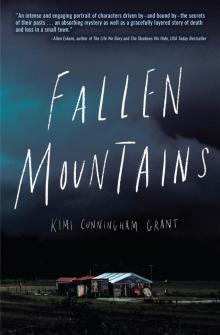
Fallen Mountains, page 8


Red began rethinking his plan, wishing he’d stopped by Judge Hess’s to get a warrant. He should’ve told Junior where he was, or at least Leigh. With Sue gone, there was no one at home to miss him, no one to say, He should be home by now. Maybe Chase had seen him drive up the hill? “I ain’t asking to poke around,” Red said. “Just wanted to know if anyone has seen him.”
“He used to come up here all the time,” the man with the thick mustache said. “But we ain’t seen him for a week or so.”
“I need you to check on whether Sailor’s done loading those pallets, Bill,” the man in the blue polo shirt said. “Go on now.” His voice twanged; he wasn’t local. Frackholes, shuttling in from all over. Oklahoma, Texas. They drove their pickups and put up their rigs and stirred up trouble and left; that’s what they did. You couldn’t even drive through the national forest—the national forest!—without crossing paths with them anymore. The last time Red had driven through one part to go fishing, they’d had two men standing along the road in orange vests, directing traffic, radioing ahead. You had to stop at a kiosk and tell them who you were, give them your driver’s license. They’d write it in a log before they let you through.
The mustached man, Bill, backed out of the trailer.
“So you been seeing him?” Red asked.
“Mr. Shultz leased us the mineral rights,” the man in the polo explained, leaning forward in his seat, his knuckles white as he continued compressing the grip strengthener. “And there were times when he came up here, poking around. Caught him on video snooping in the dark. Three, four in the morning. I had to double up on security, got a crew working the night shift now.” The man stretched his thick fingers. “Once, he showed up, barged right in here without checking in, and started hollering about the contract. My boss happened to be here that day, in from Texas. Which I took a lot of heat for that, looking like I don’t know how to run the place.”
“What was Transom mad about?”
The man shrugged. “Didn’t like the way things were going up here, I guess.” He shook his head in disgust. “You people just don’t seem to get it. You sign a contract, you’re paid. You don’t get to come in here and say how things go anymore.” He turned to the man beside him and began to laugh. “I think I’m gonna tell corporate I have an idea. They can hire me to start teaching classes on what a contract is.” He laughed harder and turned to Red. “You guys have schools out here in the sticks?”
Inside, Red was seething, this guy talking down to him, making fun of his town and his people, but he forced himself to remain calm. “I just want to know the last time you saw Transom Shultz, and what happened.”
“Don’t get your panties in a wad, old man. I see what you’re getting at, and I assure you, he ain’t here. Haven’t seen him for over a week. We’ve got men here, equipment, machines.” He looked closely at Red, his gray eyes piercing. “You’re a man of the law. You understand the need for rules and regulations. Order. We can’t have people up here who aren’t with the company. It’s not safe.”
“Right.”
“Which is why I have to ask you to be on your way now.”
Red grimaced at the self-assured smirk on the man’s ugly face. There was nothing he could do at that moment in the confines of this dark, simmering trailer, him against the two men, at least one more outside, and with all those pickups, more around, somewhere. His arthritic right wrist, his whining knees. He stared. “All right,” he said at last, the words lisping through his clenched teeth.
“Let me get your name and number,” the man in the polo said. “You got a card or something?”
Red wondered whether or not he should give it, his paranoia humming, but he reached into his wallet and pulled out one of the green and white business cards Leigh had made for him. It was the first one he’d ever used.
The man slipped it into a drawer without looking at it. “If something comes up,” he said, squeezing the grip strengthener, “we’ll give you a ring.”
Red nodded and muttered a thank-you, and as he stepped back out into the blinding June afternoon, the heat slamming his face, his eyes struggling to adjust to the intense light, the man in the polo called after him, in that singsong drawl of his, “Be careful out there. You hear?”
BEFORE
It was February already, and Chase found himself exhausted each night, a heavy winter tiredness that tugged at his limbs. This was supposed to be a slower time of year for him at the farm, but day after day he was dragged into another one of Transom’s projects. These tasks were on top of the usual chores, feeding and milking the cows, twice a day, mucking the barn, all of which Transom never helped with. Too busy, he said every time Chase asked.
Transom possessed a kind of wild energy—he always had— that could be infectious. He began by gutting a bathroom in the house, one that, once it was pointed out, Chase realized was indeed hideous. The toilet wailed and sputtered with every flush. The tile was an unbearable peach-but-almost-pink shade, and the sink was shaped like a seashell. Chase knew nothing about remodeling, but Transom knew a great deal. They drove to a home improvement store thirty miles away and came back with everything they needed, piled in Chase’s truck: paint, a new vanity, dark bronze fixtures, vinyl flooring, a toilet, a fan and light. Within six days, the two of them had transformed the room. Transom taught Chase how to plumb the sink and wire the light and fan, and he liked it, learning these new and useful things from his old friend.
After Transom finished the bathroom, he insisted they move on to Jack’s “office,” a room that was more of a junk storage area than anything else. In there, they unearthed all sorts of things. Ticket stubs to a 1977 Pirates game. A receipt for the Farm-All that Jack had sold ten years earlier. Calendars, photo albums, instruction manuals, birthday cards, stacked neatly in an old shoe box, decades’ worth, some of them from Chase and Transom. And traps, lots of traps, newer ones and ones that hadn’t been used for decades. Transom sat on the floor amidst the mess, transfixed. He held them up to get a sense of how they worked, ran his fingers along the metal, pressed the sharp, deadly edges into his palms.
“Careful,” Chase warned. The mere sight of the ugly contraptions made the hair on his body stand up. There’d been a time, long ago, when he’d run lines with Jack, but he’d sworn off trapping when he’d sworn off hunting, all of it at once.
In the dim light of Jack’s office, Transom began sorting the traps, placing them into separate piles. Chase asked what the method was to the organizing. Transom shrugged his shoulders. “Rusty, not rusty.”
“What you gonna do with them?”
“Some of them we can get rid of, right?” He motioned to a heap behind him: a stack of seed trays, an aquarium, the blade to the old rototiller. “Thought I’d take a load of stuff to the transfer station, get some money for the scrap metal.” Transom ran his fingers along one of the traps. “The other ones, I’m gonna use. Try my hand at trapping.” He looked up and held Chase’s eyes. “I mean, as long as you think you’d be all right with it.”
Chase looked away, out the window, where a light snow had just begun to fall, the flakes slow and deliberate, mesmerizing. He knew why Transom was feeling him out, trying to get a read on him. They were both remembering the day, eighteen years ago, that had resulted in Chase giving up hunting and trapping for good. He didn’t want to go there; he didn’t want to think about it. “You got to be organized about it, you know. You have to know how many you set, and where.”
“Yeah, I know,” Transom said. He placed another rusty trap into the heap.
The traps, Chase knew, were like so many other things with Transom: he would argue and insist and nag until he got his way. And half of the time it was all bull anyway. It was easier just not to get into it. Mostly, Chase found himself grateful for his friend’s presence, for his ability to absorb those around him in his undertakings. If Transom hadn’t been there, Chase felt sure his grief would’ve yanked him into a dark, winding funnel. Instead, Chase remained busy, in a useful way, with all the projects and outings. Things had been good between them, simple. Having Transom around had also given him a welcome distraction from whatever was transpiring between him and Laney. With so much up in the air, with so many emotions swirling through his head, he wasn’t ready to make any commitments. He just couldn’t.
Chase still missed Jack all the time. He continued to be caught in that chapter where he would be able to think about something else for a while, and then he would be plunged back into the grief, a bad baptism that kept on happening. It didn’t take much to trigger a memory. The nuthatch, his grandfather’s favorite bird, that came and settled on a branch just outside the kitchen window, tilting its head curiously instead of darting away when Chase shifted his weight. The sweet, pungent smell of chewing tobacco, a whiff he caught in line behind an older fellow at the grocery store.
He found himself missing Maggie, too, more than ever. When Maggie passed away, Chase didn’t have the luxury of grieving her. The farm was in shambles; Jack was in shambles. Chase held everything together, plodding ahead with the everyday demands while Jack took all the time he needed to start functioning again. Now that Jack was gone, it was almost as though Chase was grieving the both of them. He wondered if the heaviness that seemed to have permanently settled deep in his chest would ever go away. Would he sleep through the night, soundly, restoratively, again? It seemed that years had passed since he had slept well, even though it had only been six weeks.
Chase continued staring out the window of Jack’s office. In some places, the snow was sticking to the ground.
Transom held up a large, heavy object. “What’s this one for?” he asked, frowning, squinting his eyes. Folded in half and turned on its side, it looked like the wide, toothy grin of an ape. Chase knew that, when opened, the trap looked like a crown.
“Bear?” Transom said.
Chase nodded.
“Man.” Transom ran his index finger over the perilous rim of teeth.
“Jack got that at an auction,” Chase said. “It was in the bottom of a box of hinges. He never used it. Look at all the rust. Thing probably don’t even work.”
“I could get it to work.”
“Transom, they ain’t even legal.” He reached out. “Give me that.”
Transom flashed him a smile, that same smile Chase had seen so many times, the one that suggested Chase was attempting to ruin all the fun. “No one would ever know. No one would care.”
“Like I said, just leave it be. Besides, why would you want to kill a black bear? You ever even seen one?” Chase knew Transom didn’t have the attention span to go through with all of this, but still, the sight of the traps, the thought of animals suffering, made his stomach churn.
“For a rug, that’s why. Right in front of the fireplace. Nothing says, ‘I’m a man,’ more than a bearskin rug. I can assure you of that.” He grinned. “Just picture it. The rug, a female companion. The good life.”
Chase was about to say something to the effect of ‘not on my property,’ but he caught himself. The month before, the two of them had sat in the attorney’s office, each signing through a two-inch stack of papers—the farm, technically, was Transom’s now. The realization stung as Chase had to rethink his approach. He reached out again. “Here, give it.”
“You’ve become a regular pansy, you know that.” Transom kicked all the traps into one giant heap and pitched the bear trap on the pile. He continued sorting through Jack’s stuff, leafing through a stack of old receipts, shuffling gear. Chase watched him for a moment, keenly aware that he was being ignored. Irritated, he mumbled something about needing a few things from town, grabbed his wallet and jacket, and walked out of the house.
Later, when he returned to the farm from his trip to town, Chase put the groceries in the refrigerator and went to find Transom. He was still in Jack’s office, but the room had been cleared out: the traps, along with the aquarium, seed trays, and rototiller blade, were gone.
Transom was rummaging through Jack’s chest of hunting clothes in the office. He held up a heavy Gore-Tex camouflage jacket and placed it beside him. Two pairs of long johns were strewn over the arm of Jack’s chair. Jack’s favorite Jones hat, the one he would replace every three years because it would grow thin and ragged and Maggie wouldn’t tolerate it, sat on Transom’s head.
“Hey, I’ve been meaning to tell you,” Transom said. “I planned us a camping trip on the Clarion.” They could hike and then camp along the river, he continued, drink beer by the fire. It would be good to get away, get out in the wild. Like old times.
“It’s winter,” Chase said.
Transom shrugged. “It’s supposed to warm up next week, be in the mid-forties. So what do you say? You in?”
“Yeah, I’m in,” Chase said, with reluctance. He knew that if he didn’t agree to go, Transom would nag him until he got the answer he wanted, anyway, so there was no point in arguing. “I picked up some burgers,” he said. “I stopped by Laney’s. She’s coming over tomorrow.”
Transom stared at him for a minute, then removed Jack’s cap and laid it in one of his stacks. His gaze dropped to his lap.
“You all right?” Chase said.
Transom reached in the corner and grabbed the beer he’d been drinking and tilted his head back. “Just needed a drink,” he said. “How’s she look? Still got them legs?” He licked his lips and grinned.
Chase leaned over and picked up an old No Trespassing sign from the floor. “Don’t,” he said, and he was surprised by the protectiveness in his voice. What was it he felt then, that tingling on his flesh? Jealousy? An urge to keep Laney safe? And if so, from what? Transom?
He’d known Laney since kindergarten, since she’d plopped into the seat beside him on the bus, the first day of school. All through high school, all through their twenties, they’d remained friends because of Jack and Maggie. In recent years Laney had been the friend that Transom should’ve been, had he stuck around. But the thing that had happened right after Jack passed—he and Laney growing closer than ever, the two of them hooking up, the contentment he’d felt in her arms, the naturalness with which it had all occurred—threatened to make everything messy, and messy was something he couldn’t handle. He left occasional messages on her phone when he knew she was at work and couldn’t answer, but for the most part he was keeping his distance, hoping things might somehow just not be awkward, with a little time and space. When he stopped by her house earlier, he realized he’d been wrong: if anything, avoiding her had made things worse. He was almost certain he’d hurt her feelings.
He flung the sign at Transom, who deflected it.
“What?”
“I’m serious,” Chase said. “Don’t.”
Transom stood up suddenly. The No Trespassing sign dropped to the floor. In one swift movement, the kind of quick movement that a man of his age and stature should not have been able to manage, he tackled Chase to the ground, on top of the pile of hunting clothes. “Why?”
Chase struggled to shove Transom, who was much heavier— but, he was happy to realize, not as much stronger as he had been when they were younger—off him. He lay on his back, barely able to catch his breath. “Get off me,” he said, pushing to free himself. “What’s wrong with you?”
Transom laughed his deep, guttural laugh. “Answer the question. Tell me about the two of you.” He rolled to the side.
Chase sat up and gave him a shove. “There’s nothing to tell.”
“You’re lying. I’m your best friend, and I can tell when you’re lying.” He still lay on the ground. “Good Lord,” he said, turning away. He reached into his pocket and grabbed a pill, then took a swig of beer. “You’re in love with her.”
“I’m not in love with her,” Chase said firmly. As he said it out loud, though, he realized Transom was right: it did sound— feel—like a lie. Panic swelled in his throat: Was he in love with Laney? Was he that far removed from his own emotions that he hadn’t been willing to face even that?
“Have you—” Transom stopped himself here, pausing, re-choosing his words. “Does she sleep over?”
“Like I said, there’s nothing to tell, except that she’ll be here tomorrow.”
“I’m happy for you, man,” Transom said with sincerity, squeezing Chase’s shoulder, and then added, “Wish you would’ve said something sooner.”
The next day, as Laney drove her truck out the road that led to the Hardy farm in the waning blue-gray light, she couldn’t help but wonder whether agreeing to have dinner with Chase and Transom was one of the worst decisions of her life. Ever since she’d seen Chase the day before, her mind had been swirling through various scenarios, all of which ended horribly. Transom spilling the news to Chase right before she got there, so that she arrived and had to witness the disappointment and disgust on his face. Transom making an off hand comment at the dinner table.
When Chase stopped by and invited her over, her first instinct had been to come up with an excuse. If things weren’t going to pan out, if he had no interest in her, he could at least have the decency to say so. But then yesterday, he’d been different: less reserved, even a little affectionate. Maybe there was something there, after all?
At the farmhouse, Chase greeted her at the back door, taking her pan of brownies and slinging an arm over her shoulder. Behind him, Transom stood in the kitchen, arms across his chest, his cheeks red from the warmth of the house, and, she suspected, the beer he was holding. She tried to read his face— what was going through his mind? Shame? Jealousy? Regret? Maybe nothing at all.
Transom stepped forward. “Laney,” he said, “it’s been a while.”
Nineteen days, it had been. She was hopeful, though: he seemed prepared to play along.
But as Transom leaned in to embrace her, she could smell alcohol on his breath, in his skin. He held her too long; it was too conspicuous, too intimate, his cheek against hers.