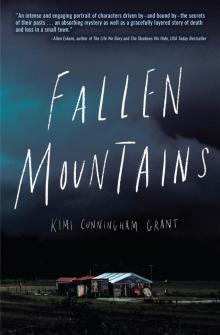
Fallen Mountains, page 2


Chase left the kitchen and walked into the adjacent room, Jack’s office. He felt around the top of the gun cabinet until his fingers grasped a key, then he unlocked the gun case. He felt a stab of grief as he glanced at Jack’s old gun, a gift Maggie had inherited from her grandfather and given Jack as a one-year anniversary present, back when he’d hunted ducks. On its barrel was gold plating with a picture of a man and his German shorthair, the dog pointing, the man kneeling, gun raised toward the ducks that were flying overhead. Jack was not the type to put much stock in stuff—store up your treasures in heaven, he liked to say, quoting the book of Matthew—but if there was one worldly possession that Jack had treasured, it was that gun. Chase grabbed the gun next to it.
Transom came back into the kitchen from his SUV. “Chilly out there,” he said, rubbing his large hands together rapidly, holding them to his mouth and blowing.
Chase handed him the sixteen gauge and reached into his pockets for a fistful of red shells.
“What about you?”
Chase shook his head. “Just gonna walk today.”
“Don’t tell me you’re still not hunting.”
“Still not hunting.” He tossed Transom a fluorescent orange hat. “You gotta wear this,” he said.
Transom rolled his eyes and pulled the hat over his head. “It’s private property,” he said, climbing into a pair of insulated coveralls. “You got someone else hunting here? Someone who might shoot us?” He struggled to zip the front. Transom had always been thick-chested, much more so than Chase, and he hadn’t gotten any smaller over the years.
“Just wear it,” Chase muttered. “And by the way,” he added with a grin, remembering how his friend had always hated the job, “you’re just in time to help me milk the cows.”
Upstairs, Laney woke to the sound of men’s voices, two of them: laughter, the ease of familiarity, simmering up from below, through the kitchen ceiling, through the floorboards and into Chase’s bedroom. Jack. That was her first thought—Jack and Chase, up early, done already with the milking and now in the kitchen making breakfast—and she felt happy. She was in Chase’s bed, where she’d dreamed about being for a very long time, in a house she loved. But then she blinked and as she stretched out of her sleep, she remembered: No. All that food, all those mourners in black and gray, shuffling through the Hardy farmhouse and Chase, Chase with his tired blue eyes and his grief hanging on him like fog. Jack was gone.
So the voices in the kitchen—she recognized Chase, but who was he talking to? Another neighbor popping in to pay respects, another old-timer friend of Jack’s? These farmers, they were early risers; they could show up at such an hour and feel sure someone would be awake. She sat up in bed and peered out the window. Snow. The sky white-gray, everything dusted, the rooftop of the barn, the fields beyond it, the world an opus of white. Beside her truck, a black SUV.
A shot of loud laughter swelled through the floor and she knew. She’d recognize that laugh anywhere, the roar from deep in his gut, the way it would float higher and higher into an octave that was surprising for a man of his size. She could picture the way his face would break into a hundred beautiful lines with the laugh; she could feel it, too, his face pressed against hers, a memory. She knew the way his eyes would glisten and his teeth would shine, and she hated how her heart darted upward at the thought of him because, just last night, Chase had invited her to stay for the first time ever. Whatever new thing might be unfolding with Chase—she wanted it. At least she thought she did. But hearing that laugh made the sweet clarity of that desire shift and blur. Transom. Transom had come home.
AFTER
Red took out his handkerchief and dabbed his forehead: another stifling June day. Across from him sat Transom Shultz’s girlfriend, Teresa, slumped in a soft, whining chair in a room with glass walls at the back of the Fallen Mountains Police Department. There was no place at the station to interview, interrogate, or even have a private con-versation, so while the room was by no means ideal, it was the best spot for such a meeting. Once a month, the school board gathered in this room, eating donuts and drinking coffee and arguing over salaries and textbooks and whiteboards, and their minutes from a previous meeting lay stacked in the middle of the table.
In the main room, Leigh sat at her typewriter and punched letters onto speeding tickets, looking up at them from time to time, curious. This was big news in Fallen Mountains, someone missing, and a beautiful, weepy girlfriend here at the station to drum up help. In the window behind Red’s desk, an air- conditioning unit moaned and sputtered. The past few days had been oppressive, a heat heavy and suffocating. Close, people called it, and that was just how it felt, like someone was hovering nearby, and you wanted to shrug them off because you needed some space. June wasn’t supposed to be so hot.
“Last time I saw him was Memorial Day weekend,” Teresa said to Red. “The Friday before.” She wiped her eyes with her bare, skinny arm and quivered. “So it’s been five days now.” She and Transom had fought that Friday night. Originally, they planned to go to her place, but instead she drove home alone. When she called his mobile phone the next day, and the day after that, he didn’t pick up. “I figured he was just mad,” she added, “ignoring my calls. Which he did that sometimes, you know. Played games. But then when I still didn’t hear from him, I started to worry.”
Red jotted things down in his pocket notebook, and his right hand, which his doctor had informed him had arthritis that he could manage by alternating ibuprofen and Aleve, protested as he squeezed the pen. He wrote the number five at the top of the page and looked at Teresa, waiting for her to go on.
“I know what you’re probably thinking, you and everyone else,” she said, rubbing her knuckles together. “He up and left again. But I’m telling you, that ain’t what happened this time. I’m sure of it, and I need your help.” She was startlingly pretty, this woman, with her shiny brown hair, her oversized brown eyes and wide, perfect mouth, her delicate face and frame. “He told me about it: his travels, he would call them. Sometimes he just got an itch to drop everything and leave, and that’s what he did. It sounds bad when I say it, but it wasn’t like that. He just never had a reason to settle, to stay put. This time, that wasn’t the case.” She sniffled and shook. “We were in love.”
Red tapped his pen on the table. He didn’t like the way this conversation was headed, with Teresa so sure something had happened to Transom. He clicked the pen. “People do it, you know. Leave. It’s hard to accept, but some people—they just can’t stay put.” He was reaching for it; he was leading her. He knew it and he felt a little guilty about it, but his desire to put an end to things before they completely unraveled was overpowering. He couldn’t help himself. “I guess what I’m saying is that, with Transom’s history, it could be hard to prove that’s not what happened this time.”
Teresa reached her left arm across the table and held out her hand. “How’s this for proof?”
Red stared at her bright red nails and a tattoo of a rose that wound its way up her wrist.
“It’s over a carat,” Teresa said. “He worked with a jeweler out in Pittsburgh and designed it himself. He asked me to marry him just last week. I’m telling you: he wasn’t going anywhere.”
Red looked at the ring, sparkling and enormous on Teresa’s tiny fingers. He took a sip of coffee and tried to swallow the anxiety that was lodging itself in his throat. “Where you from, Teresa?” he asked. She wasn’t local, he knew that.
“Empire.”
Empire was twenty-five miles north, up Route 666, the Devil’s Highway, people called it, a winding, skinny road that rolled through thick pines and ended in a town even smaller than Fallen Mountains. For years Red had heard about a meth ring on its outskirts, but recently there were other troubles: people stretched thin for too long and fraught, selling off the mineral rights, hundred-acre farms, small plots, too, and trucks and drill rigs and strangers rolling through in their pickups, starting fights with the locals, knocking up girls, too. Empire. How had a pretty thing like Teresa come from a place like Empire?
“And how long have you and Transom been together?”
“Since February. We met at a bar up in Empire.”
“So not even four months.”
“I guess when you know, you know.”
He couldn’t argue with that. He’d known he wanted to marry Sue the day he met her.
“He was under a lot of pressure,” Teresa said. “Mostly with that property, the Hardy farm. Chase, the oil people. Once you sell the rights, you don’t got no say in how things go: when they come, where they set up, what they do. Which, that’s just how it works.” She wiped her eyes with her arm. “He changed his mind, you know. He tried to get out of it, the contract, after he seen what it done to Chase. ’Course, the oil people wouldn’t have that.”
Red plucked a tissue from the box on the metal cabinet behind him and handed it to her. He made a note. Had Transom gotten into a disagreement with someone from the oil company? A foreman? A worker? He envisioned a struggle in the woods of the Hardy farm, two men warring in the heat, things getting out of hand. An accident, maybe. This was exactly why Red had been pushing so hard for that ordinance to keep the oil companies out of Fallen Mountains. There was nothing but trouble with those outfits, nothing but disturbance of various sorts: the land, the roads, the streams, the people, most of all. Trouble.
“He was just so tore up about it,” Teresa said. “The farm, Chase. Said he loved both. People don’t know this about Transom—he comes across as not caring about anybody, always doing what he wants—but inside, he does care. He’s soft like that.” She paused, rifling through her purse. She pulled out a piece of gum, slid the gum in her mouth, and refolded the silver wrapper back to its original shape. “I grew up in a trailer park in Empire, and we didn’t own the trailer or the land it was on, so I never really understood how a person could love a place. I told him, business is business. You gotta keep your emotions out of it. But he couldn’t.”
“Tell me again about the weekend he disappeared,” Red said. “What happened?”
Teresa wiped her eyes again. “We went to the shooting match. We got into a fight, and I drove home.”
Red interrupted. “A fight about what?”
She sighed. She didn’t want to say.
“Miss,” Red said, leaning closer. “I’m not trying to pry, you understand that. Just need to piece things together, best we can here.”
Teresa nodded. “About them pills he was on.” Painkillers. She didn’t know where he’d been getting them, but he’d been on them since they met. “He kept taking more and more, and, you know, he’d drive and stuff. He’d drink. Sometimes he’d get disoriented, forget where he was going, what he was doing. He’d get a look, eyes glassy, like he wasn’t really there. I told him he needed to get off them or else—” Teresa stopped there, and tears welled in her brown eyes. She tried to fight them, but as soon as she blinked, they spilled, ambling down her cheeks.
“Or else what?”
She began sobbing, doubling over and tucking her head. “Or else it was over between us,” she said, her face buried in her knees.
Red glanced up and saw Leigh standing, tiptoed, craning her neck, hands raised to her sides as if to ask, do you want me to do something?
He shook his head at her and placed a hand on Teresa’s bony shoulder. “Did you say anything else? Did he say anything? Like maybe something about leaving.” He paused, hoping, leaning forward. One mention of it would be all he needed, really, and he could close the books. Transom had a fight with his fiancée, he threatened to leave, and did, just like he had before. Red could have Leigh type up a quick report. He could hand in his resignation letter the very next day and be done with it. “I need you to try to remember. This is important.”
“I called him all sorts of names, said things you say when you’re mad. I told him I never wanted to see him again. But, Sheriff, that was just talk. We said those things to each other, both of us did, that was the way things was between us, but we always made up in a day or two. I kept calling him all weekend, he wouldn’t return my calls. Finally, Monday, I called the farmhouse, and that’s when Chase told me he hadn’t seen him, either.”
At this point Teresa’s crying turned into a wrenching wail that overtook her. She bent over onto the boardroom table and wept, and Red wasn’t sure what to do—reach out and pat her on the back, ease out of the room? He had the plummeting sense that he was in over his head, that Transom really hadn’t just run off again, also that the thing with Possum he’d buried all those years ago lay just beneath the surface, ready to burst through. He raised a hand and motioned for Leigh to come in—Leigh the comforter, with her sweet voice and cherub face, Leigh who was surely better able to handle such a thing. She hopped up and walked quickly to the room, high heels clattering across the checkered linoleum. Red slipped out of the room and then out of the building, too, into the abominable heat, and he thought of the letter in his desk drawer and wished and wished and wished he’d decided to hand it in last month.
BEFORE
At the Hardy farm, Chase and Transom headed toward the western fields. The December ground, frozen for weeks now in northern Pennsylvania, was hard and dusted with snow, and their boots crunched with each step.
“Beautiful here,” Transom said as he stopped walking and turned to look over the farm behind them, the rows of short dry stalks of corn, the mountains gray and white in the distance. “You’re gonna stay, right?”
Chase kicked at a stalk and shrugged. “Not sure if I can.” He was quiet for a moment, trying to figure out how to explain things. Just the day before, he’d sat across a wide, tidy desk in town, where an attorney leaned back in his dark leather office chair, shaking his head.
“It’s not good, Chase,” the attorney had told him. “I won’t lie to you. Your grandfather, God love him, he left things a real mess here.” Jack had been in default on the mortgage for eight months. Last year, he hadn’t paid the property taxes. There were equipment loans, too. In all, tens of thousands of dollars. “You got any cash?” the attorney had asked Chase. “A savings account? Sometimes these things can be negotiated a bit.”
Chase had some money stashed, but he’d never had a job besides working at the farm, so he had nowhere near enough to pay his way out of the kind of hole the attorney was talking about. He’d shaken his head and stared out at the street in front of the office, watching the wind pelt freezing rain against the wavy old glass, the heat of their bodies fogging it up.
The attorney had then asked if Chase had considered leasing the mineral rights. “You got Marcellus shale there, whole town does. Might be a way for you to keep the place, farm parts of it if you wanted to.” He’d paused and adjusted a stack of paper on his desk. “I know Jack didn’t support that, initially. But things have changed now. Perhaps he’d understand your predicament.”
Fracking. Not that long ago, two men had come to the house, making small talk, asking about the Holsteins. They’d shown Jack a contract, explained the benefits of leasing the mineral rights. Jack had sent them on their way. He’d been opposed to it from the start, long before the oil companies had started knocking on the doors of local farms—the very idea of people coming in and stomping around the property, drilling deep and taking what they needed and potentially hurting the land he loved— and Chase wouldn’t dream of doing something he knew Jack was against.
“Fracking’s not an option,” he’d told the attorney.
The attorney had handed Chase a small stack of papers tucked in a folder. “Well, take some time to think things over,” he’d said. “I’ll do my best to keep the sharks at bay for now. But try to get back to me in a week.” He’d walked Chase to the foyer, gestured a good-bye that was almost a bow, and backed into his office.
Now, as Chase plodded through the snow with Transom, he thought about that conversation; in his mind he marked a day off the week he’d been given. Six days left. Six days to figure out some way to save the farm that had been in his family for two centuries, the farm his grandfather had loved and tended, the farm he loved, too. There was no way out of the mire Jack had left, and Chase suddenly grew angry at his grandfather for leaving him with such impossible odds.
“When Maggie got sick, there were a lot of medical bills to pay,” Chase said, taking a deep breath, forcing out the anger in a great white puff, “and we had to make some sacrifices. Well, I guess that’s what must’ve happened. Jack let the other bills pile up, taxes, too. I didn’t know any of this, not until yesterday. You know Jack: he wouldn’t want to ‘burden’ me with his problems.” He shrugged. “Anyway, to answer your question, I don’t know that I can stay.”
Transom shook his head. He reached into his pocket and pulled out a small brown bottle of pills. He popped one in his mouth, tilted his head back, and swallowed. “I’m sorry.”
The two walked in silence for a few minutes. They climbed over an old barbed-wire fence and stepped into an overgrown field, where the switchgrass was tall and the autumn olives rose up in thick clusters.
“This is probably a good place to load,” Chase said. He didn’t feel like talking about his sadness over Jack’s death, and he certainly didn’t feel like ruminating on how disappointed Jack would feel about losing the farm. He didn’t feel like talking at all, actually.
Transom loaded his gun with three shells and flipped on the safety.
They walked through the field, their breaths heavy and white. Ten yards ahead, a rabbit darted out from a shrub, zigzagging through the snow, shuffling in and out of sight. Transom was slow, pulling his gun to his shoulder awkwardly and firing far too late. Snow flew up where the BBs pelted the ground. The rabbit was gone, disappeared in the brush ahead and out of range.