

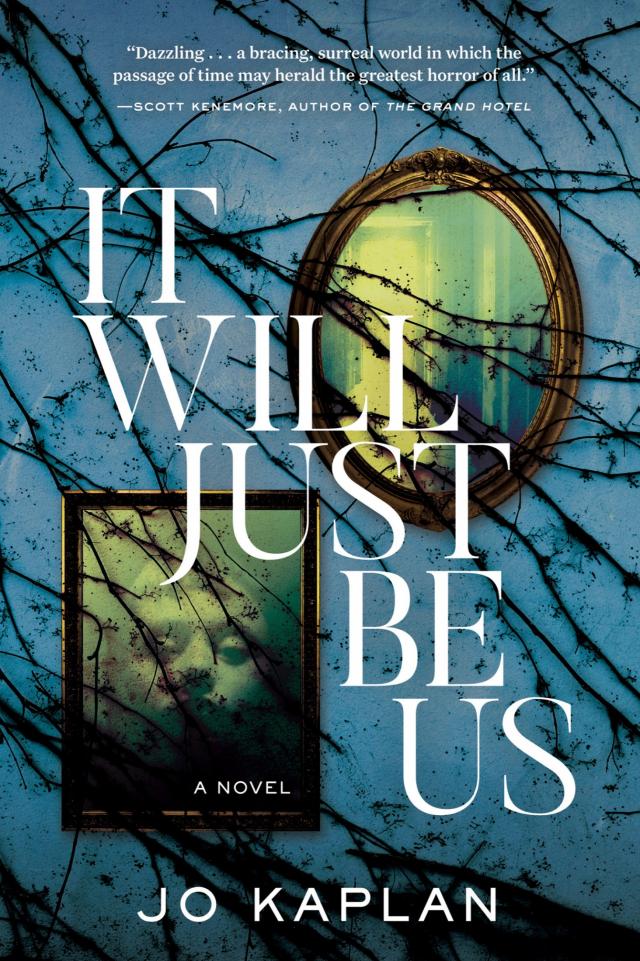
It Will Just Be Us, page 17


I just want to protect her. I know what she’s like when she breaks.
I roll down the window, and a cold wind unfurls through the car. She glances at me, but I say nothing. The cold air whips me awake, lifts my hair over my eyes.
In the end, I don’t tell her. I pull through the wrought-iron gate and down the long driveway with tree roots disturbing the cracking pavement, toward the looming endless labyrinth of memories and rooms and locked doors.
* * *
Mother sleeps heavily tonight.
My thoughts are spinning, and I cannot sleep a wink. It is always like this, when the more I want to sleep, the more I convince myself to sleep, the less able I am, and I grow too hot for the covers so I cast them off, and my ear hurts pressed into the flat old pillow so I turn to my other side, and now I am too cold on that side so I pull the covers back up and stretch my legs out, pondering the end of the bed with my toes.
Outside I hear a rough-throated creak. It shrieks, pauses, shrieks again in a nerve-shuddering rhythm, as if to deliberately antagonize me. After a time I realize I am hearing the front gate buffeted back and forth on its rusted hinges by a bored, irritable wind.
Unable to take the incessant wails, I get up to go latch the gate shut.
Night meets me, cold, pushing me along the front drive, urging me away from the house. The sky must be overcast because there are no stars, only an oppressive dark, and the clouds breathing down on me. The wind incuriously whistles out the word who as it passes.
I wish the gate were closer. With the stars shut out, the only light comes from the hazy impression of moon blurring mysteriously behind thin clouds, and beyond that a dull flickering light on the front porch that I switched on as I came outside. My eyes adjust well enough, but the dark is unfriendly.
And in that unfriendly dark, the moon reveals someone standing on the other side of the gate.
The gate swings back, away from me, toward the faceless boy of twelve or thirteen who stands against the night. He grabs the rusted black edge of the iron gate, which must be biting cold to the touch, and pushes; it swings back my way, releasing a burdened groan.
The wind drags it back again, asking who? as it passes.
Julian pushes the gate toward me.
Slowly I begin to back up the driveway toward the house, my skin gone prickly with goose bumps and a sick chill, like that of a fever.
“Auntie?” he says.
I stop. His face is trained on me, the darkness of his eyes in my direction. I don’t respond. Maybe he does not see me after all. It seems an irrational hope, but it is the only thing that makes sense.
“Auntie?” he says again.
My voice comes out low and rough. “Yes, Julian?”
“Let’s play hide-and-seek.”
“No,” I say as I resume backing up, unable to turn my back on that faceless gaze.
“You better hide,” he says. “I’m going to find you.”
Then he puts his hands over his eyes and begins counting. “Twenty … nineteen …”
I turn and run.
Distantly I am aware of how absurd it is, to be running from a child like this, a child who isn’t even really there (or is he?), but I can’t stop thinking about the way he said he would find me, he is going to find me, and the wind is blowing frantically in my ears now, asking WHO? WHOOO? as I bolt for the house.
“Sixteen … fifteen …” His voice recedes, almost inaudible beyond the roar in my ears.
I reach the front door, pull it open, throw myself inside, and close it behind me.
The sudden silence and utter dark make it all feel unreal. My heart thunders in my ears. I lock the door.
Go to bed, I tell myself. Go to bed, forget this happened, and in the morning you’ll feel awfully silly, won’t you?
Instead, I peer around the curtain to see out the window. From here, I can’t quite make out the gate, even with the porch light still on. My breathing is annoyingly loud. I wait, searching out movement in the stillness, for a moment that seems painfully long.
Maybe he has gone, I think.
Then I see the shape of him moving slowly up the driveway toward the house. My heart leaps and I flick the switch to turn off the porch light, realizing belatedly that he will know I am standing here when he sees the light go out, realizing also belatedly that now I cannot see him out there, cannot watch his progress to the front door, cannot know how close he is, knowing that at every moment he is closer still, and even though the door is locked, I drop the curtain and back away.
All the house seems strange and unfamiliar to me. I have to feel my way blindly from the foyer into the sitting room, where I trip over something hard and land roughly on my knees. The offending object is Nathaniel’s camera. He must have left it when he ran from here. I pick it up and pull the strap around my neck to carry with me.
Just when I think I have passed into the dining room, I realize I am actually in the library, and I’ve not a clue how I got there. Panic rises in me, reminding me of the time I became lost in the dark as a child, running through the house in a frantic bid to find my way and finding, instead, tucked away in a corner of the library, the old woman in the chair, the old woman with Xs for eyes, who froze me fearfully while her gnarled fingers trembled as she lifted them into the air, who chuckled behind closed lips, who vanished when I threw on the light. It is as if the house must mutate in the dark, changing and transforming itself when it cannot be seen. As if it becomes malleable, uncertain.
I hear the front door click and swing open.
Maybe it is Julian making the house like this, making it shift into different shapes. Maybe Julian is like a tumor, a cancer, driving the house insane.
The twisting in my gut tells me to hide. Whatever happens, I don’t want him to find me.
There is nowhere to hide in this room. The walls are lined with bookcases, and the only furniture is a set of ancient moth-eaten chairs and a chaise lounge. It’s possible I could elude him by slinking along the towering bookcases, making sure there is always one between me and him, but eventually he would find me. In the foyer, I can hear his footfalls creaking slowly across the floor, and I pad on silent cat feet, carefully distributing my weight so as not to make a sound.
Now I am in front of a door where I do not think there was one before—or maybe only the memory of a door, the house remembering something that once was here but is no longer. Can I open the door if it is only a memory? And where would it lead? Into memoryscape, dreamland, the impossible space between dimensions?
I push it open, and it is solid under my palm—real, then. And within a descending blackness, releasing an abyssal cold. I am at the door to the basement, though I cannot fathom how I’ve gotten here. I am turned around, and it so unsettles me that I feel on the verge of panic at every moment, thinking I may never find my way out of this rat’s maze. At least, not until dawn, which seems so very far away.
Julian is much closer than the sun.
No, I do not want to go into the basement, but I can hear him following me through the rooms as he rustles through hiding spots—the shift of a curtain, the opening of a large cabinet, the tossing of blankets off couches—all done in methodical silence rather than the boisterous animation one might expect of a child playing hide-and-seek.
Away from the basement door, I move on, across to the billiards room inhabited by a very old pool table, never used even though sometimes you can hear the faint clicking of balls when you walk past. Now three-quarters of the balls are missing, and there are only two sad lonely cues left, splintered and long forgotten, against the wall to watch over the green domain of the table. At the other end of the room are another sitting area, a china cabinet, and a small card table.
Shall I hide beneath the pool table? That is a terrible spot, as there is no real cover—but does it matter, in this kind of darkness? I could simply stand in the corner and I doubt he would find me, for he wouldn’t be able to see. Though now, as I think it, I am getting the strange sensation that perhaps he has the capacity to see in the dark. Certainly it is absurd, but I cannot shake the idea, and as I stumble around the room, seeing it only in my mind’s eye, from memory, I slam my hip into the corner of the pool table and let out a yelp of pain and surprise.
As soon as I do, I freeze, listening.
At first I do not hear anything. Then, footsteps, moving quickly now toward the billiards room. I stumble and feel my way to the next room, thinking how ridiculous it is that there should be so many rooms with so many names and functions, so many layouts I have had to memorize, and for what? So that I can get lost in my own house as it pushes me from one room to the next, daring me to forget, forget where I am, until I am locked in a black hole with no escape?
I make my way to the back of the house, through the kitchen, and now I am in the laundry room, a cold concrete space that seems to lack the warmth of the rest of the house. This is it, I think, and for a moment I contemplate climbing into the washing machine, but the thought of locking myself in that tiny space unhinges me and I instead ensconce myself in the linen closet, which unfortunately has slats in the doors and only so much room that I must stand right up against the doors when they are closed. From the dingy window, the moon washes gray over the little room.
Just then I hear several sharp clacks, something bouncing and rolling across the floor. A white orb, like a flash-frozen blind cow’s eye, rolls into the laundry room and eventually comes to a stop. It is the cue ball.
The laundry room door, which I left ajar, creaks open a little more, and the shadow steps in.
“I’m going to find you,” he says.
He is holding one of the two remaining pool cues, its dull tip pointed up and the heavier end below. When the light approaches his face, it seems to blur even further until it is no more than a strange white oval.
Julian jabs the cue into a pile of laundry like a javelin and uses it to lift up the crumpled shirts. He comes around to the washing machine and taps the cue against it, three small hard taps with increasing force.
He starts laughing as he hits various objects, laughing at nothing.
I could tackle him, I think. I could burst from this closet and throw myself upon him, wrestle the pool cue free—
But what if he is stronger than his size suggests? What if I am not fast enough, or not strong enough? I am small, yes, perhaps not small enough to be bested by a twelve-year-old, but who is to say?
At last he approaches the closet. He brings the cue up and drags it down the slats, making a staccato sound.
“Auntie,” he whispers into the slats. “Are you in there?”
He can hear my breathing. He must know I am here, even if he cannot see me through the slats of the dark closet, where the moon doesn’t penetrate.
Then, bringing his mouth up close to the nearest opening: “Found you.”
He rips open the closet doors as I lift the camera and hit the shutter, and a bright flash sears the air but does not seem to slow him; he swings the pool cue wide and hard. The stick connects with my shoulder and I cry out at the sting, fold over to my knees on the floor, the camera swinging around my neck. He hits me again on the small of my back; the force nearly puts me flat on my stomach, but I manage to crawl forward, away from the blows as he laughs above me, and reach out for the cue ball. As I do, he lunges forward, stomping where my fingers were only a moment ago, trying to stomp them like he did to those frogs, to that bird, and laughing. When he steps back, I reach out again, swiftly this time.
Before he can bring the stick down on me, I turn over and heave the ball at him like a shot put. To my amazement, it passes through him as if he were no more than smoke, then passes through the window with a great shattering crash. Julian disappears before his laughter does.
The cold moon creeps in upon me through the hole in the window as I lie panting on the floor, feeling a red sting in the places where he hit me.
From upstairs, I hear my mother call out groggily, “Sam? Sam? What was that?”
I crawl to my feet and look out the broken window. Outside, the cue ball sits in the dewy grass among the glittering shards of glass.
* * *
“I’m sorry about the window.”
Agnes waves a dismissive hand, but I can see she is thinking about her bank account and making some calculations. “At worst, we have cardboard and duct tape. I think there’s an old tarp around here somewhere.”
A red welt has erupted on my shoulder, and it hurts when I move it; I try not to let on as I crouch in the damp grass, picking up shards of glass by the light from inside the laundry room. Mother initially told me to leave it until morning, but I find something cathartic about picking up the glass. It focuses my attention away from the bruises growing on my back.
“Why did you throw the ball?” Agnes asks. Her voice is nonchalant, but there is something more beneath it, covered over with carefulness.
I cannot keep it inside me any longer. The secret is clawing its way out. What if Julian hurts my mother, too? She has to know about him.
“He frightened me,” I say at last.
“Who did?”
“Julian.”
I prick my finger on a shard of glass and put it in my mouth as blood bubbles to the surface. “I’ve seen him,” I continue, not looking at her. “I’ve seen him everywhere.” I think of the small crawling thing in the hallway, the boy pulling feathers off a bird, the one who chases me through the house, these many incarnations of him.
When I finally look up at her, I see shock on her face. Shock, but not the disbelieving kind.
“Why didn’t you tell me?”
“I didn’t want you to worry.” I turn back to the work of picking up the glass. “There’s something wrong with him.”
The moon comes out and lights the pieces of glass into beautiful shining things. How strange that something so sharp and dangerous could be so beautiful, like stars crashed into the ground. I remind myself to be careful.
“What do you mean?”
“He’s going to kill a little girl,” I tell her, wishing this revelation felt like a weight off my chest rather than a deep, sinking feeling in my gut, as if speaking it aloud has made it more real, as if the act of sharing reality has cemented its true form. I hear my mother suck in her breath. “And … others, too, I think. I don’t know how many. There’s something … inhuman about him. Even as a boy.”
My mother appears to be speechless. A long moment passes. “Well, that can’t be,” she mumbles at last, shaking her head.
I resume my cleaning while she stands where she is, lost in thought, and we are left with the sound of the locusts buzzing low and mellow, owls adding their spectral moans to the song of the swamp. The night is cold, and the dew on the grass is half-frozen, making it increasingly difficult for me to differentiate between glass and ice. My fingers, gone white and numb, grow clumsy and stiff. They stop feeling like my fingers.
“Let’s finish this in the morning,” says my mother with a hand on my shoulder, pulling me up.
“But what about Julian?”
Her eyes are sharp as the shards of glass scattering the ground. “What about him?”
I gape at her, wondering how my mother can just tuck away the thought of her grandson murdering children—tuck it away with whatever else lives under the blanket of wine she used to pull over her brain, the way she had to learn to tuck away the sight of her husband hanging himself.
“Don’t you care?” I snap, thinking of all those times she ignored us as children, turning away from my nightmares of the old woman with Xs for eyes, becoming a ghost of herself while Elizabeth and I got lost in the swamp. My heart feels laden with rot.
“There are more important things,” she says. “Lizzie is in the hospital right now.”
“Yeah, because of him!”
“It’s no use making yourself sick over it now.” She turns to go back into the house. “We will deal with Julian when the time comes. We will make everything right.” Wind whistles through the gaping, jagged hole in the window, and she pauses beside it. “Put some tarp over this, will you? Best keep out the chill.”
She disappears into the house and, presumably, up to bed. I do as she asks—what else can I do?—but even when I return to my own room, sleep eludes me. I gaze wide awake through the dark, imagining Julian creeping up the stairs, Julian twisting the handle of my bedroom door, Julian hovering somewhere in the shadowy corners of my room, watching me sleep, and I find I can hardly close my eyes. The welt on my shoulder stings when I remember where it came from.
I go to the bathroom to splash water on my face, and when I raise my head, I think I see him, or some dark shape, behind my own reflection.
My father said something was following him through the mirrors. I rub my arms, my skin prickling over with goose bumps. I back out of the bathroom, unable to turn from the mirror until I can safely step out of its grasp.
Perhaps there is more in his journal that will help me understand. I go back to my room for it, but before I grab it, my eyes alight on the old brass key hanging on a small hook. Maybe instead of telling me, he can show me.
Do I want to see what my mother saw?
I take the key and let my feet carry me up the creaking stairs, around the soft sagging spots where the floorboards have rotted, to that narrowing of the third floor hall that gives one a sense of the walls closing in.
I have already placed the key in the lock when I notice a piece of paper on the floor, stuck partially under the door. It is a child’s drawing, filled with trees, and frogs leaping out of the swamp—leaping, in motion, but dead, their eyes covered over with Xs, closing them forever from what they cannot see.
I take a step back, considering the drawing.
This is Julian’s room, isn’t it?
The back of my neck prickles. I feel the sensation that I am not alone. Someone is behind me, perhaps whoever I thought I glimpsed in the bathroom mirror.
When I turn, expecting Julian, expecting whatever dark shape lurks on the other side of our own reflections, I see August Wakefield holding a gun.
I roll down the window, and a cold wind unfurls through the car. She glances at me, but I say nothing. The cold air whips me awake, lifts my hair over my eyes.
In the end, I don’t tell her. I pull through the wrought-iron gate and down the long driveway with tree roots disturbing the cracking pavement, toward the looming endless labyrinth of memories and rooms and locked doors.
* * *
Mother sleeps heavily tonight.
My thoughts are spinning, and I cannot sleep a wink. It is always like this, when the more I want to sleep, the more I convince myself to sleep, the less able I am, and I grow too hot for the covers so I cast them off, and my ear hurts pressed into the flat old pillow so I turn to my other side, and now I am too cold on that side so I pull the covers back up and stretch my legs out, pondering the end of the bed with my toes.
Outside I hear a rough-throated creak. It shrieks, pauses, shrieks again in a nerve-shuddering rhythm, as if to deliberately antagonize me. After a time I realize I am hearing the front gate buffeted back and forth on its rusted hinges by a bored, irritable wind.
Unable to take the incessant wails, I get up to go latch the gate shut.
Night meets me, cold, pushing me along the front drive, urging me away from the house. The sky must be overcast because there are no stars, only an oppressive dark, and the clouds breathing down on me. The wind incuriously whistles out the word who as it passes.
I wish the gate were closer. With the stars shut out, the only light comes from the hazy impression of moon blurring mysteriously behind thin clouds, and beyond that a dull flickering light on the front porch that I switched on as I came outside. My eyes adjust well enough, but the dark is unfriendly.
And in that unfriendly dark, the moon reveals someone standing on the other side of the gate.
The gate swings back, away from me, toward the faceless boy of twelve or thirteen who stands against the night. He grabs the rusted black edge of the iron gate, which must be biting cold to the touch, and pushes; it swings back my way, releasing a burdened groan.
The wind drags it back again, asking who? as it passes.
Julian pushes the gate toward me.
Slowly I begin to back up the driveway toward the house, my skin gone prickly with goose bumps and a sick chill, like that of a fever.
“Auntie?” he says.
I stop. His face is trained on me, the darkness of his eyes in my direction. I don’t respond. Maybe he does not see me after all. It seems an irrational hope, but it is the only thing that makes sense.
“Auntie?” he says again.
My voice comes out low and rough. “Yes, Julian?”
“Let’s play hide-and-seek.”
“No,” I say as I resume backing up, unable to turn my back on that faceless gaze.
“You better hide,” he says. “I’m going to find you.”
Then he puts his hands over his eyes and begins counting. “Twenty … nineteen …”
I turn and run.
Distantly I am aware of how absurd it is, to be running from a child like this, a child who isn’t even really there (or is he?), but I can’t stop thinking about the way he said he would find me, he is going to find me, and the wind is blowing frantically in my ears now, asking WHO? WHOOO? as I bolt for the house.
“Sixteen … fifteen …” His voice recedes, almost inaudible beyond the roar in my ears.
I reach the front door, pull it open, throw myself inside, and close it behind me.
The sudden silence and utter dark make it all feel unreal. My heart thunders in my ears. I lock the door.
Go to bed, I tell myself. Go to bed, forget this happened, and in the morning you’ll feel awfully silly, won’t you?
Instead, I peer around the curtain to see out the window. From here, I can’t quite make out the gate, even with the porch light still on. My breathing is annoyingly loud. I wait, searching out movement in the stillness, for a moment that seems painfully long.
Maybe he has gone, I think.
Then I see the shape of him moving slowly up the driveway toward the house. My heart leaps and I flick the switch to turn off the porch light, realizing belatedly that he will know I am standing here when he sees the light go out, realizing also belatedly that now I cannot see him out there, cannot watch his progress to the front door, cannot know how close he is, knowing that at every moment he is closer still, and even though the door is locked, I drop the curtain and back away.
All the house seems strange and unfamiliar to me. I have to feel my way blindly from the foyer into the sitting room, where I trip over something hard and land roughly on my knees. The offending object is Nathaniel’s camera. He must have left it when he ran from here. I pick it up and pull the strap around my neck to carry with me.
Just when I think I have passed into the dining room, I realize I am actually in the library, and I’ve not a clue how I got there. Panic rises in me, reminding me of the time I became lost in the dark as a child, running through the house in a frantic bid to find my way and finding, instead, tucked away in a corner of the library, the old woman in the chair, the old woman with Xs for eyes, who froze me fearfully while her gnarled fingers trembled as she lifted them into the air, who chuckled behind closed lips, who vanished when I threw on the light. It is as if the house must mutate in the dark, changing and transforming itself when it cannot be seen. As if it becomes malleable, uncertain.
I hear the front door click and swing open.
Maybe it is Julian making the house like this, making it shift into different shapes. Maybe Julian is like a tumor, a cancer, driving the house insane.
The twisting in my gut tells me to hide. Whatever happens, I don’t want him to find me.
There is nowhere to hide in this room. The walls are lined with bookcases, and the only furniture is a set of ancient moth-eaten chairs and a chaise lounge. It’s possible I could elude him by slinking along the towering bookcases, making sure there is always one between me and him, but eventually he would find me. In the foyer, I can hear his footfalls creaking slowly across the floor, and I pad on silent cat feet, carefully distributing my weight so as not to make a sound.
Now I am in front of a door where I do not think there was one before—or maybe only the memory of a door, the house remembering something that once was here but is no longer. Can I open the door if it is only a memory? And where would it lead? Into memoryscape, dreamland, the impossible space between dimensions?
I push it open, and it is solid under my palm—real, then. And within a descending blackness, releasing an abyssal cold. I am at the door to the basement, though I cannot fathom how I’ve gotten here. I am turned around, and it so unsettles me that I feel on the verge of panic at every moment, thinking I may never find my way out of this rat’s maze. At least, not until dawn, which seems so very far away.
Julian is much closer than the sun.
No, I do not want to go into the basement, but I can hear him following me through the rooms as he rustles through hiding spots—the shift of a curtain, the opening of a large cabinet, the tossing of blankets off couches—all done in methodical silence rather than the boisterous animation one might expect of a child playing hide-and-seek.
Away from the basement door, I move on, across to the billiards room inhabited by a very old pool table, never used even though sometimes you can hear the faint clicking of balls when you walk past. Now three-quarters of the balls are missing, and there are only two sad lonely cues left, splintered and long forgotten, against the wall to watch over the green domain of the table. At the other end of the room are another sitting area, a china cabinet, and a small card table.
Shall I hide beneath the pool table? That is a terrible spot, as there is no real cover—but does it matter, in this kind of darkness? I could simply stand in the corner and I doubt he would find me, for he wouldn’t be able to see. Though now, as I think it, I am getting the strange sensation that perhaps he has the capacity to see in the dark. Certainly it is absurd, but I cannot shake the idea, and as I stumble around the room, seeing it only in my mind’s eye, from memory, I slam my hip into the corner of the pool table and let out a yelp of pain and surprise.
As soon as I do, I freeze, listening.
At first I do not hear anything. Then, footsteps, moving quickly now toward the billiards room. I stumble and feel my way to the next room, thinking how ridiculous it is that there should be so many rooms with so many names and functions, so many layouts I have had to memorize, and for what? So that I can get lost in my own house as it pushes me from one room to the next, daring me to forget, forget where I am, until I am locked in a black hole with no escape?
I make my way to the back of the house, through the kitchen, and now I am in the laundry room, a cold concrete space that seems to lack the warmth of the rest of the house. This is it, I think, and for a moment I contemplate climbing into the washing machine, but the thought of locking myself in that tiny space unhinges me and I instead ensconce myself in the linen closet, which unfortunately has slats in the doors and only so much room that I must stand right up against the doors when they are closed. From the dingy window, the moon washes gray over the little room.
Just then I hear several sharp clacks, something bouncing and rolling across the floor. A white orb, like a flash-frozen blind cow’s eye, rolls into the laundry room and eventually comes to a stop. It is the cue ball.
The laundry room door, which I left ajar, creaks open a little more, and the shadow steps in.
“I’m going to find you,” he says.
He is holding one of the two remaining pool cues, its dull tip pointed up and the heavier end below. When the light approaches his face, it seems to blur even further until it is no more than a strange white oval.
Julian jabs the cue into a pile of laundry like a javelin and uses it to lift up the crumpled shirts. He comes around to the washing machine and taps the cue against it, three small hard taps with increasing force.
He starts laughing as he hits various objects, laughing at nothing.
I could tackle him, I think. I could burst from this closet and throw myself upon him, wrestle the pool cue free—
But what if he is stronger than his size suggests? What if I am not fast enough, or not strong enough? I am small, yes, perhaps not small enough to be bested by a twelve-year-old, but who is to say?
At last he approaches the closet. He brings the cue up and drags it down the slats, making a staccato sound.
“Auntie,” he whispers into the slats. “Are you in there?”
He can hear my breathing. He must know I am here, even if he cannot see me through the slats of the dark closet, where the moon doesn’t penetrate.
Then, bringing his mouth up close to the nearest opening: “Found you.”
He rips open the closet doors as I lift the camera and hit the shutter, and a bright flash sears the air but does not seem to slow him; he swings the pool cue wide and hard. The stick connects with my shoulder and I cry out at the sting, fold over to my knees on the floor, the camera swinging around my neck. He hits me again on the small of my back; the force nearly puts me flat on my stomach, but I manage to crawl forward, away from the blows as he laughs above me, and reach out for the cue ball. As I do, he lunges forward, stomping where my fingers were only a moment ago, trying to stomp them like he did to those frogs, to that bird, and laughing. When he steps back, I reach out again, swiftly this time.
Before he can bring the stick down on me, I turn over and heave the ball at him like a shot put. To my amazement, it passes through him as if he were no more than smoke, then passes through the window with a great shattering crash. Julian disappears before his laughter does.
The cold moon creeps in upon me through the hole in the window as I lie panting on the floor, feeling a red sting in the places where he hit me.
From upstairs, I hear my mother call out groggily, “Sam? Sam? What was that?”
I crawl to my feet and look out the broken window. Outside, the cue ball sits in the dewy grass among the glittering shards of glass.
* * *
“I’m sorry about the window.”
Agnes waves a dismissive hand, but I can see she is thinking about her bank account and making some calculations. “At worst, we have cardboard and duct tape. I think there’s an old tarp around here somewhere.”
A red welt has erupted on my shoulder, and it hurts when I move it; I try not to let on as I crouch in the damp grass, picking up shards of glass by the light from inside the laundry room. Mother initially told me to leave it until morning, but I find something cathartic about picking up the glass. It focuses my attention away from the bruises growing on my back.
“Why did you throw the ball?” Agnes asks. Her voice is nonchalant, but there is something more beneath it, covered over with carefulness.
I cannot keep it inside me any longer. The secret is clawing its way out. What if Julian hurts my mother, too? She has to know about him.
“He frightened me,” I say at last.
“Who did?”
“Julian.”
I prick my finger on a shard of glass and put it in my mouth as blood bubbles to the surface. “I’ve seen him,” I continue, not looking at her. “I’ve seen him everywhere.” I think of the small crawling thing in the hallway, the boy pulling feathers off a bird, the one who chases me through the house, these many incarnations of him.
When I finally look up at her, I see shock on her face. Shock, but not the disbelieving kind.
“Why didn’t you tell me?”
“I didn’t want you to worry.” I turn back to the work of picking up the glass. “There’s something wrong with him.”
The moon comes out and lights the pieces of glass into beautiful shining things. How strange that something so sharp and dangerous could be so beautiful, like stars crashed into the ground. I remind myself to be careful.
“What do you mean?”
“He’s going to kill a little girl,” I tell her, wishing this revelation felt like a weight off my chest rather than a deep, sinking feeling in my gut, as if speaking it aloud has made it more real, as if the act of sharing reality has cemented its true form. I hear my mother suck in her breath. “And … others, too, I think. I don’t know how many. There’s something … inhuman about him. Even as a boy.”
My mother appears to be speechless. A long moment passes. “Well, that can’t be,” she mumbles at last, shaking her head.
I resume my cleaning while she stands where she is, lost in thought, and we are left with the sound of the locusts buzzing low and mellow, owls adding their spectral moans to the song of the swamp. The night is cold, and the dew on the grass is half-frozen, making it increasingly difficult for me to differentiate between glass and ice. My fingers, gone white and numb, grow clumsy and stiff. They stop feeling like my fingers.
“Let’s finish this in the morning,” says my mother with a hand on my shoulder, pulling me up.
“But what about Julian?”
Her eyes are sharp as the shards of glass scattering the ground. “What about him?”
I gape at her, wondering how my mother can just tuck away the thought of her grandson murdering children—tuck it away with whatever else lives under the blanket of wine she used to pull over her brain, the way she had to learn to tuck away the sight of her husband hanging himself.
“Don’t you care?” I snap, thinking of all those times she ignored us as children, turning away from my nightmares of the old woman with Xs for eyes, becoming a ghost of herself while Elizabeth and I got lost in the swamp. My heart feels laden with rot.
“There are more important things,” she says. “Lizzie is in the hospital right now.”
“Yeah, because of him!”
“It’s no use making yourself sick over it now.” She turns to go back into the house. “We will deal with Julian when the time comes. We will make everything right.” Wind whistles through the gaping, jagged hole in the window, and she pauses beside it. “Put some tarp over this, will you? Best keep out the chill.”
She disappears into the house and, presumably, up to bed. I do as she asks—what else can I do?—but even when I return to my own room, sleep eludes me. I gaze wide awake through the dark, imagining Julian creeping up the stairs, Julian twisting the handle of my bedroom door, Julian hovering somewhere in the shadowy corners of my room, watching me sleep, and I find I can hardly close my eyes. The welt on my shoulder stings when I remember where it came from.
I go to the bathroom to splash water on my face, and when I raise my head, I think I see him, or some dark shape, behind my own reflection.
My father said something was following him through the mirrors. I rub my arms, my skin prickling over with goose bumps. I back out of the bathroom, unable to turn from the mirror until I can safely step out of its grasp.
Perhaps there is more in his journal that will help me understand. I go back to my room for it, but before I grab it, my eyes alight on the old brass key hanging on a small hook. Maybe instead of telling me, he can show me.
Do I want to see what my mother saw?
I take the key and let my feet carry me up the creaking stairs, around the soft sagging spots where the floorboards have rotted, to that narrowing of the third floor hall that gives one a sense of the walls closing in.
I have already placed the key in the lock when I notice a piece of paper on the floor, stuck partially under the door. It is a child’s drawing, filled with trees, and frogs leaping out of the swamp—leaping, in motion, but dead, their eyes covered over with Xs, closing them forever from what they cannot see.
I take a step back, considering the drawing.
This is Julian’s room, isn’t it?
The back of my neck prickles. I feel the sensation that I am not alone. Someone is behind me, perhaps whoever I thought I glimpsed in the bathroom mirror.
When I turn, expecting Julian, expecting whatever dark shape lurks on the other side of our own reflections, I see August Wakefield holding a gun.


