

It Will Just Be Us, page 12
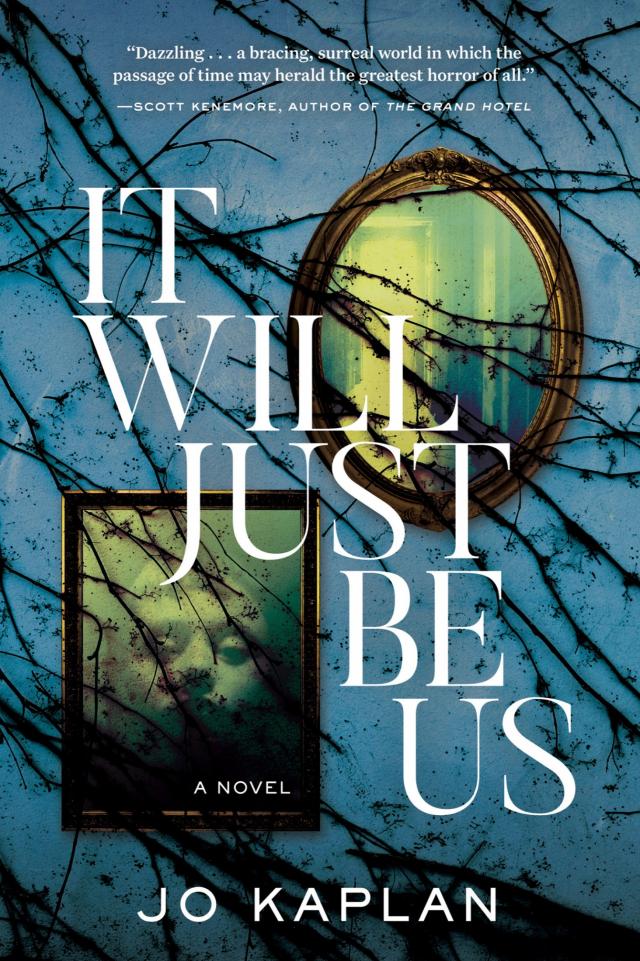


The other creatures, indeed, who are whispering now all around me.
My voice feels too loud, even though I speak with the merest breath. “Julian? Is it you?” I steady my voice. “I want to talk to you, Julian. Come out, now. Let’s just talk. Can you tell me … what did you do to the girls you put down here? Why did you hurt them?”
Still no clear answer but for the indistinct vocalizations that I hear from the walls, or perhaps from the mirror, susurrations of history, haunting us here.
I am waiting to see him creep out of the shadows, into the shivering candlelight. I hope he doesn’t have a knife.
Instead I see vague movement in the mirror, and I feel, like a whisper of the swamp, warm muddy breath on the back of my neck. A low throaty sound begins chattering beside me, and I see now that there is a face in the mirror, although I cannot make out any of the features at this angle, only the shape of it, the impression of eyes and a mouth. It takes all my willpower not to turn my head.
“Hello?” A pit of dread opens in my gut. As awful as it is to think of speaking with Julian, I am unnerved by the possibility that I’ve opened a doorway to something else entirely. “Who am I speaking to?”
The voice intones only guttural nonsense syllables. It is like listening to a garbled television submerged in a fish tank. I must not look into the mirror.
“Julian.” Without shouting, I raise my voice—what I think of as my teacher’s voice. It echoes through the basement like a slap.
The only way to change the future is to understand it, but I’m starting to wonder, the longer I wait in the dark, how much more there really is to understand. I keep hoping to see a sliver of humanity in him, something to reach out to, but what if it isn’t there?
I think of the way he brought the rock down on Constance: deliberate, unemotional.
A door in front of me—one of the doors to those flooded tunnels that snake through the damp earth—creaks slowly open, exhaling with it the black stench of death. Now I cannot take my eyes off the doorway, even though I am blind to whatever lies within. I must watch. I must not look into the mirror, but in its surface the face opens its mouth as if to laugh, and a low slithering voice emerges. How long will you wait before you stop him?
Now I can sense something in the tunnel, creeping down the throat of earth toward the basement on its hands and knees, or on many legs; I can hear the slosh of water, sucking feet in mud; yes, something is coming.
Will you wait for him to begin mutilating animals?
The candle fights to maintain its potency, but its flame flickers in the damp air moving in from the tunnel.
Will you wait for him to begin murdering children?
I can almost see a figure now, in the darkness, pressing against the doorway, but it is only my imagination conjuring him up. The distant sounds of the tunnel might be nothing at all—might be rodents or frogs or only my imagination. I cling to this belief, wanting nothing of whatever might live in those dank underground passages.
Will you wait for him to grow into a man?
“No,” I say to the voice in the mirror, a sharp crack, a command that stays the invisible figure beyond the doorway. “Who are you? You’re not him. Who am I speaking to?”
Cold, sick air blows in from the tunnel and caresses the candle flame.
You are speaking to yourself.
Unable to stand it any longer, I turn my head to look into the face that has been mocking me from the fringes, and with a start I see only my own face staring back—my own face, my own eyes, my own mouth, but all is strange and unfamiliar, like the face of a stranger. As if it isn’t my face at all but only the house, replicating me.
“I am speaking to myself,” I murmur, and then laugh wildly. Thank goodness Elizabeth and my mother are asleep and not here to witness my foolishness. And it will serve them right, I think spitefully, when they realize, at last, what Julian is. What he really is. Elizabeth will never believe, until she sees it with her own eyes, that she could create such a monster in her womb. Create something terrible out of her own flesh.
Unless, I think with a chill coming over me. Unless that is why the house is showing him to me—because I am the only one who can do the unthinkable. Unless I am to stop him from ever being born.
Can I do the unthinkable deed?
When a figure moves across the basement, I nearly jump out of my skin, thinking it is Julian, come at last, come to take care of his auntie—but it is only my mother. I laugh again, as we do so often when we are afraid.
“Jesus, Mother, you scared me. What are you doing up?”
I expect her to ask what I am doing sitting alone in the dark, laughing to myself; she does not respond but continues to the shelves, and I see in the candlelight that she is younger—not terribly younger, perhaps by fifteen years or so. It is not my mother. Or rather, it is an echo of her.
“What are you doing?” I ask, knowing she cannot hear me.
Taking my candle to light the way, I follow her to the shelves that house old dolls and boxes of dusty antiques, peeling away spider webs grown over the forgotten detritus. Holding up the light, I see that her face is haggard and drained, with hollow, red-rimmed eyes. This is from the time when she drank heavily.
Eventually she finds a small wooden jewelry box with a chain of pearls curled up in its velvet-lined interior. Lifting the tangled necklace, she takes something metallic from her pocket and slips it into the box. Just before she lays the pearls on top of it, I get a glimpse of rusted bronze.
Shutting the box, she stands on her toes and reaches up to slide it onto the highest shelf. Then, wiping dust from her hands, Agnes turns and stalks away.
Dread thrills my heart. What did she slide so delicately under that string of pearls so many years ago?
Because I am several inches shorter than my mother, I drag the wooden chair to the shelves and stand on it to peer over the highest one. As I do, the rickety legs tremble and rock beneath me. Lifting the candle reveals in that flickering glow a small jewelry box sitting at the far back of the shelf, flush against the wall and gray with years of accumulated dust and webs. I reach for it; the box feels sticky with grime.
Perhaps I will open this box and there will be nothing inside anymore—or perhaps I will find only my great-grandmother’s pearl necklace, and I will be left to wonder at the mystery of it all. It feels somehow as if I have been waiting my whole life to open this little box, and I almost laugh again at my foolishness. Fear does make us irrational creatures. I vow to be less irrational, to be more sensible in the future.
Still standing on the chair, with the candle balanced on the shelf, I blow frenetic plumes of dust from the top of the carved wooden box and carefully open the lid, which creaks on its rusted hinges. Inside, the pearls gleam, untouched; gently, I pull them out in one long knotted strand and hold them up, away from the box.
Sitting in the black velvet lining, as if it has been waiting here just for me, is an old bronze key.
* * *
Perhaps they are like reflections, these echoes in the house. Reflections of what once was there, the house constructed of one great mirror so seamlessly incorporated with reality that we do not even see the edges or the backing but only the perfect image of the world echoed back at us. If so, my encounter with the mirror, with seeing a me that was not-me, reveals itself as a recursive anomaly; if I was attempting to shine a mirror onto a mirror, then I was creating an infinity mirror, and here I am, mise en abyme, placing myself into an abyss of reflections. If such is the case, and the reality of this house is a mirror, then it would stand to reason that all mirrors in this place are suspect, are wormholes to infinity, and are therefore not to be trusted. I shall have to be careful not to look directly into them while I brush my teeth.
Or, perhaps, shining a mirror onto another mirror will finally reveal the secrets of the house, solving the mystery of our lives. Like a key in a lock.
That I now have possession of the key mitigates my dread not at all, for the weight of it lies heavy in my pocket, and I can feel it there, waiting to be reunited with the lock. Even though I have never seen this key before, it is only too clear where it leads. All other doors in this house are fitted to the skeleton key that opens them all, all except one. The one that, supposedly, has never been opened.
But if it has never been opened—if it has been locked since time immemorial—then how did my mother come to possess this key? And did she use it?
And why did she hide it?
Before leaving the basement and after pocketing the key, I make sure to close the door leading to the tunnel, hesitating there to feel the cold rank air pass over me and to peer down its length as far as I can see, which isn’t very far at all. Just far enough to make out the uneven ground patched with puddles and the roots that reach down through the earth like crooked tentacles from above.
It is almost two in the morning when I am finally back in bed. I leave the candle lit beside me and the mirror facedown, just in case.
* * *
My class the next morning proceeds in a groggy stupor. It is one of the introductory archaeology courses that does not involve fieldwork. You can tell, looking at the students, that they want to be out there doing things, digging in the earth like groundhogs, but instead they are trapped here in this little white box of a classroom, with me.
It is the kind of class where I set up the premise of finding a piece of clay pottery and ask them what sort of dating techniques they would use, and a student in the back replies, “I would start with buying her dinner.” It is the kind of class where I try again after the laughter has died down and am met only with dull silent stares, two dozen pairs of eyes gazing blankly at me like chips of glass, waiting for me to answer my own question. And I fight with myself because I want to teach them, I want them to offer their ideas and their excitement, but I am also afraid of them, afraid of their unreadable condemnatory stares and the thickness of their boredom, which pours into the air with a physical presence. They are strange beings, fortuitously wrought in human form by the whims of nature.
When class is over, I sit briefly in the emptied classroom, thinking how different it looks with its unpeopled desks—how different everything is when those who are meant to be there have vacated. Then I make my way down the long corridor toward the exit, passing small clusters of students, rooms filling up for the next period of classes, colleagues who offer a polite, indifferent nod. I am nearly to the end of the hall and the double doors that will expel me into the late-morning sunlight when I see, to my left, just beside the bathrooms and the custodian’s closet, a door that I have never noticed before, that does not match the others in this hallway. It is a large, heavy door of a dark wood with dizzying grain patterns that draw the eye to its bronze handle and lock.
There is no room number. When I put my hand against the wood, it feels cold, and when I put my ear against the wood, I hear nothing. I grasp the handle and try to turn it, but the door is locked.
And here is the bronze key, burning a hole in my pocket.
Perhaps, instead of unlocking the door and unleashing whatever lives inside, I should peer through the keyhole?
It is a large, old-fashioned keyhole, and I bend down and press my eye to it. Darkness within, but if I close my other eye and focus, I can just begin to make out a figure standing there, on the other side.
I stand up quickly, unnerved by the figure. I know it is impossible, but I wonder if my key will open this door. I consider taking it out, sliding it into the keyhole, stepping through … and where will I come out?
Footsteps pass behind me in the hallway. I ignore them.
Maybe Elizabeth is right. Maybe I am crazy.
Thinking this, I turn to leave the door behind me, and nearly step straight into one of my students, Valerie.
“Oh, sorry, Professor Wakefield,” she says, catching her balance. She peers at me through thick glasses that magnify her eyes to insectile proportions. “I was actually looking for you. I hope you don’t think I’m a snoop, but I heard you live near the Great Dismal Swamp.”
My attention is torn in two—half to the door, half to her. The school is not in Shadydale, it is far outside that little town, in its own college world, and yet for a moment I recoil in horror, thinking she must be one of them, thinking that Shadydale has bled its boundaries over to the school and has come to spread its sickness here.
“Yes?” I say, my throat tight with dread that I may have to abandon my post here and find some other position to make ends meet, that it is no longer safe for me here with this Shadydaler finding me, pinning me to a corkboard, identifying me as one of those Wakefields.
“I’ve always been curious about the area. Have you followed any of the archaeological work done there? Or have you done any?”
“I’m afraid I haven’t,” I say, trying to swallow my heart. “Done any of my own work, that is. I have studied it, though. It is a fascinating place.”
“It must be so interesting to live there,” Valerie agrees. “Do you think it would be worth it to take a field trip? Or maybe an independent study? I’d really like to do some fieldwork.”
“You want to go into the swamp?” What is she doing, I wonder; is she trying to distract me from what I have found? “It’s dangerous. The swamp swallows people whole and doesn’t even spit out their bones.”
“Oh,” she says, taking a small involuntary step back.
Briefly my mind flits to the possibilities of working with an apprentice in the field, the splendid conversations and the adventures we could have digging for small artifacts of forgotten civilizations, for Meriday’s decomposing dolls, for Wind Walker’s pipe, for the bones of the dead, the bones of children, the bones of those he’s killed—
“Do you know what this door leads to?” I say instead.
“I don’t know. I think there’s a faculty bathroom at the other end of the hall, if that’s what you’re looking for.”
“No.” Suddenly the wide hallway feels oppressive, the fluorescent lights harsh against the dim corners, washing out people’s faces and glaring strangely on their foreheads so that their eyes disappear into indistinct black pockets. There are no windows in this hallway, so we are enclosed, like the long narrow hallways of Wakefield Manor and its rooms draped with heavy curtains to keep out the light of the world.
“I’m sorry, but I have to go,” I tell her, needing to get away from here. Surely my key would not have opened it anyway. This is not the same door. Reality and I haven’t parted ways just yet; I am only mad north by northwest.
* * *
On the long drive home, I watch the countryside rush by and feel embraced by a state of calm. Now everything is opened up to me. How silly it was to fear that locked door, here with the sun beaming in through the windows. Next week, I will be wonderful with my students. I will be animated, I will engage them, and I will not be afraid of mysterious doors, because I will open the one at home and put it behind me. The thought brings me comfort.
How nice it is to drive, alone on the road. What a joy are the trees that stand so tall and proud even through their dying autumn, that lean this way and that to question who will inherit this earth of theirs, these trees that transcend time. What a joy is the day with its sun on the long dewy grass that hides multitudes of insects and other tiny creatures in its gently waving skin. I could stay out here all day and never tire of looking: the light, the sun. Why do we shut out life with curtains and shield ourselves from the marvel of the flowers that grow in their perfect golden spirals?
I almost consider passing up the turn that will lead me windingly to the house, passing it altogether so that I may simply keep driving, driving forever, but I do not because home draws me to it with a gravitational pull. I drive through the intricate iron gate with its fickle latch and come up to the house, observing it like a stranger to see what it looks like from the outside.
When you pull up, the house dwarfs you to insignificance. One can imagine it was once proud and beautiful, but now it is ill kept and fallen, bit by bit, into disrepair, into a great colossal wreck. I think one would not be surprised to discover that my mother and sister and I are all, in fact, ghosts, and that the place has actually been abandoned for years. That would explain the dusty windows, the thorny vines creeping over the facade, and the general air of gloom that presides over the land around it, which the house casts into shadow.
Autumn is especially apropos. Children who visit on Halloween come wanting to see the haunted house. They don’t come for the candy, or if they do, the candy is a kind of prize, not to eat so much as to show where they have been. They will come riding up on their bicycles in zombie makeup or ghost sheets, and push and shove one another closer to the house as a testament to their bravado, through the front gate, until they are finally at the porch and cannot turn back because now they have committed themselves.
Elizabeth always loved trick-or-treating. She and her gaggle of friends would sprint out into the night in their costumes like a flock of hungry birds. My mother would likely be inside watching a black-and-white monster movie over a glass of wine.
As for me, I preferred to stay home. It gave me a thrill to creep to the front door and peek out at whoever stood on the stoop, quivering, their pillowcases outstretched like beggars. It pleased me to watch their faces contort in fear, faces that had previously eyeballed me with whispered looks and corner-eyed glances. Children who muttered nasty things about the strange girls who lived on the edge of the swamp, whose games I tried to join even as they snickered behind my back, or behind their books and magazines—whose snickers and smirks I would like to wipe right off their faces.





