Collected Short Fiction, page 428


“Nevertheless,” Lundoon said gravely, “I have mining interests there. I must go, to protect them.”
“Impossible, señor!” The agent flung up his arms. “El Espanto would destroy the plane!”
“I have banking references. I’ll buy the plane.”
“Si, the plane. But the pilot! Who would risk his soul—?”
“Surely—” Lundoon said. “For American dollars—”
There was, the agent suggested, un Americano, who had no soul to risk. He might be found at some cantina in the city. Now, if the señor Burns were not too drunk to fly—
“Find him,” said Lundoon.
Sammy Burns was drunk enough to take the chance, and not too drunk to fly—as he explained, “Hell, it ain’t noon yet.” The battered plane took off. The Andes were first a mighty, snow-crowned barrier ahead, then a white and cragged waste beneath, and then a wall behind.
“Stranger,” Sammy Burns shouted at last, “I said I’d fly you to hell for a thousand bucks, and no questions asked or answered. Well, there you are. That’s Canusayacu.”
Still a hundred miles away, the mountain was blue with haze. But Lundoon could see that it had been truncated. Upon the leveled summit stood colossal machines. A skeletal tower, taller than the old peak had been, was spindle-shaped in outline.
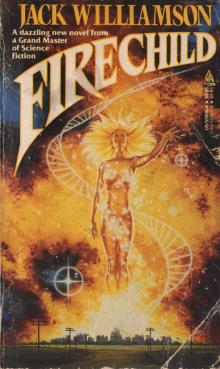
SEEMING small amid his stupendous mysterious works, and yet clearly visible at a hundred miles, Lundoon could see the nude gray magnificent form of the busy Child.
“Land me on the mesa,” shouted Lundoon. “As close as you can.”
Sammy Burns lit a cigarette, leaned smiling to offer one. But Lundoon could feel his tenseness, glimpse the staring terror in his eyes.
He set down the little plane at last, upon a pajanole: an open, treeless plateau, tufted with yellow ichu grass. From its edge a great chasm dropped. Below naked boulder-fields rolled the far green of forests. Beyond, twenty miles away, stood truncated Canusayacu.
“So long, amigo,” shouted the pilot. “Don’t get too rough with him.”
The little plane bumped into the air, and whirled away as if on wings of fear. It was cold, at this altitude, even in the sun’s white glare. Lundoon’s heart thumped painfully from the small exertion of climbing a little grassy ridge, from which he could look across the valley.
For a long time he stood there, staring through binoculars at the busy Child. It seemed to Lundoon that his mighty hands molded the stone of the mountain as a man molds clay—and he knew that those lofty, enigmatic constructions were of something stronger than any common metal.
Lundoon’s task was simple.
He had merely to make this gray splendid god the slave of mankind. Or, if the Child refused, if all his persuasions and his threats were to fail, if nothing else was left—then he had to kill the Child.
A simple task—but infinitely appalling.
The long afternoon slipped away. Lundoon stopped his watching long enough to open the Gladstone and set up the radio communicator. But still he could not bring himself to speak. His mind was dulled with awe. Doubts rose against his resolution.
The Child was perfect, he thought, eternal. Truly, a god. It might be that the entire purpose of all mankind, in the cosmic telology, had been only his creation. What possible right had men to enslave or destroy him?
The sun dropped beyond the westward summits. For a brief time the Child’s machines were stark enigmas against the flaming Andean dusk. Then it was dark. But a pale green, that had been invisible by day, shone from the Child’s body—a secondary emanation, Lundoon supposed, from his radioactive vital processes—and he worked on without rest at his unknown enterprise.
The icy night wind of the páramos came down from the high glaciers. Lundoon stirred himself at last, to put on a heavy coat, eat and drink hastily from the supplies he had brought, and then to inspect again the small aluminum tube that held the Child’s death.
Again Lundoon hesitated. He shuddered, from something more than cold. But at last he closed the transmitter key, and said quietly:
“Hello. A man is speaking.”
THE valley was a black sea. Beyond it, the nude glowing form of the Child was motionless for an instant, amid the great machines that loomed against the tropic stars. Then blue flaming eyes discovered Lundoon.
“Man, I am glad you have come.” The giant’s lips did not move, but the voice in the phones was deep and clear. “I wanted to warn your race, so that you may prepare to die.”
Lundoon drew a long uneven breath, of the icy mountain air.
“You are going to destroy mankind—your makers?”
“Not from malice,” said the phones. “My first anger at you is forgotten.” The Child’s flaming eyes lifted, toward the tropic stars. “But I see other worlds, and beings upon them that seem closer kin than men. I am building a ship, to seek them.”
The green giant touched the spindle-shaped skeleton.
“My ship can’t be launched without the liberation of vast energies. I shall curb them as much as may be. But I think the recoil, the disturbance of air and sea and the Earth’s crust beneath the blast of atomic force that drives my ship, will surely be fatal to your puny race.”
The issue appeared sharp to Lundoon as the night wind’s chill. It was the life of man or the life of the Child. But what right, he asked himself uneasily, had he to judge?
At last, trembling, he said:
“So you will destroy your makers?” “I am sorry,” said the Child. “But it is not at my request that I exist.” Lundoon reached under his coat. His numbed fingers found the studs on the detonator of the radiation-bomb. He could set it off, he thought, before any agency of the Child could cross the intervening miles.
Across the black chasm, that immense shining figure jerked as if with surprise. Lundoon knew that the Child had perceived his action and its meaning. But the giant made no hostile move. From the phones, the deep voice asked:
“Why do you delay my death? You know you can’t coerce me. I’ll be no slave to your miserable breed!”
“I know,” Lundoon said slowly. “But still I’m not sure that I’ll destroy you.”
The shining face of the Child looked puzzled.
“Why should you let me destroy your race?”
“I’ve no right to kill you,” Lundoon said. “Men are chained to this planet, doomed with it. You may lead a greater life, eternal as the universe. You are a more splendid being, above the baseness, the uncertainty, the conflicts that torment mankind—”
“Wait.” Beyond the black chasm, the Child lifted a shining arm. “I’m a man. Suddenly, now, I see that. With the same weakness, the same selfishness. But you have made my plan impossible. I couldn’t accept the willing sacrifice of the race that made me.”
The Child lifted a colossal beam, that he had been about to set in place upon the space ship. For a little time he held it, as if uncertainly. Then he flung it down the mountain slope. The plateau shook to its fall.
Suddenly it occurred to Lundoon that he ought to suspect a trick. The voice in the phones said promptly:
“No, neither of us has lied.”
He knew then that the Child was above deception. A slow elation began to rise from his new sense of communion with the supernal mind beyond the chasm. Here was a god, indeed, able to satisfy all the needs of mankind.
“The man who was my father,” that great voice came again, “told me of all he planned for me to do. He wanted me to be the leader and the judge and the servant of mankind. You have made me see that I must do that.”
CHAPTER VIII
FOR a long time, that night, Lundoon talked to the Child. The shining giant upon the far-mountain ceased to be strange and terrible.
They were like two men, calmly discussing a practical matter across a table. The plan they made was simple. The Child would talk to men, and they would follow him.
All the rest would come from that. But, first, there were two preliminary steps. The Child must build a radio station, powerful enough to carry their appeal to all the world. And he must bathe his body with a solution which would absorb those deadly radiations, which had been fatal to Kallent and the woman Marion. Meantime, for his own safety, Lundoon must wait where he was.
Dawn had come when their communion ended, and the Child went back among his machines, to begin his new tasks. Lundoon found himself stiff with cold. He found dry brush to make a fire, and warmed himself, and heated food. Then, lying in the direct cold sun, he wrapped himself in his coat and went to sleep—to dream of the new era coming, of men beneath the Child.
The roar of a motor woke him, to the glare of noon. He peered across to the flat-topped mountain, looking for the Child. The giant was invisible. But, among the machines, was a new immense black cylinder. He supposed that must be the tank in which the Child was treating his body, to stop the harmful rays.
Dazzled, it was a little time before he could find the plane. But it landed, and came bumping toward him across the clumps of sere yellow grass. Out of it sprang Gina Arneth.
She wore no prosaic flying togs, but something of shimmering silk. Her hair was amber flame. In the pale, passionate oval of her face, her eyes were still pools of violet midnight. In a glad husky voice, she sobbed:
“Wendy—”
Like a wild cold wind, a great sudden fear swept Lundoon. His knees were weak, as he stumbled to meet the girl. He knew that her coming promised disaster to the Child, and all their splendid plan.
But she was in his arms, and in his blood.
“Wendy, I’ve brought you a letter.” Her whisper was swift and uneasy. “Don’t be angry, please. This was the only way they would let me come. They learned about Kallent, you see, and traced you here.”
Lundoon ripped open the stiff yellow envelope. He saw the printed name, Cotterstone, and the sheet trembled in his fingers. He read the bold black script:
Lundoon: A thankful world will reward your destruction of the giant with a lifetime annuity of one hundred million dollars, the yearly payment of that sum being guaranteed by the great nations.
—J. Hollworthy Cotterstone.
He slowly crumpled the heavy yellow sheet, and looked up into the anxious violet eyes of Gina Arneth. He smiled a faint tired smile.
“I’m sorry you came, Gina,” he said softly. “Because I loved you—too much to expect you to stoop to this. I think I ought to kill you, Gina—there’s an automatic in my bag. But I’m going to let you go back to Cotterstone. Tell him again: no sale.”
HER violet eyes were level, unflinching.
“You don’t understand,” she told him quietly. “Cotterstone knows now that I really love you. He’s afraid that I would betray him, to you and the giant. He told me not to come back—not until the giant is dead. He’d kill me, if I did.
“Cotterstone’s an emperor, Wendy.” Her voice was low and urgent. “He knows that the giant threatens his power—he has an idea of why Kallent created the giant. And he’s fighting, now, to save his empire from any reform the giant might lead.”
Tears shone in her eyes.
“You see, Wendy, I can’t go back. He’s ruthless. His enemies just vanish.” Her persuasive fingers caught his arm. “May I stay, Wendy? If you are going to join the giant—and make the world over, as Cotterstone fears—I want to be on your side. Because—really—I love you.”
His dark head bent slowly, half reluctantly.
He whispered, “You may stay.”
“Wendy—my darling!”
She flung ecstatic arms around his neck. He kissed her, thirstily. Still he felt misgivings. He could not trust her, fully—he knew how much that reward must mean to her. But he began to talk about the plan. When she understood its reach and its splendor, she couldn’t fail to be loyal.
Gina Arneth was a bright and joyous companion. She listened eagerly to all he said, and her acceptance seemed complete. Her presence on that bleak mesa, Lundoon thought, made him happier than he had ever been.
“I love you, Gina,” he told her again. “If you’ll really come with me—and join the Child—it will be more than I ever hoped for.”
“I’ve done that, Wendy—for I love you, too.”
Her lips, and her warm, eager body, repeated her answer.
Still, when the sun set, the Child had not emerged from that huge black cylinder. Lundoon set out a simple meal. They ate, and presently—when even Lundoon had tired of his visions of the bright tomorrow dawning—they slept.
Lundoon to a sense of ineffable joy—from a dream that he was walking, hand in hand with Gina Arneth, through the halls of a splendid crystal palace. He whispered her name. Then, numb with sudden fear, he knew that she had gone.
His first conscious move was to grope for the little aluminum tube. It was gone. He knew instantly that Gina had taken it—that its loss meant the death of the Child.
Lundoon had not spoken of the radiation-bomb. Some tiny unconscious gesture must have betrayed its position. But Gina—Incredulity stunned him. Still he could feel the laughing joy of her nearness, her love like a flame. It simply couldn’t all have been a ruse, a lie.
But the bomb was gone.
Then he heard the motor again, and realized that it had waked them. In the cold night wind that came down from the glaciers, the stiff motor was reluctant to start. It coughed and died. Again he heard the starter.
DESPERATELY, Lundoon stumbled upright. He found his bag. The contents were turned out. Gina evidently had searched for the gun. But he found it safe in the little hidden pocket that had brought it through the customs.
The cold motor caught at last, roared.
Lundoon worked the slide to load the gun. He ran stiffly toward the plane. Pale in the light from the instruments, he saw Gina’s face. Intent over the controls, she was unaware of him.
The flat gun came up in his hand, grew steady. Then Gina’s oval face looked up, and she smiled. Her beauty meshed him, a clinging web he could not break. The plane lurched forward, rushed past him. It was a diminishing sound in the night.
The gun dropped out of Lundoon’s hand.
The Child was doomed.
Regret more bitter than the night wind pursued Lundoon across the black plateau. His shoulders sagged beneath a weight of guilt that seemed too great to bear. His tortured brain could find but one possible atonement.
Staggering against the freezing wind, he went back to the camp—now starkly desolate, since Gina was gone. He found flashlight, notebook, pen. For a time, with numb fingers and straining eyes, he was busy.
He set down the formula for generation of the azoic radiation. An untested force. And there was no time for experiment, for selection and precision. It would be merely a hasty blotting of other life from the Earth, so that the Child might survive.
Lundoon was sick, shuddering, but he spurred himself to the task. When mankind was composed of such individuals as himself and Cotterstone and Gina Arneth, when it exiled Jethro Kallent and murdered Andrew Douglas, when it fought the Child through fear not of evil but of good—then the thing he did was right.
As he calculated and set down the last equations, he felt a tremor of the earth. The Child had already left the other mountain, and was striding toward him through the dark valley. The lean majestic body still shone, but the green had changed to a pure and luminous white.
Lundoon reeled to the communicator, to blurt out his confession:
“Master, I have given your life away—”
But the Child’s deep voice spoke gravely from the phones:
“I know what you have done. And I see the weapon that you have prepared to give me, to enable me to annihilate your kind tonight.”
Lundoon tried to shake away his awe.
“But you must hasten!” he cried. “Before your enemies can strike. Go back to your machines, and make the generator. I’ll read you the specifications.”
But the Child came on, with an unhurried stride, across the valley. The blue shining eyes were calm and not afraid. The edge of a level hand was set against the cliff. Lundoon, obeying a nod, leaped upon it, carrying the communicator. He was lifted into the night.
THE Child stood still. For a little time the blue radiant eyes rested upon Lundoon, and then they lifted toward the tropic sky.
“I have not lived,” the deep voice throbbed in the phones. “For I have been alone. Splendid visions have beckoned to me, and I have not attained them. And now I must die.”
“No!” A panic shook Lundoon, standing in the bitter wind upon that vast and luminous palm. “Use the ray—or, if you will not, the range of the bomb is limited. If you fled to the polar continent, perhaps, or into the sea—even yet there might be time!”
“No,” that great voice said slowly. “I am a man. I am the stuff of mankind—strength and weakness mingled. Any violence would destroy the strength. The best that I can do is leave its memory to my fellow men.” And the Child added, presently:
“All our plan was wrong. It had to fail. Man cannot be uplifted by force. He can only grow from within. He must have leaders, but the very need calls them forth. I am no more than another man, and less than others that shall come. My small part, now, is to die.” The shining hand moved beneath Lundoon. “I shall set you down, and wait—”
“No,” Lundoon protested. “Please hold me.”
He wanted to urge the Child again to save his life. But thinking of another, two thousand years ago, whose death had been the beginning of a new faith, he couldn’t speak. The Child’s eyes lifted to the starry sky again, and the deep voice said:
“You know, I have perceptions more delicate than men’s. Now, looking upon a vast planet that circles another sun—”
At that moment Lundoon saw a new violet star in the west. An intense flaming point, it fell in a long swift arc. Lundoon knew that it was the radiation bomb, dropped from a plane. It had the same color, he thought, as the eyes of Gina Arneth.
The Child’s bright palm quivered beneath him, and was suddenly rigid as iron. The pure white glow of the great body was abruptly extinguished, as the vital radioactive processes ceased. The blue light faded from the uplifted eyes.