A Duet (ss), page 1
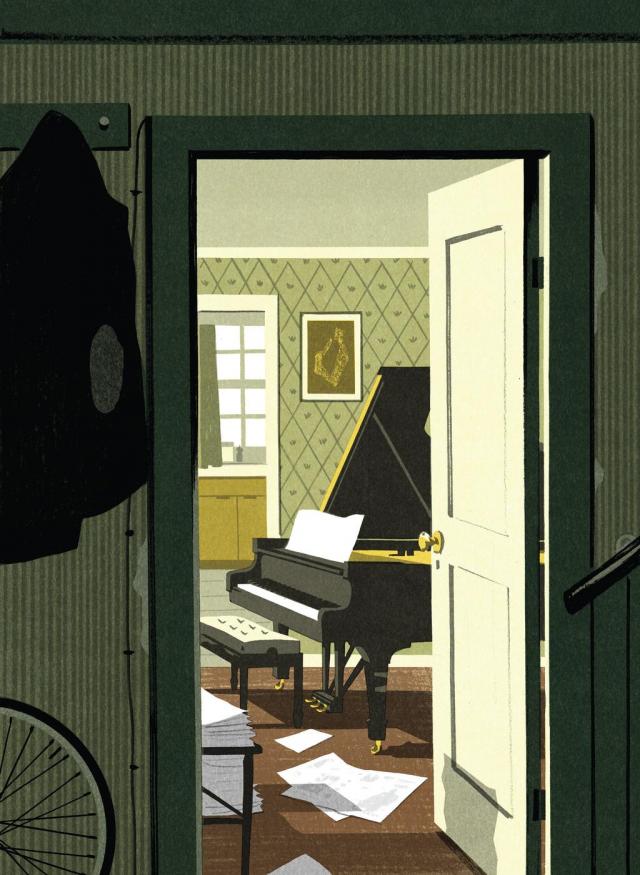


Fiction: A Duet
Ian McEwan
(ILLUSTRATION BY BILL BRAGG)
Berners, like most schools, was held together by a hierarchy of privileges, infinitesimally graded and slowly bestowed over the years. It made the older boys conservative guardians of the existing order, jealous of the rights they had earned with such patience. Why bestow new-fashioned favors on the youngest when they themselves had tolerated privations to earn the perks of greater maturity? It was a long, hard course. The youngest, the first- and second-years, were the paupers and had nothing at all. Third formers were allowed long trousers and a tie with diagonal, rather than horizontal, stripes. The fourth-years had their own common room. The fifth exchanged their gray shirts for drip-dry white, which they scrubbed in the showers and draped on plastic hangers. They also had a superior blue tie.
Lights-out time advanced by fifteen minutes each year. To start, there was the dormitory shared by thirty boys. Five years later, that was down to six. The sixth form could wear sports jackets and overcoats of their own choice, though nothing colorful was tolerated. They also had a weekly allowance of a four-pound block of Cheddar cheese to be divided among a dozen boys, and several loaves, a toaster, and instant coffee, so they could entertain themselves between meals. They went to bed when they pleased. At the apex of the hierarchy were the prefects. They were entitled to take shortcuts across the grass and shout at anyone lower down the scale who dared to do the same.
Like any social order, it seemed to all but revolutionary spirits to be at one with the fabric of reality. Roland did not question it at the start of the academic year in September, 1962, when he and ten others in his house took possession of their fourth-form common room. After three years' service, this was their first significant step up the ladder. Roland, like his friends, was becoming naturalized. He had acquired the easy manner the school was noted for, with hints of the nuanced loutishness expected of the fourth-years. His accent was changing from his mother's rural Hampshire. Now there was a touch of Cockney, a smaller touch of BBC, and a third element that was difficult to define. Technocratic, perhaps. Self-sure. He recognized it years later among jazz musicians. Not posh, and neither impressed by nor contemptuous of those who were.
In a dormitory shared with nine others, the expression of difficult feelings—self-doubt, tender hopes, sexual anxiety—was rare. As for sexual longing, that was submerged in boasts and taunts and extremely funny or completely obscure jokes. Whichever, it was obligatory to laugh. Behind this nervous sociability was the boys' awareness of a grand new terrain spread out before them. Prior to puberty, its existence had been hidden and had never troubled them. Now the idea of a sexual encounter rose on the horizon like a mountain range, beautiful, dangerous, irresistible. But still far away. As they talked and laughed in the dark after lightsout, there was a wild impatience in the air, a ridiculous longing for something unknown. Fulfillment lay ahead of them, they were cocksure of that, but they wanted it now. In a rural boarding school for boys, not much chance. How could they know what "it" really was when all their information came from implausible anecdotes and jokes? One night, a boy said into the darkness, during a lull, "What if you died before you had it?" There was silence in the dormitory as they took in this possibility. Then Roland said, "There's always the afterlife." And everybody laughed.
When the dormitory talk trailed away into the beginning of sleep, he retreated into his special place. The piano teacher, who no longer taught him, who had kissed him full on the lips when he was eleven, pinched his thigh once, unbuttoned his shorts to tidy his rumpled shirt, did not know she led a double life. There was the woman, the real one, Miss Miriam Cornell, the one who had invited him to lunch in her cottage when he was twelve. He had been too frightened of her to turn up. He saw her occasionally when he was near the sick bay, the stable block, or the music rooms. She would be alone, walking to or from her little red car, after or before a lesson. He never actually passed by her—he made sure of that. Then there was the woman of his daydreams, who did as he made her do, which was to deprive him of his will and make him do as she wished. He had to accept that she was now embedded in a special region of fantasy and longing, and that was where he wanted her to remain, trapped in his thoughts like the tamed unicorn behind its circular fence—the art master had shown the class a picture of the famous tapestry. The unicorn must never be free of its chain, never leave its tiny enclosure.
After three years of two hours a week with Mr. Clare, Roland was a promising pianist. He was working his way up the grades. After scraping through Grade 7, Roland was told by his teacher that he was "almost precocious" for a fourteen-year-old. Twice he had accompanied hymns on Sunday, when Neil Noake, by far the school's best pianist, was down with a cold. Among his peers, Roland's status hovered just above average. Being mediocre in sport and in class held him back. But he sometimes said something witty that was repeated about the place. And he had less acne than most.
The fourth-form common room had one table, eleven wooden chairs, some lockers, and a notice board. A further entitlement the boys had not expected appeared each day after lunch—a newspaper, sometimes the Daily Express, sometimes the Daily Telegraph. Discards from the staff common room. Roland came into the room one afternoon to see a friend sitting with his legs crossed, holding in front of him an open broadsheet, and he realized that they were grownups at last. Politics bored them, as they liked telling one another. As a group, they went for human interest, which was why they preferred the Express. A woman set on fire by her hair dryer. A madman with a knife shot dead by a farmer, who ended up in prison, to general disgust. A brothel unearthed not far from the Houses of Parliament. A zookeeper swallowed whole by a python. Adult life.
In that time, moral standards were high in public life and so, therefore, was hypocrisy. Delicious outrage was the general tone. Scandals became part of their sex education. The Profumo affair was less than a year away. Even the Telegraph carried photographs of smiling girls in the news with bouffant hair and eyelashes as thick and dark as prison bars.
Then, in late October, politics in the fourth-form common room became interesting. Unusually, the two newspapers arrived together on the table after lunch. Both were well thumbed, dog-eared, the newsprint softened by many hands, and both showed the same photograph on their front pages. For boys who had recently visited Lakenheath, the nearby U.S. Air Force base, on open day and had touched the cold steel nose of a missile, the way some might a holy relic, the story was compelling: spies, spy planes, secret cameras, deception, bombs, the two most powerful men on the planet ready to face each other down, and possible war. The photograph could have come from the triple-locked safe of an intelligence mastermind. It showed low hills, square fields, wooded terrain scarred white by tracks and clearings. Narrow rectangular labels had helpful pointers: "20 long cylindrical tanks"; "missile transporters"; "5 missile dollies"; "12 prob guideline missiles." Flying their U2 reconnaissance jets at impossible heights, using cameras with exciting telescopic power, the Americans had revealed to the world Russian nuclear missiles on Cuba, only ninety miles from the Florida coast. Intolerable, everyone agreed. A gun to the head of the West. The sites would have to be bombed before they became operational, then the island invaded.
What might the Russians do? Even as the boys of the fourth-form common room affected genuine grown-up concern at this new state of things, the words "thermonuclear warhead" conjured for them, like towering thunderclouds at sunset, a thrilling reckless disruption, a promise of ultimate liberty by which school, routines, regulations, even parents—everything—was to be blown away, a world wiped clean. A boundless adventure was at hand. They knew they would survive; they discussed rucksacks, water bottles, penknives, maps. Roland was by then a member of the photography club and knew how to develop and print. He had clocked some hours in the darkroom working on multiple versions of a view across the river, with oak trees and ferns, six inches by four, rather fine except for an annoying brown streak across the center that he had failed to eliminate. He was listened to with respect as he examined the fresh U2 photo that appeared on the second day. This one had new labels: "erector/launcher equipment"; "8 missile trailers"; "tent areas." Someone passed him a magnifying glass. He leaned in closer. When he discovered the mouth of a tunnel that the C.I.A. analysts had missed, he was believed. One by one, his classmates looked and saw it, too. Others had important theories of their own of what should be done, and what must happen when it was.
Classes went on as usual. No teacher referred to the crisis, and the boys were not surprised. These were separate realms, school and the real world. James Hern, the stern but privately kind housemaster, did not mention in his evening announcements that the world might soon be ending. The somewhat put-upon matron, Mrs. Maldey, did not speak of the Cuban missile crisis when the boys handed in their laundry, and she was usually irritated by any threat to her complex routines. Roland did not write about the situation in his next letter to his mother. President Kennedy had announced a "quarantine" around Cuba; Russian vessels, with a cargo of nuclear warheads, were heading toward a flotilla of American warships. If Khrushchev did not order his ships back they would be sunk, and the Third World War could begin. How could that make sense alongside Roland's account of planting nursery fir trees with the Young Farmers Club on boggy land behind the dormitory? Their letters crossed, and hers were as innocent as his. The boys had no access to TV—that was for the sixth form only on certain days. No one listened to or knew about serious radio news. There were some breezy announcements on Radio Luxembourg, but essentially the Cuban missile affair was a drama confined to the two newspapers.
The first rush of boyish excitement began to fade. The official school silence was making Roland anxious. He was most affected when alone. A moody stroll through the oaks and bracken beyond the ha-ha didn't help. For an hour he sat at the foot of the statue of Diana the Huntress, looking toward the river. He might never see his parents again, or his sister Susan. Or get to know his brother Henry better. One evening, after lightsout, the boys were discussing the crisis as they did every night. The door opened and a prefect came in. It was the Head of House. He didn't tell them to quiet down. Instead, he joined their conversation. They began to ask him questions, which he answered gravely, as if he himself were just back from the Crisis Room in the White House. He claimed insider knowledge, and they believed everything he said and were flattered to have him to themselves. He was already a full member of the adult world, and their bridge to it. Three years ago, he had been one of them. They couldn't see him in the darkness, only hear his low certain tone coming from the direction of the door, that school voice of softened Cockney touched with bookish confidence. He told them something startling, which they should have worked out for themselves. In an all-out nuclear war, he said, one of the important targets in England would be the Lakenheath airbase, less than fifty miles away. That meant that the school would be instantly obliterated, Suffolk would become a desert, and all the people in it would be—and this was the word he used—vaporized. Vaporized. Several boys echoed the word from their beds.
The prefect left, and the talk slowed and stumbled into the night as sleep took hold. Roland remained awake. The word would not let him sleep. It made sense. Mr. Corner, the biology teacher, had told the class not so long ago that the human body was ninety-three per cent water. Boiled away in a white flash, the remaining seven per cent coiling in the air like cigarette smoke, dispersed on the breeze. Or whipped away by the bomb's blast. There would be no heading north with his best friends, rucksacks loaded with survival rations, fleeing like Daniel Defoe's citizens escaping London in the plague year. Roland had not believed in the survival adventure, anyway. But it had kept him from dwelling on what might really happen.
He had never contemplated his own death. He was certain that the usual associations—dark, cold, silent, decay—were irrelevant. These were all things that could be felt and understood. Death lay on the far side of darkness, beyond even nothing. He was dismissive of the afterlife, like all of his friends. They sat through the compulsory Sunday-evening service in contempt of the earnest visiting vicars and their wheedling and beseeching of a nonexistent God. It was a point of honor with them never to utter the responses or close their eyes, bow heads or say "Amen" or sing the hymns, although they stood and opened the hymnal at a random page out of a residual sense of courtesy. At fourteen, they were newly launched on a splendid truculent revolt. It was liberating to be or feel loutish. Satire, parody, mockery were their modes, ludicrous renderings of authority's voice and stock phrases. They were scathing, merciless with one another, too, even as they were loyal. All of this, all of them, soon to be vaporized. He did not see how the Russians could afford to back down when the whole world was watching. The two sides, protesting that they stood for peace, would, for pride and honor's sake, stumble into war. One small exchange, one ship sunk for another, would become a lunatic conflagration. Schoolboys knew that this was how the First World War had begun. They had written essays on the subject. Each country had said it didn't want war, and then each had joined in with a ferocity the world was still trying to understand. This time there would be no one left to try. Then what of that first sexual encounter, that beautiful dangerous mountain range? Blown away with the rest. As Roland lay waiting for sleep, he remembered his friend's question: What if you died before you had it? It.
The next day, Saturday, 27th October, was the beginning of half-term. No Saturday lessons, no games, was the extent of it. School would resume on Monday. Some of the London boys had parents coming down. A sixth former had a copy of the Guardian and let Roland look. In the Caribbean, the Americans had allowed a Russian oil tanker bound for Cuba to pass. It was assumed that it contained only oil. The Russian ships carrying missiles brazenly strapped to their decks had slowed or stopped. But Russian submarines were reported in the area and new reconnaissance photos showed that work was continuing on the Cuban sites. The missiles were ready for firing. There was a buildup of American military forces in Florida, at Key West. It looked likely that the plan was to invade Cuba and destroy the sites. A French politician was quoted as saying that the world was "teetering" on the brink of nuclear war. Soon it would be too late to turn back.
Roland's bike was on a raised pavement behind the school kitchens, a rusty old racer with twenty-one gears and a slow leak in the front tire that he could never be bothered to fix. The day was warm and almost cloudless. Clear enough to watch missiles sailing in from the east. He came down the slope toward the church at speed, holding his breath against the smell of warmed pig swill from the sty, and at the Berners School lodge turned left toward Shotley. After a mile, he was looking out for his shortcut, a farm track on his right that would take him across flat fields, past Crouch House, along Warren Lane to the duck pond and Erwarton Hall. Every boy at school knew that Anne Boleyn had been happy there, visiting as a child, and that the future King Henry had come to court her. Before she was beheaded in the Tower of London at his command, she asked for her heart to be entombed in Erwarton church. It was said to be in a little heart-shaped box buried underneath the organ.
At the hall, Roland stopped, propped his bike by the ancient gatehouse, crossed the road, and walked up and down. Her house was only minutes away. He wasn't ready. It was important not to arrive sweaty and out of breath. He had spent so much time thinking about and avoiding Erwarton that he felt as if he, too, had spent his childhood here. Minutes later, he was passing a pub and some scattered houses and soon after he was outside her cottage. He knew it by her red car parked on the grass. There was a white picket gate and a brick path that led with a slight curve to her front door. He leaned his bike against the car, pulled his trousers free of his socks, and hesitated. He felt watched, though there was no movement at the two downstairs windows. Unlike the other cottages around, this one had no net curtains. He would have preferred her to come out to him. Greet him and do all the talking.
After a moment, he pushed open the gate and went slowly toward the door. The borders that ran along the path had the ruined look of a forgotten summer. She hadn't yet dug out the dying plants. He was surprised to see old plastic flowerpots on their side and sweet wrappers trodden into the dead leaves. She had always seemed a neat and organized person, but he knew nothing about her. He was making a mistake and should turn back now, before she saw him. No, he was determined to tie himself to his fate. His hand was already lifting the heavy knocker and letting it fall. And again. He heard rapid muffed thumps as she descended the stairs. There was the sound of a bolt withdrawn. She pulled the door open so fast and wide that he was instantly intimidated and couldn't meet her gaze. The first thing he saw was that she was barefoot and her toenails were painted purple.
"It's you." She said it neutrally, without hesitation or surprise. He lifted his head and they exchanged a glance, and for a confused moment he thought he might have knocked at the wrong house. Sure, she recognized him. But she looked different. Her hair was loose, almost to her shoulders. She wore a pale-green T-shirt under a cardigan, and jeans that ended well above her ankles. Her Saturday clothes. He had prepared something to say, an opening, but he had forgotten it.
"Almost two years late. Lunch is cold."
He said it quickly. "I had a long detention."
She smiled, and he blushed with helpless pride in his smart reply. It had come from nowhere.
"Come on, then."
He stepped past her into a cramped hallway, with a steep run of stairs in front of him and doors to the left and right.
"Go left."
He saw the piano first, a baby grand squashed into a corner but still taking up a good part of the room. Piles of music on two chairs, two small sofas facing each other over a low table, stacked with books. Today's newspapers were on the floor. Beyond, a door through to a tiny kitchen that gave onto a walled garden.