A Duet (ss), page 3


"Not ready yet," she said, and then she saw him. "Look at the state of you. Your trousers are filthy." She took his hand. "You're all scratched. You poor darling. Get your shoes off. Into the shower with you!"
He let himself be led upstairs. The backs of his hands were indeed bloody from the rose thorns. He felt cared for and just a little heroic. In her bedroom, he undressed in front of her.
Her tone was warm. "Look at you. Big again." She drew him toward her and fondled him while they kissed.
The shower was not a good experience. The water came out in a dribble, with a hair's-breadth turn of the tap between icy and scalding. When he returned to the bedroom, towel round his waist, his clothes were gone. He heard her coming up the stairs.
Before he could ask, she said, "They're in the washing machine. You can't go back to school covered in mud." She passed him a gray sweater and a pair of her beige slacks. "Don't worry. I'm not lending you my knickers."
Her clothes fit well enough, though the slacks looked girlish around the hips. There was an odd little loop that was supposed to go under his heel. He let it drag. As he followed her down the stairs, the thought that they were both barefoot pleased him. At their very late lunch she had a glass of white wine, which she said she preferred at room temperature. He did not know the rules of wine, but he nodded. She poured him some homemade lemonade. At first, they ate in silence, and he was nervous, for he was beginning to understand how quickly her moods shifted. It was also worrying that he was without his clothes. The washing machine was turning, making little moaning sounds. But soon he did not care, because he had a plate of roast lamb, pink, even bloody in places, which was new to him. And seven large pieces of roast potato and much buttery cauliflower. When it was offered, he accepted another plate of meat and then a third and a total of fifteen potato chunks and most of the cauliflower. He would have liked to pick up the half-full gravy boat and drink it all, because it was surely going to be thrown away. But he knew his manners.
Finally, she raised the subject, the only real topic. Since it had been the cause of his visit, he had automatically assumed the matter buried.
"I don't suppose you read the papers."
"I do," he said quickly. "I know what's happening."
"And what do you think?"
He considered carefully. He was so full of food, and he was also a new person—a man, in fact—and at that moment he was not really bothered. But he said, "We might all be dead tomorrow. Or tonight."
She pushed her plate aside and folded her arms. "Really? You don't look very scared."
His present indifference was a heavy weight. He forced himself to remember how he had felt the day before, and the night before that. "I'm terrified." And then, suddenly feeling the rich aura of his new maturity, he returned her question, in a manner that would never have occurred to a child. "What do you think?"
"I think Kennedy and all of America are behaving like spoiled babies. Stupid and reckless. And the Russians are liars and thugs. You're quite right to be frightened."
Roland was astonished. He had never heard a word against the Americans. The President was a godly figure in everything Roland had read. "But it was the Russians who put their missiles—"
"Yes, yes. And the Americans have theirs right against the Soviet border with Turkey. They've always said that strategic balance was the only way to keep the world safe. They should both pull back. Instead, we have these silly dangerous games at sea. Boys' games!"
Her passion astonished him. Her cheeks were red. His heart was racing. He had never felt so grown-up. "Then what's going to happen?"
"Either some trigger-happy idiot out at sea makes a mistake and it all blows up, just like you fear. Or they do the deal they should have done ten days ago, like proper statesmen, instead of driving us all to the brink."
"So you think a war might really happen?"
"It's just possible, yes."
He stared at her. His own position, that they might all die tonight, was largely rhetorical. It was what his friends and the sixth formers said at school. There was comfort in having everybody say it. But hearing it now from her was a shock. She seemed wise. The newspapers were saying the same kind of thing, but that mattered less. Those were stories, like entertainments. He began to feel shivery.
She placed a hand on his wrist, turned it, and found his fingers and interlocked them with hers. "Listen, Roland. It's very, very unlikely. They might be stupid, but both sides have too much to lose. Do you understand?"
"Yes."
"Do you know what I'd like?" She waited for his answer.
"What?"
"I'd like to take you upstairs with me." She added in a whisper, "Make you feel safe."
So they rose without letting go, and for the third time that day she towed him up the stairs. In the fading light of the late afternoon it happened all over again, and again he wondered at himself, how earlier in the day he had been so eager to get away, to regress and become a kid on a bike. Afterward, he lay on her arm, his face level with her breasts, feeling a growing drowsiness begin to smother him. His attention drifted in and out of what she was quietly saying.
"I always knew that you'd come....
I've been very patient, but I knew ... even though you didn't. Are you listening? Good. Because now that you're here you should know. I've waited a very long time. You're not to speak about this to anyone. Not to your closest friend, no boasting about it, however tempting it is. Is that clear?"
"Yes," he said. "It's clear."
When he woke it was dark outside and she had gone. The bedroom air was cold on his nose and ears. He lay on his back in the comfortable bed. From downstairs he heard the front door open and close and then a familiar ticking sound that he could not place. He lay for half an hour in loosely associated daydreams. If the world did not end, then the school term would, in fifty-four days. He would make the journey to his father's latest Army posting, in Germany, to be with his parents for the Christmas holidays, a prospect of comfort and boredom. What he liked was to think about the stages of the journey, the train from Ipswich to Manningtree, where the River Stour ceased to be tidal, change there for Harwich to get the night boat to the Hook of Holland, walk across the railway lines on the quayside and climb up onto the train to Hanover, at all stages checking the inside pocket of his school blazer to make sure his passport was still there.
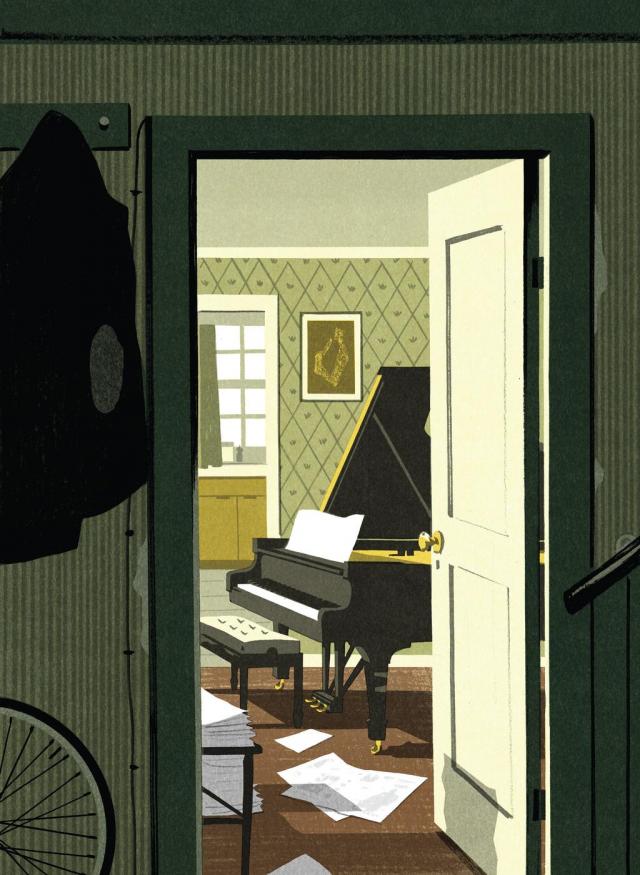
He dressed quickly in the clothes she had lent him and went downstairs. The first thing he saw was his bike propped against the piano. She was in the kitchen, finishing the washing-up.
She called to him. "Safer in here. I spoke to Paul Bond. Did you know I teach his daughter? It's fine for you to stay overnight." She came toward him and kissed his forehead.
She was wearing a blue dress of fine corduroy, with darker blue buttons down the front. He liked her familiar perfume. Now it seemed that for the first time he really understood how beautiful she was.
"I told him we're rehearsing a duet.
And we are."
He wheeled his bike through the kitchen into the garden and propped it by the shed. It was a night of stars and the first touch of winter. Already the beginning of a frost was forming on the lawn that he had raked. It crunched underfoot as he moved away from the kitchen light in order to see the smudged forked road of the Milky Way. A Third World War would make no difference to the universe.
Miriam called to him from the kitchen door. "Roland, you'll freeze to death. Get inside."
He went immediately toward her.
That evening they played the Mozart again, and this time he was more expressive and followed the dynamic markings. In the slow movement, he tried to imitate her smooth and seamless legato touch. He thundered his way through the allegro molto and the cottage seemed to shake. It hardly mattered. They laughed about it. At the end, she hugged him.
The next morning, he slept late. By the time he came downstairs, it was even late for lunch. Miriam was in the kitchen preparing eggs. The pages of the Sunday paper, the Observer, were spread across an armchair and the floor. There was no change; the crisis continued. The headline was clear—"KENNEDY: NO DEAL TILL CUBA MISSILES ARE MADE USELESS." She gave him a glass of orange juice and made him play another Mozart duet with her, this time the F major. He sight-read all the way. Afterward, she said, "You play the dotted notes like a jazz musician." It was a rebuke he took as praise.
When, at last, they sat down to eat and she turned on the radio for the news, the story had moved on. The crisis was over. They listened to a deep voice, rich in authority, issue the deliverance. There had been an important exchange of letters between the leaders. The Russian ships were turning back, and Khrushchev would order that the missiles be removed from Cuba. The general view was that President Kennedy had saved the world. The Prime Minister, Harold Macmillan, had phoned his congratulations.
It was another cloudless day. The low afternoon sun, well past the equinox, blazed through the glazed upper half of the kitchen door into the little sitting room and spilled across the table. As Roland ate his omelette, he felt again the insidious desire to be off, hurtling along the route he had in mind. Out of the question. He had already been told that while she ironed his clothes he would be washing the dishes. She had earned the right to tell him what to do. But she'd had it from the beginning.
"What a relief," she kept saying.
"Aren't you happy? You don't look it."
"I am, honestly. It's amazing. What a relief."
Thirty years later, he would understand the damage, how derailed his life was by her, how distorted his expectation of love. When he was twelve, she had touched and unwound a little coil in his being and, without having to do more, she had possessed him. Two years later, pursued by fear and childish vanity and incoherent desire, he had run to her. It would take him half a lifetime to frame it in such simple terms. But now, here at the sunlit lunch table, many layers below his outward decorum, and barely available to the ignorant boy, was a mere suspicion that he had been cheated of something. The world would go on, he would remain unvaporized. He needn't have done a thing.
NEWYORKER.COM
Ian McEwan on global events and private lives. ■
Ian McEwan, A Duet (ss)