

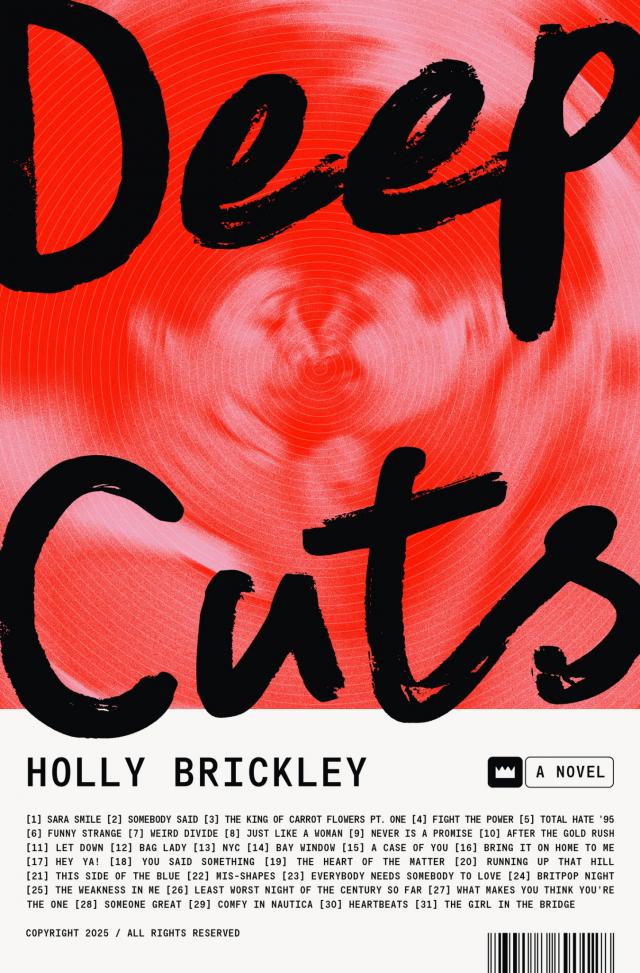
Deep Cuts, page 4


I felt an impulse to argue with this—he was smart, he was young, etc.—but I held it back. It occurred to me he might not be getting the best grades.
“The problem is, it’s not always easy for me to know what’s good, when it’s my own stuff. All I know is ‘Somebody Said’ is the best thing I’ve written—I’m sure of that, I’ve never been so sure of anything. And it makes me think I…I need your help.”
“I’m not a songwriter,” I said.
“You don’t need to write. Just react. Do what you did with ‘Somebody Said.’ ”
I felt myself smiling. “Okay.”
We worked all night. We drank coffee with heaping spoonfuls of sugar. I started by telling him which fragments I liked best and why—I had retained enough from my mom’s piano lessons to speak the language of music, albeit with a child’s proficiency—and then opened the spigot on my opinions as he worked. He had absorbed some confusing music theory from a handful of three-inch tomes on his bookshelf with names like How Music Really Works, all of them swollen and shaggy with Post-its, and he would use this knowledge to explain some beautiful choices and also to defend some extremely questionable ones.
“But I wanted to do the sixth with the diminished chord!” he’d say.
“But it clashes with what the song is saying here.”
“But what you’re proposing is less interesting!”
“But it works.”
He’d play it my way on the keyboard and the guitar and then the keyboard again. Finally he’d plug it into Cakewalk on his desktop, just to prove me wrong, while I did some of Megan’s yoga stretches on the floor or read his CD booklets.
“Damn,” he’d say, playing it back, realizing I was right. (Not always. Sometimes I made a fool of myself with musically illiterate suggestions; some things he refused to change, trusting his gut more than me. These moments felt initially devastating, but he was so casual about them, moving on before I had a chance to dwell—plus I felt buoyed by our victories, by each time the song would suddenly, in a single tectonic shift, become better.)
At one a.m. a roommate came into the living room and announced in a huff that he was going to his girlfriend’s. Joe promised to make it up to him, something about donuts from Oakland.
We had turned his fragments into two almost-songs when I noticed the window had lightened. I became, at the sight of the dawn, crushingly tired. I had Shakespeare at ten-thirty.
“Come with me to get donuts,” Joe said, putting the computer to sleep. “Then I’ll drive you home.”
Outside the air was bluish and unreal. The streetlights were still on, accomplishing nothing. As soon as we found his roommate’s car parked four blocks away, I curled up in the passenger seat and rested my head on the seat belt strap.
“Oh, hell no,” Joe said as he turned onto Telegraph. “Talk to me. Keep me awake.”
“But I’m cozy,” I murmured.
“Remember twelve hours ago or whatever at the beginning of this night, when I gave you that speech about Public Enemy—God, was I standing?”
“Yes. The whole time. And holding your guitar like this.” I held my arm out.
He laughed. “Well, give me your speech. What’s your high school story?”
“I just existed,” I said, yawning. “Nobody died. I had one friend, but her parents were strict so I was alone a lot. There was a tendency for people to be”—I used my hands to show opposing magnetic force—“repelled. By me.”
He leaned over the steering wheel and looked intently out the window as if he were having a conversation with the road. “And this was in Indiana?”
“Yeah. Madison. Small town on the river.”
“One of those places with racists and big-box stores?”
“No. I mean, yes, racists, but historical charm. My mom would never live somewhere ugly. She’s a snob.”
“No way.”
“Yeah, she—oh, you’re kidding. Hah.”
“Sorry.”
“It’s okay. I don’t see myself as a snob, but I get what you mean.”
He glanced at me, seemed reassured by whatever he saw. “What do people do there?”
“My dad makes car parts at a factory. He works hard.” I tried to think of what else people did in my hometown, but instead my brain served up an image of my mom scrubbing a spot on our Formica counter with a sponge, then switching to her fingernail. “So does my mom.”
“Were you poor?”
“Only moderately, in the context of our town. In fifth grade my dad got promoted to manager—that was the year I got real Keds.”
“Hah. My dream was Reebok Pumps.”
I smiled, remembering the way a certain type of pubescent boy would crouch down to his shoes, pump up the tongues with a toss of his hair. “Did you ever get them?”
“No. I always managed to get tapes and CDs, though.”
“Me too. I got a job at the Dairy Queen to support that habit. The high point of my year would be my brother’s games in Louisville or Indianapolis—I’d have my parents drop me off at the HMV and blow my whole check.”
“Okay, so, here’s my question,” he said. “Why? Why’d you get so into music?”
“I didn’t get into music,” I said. “People who work at Amoeba, they got into music. My mom got into music. I got into songs.”
“Mmm. I like that.” He drove quietly for a minute and then he tapped my thigh lightly with the back of his hand. “You haven’t answered me. Why? Was it your snobby mom? Dad a jerk?”
I laughed. “You think bad parenting is the only reason people love songs?”
“Well—” He laughed too. “Maybe? I mean really love songs. There’s got to be a driving force.”
My eyelids were a heavy curtain above the sky, which was white now with morning fog. I could still sense the presence of his hand; he must have rested it on the edge of the passenger seat. “I think songs gave me a window into a magical life,” I said. “Something bigger, or whatever, waiting out there. And I felt like the only way to get there was through the songs. Like the songs, if I listened hard enough, would show me how to get it right.”
“Get what right?”
I let my eyes close, feeling the rumble of the car, the heat of his upturned palm near my leg.
“This.”
Total Hate ’95
The first time I heard Zoe’s loud, lispy voice was on my answering machine, when she invited me to a Ring Finger meeting. I went to her apartment at the appointed time, the night before everyone left for Thanksgiving. She lived in one of those boxy ’70s buildings with sliding-glass doors and bikes on the balcony. The idea was to use the long weekend to work on our contributions for the next issue, but I’d come prepared with my No Doubt piece, the printout still warm in my Dickies bag. I wore my thick-soled Mary Janes because they were the closest thing I had to platforms.
Zoe greeted me warmly. “Joey loves you!” she said in that voice. If there was any complexity behind this statement, any resentment, it didn’t show. We hugged, and I smelled the astringent hair product keeping two tangled mounds of hair high on her head.
She sat on a black tufted couch and two girls alighted beside her. Each wore a heavy studded belt on low-slung pants. Another girl and I found spots on scattered pieces of IKEA furniture. Joe wasn’t there; it was later revealed he’d gone to San Francisco to see a friend’s band. Everyone discussed their travel plans for the long weekend, their one- or two- or six- or seven-hour drives. When I said I’d be staying in town, there was an awkward silence, like they were trying to figure out how to express sympathy without sounding condescending. It occurred to me in this moment that the printout in my bag might actually be quite terrible.
When it was my turn, I handed it to Zoe, hoping nobody noticed my shaking hand. The two girls next to her on the futon bent their heads next to hers, and the third scrambled to the arm of the couch, peering over their shoulders.
No Doubt Is Fucking Good
Oh shut up. I’m tired of being impressed by how much you hate No Doubt. Because before she was a red-carpet gazillionaire Gwen Stefani was fucking rad, with a voice like an ambulance siren and the stage presence of a prehistoric beast. Take “Total Hate ’95,” from the self-released album The Beacon Street Collection, whose cover appears to feature a black-and-white photo of Phil Collins swallowing a bright yellow canary and should thereby prove my point that this band is magnificent, no? PHIL COLLINS SWALLOWING A CANARY. Think of the implications. (There are probably no implications.) (I am also not positive it’s Phil Collins.)
“Total Hate ’95” features a classic ska breakdown sung by Bradley Nowell, pre–heroin overdose, of the band Sublime. I KNOW I KNOW YOU HATE SUBLIME EVEN MORE THAN YOU HATE NO DOUBT. And his part does include the line “Sublime rockin’ No Doubt stylie,” which is indefensible. (Doesn’t it seem impossible that someone with a heroin addiction could say “stylie”?) But listen to those horns. Listen to Gwen fucking owning this whole giant mess of musicians, the control in her voice, the rich contempt. Listen to all the guitars in the chorus, a descending seesaw of the crunchiest chords that make even me want to mosh, and I am not a mosher, never been a mosher, my boobs are too big.
Listen to something unexpected for once, something uncool, far from the college playlists. Listen just for yourself.
Listen to the great big beautiful FUN of it all. Ska was the fun side of punk, the reverse image of grunge, and of course MTV chewed it up until it was a big shiny wad of flavorless gum on the underside of a picnic table, but let us not forget the fresh stick it once was. Please. Get your hands on this song somehow and play it loud, pogoing on your childhood bed until your hair is filled with popcorn ceiling, please.
The girl on the arm of the couch looked up. “Uh, okay. Aren’t we more, like, underground than No Doubt?”
Zoe considered this. “I think she addressed that in the first sentence.”
The girl glanced down and rolled her eyes. “Fine. Still. The whole tone just feels weirdly…corporate?”
“I said fucking three times,” I said, trying to keep my voice light.
She gave me a side-eye. “Okay, I’m not trying to be a cunt here, but just the fact that you said that. Like who cares how many times you said fucking?” She looked down the length of the couch for agreement.
But Zoe’s eyes were on the page. “She’s calling us out, though. I like the flippant attitude, the all-caps freakouts, the energy of it. It’s different for us.”
The consensus aligned with Zoe, as I sensed it often did. She nodded and stuck the paper into a folder.
“Any notes, going forward?” I said. “Longer, shorter?”
She looked at the girls, then back at me. “It’s a little slight. Silly, even. Fine for now, but you can go meatier next time.”
“I would love to go meatier,” I said, and our eyes locked for a minute. My obsession with your boyfriend is largely platonic, I said telepathically. I swear she nodded slightly.
* * *
—
It was my first time skipping my family’s Thanksgiving, having finally achieved a level of stability at school that revealed flying home to be the waste of time and money it had always been. I had told my parents that Megan had invited me to her house in Sacramento, leaving out the minor detail that I’d turned the offer down.
It wasn’t a terrible Thanksgiving. I blasted music and ate cereal out of unwashed bowls. I made my way through Megan’s collection of magazines and Sex and the City DVDs, consuming them simultaneously with the tiny portion of my brain required for each. And I worked on my next column for Ring Finger. In order to go “meatier” without sliding into the navel-gazing attempts I’d hidden in my Archives folder, I was trying to layer in more sociopolitical commentary—not my specialty, but I’d absorbed enough from two years at Berkeley to push out a subtly pro-Nader piece on Sonic Youth that did not, looking back, age well.
My mom called me on speakerphone in the lull between dinner and pie. She and my dad ranked the turkey against the turkeys of years past, apparently for my benefit, and my brother detailed the various affronts that had been made to the house in our absence: A sewing table in the living room! A duck-shaped throw pillow on the couch! I feigned indignance, playing our long-standing game of uniting against our parents on inconsequential matters just to have something to talk about. He and my dad were being good, sitting at the table instead of the couch, but they were clearly listening to some big game because I was in the middle of describing the incongruously warm weather in Berkeley when they gasped in unison and scraped their chairs away. Mom took me off speakerphone.
“Get any gossip?” I asked, referring to my brother, who was a serial monogamist at the southern college where he played football.
“The Victoria’s Secret salesgirl has gone past tense, but I didn’t ask for details,” she said. “How’s school? Did you get that Hamlet paper back?”
“Yeah. A.”
“Ah.” She was always miffed when I didn’t get an A-plus, disappointed not in me but in the professor’s inability to recognize her daughter’s genius. “Should you put Megan’s mother on the phone, maybe? So I can thank her?”
I knew this wasn’t a real offer—she was just waiting for me to say no, that’s not necessary—but it made me feel caught anyway. “I didn’t go, in the end.”
“Honey!”
“It sounded more awkward than staying here sounded lonely.”
She paused, then said, “I understand that.” I knew she would.
* * *
—
The day after Thanksgiving, Joe and Zoe called with orders to come visit their suburb. “Not optional,” Zoe piped into the receiver Joe was holding.
I wrote down the name of the train stop and began ping-ponging around the apartment, getting halfway dressed before remembering I needed to shower, applying makeup and then wiping it off. On the way there I listened to “Total Hate ’95” on my Discman to psych myself up, and it worked: I felt an amount of excitement that bordered on the absurd.
From the platform at the station I could see them in the parking lot, sitting on the hood of an old sedan, smoking. The lot was framed by blue glass walls of office parks, low purple mountains in the distance. I imagined growing up with such easy access to Oakland and San Francisco and felt both jealous and disdainful. It seemed too easy.
I clattered down the cement steps so fast I tripped, but nobody saw. My black jeans absorbed the blood from my knee politely.
They drove me around to chain restaurants and donut shops and the 7-Eleven where they had spent their Saturdays pouring vodka into partially consumed Snapples. The streets were so wide they felt like freeways. The conversation kept returning to whether Joe should do a set at some open mic (Zoe was anti, not wanting to see the crowd of high school friends that would be there; I was pro, with the motive of seeing Joe sing “Somebody Said” for an audience). In a booth at Macaroni Grill, Zoe told Joe about my column.
“My favorite part was when you said you can’t mosh because your boobs are too big,” she said, spooling spaghetti around a fork. “I’m hoping you do more of that stuff—that’s what zine culture is all about.” She had a way of going concave when she talked, her shoulders leaning into her words to give them more force, her sternum receding. “Telling our own stories. Things people can’t know unless they’re in your life, in your body.”
Joe nodded. “I definitely have never thought about how it would feel to mosh with boobs.”
“Me neither!” Zoe said, laughing.
“Boobs hurt,” I said. We were all talking loudly over the noise in the place, which was packed with a mix of families and middle-aged couples in their date-night finest. “Why does nobody ever talk about this? I have been made aware of the pain a man feels when he’s kicked in the nuts since I was probably seven.”
A teenage-boy waiter arrived to deliver our second round of specialty cocktails, which were startlingly bright, each a different primary color (mine was red and tasted like Robitussin).
“Exactly!” Zoe said. She felt herself up, causing the waiter, who was clearing our first round, to blush into his acne. “Even mine hurt right now, but that’s because of where I am in my cycle.”
“Fat week?” I said, and Zoe nodded. “I’m in skinny week.”
“ ‘Fat week’?” Joe said.
The waiter paused as if waiting for an answer, then scampered off.
“We get all bloated and our boobs swell,” she explained, then turned back to me. “Although I’m increasingly taking issue with the way we refer to the miracle of ovulation through a male gaze. You know every time you talk about your body like that, you’re playing into the capitalist patriarchy’s hands, right?”
My brain reeled. This kind of question would become standard a couple decades later, when the world caught up to Zoe Gutierrez, but it was brand-new to me then. Even the “fat week/skinny week” terminology had been new to me, picked up from Megan just days earlier; I was showing off my college-girl talk. The truth was I rarely thought about my body at all, let alone spoke about it. I saw Joe’s eyes flick up from his plate to my chest, so quickly he thought he got away with it.
“To be fair,” I said, straightening, “why do you think our boobs swell while we’re ovulating? All of human physiology is built for the male gaze.”
Zoe pretended to choke on her pasta. “Jesus, what are you saying?”
“I’m saying I like to argue when I drink,” I said.
“Are you a constitutional originalist too?”
“I’m a constitutional McCartneyist.”
Joe leaned in. “As in, Paul over John?”
I made a face. “I hate being asked to choose, like they’re New Kids on the Block or something. Talk about playing into capitalism. That attitude sells merch, but it has nothing to do with music. They’re both geniuses who made each other better in ways we’ll never know—”


