Inside, Outside, page 31
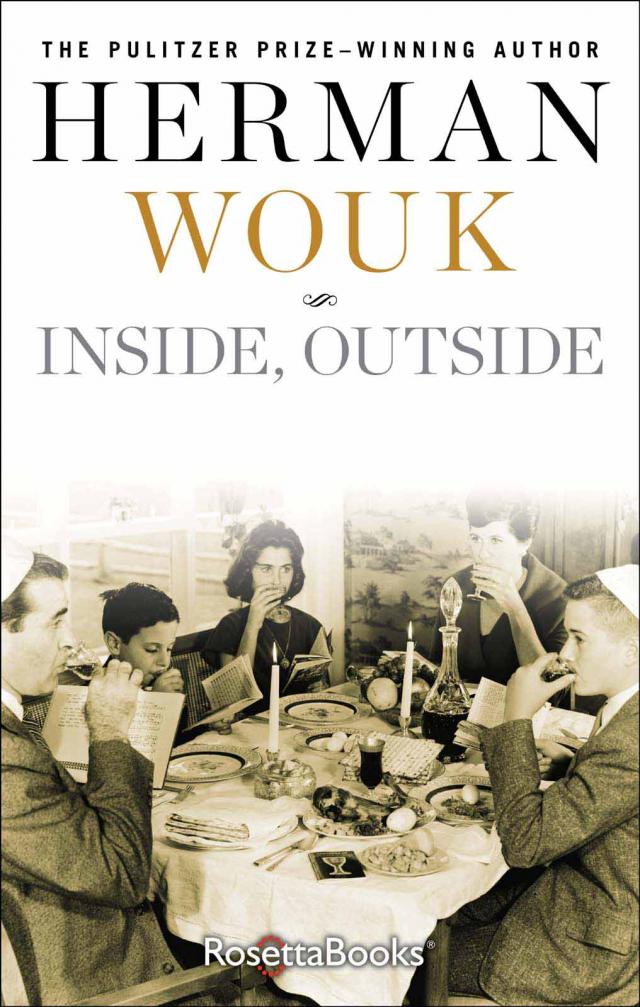


One day I remind him of our days at Camp Eagle Wing. “Good Christ!” he exclaims. “Of course. You were that Les Misérables kid. A million years ago, wasn’t it, Davey?” He never does call me Tex. That was just his suave approach to a Bronx boy who rhymed sword and broad.
42
Quandary
The Herz and Quat musical is about a Jewish bullfighter from Brooklyn: title, The Kosher-Killed Bull. Quat invites me to sit in with him and Herz as they work on their script. I hang around them as they write, and even contribute a joke or two, to my vast exaltation. Herz sits at the typewriter, and Quat roams around, sparking off jokes and ideas. They have a hilarious time, laughing hardest at Quat’s obscene suggestions which they can’t use. Peter displays gleams of his later form with those quips, and with that title; also with jokes about the Jewish matador’s big nose, his cowardice, his circumcision, his distress at learning he is eating ham, and so on.
The Deke who manages the show makes them change the title to Si Si, Señorita. “Nobody knows what kosher means,” says the Deke. The Deke house is some kind of ivory tower, obviously, but what the manager says, goes. The Deke manager also books a theatre for the two performances of the show on the two Passover seder nights. I find myself in a quandary. I’ve been counting on seeing both performances, but the Passover seders are sacrosanct, the one solid island of religion left in the year. Passover is Zaideh’s great hour, with the whole Mishpokha crowded at tables zigzagging through the book-lined flat. No matter how the old Mishpokha ties are weakening, everyone who is alive and within a hundred miles shows up. That Yisroelke should absent himself is unthinkable.
Nevertheless, after agonizing for days, I announce flat out that I intend to skip the second seder. Mom responds that it’s unthinkable. It’ll be a scandal in the family. The shock to Zaideh will ruin his Passover. She won’t be able to face him or the Mishpokha. I point out that in Palestine there is only one seder. The doubling up of the seder elsewhere is a mere survival of the moon calendar problem, from the days before exact calculation of orbits. So the second seder can’t matter all that much, can it? My own sister Lee isn’t going to two seders, is she? “No. So wait till you get to Palestine,” is Mom’s answer. “Now you’re in the Bronx. Two seders, and stop rolling your eyes and making those crazy faces.”
Protracted bickering on this topic comes to an abrupt end on Saturday, when Pop and I are walking home from the synagogue. He stops to catch his breath, and says, panting a bit, that he’s always felt he and Mom owe us the best of everything: a good home, a fine education, a trip abroad for Lee, a fraternity for me, and whatever else can advance us in life. Maybe I ought to consider, he says, whether in return we owe them anything at all. With that, he walks on again. He says nothing about the seders, but I am done for. I sit through the dress rehearsals of Si Si, Señorita, a show I know almost by heart, but I miss the performances. Peter afterward tells me that a couple of my jokes got good laughs.
***
Yet sometimes it is better not to win a fight. In the end, Mom loses more than she gains.
My slide from Jewish observance, as the reader will surmise, is now well along. Joining Tau Alpha has really greased the skids. We eat lunch every day at the house. I ask no questions about the lamb chops and pot roasts and stews which a black butler serves us. One day as we are finishing the meal, Peter Quat, who handles our finances, inquires, “By the way, does anybody here object to eating ham?”
“I do,” I exclaim. I may be a long way from worrying about the horse glue in Coca-Cola bottle tops, but I have never touched pork products.
“Well, you’ve just eaten it,” says Quat, raising a merry laugh among my Jewish brethren. I stare at the remnants on my plate of the peculiarly pink corned beef I thought I was having. The scene ends right there in my memory, so I won’t embellish it. Maybe that is what inspires Peter’s ham jokes in Si Si, Señorita. So far as I know, I’m not served pig again at Tau Alpha, and I go on eating there.
Now I trust that my non-Jewish readers know of another Mosaic food edict, the prohibition of leavened bread on Passover—a rule more honored in the breach than in the observance, perhaps, by some of their Jewish friends, yet a stern decree of our ancient law, actually stricter than the ban on pork. It’s the point of what comes next.
The first seder passed off well enough, but the second is a bust. Mom has invited the Brodofskys, all six of them. Added to our growing Mishpokha, they jam Zaideh’s small flat to gridlock. There is a shortage of prayer books. Zaideh’s tranquil voice is drowned out in the din from the women in the kitchen, and the chatter of bored youngsters without books. Pop and I keep up with the limping service, nobody else. By custom I sit on Zaideh’s right hand at seders, and for years I have made him happy by disputing fine points of the haggada text with him. Tonight I just mumble grumpily in Hebrew. My grandfather bears on in good spirits, all the same.
The big trouble comes at mealtime. Bobbeh’s matzoh balls, her annual occasion for praise and applause, turn out stony. They are really no more edible than billiard balls. The scoffers’ section, presided over by Cousin Harold, fires off a stream of matzoh-ball jokes. We are all convulsed, until Bobbeh turns blue and begins to cry. A frantic uproar to comfort her ensues, and during this crisis the food gets cold. Anyway, there isn’t enough to go around. Mama heaps up the Brodofsky plates; never let it be said the Brodofskys went hungry at a Goodkind meal! Young Goodkinds fare poorly.
The upshot is that Cousin Harold and I worm out of the jammed flat to take a walk; both ravenous, and I for once as full of heretical scorn as Cousin Harold. He proposes that we get ourselves hot dogs, and I am all for it. At a kosher delicatessen, we buy frankfurters on rolls. If a religious sophisticate breaks in here to ask how come a kosher place would serve leavened rolls on Passover, he doesn’t know what a mess Bronx Jewish mores were then. We are devouring the dogs, when out of the washroom in back comes nobody but Felix Brodofsky, fatter than ever. “Well, whaddya know! Davey Goodkind eating bread on Passover! What will Grandpa say?” He leaves, leering, to return to the seder. So the jig is up, the fix is in. The Brodofskys will rub Mom and Pop’s nose in this scandal, until they will wish they had never had a Yisroelke in the first place.
Cousin Harold, of course, is unperturbed. Wolfing another hot dog on the way back to Zaideh’s flat, Cousin Harold explains that the Jewish religion is mere primitive nonsense. He urges me to read H. L. Mencken’s Treatise on the Gods. H. L. Mencken proves that all religion is nothing but mankind’s fear of the unknown, institutionalized as propitiatory magic, and perpetuated as a fat racket for priests. Cousin Harold is now a freshman at City College, majoring in psychology. But his real major these days, to hear him tell it, is fornication. Cousin Harold’s tales of his conquests are long and lurid, going into explicit details of contraception, positions, the cries of the females, oral variations, and so on, in a manner remarkably anticipating Peter Quat’s artistic breakthrough years later. It is a pity that Cousin Harold has no literary gift, and anyway is ahead of his time.
In point of fact, I never hear another word about the hot dogs. Did Brodofsky tell Pop? I get no hint of it. Pop has seen me go off to football games on Saturday. He has heard, in the way I argue about religion with Mom, abrasive echoes of my Columbia education. He himself was a rebel of sorts, a fiery young socialist who came back by degrees to his shammas father’s religion. If Brodofsky did say anything, I’m sure Pop shrugged it off with a sad smile.
America!
***
But the thing eats at me. Not so much the incident in itself, as the whole snowballing oppressiveness of the religion. At every turn the faith is beginning to nag at my conscience, conflict with my schedule, and clash with my changing views. In my comparative religion course I have been taught that the Torah is a patchwork of several documents of different eras and regions—J, E, P, D, and whatnot—which if true makes a joke of the Talmud’s minute analysis of the Torah as one seamless Mosaic unity. All religions, I now gather, are really a special sort of folkloristic literature. Whether you are a Christian or a Buddhist or a Jew or a Hindu simply depends on when and where you were born, not on the intrinsic content of this or that faith. Our comparative religion professor, a naturalized former Englishman named Dr. Vyvyan Finkel, vaguely Jewish, an amusing lecturer and a very tough marker, is clearly above being taken in by any of these naive myths—including, of course, Judaism—but thinks them all worth study, like the bones of dinosaurs.
My readings in philosophy, which Dr. Finkel also teaches, have further eroded the ground of faith. And a psychology course, in which we’ve spent a couple of weeks on the psychopathology of religious experience—that is, the study of nuts who think God talks to them—has cast something of a shadow on figures like Abraham and Isaiah. In short I am becoming an atheist. I have read H. L. Mencken’s Treatise on the Gods. Great stuff. Why should an atheist who has read Mencken feel guilty about eating a frankfurter on a roll on Passover? Preposterous.
43
I Rebel
The holiday we call Shavuos (Pentecost)—which follows Passover by seven weeks—falls smack during the final exam period. In freshman year, by luck of the shifting Jewish moon calendar, I escaped that problem. Now I have three finals on the two days of Shavuos, when observant Jews don’t write. In public school and high school, where there were so many Jews, the administrators avoided such conflicts. At Columbia the matter promises to be awkward. I have to appeal to each department head for a special test on another day. Logically, a man who rides to football games on the Sabbath should take exams on Shavuos without a qualm, but a collapsing religious commitment is not a matter of logic; it is a mishmash of pretenses, evasions, embarrassments, and inconsistencies. With these, I am fed up.
Final exams are a week away when I hear that all applicants for special tests are being turned down. One rabbi’s son is appealing to the university’s board of trustees. Monroe Biberman, of all people, approaches me with a petition to the dean. He is more religious, or more subservient to his parents, than I imagined. Maybe it’s because of Monroe that I mulishly refuse to sign; and I ride home on the subway that evening seething with resolve to have this issue out.
Off at a Zionist meeting, Pop doesn’t get home for supper. I do my homework, trying hard to keep myself at a boil. I have to stage this showdown tonight. I have built up the steam of righteous indignation which will carry me through; I may have trouble generating it again. By the time I manage to confront my parents, they are both in bed. Propped up on thick pillows, Pop is reading the Book of Psalms. That is how he goes to sleep, sitting up. Otherwise he has some trouble breathing. He is working through the Hebrew text with the commentaries, and has told me that he finds it full of marvels.
Well, I let them have it: a stark brutish summary of what human existence is all about, the real truth of the matter, displacing once for all the hoary and hobbling Jewish ideas drummed into me from childhood. Man is an animal, I inform them, like other animals. As for the soul, nothing exists of a person’s consciousness or identity except what is inside his skull. The universe is a vast machine operating by natural laws. There is no heaven or hell, therefore, and no white-bearded God up there to keep track of our sins and our good deeds. We live and after a while we die, like the dogs and the pigs. There is nothing after death. Dead men are just machines that have stopped. That’s the end of them.
Pop sits there listening, his head resting back on the pillows, his eyes brightly fixed on me; not angry, not even visibly upset. He has closed the Bible, and holds it loosely in his pale hands. I pause for breath. Having laid down the general principles of my newly liberated viewpoint, I am about to launch my bombshell announcement that, in the light of these advanced ideas, I intend to take my finals on Shavuos.
“So the universe is just a machine. People are just machines,” Pop says, nodding. “But who put together the machines, Yisroelke?”
“Oh, that’s the old argument from design, Pop,” I say, trying not to sound too condescending. “It’s fallacious. It was exploded long ago by Immanuel Kant.”
“Why do you keep rolling your sleeves up and down?” Mama says. “You look so stupid.”
I’ve been thinking how remarkably suave and self-possessed I am being in this crisis, but I guess I’m a bit nervous at that. It has taken the form of constantly rolling up and unrolling my shirt sleeves as I expound my new philosophy. I let go of the sleeve I’m about to roll up. I now have one sleeve up and one down.
“Immanuel Kant. Kant is a German philosopher,” says Pop, “like Hegel. Isn’t he? Karl Marx was a student of Hegel. Karl Marx said he stood Hegel on his head.”
“That’s right,” I say, surprised at this scrap of erudition, retained no doubt from Pop’s socialist days. “And Kant exploded the argument from design for good, Pop.”
“He did? How?” Pop inquires with genuine curiosity.
I can feel my head of moral steam dissipating in these irrelevancies. I say sternly, “We can talk about that another time, Pop. There’s something much more important to discuss—”
Mama says, “Roll both sleeves up or both sleeves down. Don’t leave them like that. It looks funny.”
“Mom, never mind my sleeves,” I exclaim, a trifle irritably, “I’m not going anywhere, for God’s sake!”
But I resume rolling up the down sleeve with jerky haste, so as to squelch her interruptions. “The point I’m making is, I have three exams on Shavuos. Maybe I can get them postponed, maybe not. They’re very tough about such things at Columbia. But my point is, I don’t want to get them postponed. I don’t believe in all that any more.”
My point sinks in. Mom and Pop look at each other with sober eyes. Pop asks, very tentatively, “What time are the exams? Can you go to shule first?”
“Impossible! Anyway, what kind of a hypocrite would I be, Pop, going to shule and then writing exam papers?”
“Now you’re making crazy faces and rolling your eyes,” says Mama. “Where did you pick up those habits, anyway? Does everybody roll their eyes and make crazy faces at Columbia?”
“Mom, I’m talking about something terribly serious, and you keep interrupting. It’s not fair. I want you to understand me!”
“What’s so hard to understand? You intend to take your exams on Shavuos,” says Mom, “because you don’t want to bother your Columbia professors to give you the tests another day. Is that it? Do I understand, or don’t I?”
“No, you don’t. Not in the least. It isn’t that I don’t want to bother my professors. It’s a matter of principle. If you’d only listen to me for once—”
“Now you’re rolling your sleeves and your eyes,” Mama says. “What’s the matter with you? Who can listen to you when you act like such a fool?”
I consider stamping out of the room in a rage. I know I imitate Peter Quat, but at the moment I can’t help it. I shake my head and grind my teeth, utterly stymied.
My father says, “Well, you can come to shule the night before, at least, can’t you, Yisroelke? You don’t want to forget that it’s Shavuos, altogether.”
According to my new philosophy I shouldn’t agree to attend the holiday eve service either. Still, my father is being a startling gent about this thing. I decide to meet him halfway, and H. L. Mencken will have to overlook my laxness. I have the rest of my life to be a consistent atheist.
“Sure, Pop,” I say. “We’ll go together.”
“Good luck on your exams,” he says, opening his Bible. “But if you can still get them postponed, Yisroelke, by all means do that.”
“You don’t understand him at all,” says Mom. “He has no soul, and we’re just animals, and there’s no God, so he doesn’t have to tell the professors he’s a Jewish boy who won’t write on Shavuos.”
Pop gives me a melancholy little smile, showing gaps in his teeth. “I understand him,” he says, and resumes reading the Book of Psalms. I return to my room, scarcely believing that the great rebellion has come off so easily.
Next morning, as I open my eyes, the recollection floods over me. Free! What a relief! Old Mom, though she missed the main philosophical point, cut pretty close to the bone, at that, in her fashion. I have dreaded talking to my Columbia professors about Shavuos. After all, I am the Vicomte de Brag, the sophisticated wit, the campus celebrity. Dr. Finkel himself has quoted my poems in his lectures, with many a puckish glance at me. My cadaverous English instructor, a Mr. Ludd, has read a rondeau of mine aloud in class, and then invited me into his office for tea and cookies; where, when I mention I am reading Treatise on the Gods, he lights up like a Times Square sign and says that book is his Bible. My psychology professor clearly holds that religion is a mild variety of mental disorder. These are not men to whom the Vicomte de Brag wants to go sniveling that he doesn’t write on Shavuos.
But now that nightmare has passed away! So I am thinking, as I dress to go to school. What to wear on this happy day—the purple, the bar-mitzva gray, or the nondescript herringbone that Michaels sold me when I went to Canal Street by myself? Mama thinks the herringbone suit is disgusting, and the price I paid sheer robbery. She is all for getting Morris Elfenbein to make Michaels take it back; so naturally I have sworn that I love the garment, and that nobody is wearing anything at Columbia this year but suits exactly like this one: loose-hanging double-breasted herringbones, with collars that fall widely away from the neck, and sleeves that cover the knuckles. In truth I am ashamed of the herringbone. I wear it only on rainy days, or for my Spectator night-editor vigils.