Inside, Outside, page 3
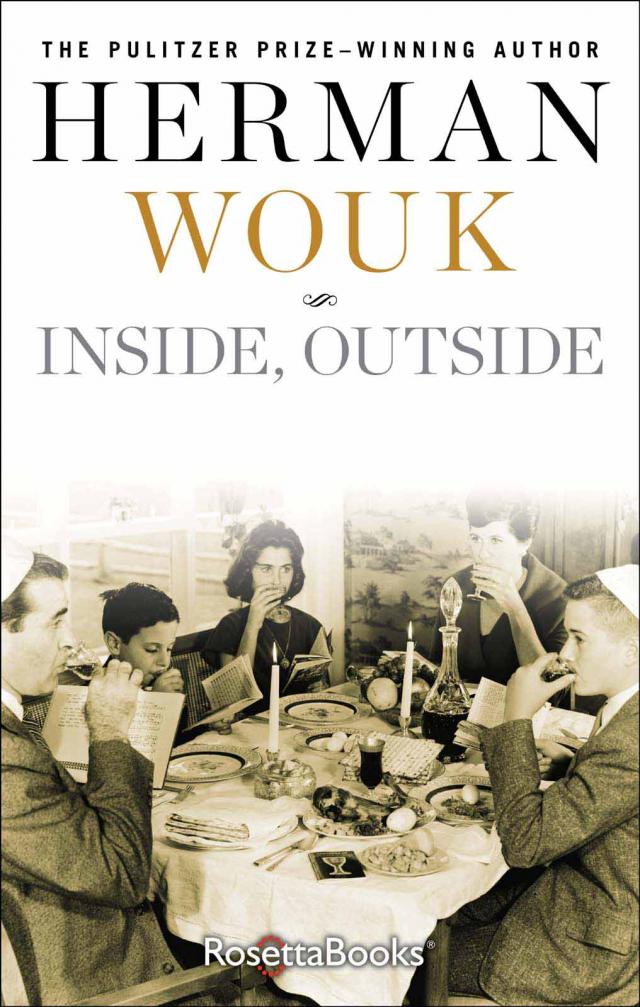


From that vanished house on Romanoff Street in Minsk, across the gulf of almost a hundred years, across seas and continents, echoes the defiant snap-back of my grandmother to her august father, as our family tradition reports it. “So? Am I supposed to marry the Shulkhan Arukh?”
In giving birth to Mama, this doughty shadow died. That retort of hers, passed down in family lore, is the chief testimony that she ever existed. It suffices to bring her to life for me, and perhaps for the reader. Her name was Leah Miriam, “Laya-Mira.” My sister Lee, whom you’ll meet in due course, bears her Yiddish name.
But we still have to get Mama out of Minsk. We are talking about two hundred rubles for the all-important shiffskarte, boat ticket, and how on earth was Zaideh going to lay hands on a fortune like that?
Zaideh burst into my life a stern-faced gray patriarch in his sixties, but that was not the Zaideh of Minsk, who married one rabbi’s daughter and then another; nothing but the cream for Zaideh, and with no spacious interval as a widower. He was then a tall burly jolly brown-bearded young stalwart, so my Aunt Sophie has told me, his zest for life utterly undimmed by long immersion in the Talmud. He wanted a woman in the house, obviously, so he married the Koidanov rabbi’s daughter; and why not? I never heard Zaideh say a word against the stepmother. He even—I thought—sometimes took a wistful tone about her, but never when Mom was around, that is for sure. And now for the two hundred rubles.
***
It’s clear, I trust, that by marrying two rabbis’ daughters, Zaideh had acquired a claim on two pulpits. This sounds great, but there can be too much of a good thing. When the eminent “David’s Tower” did die, fairly young, and Zaideh hastened back to Minsk to embrace his fortune with grief condign, he ran into a snag named Reb Yankele.
Reb Yankele had been the rabbi’s assistant for years. You have to understand the star system in our old-country religion. A luminary like “David’s Tower” would deliver two sermons a year, and give judgments on very knotty legal questions. Otherwise he shed lustre on the congregation by his mere awesome presence, while the assistant rabbi ran things, taught the men the Talmud, decided for housewives whether chickens were kosher or not, and the like. The star rabbi himself meanwhile studied, prayed, meditated, and wrote. Thus Reb Yankele had gained a following, and his faction wanted him to get the vacant post. The Yankele faction argued that Zaideh, as the Koidanov rabbi’s son-in-law, was in line for that pulpit, wasn’t he?
True enough, and Zaideh was in real trouble, but he had an ace in the hole: to wit, Mama. Mama was the synagogue pet, beloved by one and all for her wit and beauty, as she herself explains; and a Mama faction rose to do battle against the Reb Yankele faction. When the fog of war cleared, the Romanover Synagogue had two rabbis, in two seats of honor on the eastern wall. Two congregations under one roof! Seems unbelievable, but there you are; and this standoff went on for years.
Then the Koidanov rabbi died.
I suppose Zaideh would have liked to speed off to the Koidanov pulpit, but again he ran into a snag. Few things involving livelihood went smoothly among the Russian Jews; most of them were too hungry, poor, and desperate. There was another son-in-law, a local Koidanov man, who wanted the vacant post. Zaideh had the senior claim, no question. However he was an out-of-towner, and he already had a pulpit—or half a pulpit, anyway—in Minsk. So argued the anti-Zaideh faction in Koidanov. His claims on two posts had in effect left him hanging in the middle.
After some terrible carryings-on, the Koidanov people offered Zaideh two hundred rubles—a handsome settlement in those days, make no mistake—to stay in Minsk and forget the whole thing. As destiny would have it, this offer came hard upon the ploika crisis. Zaideh had already heard his wife’s ultimatum about the crazy stepdaughter who had tried to murder her, a formula familiar in many languages, in many contexts: “She goes, or I go.”
But sending Sarah Gitta away just anywhere would not have worked. Mama had leverage in that Minsk synagogue, and like Samson, she might have brought Zaideh’s whole edifice crashing down, just to bury her stepmother in the ruins. However, Mama said well, yes, she would consent to leave, providing she could go to America. So Zaideh took the Koidanov cash, bought Mama’s steamship ticket, and resigned himself to leading half a flock for the rest of his days; for Reb Yankele was a young man, and hardy as a camel.
On the morning of her departure, according to my mother, all was warm sentimental regret. Neighbors and synagogue members gathered to watch the sensational departure of a lone teenage girl for America. Given an audience, Mama seldom fails to deliver. As she walked out the door after the farewell embraces—so she tells me—she turned to Zaideh, and, streaming tears, she cried out, “For the last time, I pass over my father’s threshold!” With that, amid great lamentations of all onlookers at this dramatic exit, straight out of Yiddish theatre, she climbed into the wagon waiting to take her to the Brest-Litovsk station; and Mama was off to the Goldena Medina.
It wasn’t the last time she crossed that threshold, though. Nobody gets shut of my mother for any two hundred rubles. Koidanov and Zaideh saw her again.
4
Uncle Hyman
Now for my father’s departure from Minsk.
Talk about your mobile society; that was something Jewish Minsk was not. My mother and father grew up within a few streets of each other, and never met over there. How could they? She was the granddaughter of the rabbi of the big Romanover Synagogue; he was the son of the humble sexton—the shammas—of the small Soldiers’ Synagogue on Nikolai Hill. No, they had to uproot themselves, cross an ocean, and meet on a new continent in a new world to engender our hero, I. David Goodkind.
And at this point, I must briefly turn over the narrative to somebody else, my father’s younger brother, Uncle Hyman. I will not paraphrase Uncle Hyman’s story of the ice-cake episode, a clue to Papa’s early yen for America. My uncle tells it better than I can. Uncle Hyman should have been a writer, not a businessman. Many Russian Jews had their talents crushed by poverty and by the Czar’s laws which kept them out of the universities, the professions, the big cities, and even out of large sections of the country. That may be why we, their offspring, in the freedom of the Goldena Medina, have tended to be exuberant overachievers. But that is a passing one-generation thing. Our children, American as apple pie, show a healthy and reassuring tendency to dog off.
Uncle Hyman scrawled this account in his late old age, very shortly before he died. I had asked my uncle to write his reminiscences, but not until recently did I find out that he had actually made a start on them. At his funeral, some five years ago, neither Aunt Sophie nor my cousin Harold said anything about it. Aunt Sophie was too weepy and stunned, and Cousin Harold was in bad shape, too. Not from grief, not at all; Harold is a cool customer, a psychoanalyst in Scarsdale, doing a land-office business in unbalanced teenagers. Not much fazes Harold, but he had a hard time with the body of Uncle Hyman.
Uncle Hyman died in Miami, you see, and the whole family lives up north in or around New York. Aunt Sophie and Uncle Hyman owned burial plots in Queens, which they had bought sixty years ago, so Cousin Harold had to fly down from Scarsdale to bring Uncle Hyman’s body back for burial in Queens. This was in February. The weather was awful. Harold made it to Florida, but flying back, with Uncle Hyman in the baggage compartment of the plane, they were forced to land in Greensboro, North Carolina, by a blizzard. The airport closed down, all snowed in. There Uncle Hyman sat, or lay, for two whole days. He clearly was past caring, but Cousin Harold wasn’t, what with a wailing mother of eighty or so on his hands, who would eat only kosher food—not readily available in the Greensboro airport—and endless telephone calls back and forth with the undertaker and our relatives, putting the funeral off, and on, and off again. Also, Harold had several unusually screwed-up Scarsdale teenagers who had to keep talking to him at all hours. His office gave them the number of a telephone booth in the Greensboro airport, and Harold hardly stirred from that booth for two days except to answer calls of nature. He had skycaps bringing him coffee and sandwiches, newspapers, everything but a chamber pot.
In short, it was a hell of a mess, and so Harold forgot about Uncle Hyman’s fragment of reminiscence, which he had found in a manila envelope beside my uncle’s deathbed in Miami, addressed to me. It got tumbled into a trunk with a lot of detritus of Uncle Hyman’s old age, including Yiddish books that Cousin Harold couldn’t read and wouldn’t if he could, a collection of 78 r.p.m. records of the cantor Yossele Rosenblatt, a photograph album of Uncle Hyman as a World War I draftee in uniform, and an enormous heap of programs from the East Side Yiddish theatres, which Harold now thinks may be valuable Americana. He’s trying to sell them. That’s how he happened to go rummaging through the old trunk, five years later; and so he came on the envelope. It arrived in the mail some weeks ago, full of scrawls in a shaky hand on the backs of bills, the blank sides of old circulars, and random sheets of paper of different sizes.
I put the thing aside. If it had not rained like the devil one Sunday, the envelope might have gotten mislaid or buried, and moldered for another five years, or until I died. But it did rain, and I started cleaning my desk, and I came on Uncle Hyman’s scrawl, so I read it. Anything rather than clean my desk. That was when I decided to make another start on this book; when I read Uncle Hyman’s anecdote of Papa’s slide on the ice cake. Why? Well, I’ll try to tell you. An old buried awareness surfaced and hit me—hit me very hard—of how much I loved my father, how strongly he influenced me at turning points in my life, and yet how little I really got to know him. Mom has lived on and on, and mainly these days she makes me laugh; though it is a big help that I now live in Georgetown, three hundred miles from Central Park West. The other day I told her on the telephone that I was writing a book. “Good,” she said. “Write about me.” Fat chance, Mama.
But Uncle Hyman says, quite rightly, that I never truly knew my father. I guess I am searching for him with this story. The clues are there in my memory, and that’s why I keep dumping out my recollections helter-skelter in these pages; the way you do when you are frantically searching all your pockets for a mislaid key to your home.
So here we go, down that hill in the vanished Minsk of my father’s childhood, that Jewish world of eastern Europe, obliterated like Carthage; here we go, whistling downhill on an ice cake, on the fresh brilliant snow of a Russian winter, past the soldiers’ barracks, past the synagogue, straight toward the river, straight toward that broad black hole cut by the peasants in the ice.
Uncle Hyman, you’re on.
5
The Ice Cake
I am not endeavoring to write. The following is not an autobiography…
When I open up the book of my memories, I find some pages outstanding in our family history. One such incident made an indelible mark. The scene comes to me as though it happened yesterday. This is going back more than seventy years…
In the recesses of our minds there are indelible events or incidents which lie dormant until…
Uncle Hyman backs up and begins again in this way several times. He gets going at last on the backs of pages torn one by one from a calendar. Inspiration evidently struck when no other paper was handy, maybe late at night. I get a picture of him sitting in the little kitchen of his Miami condominium in his bathrobe, scrawling away on ripped-off calendar pages.
One note: Uncle Hyman presumes the reader knows that pious Jews do not work on the Sabbath, kindle fire, or do other workaday acts. That is the premise of the whole story.
It is the 31st of July, 1968. I finally am getting started on what I have meant to write for many, many years. This is the second time I have started. The first was fifteen or more years ago. After working on it for some time, I destroyed all I had written. Of what interest would all this be, I thought, to anyone today? In this so swiftly changing world, the lives of people who have gone before us, their ways, their conditions, their beliefs, the heritage they have left us, all seemed to have gone into eternity without attracting any attention, having no practical use in the “new world” that was being built, on new foundations.
But these illusions of a “new world,” these air balloons, began to pop, and the past came back to view. I began to hope that some day there would be one in the family who would want to know about his ancestors, what influence they had on the next generation, and what their accomplishments were. And then my nephew David came and asked that I write my memoirs. And so I am sitting down to do it.
The starting point will be the first thing that comes to my memory. It has left an indelible mark. Nothing else comes to me before that time. My father once found a whole treasure of family records, but to everybody’s sorrow they were destroyed; all those people, gone forever.
***
A scene in midwinter. Saturday. Late afternoon, the home where I was born and lived till my departure to the U.S. at seventeen. The place is the city of Minsk, Russia. My home is part of the Soldiers’ Shule, just a section of the foyer entrance to the synagogue, partitioned off to make a home for the shammas, my father.
By the end of September the rains grow colder in Minsk with the dropping temperature. About the middle of October the rain turns to snow. The earth freezes, and the snow does not melt any more. A couple of days, and there is enough snow on the ground to discontinue wheeled vehicles and turn to the sleighs. This changeover comes fast, almost at the same time each year. For Minsk is far inland, away from any ocean, or even a sea. The only water in the city is a narrow river, about a hundred feet across, but very deep. It passes the bottom of the street on which our synagogue stands, a very long steep hill. This hill ends in a cross street and the bank of the river.
In winter the river freezes up. The ice runs a foot thick or more. The peasants cut the ice out in cakes, and pack it between layers of straw in their ice houses, deep holes in the ground with little huts over them. The ice then holds through the whole summer. When the peasants are finished with the day’s ice cutting, there are always some cakes left. Boys that have no sleighs use these cakes for sleds. It is a daring feat, and some boys even sleigh all the way down the long hill, across the street, and down the bank on to the river. This is extremely dangerous, for there are big holes in the ice left by the peasants. Mainly the boys who do that are well grown, and never Jewish boys, all gentiles.
***
Now I will describe our home, if one wants to call it that. It was just one room divided by a partition, in which a curtain served as a door. The smaller space had no window and no furniture but a bed where Mother slept. The rest of us, sometimes even my father, slept in the main room on doors taken off their hinges and laid between two chairs. My mother had a feather mattress, a remnant of her dowry, but we all used an old overcoat or anything else to soften the discomfort of bare boards. There was no plumbing. For water, there was a barrel in the synagogue foyer, filled by a water carrier with water drawn from the river; the same river where everyone bathed, where laundry was washed, and all the rain and melting snow from Minsk’s streets ran down. An outhouse in the courtyard served everybody, even the worshippers.
The shule was built of logs. The main building was plastered inside, but in our apartment the walls were just the logs. The two small windows had double frames, to keep in as much heat as possible. Right inside the door there stood a big oven reaching almost to the ceiling, which was used for cooking, baking, and heating. Another small fireplace beside it gave extra heat in the winter. Both led into one chimney. Together they formed an L-shaped nook where one could sleep in cold weather, or else just sit there to keep warm.
On Friday afternoon the two fireplaces would be heated up almost to a glow. That evening the house would be warm, even in the coldest winter weather; but by Saturday morning it had already lost the first heat, and with the passing of the day it cooled more and more. The only heat one could feel was by leaning right up against the big oven, and it was not real heat, only warm bricks.
***
So as I say, the scene is late Saturday afternoon, midwinter. The sun is beginning to set. The lone kerosene lamp which has been burning since Friday is using up the last of the oil, giving but a dim light. I am alone with my mother. Father is next door in the shule, which is full of worshippers and their children. My brothers are there also, playing games with other boys their age. I am too young to be left alone, or perhaps I am tired of playing. So I am in the house with my mother, perhaps dreaming that the Sabbath will soon be over. Father will come in and say, “Gut vokh,” a good week. He will take out the havdala candle and light it, and let me hold it. (I always liked to watch the havdala flame flare up, trying to light the whole gloomy house.) He will bring out the wine, fill a glass, say the havdala prayer, and let me taste the wine, because I am the youngest. Mother will walk over to the frost-covered windows and rub some moisture on her hands—which you have to do before praying—and she will say the prayers to welcome the oncoming week. Father will fill the lamp and it will burn up bright, spreading light all through the room. He will throw dry logs into the small fireplace and put a light to it. The wood will burn fast and heat will begin to spread again through the house.
All this will be very welcome. But Shabbess is still not over, perhaps another half hour before the stars will be seen in the sky. The house is very quiet. Only the voices of the boys going sleigh-riding down the hill, you hear their happy outcries now and then.
***
I and Mother were sitting close to one another, leaning against the lukewarm oven. Maybe she was telling me stories about her childhood days: the big house she was born in, where everyone had his own room, beautifully furnished, chandeliers with large lamps and hanging crystals reflecting dazzling light everywhere. The house was full of servants who answered all your calls and needs. Mother would go out each day, riding through the countryside in a coach with a team of horses, she said. A few years later, when I visited my aunts and other relatives, I saw they really did live in such big houses and I compared these with our one room with log walls in the foyer of the shule….