Complete Short Fiction, page 51


It must have taken Bob’s father about twenty minutes to get the drum cleaned and refilled, but finally appeared on the causeway, driving at a pace that fully justified the Hunter’s deduction of his attitude toward personal injury. Even Bob nodded slowly as he saw the little vehicle racing toward the land. They watched until it reached the shore and disappeared among the sheds clustered near the end of the causeway; then they moved to the door of the shed and peered cautiously out, Bob holding a match ready to strike.
They heard, and Bob interpreted, the sound of the little car coming up the road; the speed of the engine changed audibly as it reached the end of the hard surface, and Bob went into action.
The first match he struck went out in the air as he tossed it out onto the oil-soaked ground; with hands that trembled with haste, he lighted another, held it until it was burning strongly, and dropped it from a height of a few inches at the edge of a puddle of oil beside the door. This time the fluid ignited, and the boy sprang back as a sheet of flame leaped into the air. In a second or two before the car came into sight around the lower sheds, the pile of tins was blazing merrily, and the doorway through which Bob and the Hunter were peering was blocked by a yard-wide pool of liquid fire.
Mr. Kinnaird saw the blaze, and reacted instantly. He had no extinguisher large enough to cope with the situation in the jeep, and he shoved the accelerator down to the floor and headed up the hill to get help. Just before he passed the door of the shed, however, Bob called him from inside.
“Dad!” He said nothing else—if his father wanted to conclude he was in danger, that was all right, but Bob was not going to lie about it. He expected his father to stop the car, start toward the shed on foot, and be stopped by the fugitive in the manner outlined by the Hunter; but he underestimated both the ingenuity and the reaction speed of his father.
At the sound of Bob’s voice, apparently from the interior of an inferno, Mr. Kinnaird took his foot from the gas pedal and cut the wheels hard toward the shed. His intention was at once obvious to Bob and the Hunter; he meant to bring the vehicle’s hood right up to the door, gaining momentary protection for both Bob and himself from the flaming pool beneath, and back out again the instant the boy could leap aboard. It was a simple, flawless plan, and should have worked. Had it done so, Bob and his guardian angel would have had to provide a new plan of their own—and some rather detailed explanations.
Fortunately—from their point of view—another factor entered the situation. Mr. Kinnaird’s hidden guest grasped the situation almost as rapidly as the man himself; but unlike his host the alien creature had no intention of risking itself any closer to a pile of flaming oil containers which from all appearance, might be expected to blast a rain of fire over the neighboring landscape at any moment. They were already within twenty yards of the blaze—man and symbiote alike could feel the heat—and there was literally no way on Earth by which the latter could force his host to turn the jeep around and drive in the opposite direction. Had the thing wasted even a second in thought, it might have done better than it did—had Mr. Kinnaird merely been blinded, as the Hunter had indicated was likely, he might have stopped the car. There is room for doubt, of course; he would have had a searingly clear mental image of his only son in the midst of the flames. No one will ever be certain, for the alien, in the panic of the moment, performed automatically the operation considered by his race the last resort in preventing suicidal action on the part of their domestic animals—only under unthinkable tension would most of them do it to their regular hosts, without permission. The web of alien cells about Mr. Kinnaird’s spinal cord constricted in certain, special areas, and the man sagged forward across the wheel of the jeep, paralyzed as completely as Bob had been a few hours earlier.
The vehicle, however, was still in gear; and it continued forward with the man’s weight-holding the wheel in a shallow turn. Its speed was low, since his foot had slipped from the gas pedal; and that probably saved him a broken neck when the jeep sailed blithely into the corrugated iron wall of the shed, five or six yards from the door at which he had been aiming.
Bob, of course, was startled by this unexpected development—everything had happened in too short a time for his wits. His first impulse was to leap the pool of fire by the door—a safe enough procedure, if he held his breath—and go to his father’s aid. The Hunter, however, interpreted correctly the tensing of his muscles, and stopped him almost harshly.
“No! He is safe enough—he is farther from the fire than we are. Get out the window, where the other won’t see you, and have the oil can ready!”
Bob was in no state of mind for calm thought, and almost anyone could have given him orders at the moment. He turned at once to follow the Hunter’s behest; but, remembering that his father was almost “Certainly conscious, he called as he went.
“N’aie pas peur! ’L y a des fenetres” in the island French that still lingered on in the Tuamotus. He was reasonably sure that the enemy would not have heard enough of it spoken to interpret the reference to windows, and infer the probability on an early rescue; in any case, he probably could not have kept silent, knowing the mental anguish his father must be suffering.
As he spoke, he leaped for one of the windows—simply an opening in the sheet metal, in a wall at right angles to that in which the door was located. At the same instant, though the boy did not know it, one of the full cans in the stack was ruptured by the heat.
Bob had chosen the liquid well. There was no explosion, which would have sent flaming oil out in a wide radius; the can simply gave along its soldered seam, and a tide of fire welled out, poured down the stack of cans, and, thinned by the heat, began to spread rapidly around the base of the pile. A moment later the other full can added its contents to the expanding lake of fire.
Bob, fortunately for his peace of mind, did not see this; he was climbing through the window twenty yards away, still carrying his oil can, with several sheets of metal in between. Neither did Mr. Kinnaird, who had been blinded as well as paralyzed by his unsuspected guest; but the creator itself saw only too well.
The plan of Bob and the Hunter had not quite gone according to schedule; but the situation they had hoped to bring about had finally occurred. Mr. Kinnaird, even if the nerve pressure were relaxed, could not possibly recover the use of his limbs for several minutes; there appeared no possibility of anyone’s reaching him in time to effect a rescue, though shouts from up the hill suggested that the pillar of black smoke from Bob’s bonfire had attracted attention; and the alien, true to the Hunter’s prediction, was faced with a problem which, to one of his proven temperament, offered only one solution.
Bob, cautioned by the Hunter, peered carefully around the corner of the shed before following his natural urge to dash to his father’s rescue; and the Hunter, looking through the same eyes, saw what he did. Mr. Kinnaird was still slumped over the steering wheel; his eyes were open, but it was not possible to tell whether or not he could see. The body of the jeep concealed from the watchers the degree to which the puddle of oil had spread, and neither of them realized how close the flames had come to the car. Their eyes riveted on a point beside the paralyzed man.
On the narrow space of seat to the left of his motionless body, a blob of greenish semiliquid was spreading. Its shape was obviously under intelligent control; instead of spreading out and flowing to the floor, it kept in a small space, remaining on the cloth covering of the seat and sedulously avoiding contact with the already warm metal of the jeep. As they watched, it reached carefully over the metal side, and established contact with the ground below. It winced for a moment as it went below the protection the car body furnished from the fire’s radiation; but evidently it decided that a little now was preferable to more later, and the tentacle remained in place while the whole weird body flowed through it and assembled itself on the ground. The arm disappeared into the main mass, and with a surprisingly rapid amoeboid motion the thing began to flow away from the car and fire, directly toward the hidden watchers. It remained in the shade of the shed roof for the time being, but that point did not interest either Dob or the Hunter.
As the fugitive started to move, the boy’s muscles tensed; and this time the Hunter made no objection. They rounded the corner at Bob’s highest speed, and raced toward the car. The alien saw Bob coming, and stopped his journey for a moment; two or three pseudopods appeared, as though it considered attaching itself to the boy; then the realization that he was heading back toward the fire, which it had no desire to approach for any reason, seemed to cause the creature to hesitate, and before it could come to any constructive decision Bob had passed it in a single bound and was at the stalled car.
For the first time, he saw how close the fire had come, and felt its blistering heat; but he wasted no time in expressing surprise or dismay. He pushed Mr. Kinnaird’s body from behind the wheel and got into the front seat himself. He had driven the vehicle often enough; and while the menacing thing on the ground was still making up its mind, he had started the engine and backed the jeep out to the track, fifteen yards away. There he stopped, leaped out, and, still bearing his oil can he dashed back toward the shed, wrenching frantically at the can’s cap as he went.
The alien was still fairly close to the fire, and seemed to be suffering some inconvenience now that the slight protection of the jeep’s body had been removed. It had resumed its journey toward the corner of the shed, and seemed to make an effort toward even greater speed as the boy approached. It must have known that the Hunter was also present, and by then had certainly realized that Bob was participating intelligently in the hunt, and it made one final effort. Knowing that it could not possibly outspeed the human being bearing down on it, the creature stopped where it was, assumed a hemispherical form, and began, very slowly, to dwindle in size.
The Hunter knew what was going on—he had used the same trick to approach Bob, that first day; but the ground on which the shed was built was a very different proposition from the sand of the beach.
It was harder, moister, and much more solidly packed; the space between grains was far smaller, and more completely blocked with fluid. Long before any significant part of the creature’s mass had soaked into the earth Bob had arrived on the scene, with the cap finally removed from the can of oil.
Without showing any sign of the hesitation he had displayed earlier at the thought of killing, the boy began pouring the sticky liquid over and around the dwindling mass of jelly. When the container was half empty he stopped pouring, and swung it violently, sending a trail of oil from his newly made pool to the blaze raging ten yards away. Then he dropped the can and ran back out of the already uncomfortable hot area.
The trail caught fire rapidly enough; but the oil was heavy stuff, and the flame did not spread as rapidly as he would have liked. After watching for a moment, Bob whipped out his book of matches once more, ran to the edge of the pool which surrounded the still visible body of the alien, ignited the whole folder, and tossed it as accurately as he could onto the center of the oil-covered lump of jelly. This time he had no occasion to be disappointed or doubtful: he barely got himself away in time.
The Hunter wanted to stay until the fire had burned out, and make sure of the results; but Bob, once he had done all he could, turned his attention at once to his father. A single glance at the inferno surrounding the fugitive’s last known position was enough for him. He ran back to the jeep, glanced at his father’s still motionless form, and sent the vehicle jouncing down the track toward the doctor’s office. The Hunter dared make no remark; interference with the boy’s eyesight at the speed they were making would have been a serious error.
Mr. Kinnaird had been able to see ever since the alien had left his body; he had been conscious the whole time. Unfortunately, the paralysis endured for some time after being administered, and he had not been in a position to see very well what went on by the shed. He knew Bob had stopped at what seemed to him dangerous proximity to the fire, and gone back for something; but he did not know what; and struggled all the way down the road to get the question past his vocal chords.
He recovered enough to sit up and talk shortly before they reached the doctor’s office; and the questions began to pour forth as the jeep pulled up before the door.
Bob, of course, was relieved to see the recovery; but he had developed a rather serious worry of his own in the meantime; and merely said: “Never mind about what happened to the shed and me; I want to find out what happened to you. Can you walk in, or shall I help?”
It was a well-phrased question, and shut the elder Kinnaird up with a snap. He emerged with dignity from the car and stalked ahead of Bob toward the doctor’s door. The boy followed; normally, he would have been grinning in triumph, but a worried expression still overcast his face.
Inside, the doctor finally obtained a more or less coherent idea of what had happened from their two stories, and ordered Mr. Kinnaird to get on the examination table. The man objected, saying that he wanted to learn something from Bob first; but the doctor insisted; and Bob, muttering something about having left the engine running, hastily went outside again. The worry that was working on him was not for his father, who was no worse off than Bob himself had been.
Outside the door he stopped, and, making sure no one was around, he spoke to the Hunter.
“What are you going to do, now that your job here is finished? Go back to Allane?”
“I told you that was not possible,” was the silent answer. “My ship was totally wrecked: and even if the other was not, there would now be no way on earth to locate it—I got the impression during my brief conversation with the fugitive, that it, like mine, fell in the water but that its occupant had taken much longer than I to reach land. His ship was probably damaged beyond repair, and, if not, it is probably somewhere in the very deep water around this island. You told me the depth was over eighty fathoms within a half mile of shore.
“I have a rough idea of how a spaceship works, but I could never build one—I told you that. I am on Earth for life, my friend. Whether I am your companion for life depends on you—we do not force ourselves on those who do not want our company. What do you say?”
Bob hesitated, looking back across the village toward the pillar of black smoke that was now thinning over the hill. The Hunter assumed he was considering the advantages and disadvantages of the proposed alliance, and felt a little hurt that there should have been any hesitation; but he did not yet know Bob fully.
The boy was intelligent for his age, as was evident enough; but he was still a boy, and was still apt to consider his immediate problems before indulging in long-term planning. He spoke at last, however; and the Hunter never did find the words to express his own feelings at what he heard.
“I’m glad you’re staying around,” Bob said slowly. “I was a little worried about it. I like you, and you can certainly help me right now. There’s one problem that I didn’t consider very carefully when I made up this trap for your enemy, and now we’ve got to have an answer.
“In a few minutes, Dad is going to come out that door with his mouth full of questions and his eye full of fire. One of those questions is going to be, ‘How did that fire get started?’ I don’t think the fact that I’m fifteen will make any difference in what’ll happen if I don’t have a very sound explanation for it. I didn’t stop before to think of a good reason, and I sure hope you can find an answer for me now. If you can’t, then get to work on the job of toughening up the protective net you’ve told me you maintain under my skin. I can tell you where it’s going to be needed most!”
THE END
1951
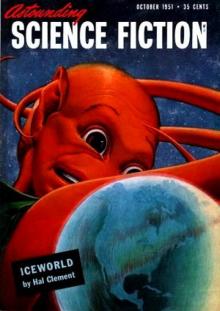
Iceworld
First of three parts. The first novel in over half a year brings Hal Clement telling of an interstellar narcotics agent and a world of terrible, unapproachable cold—our earth!
Sallman Ken had never been really sure of the wisdom he had shown in acceding to Rade’s request. He was no policeman and knew it. He had no particular liking for physical danger. He had always believed, of course, that he could stand his share of discomfort, but the view he was now getting through the Karella’s port was making him doubt even that.
Rade had been fair enough, he had to admit. The narcotics chief had told him, apparently, everything he himself knew; enough so that Ken, had he used his imagination sufficiently, might even have foreseen something like this.
“There has never been much of it,” Rade had said. “We don’t even know what the peddlers call it—it’s just a ‘sniff’ to them. It’s been around for quite a few years now; we got interested when it first appeared, and then took most of our attention from it when it never seemed to amount to much.”
“But what’s so dangerous about it, then?” Ken had asked.
“Well, of course any habit-forming drug is dangerous—you could hardly be a teacher of science without knowing that. The special menace of this stuff seems to lie in the fact that it is a gas, and can therefore be administered easily without the victim’s consent; and it seems to be so potent that a single dose will insure addiction. You can see what a public danger that could be.” Ken had seen, clearly.
“I should say so. I’m surprised we haven’t all been overcome already. A generator in a building’s ventilation system—on board a ship—anything like that could make hundreds of customers for whoever has the stuff to sell. Why hasn’t it spread?” Rade had smiled for the first time.
“There seems to be two reasons for that, also. There are production difficulties, if the very vague stories we hear have anything in them; and the stuff doesn’t keep at normal temperature. It has to be held under extreme refrigeration; when exposed to normal conditions it breaks down in a few seconds. I believe that the active principle is actually one of the breakdown products, but no one had obtained a sample to prove it.”