Complete Short Fiction, page 167


“I don’t think that’s a very good analogy. I just want to know what to expect—”
“You can’t know what to expect. No one can. Ever. You have to play the odds. At the moment, the odds are so high in your favor that you’d almost be justified in saying that you know what’s going to happen. All I’m asking is that you tell me straight whether or not you want Bert and me to ride control as your face heals, or let it go its own way.”
“But if you can grow a vine that produces ham sandwiches instead of pumpkins, why—” Mancini made a gesture of impatience. He liked the youngster and still hoped to recruit him, but there are limits.
“Will you stop sounding like an anti-vivisectionist who’s been asked for a statement on heart surgery and give me a straight answer to a straight question? The chances are all I can give you. They are much less than fifty-fifty that your face will come out of this without scars on its own. They are much better than a hundred to one that even your mother will never know there’s been a controlled regeneration job done on you unless you tell her. You’re through general education, legally qualified to make decisions involving your own life and health, and morally obligated to make them instead of lying there dithering. Let’s have an answer.”
For fully two minutes, he did not get it. Rick lay still, his expression hidden in dressings, eyes refusing to meet those of the man who stood by the repair table. Finally, however, he gave in.
“All right, do your best. How long did you say it would take?”
“I don’t remember saying, but probably about two weeks for your face. You’ll be able to enjoy using a mirror long before we get that hand unplugged, unless we’re remarkably lucky with the graft.”
“When will you start?”
“As soon as I’ve had some sleep. Your blood is back to normal, your general pattern is in the machine; there’s nothing else to hold us up. What sort of books do you like?”
“Huh?”
“That head’s going to be in a clamp for quite a while. You may or may not like reading, but the only direction you can look comfortably is straight up. Your left hand can work a remote control, and the tape reader can project on the ceiling. I can’t think of anything else to occupy you. Do you want some refreshing light fiction, or shall I start you on Volume One of ‘Garwood’s Elementary Matrix Algebra for Biochemists?”
A regeneration controller is a bulky machine, even though most of it has the delicacy and structural intricacy possible only to pseudolife—and, of course, to “real” life. It’s sensors are smaller in diameter than human red blood cells, and there are literally millions of them. Injectors and samplers are only enough larger to take entire cells into their tubes, and these also exist in numbers which would make the device a hopeless one to construct mechanically. Its computer-controller occupies more than two cubic meters of molecular-scale “machinery” based on a synthetic zeolite framework. Mating the individual gene record needed for a particular job to the basic computer itself takes nearly a day; it would take a lifetime if the job had to be done manually, instead of persuading the two to “grow” together.
Closing the gap between the optical microscope and the test tube, which was blanketed under the word “protoplasm” for so many decades, also blurred the boundary between such initially different fields as medicine and factory design. Marco Mancini and Bert Jellinge regarded themselves as mechanics; what they would have been called a few decades earlier is hard to say. Even at the time the two had been born, no ten Ph.D.’s could have supplied the information which now formed the grounding of their professional practice.
When their preliminary work—the “prepping”—on Rick Stubbs was done, some five million sensing tendrils formed a beard on the boy’s face, most of them entering the skin near the edges of the injured portions. Every five hundred or so of these formed a unit with a pair of larger tubes. The sensors kept the computer informed of the genetic patterns actually active from moment to moment in the healing tissue—or at least, a statistically significant number of them. Whenever that activity failed to match within narrow limits what the computer thought should be happening, one of the larger tubes ingested a single cell from the area in question and transferred it to a large incubator—“large” in the sense that it could be seen without a microscope—just outside Rick’s skin. There the cell was cultured through five divisions, and some of the product cells analyzed more completely than they could be inside a human body. If all were well after all, which was quite possible because of the limitations of the small sensors, nothing more happened.
If things were really not going according to plan, however, others of the new cells were modified. Active parts of their genetic material which should have been inert were inerted, quiet parts which should have been active were activated. The repaired cells were cultivated for several more divisions; if they bred true, one or more of them was returned to the original site—or at least, to within a few microns of it. Cell division and tissue building went on according to the modified plan until some new discrepancy was detected.
Most of this was, of course, automatic; too many millions of operations were going on simultaneously for detailed manual control. Nevertheless, Mancini and Jellinge were busy. Neither life nor pseudolife is infallible; mutations occur even in triply-redundant records. Computation errors occur even—or especially—in digital machines which must by their nature work by successive-approximation methods. It is much better to have a human operator, who knows his business, actually see that connective tissue instead of epidermis is being grown in one spot, or nerve instead of muscle cells in another.
Hence, a random selection of cells, not only from areas which had aroused the computer’s interest but from those where all was presumably going well, also traveled out through the tubes. These went farther than just to the incubators; they came out to a joint where gross microscopic study of them by a human observer was possible. This went on twenty-four hours a day, the two mechanics chiefly concerned and four others of their profession taking two-hour shifts at the microscope. The number of man-hours involved in treating major bodily injury had gone up several orders of magnitude since the time when a sick man could get away with a bill for ten dollars from his doctor, plus possibly another for fifty from his undertaker.
The tendrils and tubes farthest from the damaged tissue were constantly withdrawing, groping their way to the action front, and implanting themselves anew, guided by the same chemical clues which brought leukocytes to the same area. Early versions of the technique had involved complex methods of warding off or removing the crowd of white cells from the neighborhood; the present idea was to let them alone.
They were good scavengers, and the controller could easily allow for the occasional one which was taken in by the samplers.
So, as days crawled by, skin and fat and muscle and blood vessels, nerves and bones and tendons, gradually extended into their proper places in Stubbs’ face and hand. The face, as Mancini had predicted, was done first; the severed hand had deteriorated so that most of its cells needed replacement, though it served as a useful guide.
With his head out of the clamp, the boy fulfilled another of the mechanic’s implied predictions. He asked for a mirror. The man had it waiting, and produced it with a grin; but the grin faded as he watched the boy turn his face this way and that, checking his appearance from every possible angle. He would have expected a girl to act that way; but why should this youngster?
“Arc you still the same fellow?” Mancini asked finally. “At least, you’ve kept your fingerprints.” Rick put the mirror down.
“Maybe I should have taken a new hand,” he said. “With new prints I might have gotten away with a bank robbery, and cut short the time leading to my well-earned retired leisure.”
“Don’t you believe it,” returned Mancini grimly. “Your new prints would be on file along with your gene record and retinal pattern back in Denver before I could legally have unplugged you from the machine. I had to submit a written summary of this operation before I could start, even as it was. Forget about losing your legal identity and taking up crime.”
Stubbs shrugged. “I’m not really disappointed. How much longer before I can write a letter with this hand, though?”
“About ten days; but why bother with a letter? You can talk to anyone you want; haven’t your parents been on the ’visor every day?”
“Yes. Say, did you ever find out what made the Shark pile up?”
Mancini grimaced. “We did indeed. She got infected by the same growth that killed the zeowhale we first picked up. Did you by any chance run that fish into any part of the hull while you were attaching the sling?”
Rick stared aghast. “My gosh! Yes, I did. I held it against one of the side hulls because it was so slippery . . . I’m sorry . . . I didn’t know—”
“Relax. Of course you didn’t. Neither did I, then; and I never thought of the possibility later. One of the struts was weakened enough to fall at high cruise, though, and Newton’s Laws did the rest.”
“But does that mean that the other ships are in danger? How about the Guppy here? Can anything be done?”
“Oh, sure. It was done long ago. A virus for that growth was designed within a few weeks of its original escape; its gene structure is on file. The mutation is enough like the original to be susceptible to the virus. We’ve made up a supply of it, and will be sowing it around the area for the next few weeks wherever one of the tenders goes. But why change the subject, young fellow? Your folks have been phoning, because I couldn’t help hearing their talk when I was on watch. Why all this burning need to write letters? I begin to smell the proverbial rat.”
He noticed with professional approval that the blush on Rick’s face was quite uniform; evidently a good job had been done on the capillaries and their auxiliary nerves and muscles. “Give, son!”
“It’s . . . it’s not important,” muttered the boy.
“Not important . . . oh, I see. Not important enough to turn you into a dithering nincompoop at the possibility of having your handsome features changed slightly, or make you drop back to second-grade level when it came to the responsibility for making a simple decision. I see. Well, it doesn’t matter; she’ll probably do all the deciding for you.”
The blush burned deeper. “All right, Marco, don’t sound like an ascetic; I know you aren’t. Just do your job and get this hand fixed so I can write—at least there’s still one form of communication you won’t be unable to avoid overhearing while you’re on watch.”
“What a sentence! Are you sure you really finished school? But it’s all right, Rick—the hand will be back in service soon, and it shouldn’t take you many weeks to learn to write with it again—”
“What?”
“It is a new set of nerves, remember. They’re connected with the old ones higher up in your hand and arm, but even with the old hand as a guide they probably won’t go to exactly the same places to make contact with touch transducers and the like. Things will feel different, and you’ll have to learn to use a pen all over again.”
The boy stared at him in dismay.
“But don’t worry. I’ll do my best, which is very good, and it will only be a few more weeks. One thing, though—don’t call your letter-writing problem my business; I’m just a mechanic. If you’re really in love, you’d better get in touch with a doctor.”
1967
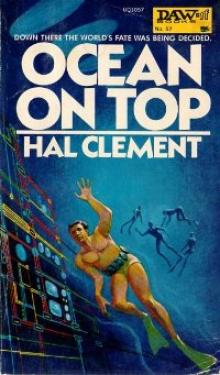
Ocean on Top
My job was simply to find and punish energy wasters—even at the bottom of the ocean!
I
I’ve never met a psychiatrist professionally and don’t much want to, but just then I rather wished there was one around to talk to. It wasn’t that I felt like cracking up; but when you have something profound to say, you like to have it appreciated, and it would have taken a professional really to appreciate the remark I wanted to make at that moment.
There’s a word for people who can’t stand being out in the open with crowds staring at them, and there’s another one for those who get all in a dither from being cramped into a small space. They’re both common enough ailments, but I would have liked to place a bet that no one before had ever suffered from agoraphobia and claustrophobia simultaneously.
With a name like mine, of course, I’ve never exactly sought the public eye, and usually I resist the temptation even to make bright remarks in company. Just then, though, I was wishing there was someone to hear that diagnosis of my feelings.
Or maybe I was just wishing there was someone.
I couldn’t hear the storm any more. The Pugnose had broken up almost where she was supposed to. She had hit the heavy weather just where the metro office had said she would, and her fuel had run out within five minutes of that time—that even I could have predicted; trust a Board boss to make sure that no more stored energy than could possibly be helped went down with her. There was some battery power left, though, and I had kept a running Loran check until she drifted as close to Point X as she was going to. This turned out to be about half a mile. When I saw I was going on past the key spot I blew the squibs, and poor little Pugnose started to come apart amidships.
She’d never been intended for any other purpose, and I hadn’t fallen in love with her as some people might have, but I didn’t like the sight just the same. It seemed wasteful. I didn’t spend any time brooding over it, though. I ducked into the tank and sealed it and let nature take its course. By now, if static pressure instruments could be trusted, the tank and I were eight hundred feet down.
It was very, very quiet. I knew water was going by because the depth was increasing about two feet a second, but I couldn’t hear it. Any loose pieces of the boat were long gone, floatables being scattered over the Pacific and sinkables mostly preceding me toward the bottom. I’d have been disturbed as well as surprised to hear anything solid bump against my particular bit of wreckage. The silence was good news, but it still made me uncomfortable.
I’d been in space once—a waste investigation at one of the Board’s fusion research stations—and there was the same complete lack of sound. I hadn’t liked it then; it gave me the impression that the universe was deliberately snubbing me until the time would come to sweep up my remains. I didn’t like it now, though the feeling was different—this time it was as though someone were watching carefully to see what I was up to and was trying to make up his mind when to do something about it. A psychiatrist wouldn’t have been much help with that notion, of course, because there was a good chance that it was true.
Bert Whelstrahl had disappeared in this volume of water a year before. Joey Elfven, as competent an engineer and submariner as could be found on Earth, had been lost track of ten months later in the same neighborhood. They were both friends of mine, and I was bothered by their vanishing.
Six weeks ago, Marie Wladetzki had followed the other two. This was much worse from my point of view. She was not an investigator, of course—the Board, as personified by its present boss whose name I’ll leave out of this account, doesn’t believe women are objective enough—but that didn’t mean she couldn’t be curious. Also, she’d been as interested in Joey as I was in her. Being Marie, she hadn’t actually broken the letter of any regulations when she took out a Board sub at Papeete, but she most certainly strained the spirit of most of them. She hadn’t said where she was going and had last checked in between Pitcairn and Oejo a thousand miles from where I was now sinking with the remains of Pugnose; but no one who knew her had any doubts about where to look first.
The boss was human enough to volunteer me for the look-see. My own inclination would have been to do just that—take a sub and see what had happened; but brains won out. Bert’s disappearance could have been an accident, although there were already grounds for suspicion about the Easter Island area. Joey’s vanishing within half a dozen miles of the same spot could conceivably have been coincidence—the sea can still outguess man on occasion. After Marie’s loss, though, only a very stupid person would have gone charging into the region any more obviously than he could help.
Therefore, I was now a thousand feet below the top of the Pacific and several times as far above the bottom, camouflaged as part of a wrecked boat.
I didn’t know exactly how much water was still below me; even though my last fix on the surface had been pretty good and I’d acquired an excellent knowledge of the bottom contours north of Rapanui, I couldn’t be sure I was going straight down. Currents near an island are not the smooth, steady things suggested by those little arrows on small-scale maps of the Pacific.
I might, of course, have tried echo-sounding, but to control that temptation I had no emission instruments in the tank except floodlights; and I had no intention of using even those until I had some assurance that I was alone. See without being seen was the current policy. The assurance would come, if ever, very much later, after I had reached the bottom and spent a good, long time listening.
In the meantime I watched the pressure gauge, which told how the water was piling up above me, and the sensors which would let me know if anyone else was using sonar gear in the neighborhood. I wasn’t sure whether I wanted them to react or not. If they did, it would be progress; I’d know someone was down here who shouldn’t be—but it might be the same sort of progress the other three had made. It might not be grounds for too much worry, since fifteen or twenty feet of smashed hull would show on any sonar scope for just what it was, and supposedly the tank inside would not. Of course, some sonarmen are harder to fool than others.
I could look out, of course. The tank had ports, and a couple of them faced the opening where Pugnose’s stern used to be. I could even see things at times. There were flecks of phosphorescence drifting upward and streaks of luminosity not quite bright enough to identify in color which sometimes whipped past and vanished in the gloom and sometimes drifted for minutes in front of a port as though they marked the position of something which was trying curiously to look in. I was tempted—not very strongly, but tempted—to turn on my lights once or twice to see what the things were.