

Beyond Revanche, page 1
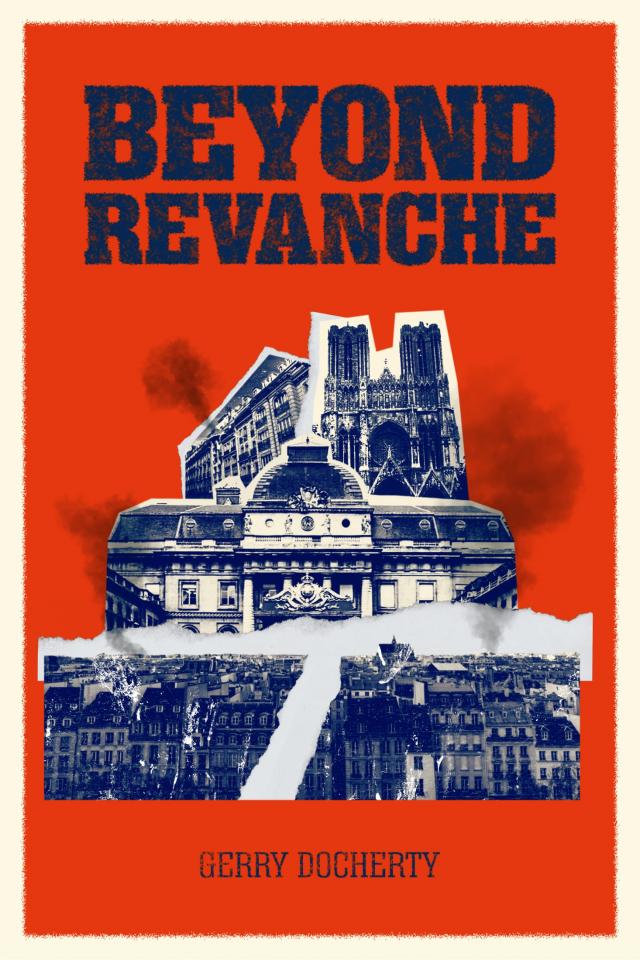


Beyond Revanche: The Death of La Belle Epoque
Copyright © 2021/2022 Anthony (Gerry) Gerard Docherty . All Rights Reserved.
Published by:
Trine Day LLC
PO Box 577
Walterville, OR 97489
1-800-556-2012
www.TrineDay.com
trineday@icloud.com
Library of Congress Control Number: 2022934857
Docherty, Anthony (Gerry).
Beyond Revanche: The Death of La Belle Epoque—1st ed.
p. cm.
Epub (ISBN-13) 978-1-63424-402-2
Print (ISBN-13) 978-1-63424-401-5
1. Fiction – World War I. 2. Fiction – Conspiracies -- History -- 20th century. 3. Fiction – World War, 1914-1918 -- Causes. I. Docherty, Anthony (Gerry). II. Title
FIRST EDITION
10 9 8 7 6 5 4 3 2 1
Distribution to the Trade by:
Independent Publishers Group (IPG)
814 North Franklin Street
Chicago, Illinois 60610
312.337.0747
www.ipgbook.com
To Those Who Dare Think For Themselves
Glossary
Action français: a far-right monarchist political movement. By 1914 it was the most effectively structured nationalist movement in France. Anti-German and pro-war.
Adams, Professor Ephraim: professor of history at Stanford University in California. Chosen personally by Herbert Hoover to oversee the vast tonnage of records, initially concerning the Commission for Relief in Belgium but expanded into virtually every pre - war piece of evidence about the origins and execution of World War I, which were transferred half way around the world to Stanford University immediately after the war.
Air raids over Paris took place in the early months of the war but became a desperate fact of life in Paris from March 1918 until the Armistice of 1918. The city was badly damaged and civilian life shattered.
Auberge is an inn.
Phillipe Berthelot: French diplomat credited with undermining peace efforts in 1914 by secretly encouraging the Serbians to continue upsetting the Austrians.
Boches: a derogatory French word for Germans. Translates roughly as cabbage-heads.
Bolivar Metro Station was built as part of the Paris Metro in 1911. It carried trains on line 7. Used as an air-raid shelter, it saw the worst case of civilian death in an air raid in Paris when, in sheer panic, 76 people were crushed or suffocated while the bombs were falling above.
Briey: an industrialized part of Northern France / Alsace with vast quantities of coal and iron. Centre of French steel production industry which lay a few kilometers from the frontier between France and Germany. Questions will always be asked about the French decision not to attack or dismantle the steel production which fed the German army.
Henriette Caillaux: French socialite and wife of former prime minister, Joseph Caillaux. On 16 March 1914 she shot dead Gaston Calmette in his offices. Her subsequent trial was one of the gravest travesties of justice in pre-war France.
Joseph Caillaux: Minister of Finance in 1914. Had been prime minister 1911-12. Known as a leader of the peace movement during the war.
Chateau Monthairons: built in the mid nineteenth century. Barely 13 kilometers south of Verdun, it served as an elegant army Headquarters.
Calmette was the editor of the French newspaper, Le Figaro, and he targeted the Caillaux family history to create maximum damage before forthcoming elections in 1914. He was on the point of publishing private love letters from Joseph Caillaux to his first wife when Henriette intervened.
The Caudron G.4 was the first twin-engine aircraft in service in numbers with the French Air Force. It was used to carry out bombing raids deep behind the front line, but it was comparably slow and increasing losses led to its withdrawal from day bombing missions in the autumn of 1916.
Comedie-Francaise on the Rue Richelieu was founded in 1680. It is the oldest active theatre company in the world.
Comité des Forges or Foundry Committee was an organization of leaders of the French iron and steel industry. It took a protectionist attitude on trade issues, and was opposed to social legislation that would increase costs. It was influential, particularly during the First World War, when it made vast fortunes from the armaments industry.
George Clemenceau was prime minister of France twice. Known as a hard man he is sometimes referred to as the “Father of Victory”. Hated by the left, especially the miners whom he crushed in a 1906 strike, he was fearless in criticizing other French governments until he himself took over in 1917. Shot by would-be assassin Emile Cottin in 1919.
Emile Cottin: an anti-war French militant who attempted to assassinate Georges Clemenceau in February 1919. Hated the prime minister for his harsh treatment of striking workers. Initially condemned to death by a military court but had the sentence commuted to ten years after loud and persistent protests. Died in the Spanish Civil War.
Committee for the Relief of Belgium was set up under the auspices of Herbert Hoover as Chief Executive of the food relief program for Belgium and Northern France. Believed to have also supplied food to Germany and thus played a major part in sustaining the war beyond 1915. Most of the produce was paid for by Britain and France in the main.
Deuxième Bureau: France’s most prestigious policing department, involved in counter-espionage and the protection of key political figures during WWI.
The Dreyfus Affair was a monstrous attempt by the French Army to imprison an artillery officer for spying for Germany. Dreyfus was Jewish and an easy target for the powerful anti-Semitic. After a retrial and immense journalistic pressure from Emile Zola and socialists like Jean Jaurès, he was eventually proven innocent.
The Élysée Palace is the official residence of the President of France
Estaminet is a small cafe-pub selling alcohol, often found in poorer quarters or out-of-the-way country places.
Pierre-Etienne Flandin: a French conservative politician who served as a military pilot during the First World War. He was prime minister from November 1934-June 1935. Involved in bombing of Briey.
Gaugin, Paul René: the grandson of the world famous artist Paul Gaugin, important figure in the Symbolist movement as a painter, sculptor, printmaker, ceramist, and writer.
General Joseph Gallieni was brought back from retirement at the start of the war. Left behind by the government which had retreated to Bordeaux, he defended Paris from the onslaught of the German armies in September 1914, and ordered many of his own troops north to stop the German advance.
General Guillaumat: chief of Adolphe Messimy’s military cabinet. Ended the war as commander of the Fifth Army. Involved in the decision to bomb Briey.
General Joseph ‘Papa’ Joffre served as commander-in-chief of French forces on the Western Front from the start of World War I until the end of 1916 when he was promoted to Marshal of France. Loved by his troops.
General Adolphe Messimy was a politician and general. He served as minister of war during the outbreak and first weeks of the war but insisted in returning to his army post and commanded a brigade at the Battle of the Somme. He was a brave and decisive leader, awarded the Croix de Guerre. Returned to politics in the 1920s.
General Robert Nivelle was promoted to commander-in-chief of the French armies on the Western Front in December 1916. Aided by his fluency in English, and his confidence with French and British political leaders, he was responsible for the Nivelle Offensive. When it failed to achieve a breakthrough on the Western Front, a major mutiny in the French army occurred and around half of the French Army refused to take part in further offensives for several months. Nivelle was replaced as commander-in-chief by Philippe Pétain in May 1917.
General Philippe Pétain, known as the Lion of Verdun, was by the end of the war Marshal of France.
The Gotha G.V. was a heavy bomber built for the Imperial German Air Service during World War I. Designed for long-range service it was used principally at night.
Célestin Hennion was head the Prefecture of Police in Paris. He was responsible for the reorganization of the service and the introduction of the flying squad, the Brigades du Tigres. He was considered one of the most influential French pioneers of modern policing.
Myron Herrick was previously Governor of Ohio. He subsequently served as U.S. Ambassador in Paris from 1912 to December, 1914 and again from 1921 to 1929. Although he was at the end of his first tenure in 1914, he assumed responsibility for some ambassadorial business covering those nationals from other countries who had been left behind in Paris.
Herbert Hoover was a former mining engineer whose close ties to the British elite gave him entrance to the upper levels of that society. Friend of Foreign Secretary Sir Edward Grey. Backed too, by President Wilson and his Wall Street supporters. Deeply involved in food supplies and international payments for these. Later 31st President of America.
Hoover was also the principal architect for the removal of all evidence of foodstuff importation and distribution through the Belgian Relief Fund, though some called it the American Relief Agency, at the end of the conflict. His organization procured and transported vast quantities of food into Europe and distributed it. How much went to Germany? Evidence removed. Profits? Audited by a company of Hoover’s choice. The records of governments, companies, deals and distribution disappeared from Europe alleged to be kept safe in Stanford University in California. Few had any idea that this was happening in the 1919-20s and even now the records of what was precisely taken remain ske
Hotel-Dieu on the Ile de la Cité is the oldest hospital in Paris, reputedly founded in 651 AD.
Jusserand, Jean Jules: the French Ambassador in Washington from 1903 - 1924. He was by the side of the American president Woodrow Wilson during the Versailles Peace Conference which began on 18 January 1919, and culminated in the signing of the Treaty of Versailles on 28 June, establishing peace in Europe, but not for long.
Lloyd George began the First World War as Chancellor in the British government, became the powerful Minister of Munitions in 1915 and then Secretary of State for War in 1916. He was head of a clique which assumed power in Britain under his prime-ministership in December 1916. Friend and associate of Basil Zaharoff.
Edward Mandell House, known as Colonel House, was the right-hand man of President Woodrow Wilson in the White House. Was never in the army and his rank of ‘colonel’ is entirely dubious. Mandell House was complicit with the English ruling elites and had access both to Prime Minister Lloyd George and King George V. He had close and dark associations with the great banking institutions on Wall Street.
Alexander Isvolsky was the Ambassador of Czar Nicholas II in Paris in 1910. He strengthened Russia’s bonds with France and Britain. He is alleged to have funded President Poincaré’s successful election in 1913. A warmonger.
Jean Jaurès was possibly Europe’s most outspoken anti-war figure and legendary publisher of the daily newspaper L’Humanité (Humanity). An antimilitarist, he spent his last days travelling across Europe desperately trying to stop the war. Jaurès was assassinated in Paris on the night of 31 Just 1914, the day before the First World War began. He remains one of the main figures in French 20th Century history.
Jean Longuet, depute editor of L’Humanitè, was the grandson of Karl Marx.
The Grand Prix de Paris at Longchamp remains France’s greatest horse-race and apex of the equine season. On 28 June, 1914 the race to the finish line was between Maurice de Rothschild’s Sardanapale and his cousin, Baron Édouard de Rothschild’s La Farina. The Austrian ambassador to France left the race meeting on hearing about the assassination of Archduke Ferdinand.
Mobilization: General mobilization was the last step before an all-out war. In 1914 it was recognized that the next step was a full declaration of war. Thus when the Russians mobilized the Kaiser tried desperately to convince the Czar to recall his troops, but when the Russians continued, he was obliged to declare war.
Montmartre is a historic district of Paris. It is primarily known for its artistic history, and as a nightclub district. Near the end of the 19th century and at the beginning of the twentieth, many artists lived in, had studios, or worked in or around Montmartre, including Amedeo Modigliani, Claude Monet, Pierre-Auguste Renoir, Edgar Degas, Henri de Toulouse-Lautrec, Suzanne Valadon, Piet Mondrian, Pablo Picasso, Camille Pissarro, and Vincent van Gogh. Nightlife included La Cigale and the Moulin Rouge. Remains very popular with tourists.
Mutilés is the French word for disfigured or mutilated. In the context of our story, it also has the sense of a disabled war veteran
Raymond Poincaré was President of France from 1913-1920. He was strongly anti-German in his attitudes, and used the Franco-German Alliance to build towards war in Europe. He visited Russia in 1912 and 1914 to strengthen the Czar’s resolve to hold fast to war against Germany and his visit in July 1914 had exactly that effect
Quai d’Orsay: Ever since the mid-19th century, this grand mansion has housed the Ministry of Foreign Affairs in Paris, and is the headquarters of the French Diplomatic Service.
Quai des Orfèvres sits on the island Isle-de France in the middle of Paris not far from the law courts called Palaise de Justice and Notre Dame Cathedral. No. 36 is the headquarters of the Deuxième Bureaux.
Rothschild, Baron Edmond: was a French member of the Rothschild banking dynasty. He was an intrepid supporter of early Zionism and played a pivotal role in the development of what became the State of Israel.
Sacré Coeur: The stunningly white travertine-stone that sits on the summit of Montmartre in Paris, towering above the city. It was scheduled to be opened in 1914 but the war intervened and it was eventually consecrated in 1919.
St. Gervais: a stunning parish church on the north bank of the Seine dates back into the middle ages. On 29 March 1918, a German shell, fired from long-range fell on the church, killing 91 people and wounding 68 others; the explosion collapsed the roof during a Good Friday service.
La Santé in Montparnasse is one of the most famous prisons in France, with both VIP and high security wings.
William Sharp: Ambassador of the United States in Paris. Appointed in June 1914 but didn’t take up post until December 1914. Remained in Paris for the duration of the war until April 1919.
Spanish Civil War 1936-1939 was a bloodbath in many quarters between the different forces of the left (anarchists and communists) and the right (Nationalists and Falangists). The war reached over to the Balearics in September 1936 and the narrative of this story follows that path. The town of Ibiza was indeed bombed.
Spanish Flu raged across the world as a pandemic in 1918-20. It did not originate in Spain. Probably brought from America by one of the first waves of army volunteers, it was an unusually deadly influenza pandemic caused by the viral H1N1 influenza. Lasting from February 1918 to April 1920, it infected an estimated 500 million people – about a third of the world’s population at the time.
The Taxi-cab army has assumed a much more grandiose legend than it probably deserves, but the Taxi drivers and companies from Paris greatly assisted the movement of many troops forward from the city towards the battle to defend the capital in September 1914.
Toul: Rhine canal (known as the Canal de la Marne au Rhin). The borders between France and Germany in the North East were served by a network of canals and rivers which boosted the industrialization of the area. Toul was an important junction with one major system running north to Verdun and Briey and a second flowing due west, crossing the river Meurthe at Nancy where a second major artery carried barges to Strasbourg and the Rhine.
Tour de France remains Europe’s premier international cycling race testing stamina and endurance over Alpine tracks and main road routes. In 1914 it was won for the second time by the Belgian champion Philippe Thys barely one week before the First World War began.
Vespasienne: the green circular public urinal which was literally a part of the street furniture of Paris at the time. Often adorned on the outside with posters for forth- coming theatrical events
Marcel Villain was Raoul’s elder brother. He served on the Western Front as an aviator
Raul Villain, the assassin, always claimed to have acted on his own. His back history is as we record it. His internalized thoughts are of course, fictional, but trace a genuine timeline. His childhood traumas, association with right-wing politics, arrest, trial and consequent life are as accurate as modern research permits.
Wendel, François: Before the war began, the Comite des Forges appointed François de Wendel as its president, the man dubbed by the socialist leader Joseph Caillaux as ‘the symbol of the plutocracy’. Deputy to the National Assembly, acknowledged as a maître de forges (iron master) from a dynastic line of iron and steel producers, Wendel became a Regent of the Banque de France. Francois was deeply anti-German and a strong supporter of Raymond Poincare and his Revanchist party.
Wendel, Henri – After the war of 1870, Henri remained behind in the annexed section of Lorraine as a subject of the new German Empire in order to keep control of the family’s extensive industrial interests there. Indeed he quickly reoriented his political loyalties and was elected to the Reichstag as a Representative for Lorraine from 1881-1890.
Wendel, Charles: elected to the Reichstag in Germany from 1907-1911. Thus the Wendel family retained both its political and economic interests on both sides of the border, with Francois in the French National Assembly and his father and cousin in the Reichstag. Together they owned the mines and factories, the plants and smelters in and around Briey.
Zaharoff, Basil: the Merchant of Death, international arms dealer. Said to be the richest man in the world in his lifetime. Of Greek or Turkish origin, he became a naturalized Frenchman. Awarded Grand Cross Legion of Honour (France) Knight Grand Cross of both the Order of the Bath and Order of the British Empire. (Great Britain) Personal friend of President Poincaré and Prime Minister Lloyd George. Sometimes called the Mystery Man of Europe.


