

Beyond Revanche, page 46


“Bombs!” she screamed. “They’re dropping bombs on Ibiza. Mother of God, we’re all going to die!”
We ran into the street, as did the entire population, bewildered by the unexpected assault on the island. The harbor buzzed with the extravagant rumor that General Franco had come in person to rescue us. Nonsense of course. But a fisherman I knew insisted that a small detachment of anarchists had landed by boat on the beach in Cala San Vincent and were wreaking havoc on the unarmed populace. I had to return immediately. Though the house was not yet finished, I had moved in my belongings and some personal items which they were certain to steal.
A black pall hung over the village as a warning to all who might seek to intervene. I picked up my stride, anxious to protect my property from those scavenging pigs. Looking back I could see clouds of billowing smoke and flames beyond Ibiza port. What was going on? The idyll was no more. As I reached the outskirts my next door neighbors approached me, clearly distressed.
“Raoul, stay away. There are angry and dangerous men stalking the streets. Came in by boat. Stay in the hills. Don’t go down to the cove.”
Not likely. Me? I ignored those idiots. I knew how to deal with soldiers. Huh, they weren’t real soldiers anyway. From the road, I could see a figure on my roof, looking out to sea.
“Hey, you,” I shouted, “get off immediately. It’s not secure enough to take your weight.”
The soldier turned and pointed a rifle towards me. It was a woman, but I knew the authority in my voice had unsettled her. She shouted at me, in Catalan, I assumed, but I marched onwards into the house.
“Stop where you are,” a voice ordered from behind. He was an officer, of some dubious rank which I was unlikely to recognize, but his pistol deserved my attention. He was young, unshaven and nervous. His cloth cap was an unnecessary status symbol. You could see that his trousers were worn and patched and his hands were stained with black ink. A printer from Barcelona, perhaps?
“Who are you and where have you been?”
“Monsieur, I am a Frenchman, from Reims, and live here as a resident.”
“This is your house?”
“Yes.”
“You have papers? You can prove this?”
“Of course I have papers.” Do they choose the particularly stupid ones as leaders to confuse the enemy?
He examined my credentials, unimpressed. I wondered if he could even read, but kept the thought unspoken. Most printers could read.
“You are Monsieur Villain?”
“I am.”
“You have placed a crucifix outside, on the hill directly behind your house. Why?”
“Because I chose to.”
“You are Catholic?”
“Yes, is that a crime? Most Frenchmen are Catholics.” I stuck out my chest inviting him to back off.
“I know many Frenchmen,” he retorted, “and none of them are Catholic. Do you favor Generalissimo Franco? Do you work for him? Perhaps you are a French fascist? Perhaps you are a Franco-spy.” He poked my chest firmly and I took a step back. “Tell me again where you were earlier today. Did you see the airplanes?”
“Look, I was in Santa Eulària visiting a friend, and yes I saw them. Nothing to do with me.”
“Did you tell anyone that we were here in Cala Sant Vicenç?”
“No. I didn’t know you were here.”
He had been joined by some others carrying loot of one type or another. A vintage clock that had long since given up telling the time. A saucepan, bedspread, and wall frame were piled in their arms. They looked like the gypsies and thieves I knew them to be. “We have to go back to the port now, but you will stay here in your house and await our return. Do you understand?”
“I’ve got business to do myself,” I protested. “I’m not about to leave the village, am I?”
“What business? Franco-business ?”
“No. I’ve nothing in the house to cook tonight. I must buy some food.”
“You will do as you are told, Monsieur Frenchman. Understand?”
He left me standing in the front room, looking out across the placid waves which lapped the coast, unaware of the trouble. I waited until they had disappeared from view, then gathered my valuables from the bedroom closet. It was hardly a fortune; two watches, a signet ring, and some cash in francs and pesetas. I would hide them six paces behind the cross in the garden, under the protruding roots of the palm tree. But he was back. He must have tiptoed into the house.
“And where do you think you are going with those?” he asked, brandishing his pistol.
“I’m taking them to a safe place,” I began sarcastically, “but I don’t think there are many left.”
His face twisted into a sneer. Perhaps he had been drinking to bolster his confidence. “You will come with us, to the port. I need to know more about you.”
“As you insist. Hopefully you will let me buy my food while we’re there.”
One of the underlings, a woman, appeared in some haste and spoke urgently to him. She looked dirty in her soiled black trousers, off-white blouse, and red-patterned neck-tie. Her short hair added to the masculinity of her demeanor and her eyes were hidden under a wide-brimmed straw hat. She carried a rifle which seemed to be at least as big as she was herself and an enamel can hung loosely from her waist. They reexamined my papers and their conversation became ever more animated. Then I distinctly heard the word Jaurès, mispronounced, as usual, but still recognizable. More pointing and excited insistence followed. They left the room to discuss me in private, so I took the chance to exit through the unfinished window by the side of the house. I ran across the road and onto the sand, picking up speed, not looking backwards. One minute was all I needed to get around the first rocks and they would not know where I had gone.
Slam. I fell as I ran, head first, down. Then the noise of gunshot carried forward past me into the soft beach. The shock of pain blasted through me and then subsided. The sand was warm and friendly. All these thoughts hit me as the bullet passed through my back and shattered my spine. I did not move because I could not. I heard my neighbors’ shouts and the soldiers’ replies, but it took some moments to understand.
“He’s not dead, Sir. Should I shoot him in the head?” It was the woman again.
You coward, I thought. I’m unarmed and cannot move, yet you would shoot me in the head? You coward.
“No, don’t waste another bullet, Chantal.”
The officer stood over me. I recognized his battered brown boots. Wouldn’t last another winter, for sure.
“You are a very stupid arrogant Frenchman. My colleague informed me that you have the same name as the murderer of the great socialist Jean Jaurès. Are you the bastard assassin?”
I chose not to answer. I had made that choice on many an occasion. My silence annoyed him further. He turned to the small crowd on the beach and warned them. “Leave him here. Do not move him. We will be back tomorrow, and if he is gone, every man, woman, and child in the street will be shot. Is that clear?”
From behind me someone said, “I’ll stay.”
So here I am, my friend. Still lying on the beautiful beach, but tired now. Very tired. Almost lifeless. Though I can’t see you properly, you are the only one who has stayed loyal, day and night. I appreciate that. I do. I have sensed your presence. For two days you have listened to my every word. No interruption. Not once, my friend. Not once. I have shared my life story with you while you calmly smoked your pipe. Oh yes, I can smell it. I’ve shared secrets with you that no one else will ever know. And for that, I am grateful. Will you stay with me to the end, my friend? Please? It won’t be long.
“I think you’re right.”
She was a woman. That woman who spoke French. Had she shot me in the back?
I wanted to see her face but she just sat there on a rock as she had for two days, cleaning and re-cleaning her rifle.
“Just to let you know,” she added, “I’ll be writing to my uncle shortly. You knew him once, I believe. In La Santé. You called him Carbolic.
And the sound of lapping waves gently seduced my being.
Denouement
A cutting slipped from the envelope. Postage stamp said Paris. With it was a two-word note in spidery scrawl.
At last.
The newspaper reported that the unarmed Raoul Villain had been shot in the back by Spanish Republicans on the island of Ibiza and died on the beach. Mathieu reread the piece without emotion.
“C’est fini,” he said aloud, and turned back to the business at hand.
“Bernard, for the last time, will you do as your mother says.”
Acknowledgments
I have to begin by thanking Kris Milligan at TrineDay for his early enthusiasm for this novel. His faith energized my writing and he backed that up by introducing me to Todd Barselow, a literary editor with the patience and insight to help me bring Beyond Revanche to the page.
Previously I have written purely historical work in conjunction with my colleague, Jim Macgregor, whose dedication to detail was formidable. Switching genres from history to historical fiction was a challenge whose difficulties I didn’t at first appreciate, and I am particularly indebted to the advice I received from a number of colleagues and friends.
I must thank Jo Bell, in particular, an up-and-coming Scottish writer and poet. Jo has presented her work at the Edinburgh International Book Festival and I am in admiration of her skills. Mark her name for the future. Louise Docherty and Lawrie Risk added helpful suggestions to the work-in-progress and guided me in areas that others might have been reluctant to criticize. Friends and family have been equally enthusiastic and I am grateful to them for reading tracts or earlier versions of the book.
Thanks also to my local expert on all things Corsican, Eddie Inglis.
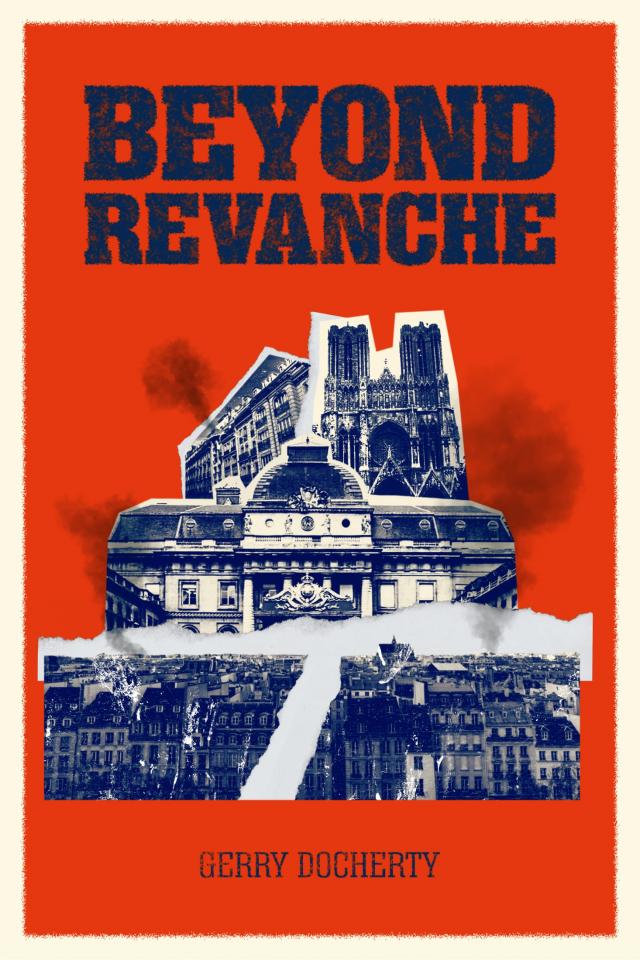
Finally, a word of particular thanks to Jack Gibson for producing the front cover.
Contents
BR00000
BR000001
BR000002
BR00003
BR00004
BR00005
BR00006
BR00007
BR00008
BR00009
BR00010
BR00011
BR00012
BR00013
BR00014
BR00015
BR00016
BR00017
BR00018
BR00019
BR00020
BR00021
BR00022
BR00023
BR00024
BR00025
BR00026
BR00027
BR00028
BR00029
BR00030
BR00031
BR00032
BR00033
BR00034
BR00035
BR00036
BR00037
BR00038
BR00039
BR00040
BR00041
BR00042
BR00043
BR00044
BR00045
BR00046
BR00047
Landmarks
Cover
Gerry Docherty, Beyond Revanche


