

Chilli Bean Paste Clan (9781911221111), page 1


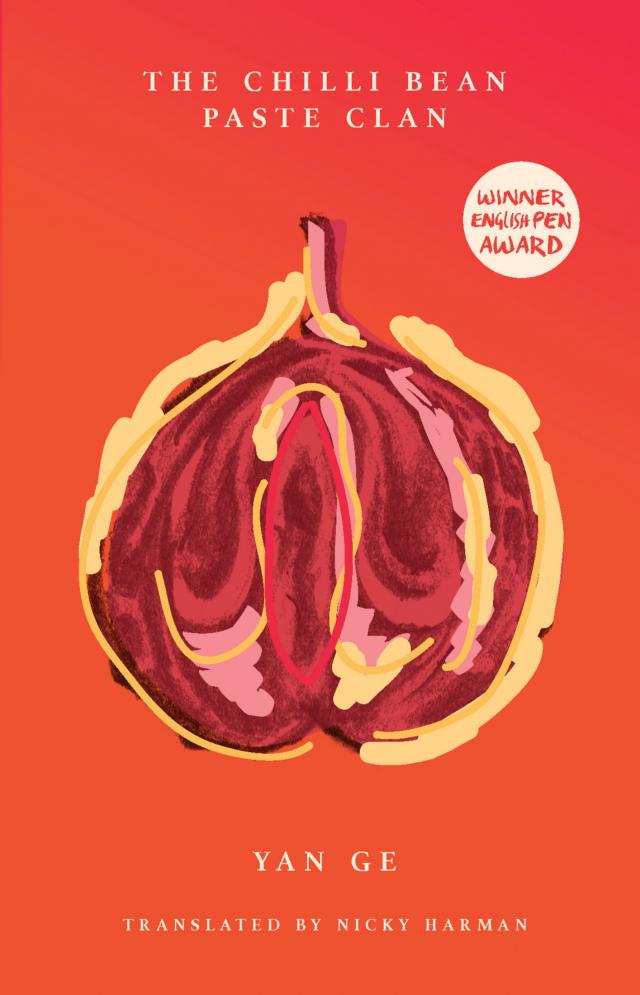
Yan Ge was born in 1984 in Sichuan in China, and currently lives in Dublin. She is a PhD candidate in Comparative Literature and was visiting scholar at Duke University from 2011 to 2012, as well as writer in residence at Crossing Border Festival in the Netherlands in November 2012.
Yan Ge writes realist, witty fiction, strongly Sichuan-based, focusing on squabbling families and small-town life. She has been named by People’s Literature magazine as one of China’s 20 future literary masters. Her writings have been translated into German, French and other languages. Her fiction translated in English includes the novella White Horse.
Nicky Harman lives in the UK. She taught translation at Imperial College London before becoming a full-time translator of Chinese literary works. She has won several awards, including the Mao Tai Cup People’s Literature Chinese-English translation prize 2015 and the 2013 China International Translation Contest, Chinese-to-English section. When not translating, she promotes contemporary Chinese fiction to the general English-language reader through literary events, blogs, talks, a short story project on Paper-Republic.org, and with the Writing Chinese project at Leeds University. She also mentors new translators, teaches summer schools, and judges translation competitions. She tweets as the China Fiction Bookclub @cfbcuk.
YAN GE
The Chilli Bean Paste Clan
A Novel
Translated from the Chinese by
Nicky Harman
BALESTIER PRESS
LONDON · SINGAPORE
Balestier Press
71-75 Shelton Street, London WC2H 9JQ
www.balestier.com
The Chilli Bean Paste Clan
Original title: 我们家
Copyright © Yan Ge, 2013
English translation copyright © Nicky Harman, 2018
First published by Balestier Press in 2018
This book has been selected to receive financial assistance from English PEN’s PEN Translates programme, supported by Arts Council England.
English PEN exists to promote literature and our understanding of it, to uphold writers’ freedoms around the world, to campaign against the persecution and imprisonment of writers for stating their views, and to promote the friendly co-operation of writers and the free exchange of ideas.
www.englishpen.org
A CIP catalogue record for this book is available from the British Library.
ISBN 978 1 911221 22 7
ISBN 978 1 911221 11 1 (e-book)
Cover design by Sarah and Schooling
All rights reserved. No part of this publication may be reproduced, stored in a retrieval system or transmitted in any form or by any means, electronic, mechanical, without the prior written permission of the publisher of this book.
This book is a work of fiction. The literary perceptions and insights are based on experience, all names, characters, places, and incidents either are products of the author’s imagination or are used fictitiously.
Contents
Foreword
The Family and Other People
Chapter 1
Chapter 2
Chapter 3
Chapter 4
Chapter 5
Chapter 6
Chapter 7
Chapter 8
Chapter 9
Chapter 10
Translator’s Acknowledgements
Foreword
Looking back, The Chilli Bean Paste Clan were as quiet as the snowfall. It was in Durham, North Carolina. I was a newcomer who had barely settled in. There was no furniture in my one-bed rental so I put my laptop on the kitchen counter by the sink and drank tap water vigorously while I wrote. I remember when, in the middle of the night, I went to the fridge to get ice, the ice cubes dropping into my glass like thunder.
I remember how sweet it felt when I typed through pages and how cozy when I sank into perpetual melancholy. It was just myself, the manuscript, the desire to dive into nothingness and the profundity of the unknown.
Except that it’s probably not true. I know for a fact that I had no idea what I was doing and that I hated every word I typed and called myself a fraud. For a while I thought I was never going to finish this novel and so I just gave up. I was binge-eating strawberry ice cream and quaffing four to five pots of coffee on a daily basis until I got sick. I cried a lot and eventually took a course on French literary criticism. This was all in the spring of 2012.
In the summer I came back and finished the first draft before August. And after that, all the pain and self-loathing disappeared, replaced instead by serene and euphoric days in which I just worked like the first bee in the hive.
And this is it. The reason I became a writer, and stayed one, is because I am forgetful. I’ve taken the habit of weaving everything into a narrative so it can be stored in order and remembered, except that I simply cannot and will not take everything in. The nature of narrative is that it’s always partial. In order to tell a story, some parts have to be bent and some need to be thrown away. The strawberry ice cream was in fact zero-fat strawberry yoghurt; and I certainly did other things in Durham which could not fit into any narrative and have since perished.
When I capture an image, the rest of the scene is deleted. When I tell a story, the rest of reality is forgotten.
When I left my hometown and could relive it only through my fiction, I was saturated with nostalgia and tenderness. In the story of The Chilli Bean Paste Clan, there was a man who cheated on both his wife and his mistress; a mother who manipulated her children so much that they became oblivious to their own wills; there was a boy who abandoned his pregnant girlfriend to escape his tedious hometown; all the small-minded and self-absorbed characters, exhibiting their cruelty in a nearly comic way; however, I loved all of them hopelessly. I loved all of them and I was one of them. In telling the story, the pain and anger had faded, leaving only faint images of kindness and joy.
I wouldn’t have been able to finish this novel if I had written it in China. The town in the story was virtually the town where I grew up. Through the faces and voices of the characters I could see my family, friends, old neighbours and acquaintances. Confined in this four-street-town, we had become extremely dependent and intimate. We cheered over our good fortune and fed on each other’s misery. It was just impossible to write about this place because I was part of it and it was part of me.
So I really struggled. I had to swallow tons of ice cream (zero-fat yoghurt) and stay up all night drinking iced water; I attempted to understand Jacques Rancière and Paul Ricœur and took endless disorientating notes; ultimately, I needed to move to the other side of the world to write about my hometown. A place I lived in, loved, but could never return to.
I could never go back because it was in the past. Somehow, I could only live a life when that life had already been lost. And it was only with insurmountable distance I could write about the past. As I said, it was just the nature of narrative, the story of my life.
Yan Ge, Dublin, 2018
The Chilli Bean Paste Clan
THE FAMILY AND OTHER PEOPLE
Surnames in capitals
Dad (full name XUE Shengqiang), the owner of the local chilli bean paste factory
Mum (full name CHEN Anqin), Dad’s wife
Xingxing (full name DUAN Yixing), their daughter, the narrator
Gran (full name May XUE), owner of the chilli bean paste factory
Granddad (full name DUAN Xianjun), now deceased
Uncle (full name DUAN Zhiming), Dad’s older brother
Aunt Coral (full name Coral XUE), Dad’s sister
Uncle Liu (full name LIU Qukang), Coral’s husband
LIU Xingchen, their son; ZHAO, his wife; Diandian, their baby son
Jasmine ZHONG, Dad’s young lover
ZHU Cheng, Dad’s driver
ZHONG Shizhong, Dad’s oldest friend (no relation to Jasmine)
GAO Tao, another bro, and Zhong’s brother-in-law
Qin (full name ZHOU Xiaoqin), Uncle’s childhood sweetheart
Old Chen (full name CHEN Xiuliang), the foreman (shifu) of the fermentation yard
And finally:
The Mayflower Chilli Bean Paste Factory
1
In Dad’s cell phone, Gran was listed as ‘Mother.’ From time to time, ‘Mother’ popped up on screen at peculiarly inappropriate moments.
Sometimes it would be during a meeting at the factory when Dad was trying to call the laughing, chattering salesgirls to order. Or he was out drinking with his bros, knocking back the maotai, the air thick with smoke. Or, worse still, Dad would be in bed, either with Mum or else some young woman of his acquaintance and, just when things were getting lively, A Pretty Sprig of Jasmine would ring out. Dad would feel himself going soft and, when his cell phone proved incontrovertibly that it was Gran, all the fight would go out of him. Floating gently to earth like a hen’s feather, he’d pick up the phone, walk out into the corridor, clear his throat and respond: ‘Yes, Mother’.
At the other end of the line, Gran would start to tug on Dad’s heartstrings. ‘Hello, Shengqiang!’ ‘Yes, Mother, what’s up?’ He’d stand, propping himself against the wall, just four or five streets from Gran. ‘Mother, I know about that. Don’t you worry. I’ll deal with it.’
Then he’d hang up and go back into the room. But those few minutes had wrong-footed him. If he was with the salesgirls, they’d be gossiping away amongst themselves, if it was a get-together with his bros, they’d be texting or lighting up another cigarette. Or if he was with a woman, she’d be bent over scraping a callus off her heel. Still, Dad would give a cough, shut the door behind him and they’d get back down to where they’d left off.
The only exception to this rule was if the woman in the bed happened to be Mum. In that case, he had to answer a few questions about Gran first. ‘What’s up with that mother of yours now?’ Mum would ask. Dad would come across the room, take off his slippers, and dive under the bedcovers. ‘Oh, just forget it!’ And they’d get back down to where they’d left off.
Dad put on a maroon striped shirt over his trousers and went out into the passageway. He called Zhu Cheng. ‘Where are you? ... Right, come and get me then.’
He started down the stairs. He had only got halfway down to the next floor when he paused, then gave voice to a stream of poetic obscenities. ‘You’re vermin, the lot of you! Son-of-a-bitch, I’m gonna murder you all one of these days!’ When he reached the ground floor, he lit up a cigarette and smoked it until, far in the distance, he saw the shiny black Audi approaching. Then he hurled his cigarette down, ground out the sparks under his foot, pulled open the car door and jumped in. ‘Cornucopia Court,’ he ordered.
Zhu Cheng turned the steering wheel and the car bowled along West Street towards the outskirts of town. As they crossed the intersection, Dad looked out of the window. The two streets were hideously thronged with people. No one paid attention to traffic regulations any more, not since the Tianmei Department Store had opened up here. One young couple, their arms draped around each other’s waists, made a reckless dash across the road in front of the car. A young mother had her hands so full of shopping bags she wasn’t holding her kid’s hand and he charged out and nearly pasted himself onto the car’s side-mirror. Zhu Cheng slammed on the brakes, just avoiding hitting them, then stuck his head out of the car window and shouted lengthy picturesque references to their ancestors.
‘Calm down, Zhu Cheng,’ said Dad from the back seat.
‘These people need a telling-off, boss. They think I won’t dare hit them!’ Zhu Cheng steered the car through the crowds.
‘Nothing’s the same any more,’ Dad said. ‘People with shoes are scared of people without, and car-drivers are scared of pedestrians.’
‘Absolutely! Chinese people are a bunch of idiots!’ Zhu Cheng agreed.
They crossed Celestials Bridge on West Street. Just three years ago, a new park had been built there and the original smelly ditch filled in and covered over. Dad could see a bunch of old people gathered in the park, some chatting, some just sitting. Gran wouldn’t be there though. He pulled out his cell phone and checked the time.
At the entrance to Cornucopia Court, Dad said: ‘Don’t bother to drive in, Zhu Cheng, just leave me here and you can be off. I won’t need the car this evening, I’ll walk home.’
‘I’ll wait for you, you can’t go home on foot,’ said Zhu Cheng solicitously.
‘It’s no distance. I can walk. And don’t take the car back to the factory, come straight to the house and pick me up at eight o’clock tomorrow morning,’ Dad instructed him. Then he got out.
Granddad had died two years previously and last spring their housekeeper announced her son wanted her back in the village to look after the grandchild, whereupon she upped sticks and left. Gran said she’d never find anyone else to suit and wasn’t going to try, so now she lived alone in the family’s old apartment, with its three bedrooms and two reception rooms, without even an hourly-paid helper. She just wanted the peace and quiet, she said.
Gran had lost weight since last year, and was getting shorter inch by inch, Dad reflected, as he walked up three floors, took out his key and opened the door. As usual, he couldn’t see Gran at first. The apartment was piled high with books, magazines and newspapers, and it looked as if no one had lived there for months. ‘Mother!’ he shouted. Then again, ‘Mother!’ Had Gran lost her voice?
‘Coming, coming!’ Gran called back, emerging from somewhere at the back. ‘Shengqiang ... it’s you!’
‘Yes, it’s me,’ said Dad, going out to the balcony to retrieve the ashtray which Gran had put beside the potted orchid. He took it back into the sitting-room and put it down on the coffee table, lit a cigarette and sat down on the sofa.
‘Smoking again!’ Gran exclaimed from her rattan chair, shaking her head.
‘Ai-ya! Don’t go on at me!’
‘Well if I don’t, who’s going to?’
‘All right, all right,’ Dad said, with a puff on his cigarette.
‘There’s something I want to talk to you about,’ said Gran.
Dad scrutinized his mother as she talked. Her hair had been completely white for a while now but she still had it neatly permed so that the waves undulated over her head. She wore a pale-green silk padded jacket over a knee-length grey silk skirt with white flowers on it. Her calves were bare below the skirt and, above her flesh-coloured socks, the skin was pallid and drooped as if half-a-dozen weights were pulling it down.
Dad let his thoughts drift back to the exact moment when he realized that Gran was old.
It was 1996, or maybe 1995, in March or April, and Gran suddenly got it into her head that she wanted Dad to take her to Chongning County see the pear blossom in Pear Blossom Gully. When they got there, the gully and all around it was crammed full of people. Gran sat in the car frowning at them. Zhu Cheng, who had just started as their driver and hadn’t quite got the hang of things, sat woodenly in the driver’s seat and Dad had to help Gran out of the car. He took her left hand, and put his other hand on her shoulder to guide her out.
That was the moment it struck him Gran was old. Through her clothes, Dad could feel the skin on her shoulders hanging in slack folds which actually quivered as she moved. He froze, appalled. Then Gran said: ‘Get out of my way, Shengqiang. If you stand in my way, how can I walk?’
Dad took a step back and watched as she made her way to Pear Blossom Gully. ‘Mother,’ he called.
Gran stopped and looked back. She looked just as normal, no different from a few minutes before, but Dad had to steel himself to look her in the face.
‘Come on!’ She said.
On their way back to Pingle Town, Gran had said: ‘Don’t you go divorcing Anqin, there’s too much at stake. She did wrong, but now she’s got down on her knees and grovelled to you, just let it go. The pair of you should stop bickering and just muddle along together.’
Dad gave a non-committal grunt. His right hand still tingled.
‘Are you listening to me, Shengqiang?’ demanded Gran now, after waiting in vain for his response.
‘Yes, right,’ Dad said again, putting out his cigarette, lifting his eyes from her calves and nodding.
‘Off you go then. I’m going to read for a bit and then go to bed.’
‘Yes, you get an early night, Mother,’ said Dad stolidly.
Outside Gran’s apartment, Dad paused for a moment, then went up to the fifth floor. Here, the staircase ended and two lonely doors faced each other. Dad took out his cell phone and made a call. It rang just once, then someone answered.
‘Open up,’ said Dad.
In a second, the door had opened. Pretty Jasmine Zhong stood there, her hair hanging in a gleaming black curtain around her dainty face.
Dad’s face finally cracked a smile. He went in, shutting the door behind him.
In Dad’s cell phone, Jasmine Zhong had gone under a variety of guises, all masculine. A few months ago, she’d been listed as Zhong Zhong, then for a couple of weeks, it changed to Zhong Jun; recently Dad had decided to keep life simple, and he listed her as just Zhong. Once, Dad had been at home eating dinner with his phone beside him on the table and it rang. Dad didn’t pick it up straightaway and Mum leaned over and took a look. ‘It’s your friend Zhong,’ she said.
‘Oh,’ said Dad. ‘Hey, bro,’ he said into the phone. ‘I’m at home having dinner. A game of mahjong, eh?’
There was a gasp of surprise from Jasmine at the other end.


