

Watergate, page 96


X. Liddy had argued extensively over which women would be most enticing to Democrats: Hunt and Barker kept wanting to recruit dark-haired, “sultry” Cuban women, while Liddy preferred fair-skinned; after reviewing only photographs provided by Frank Sturgis, he had identified two Anglo-Saxon women he felt confident could seduce discerning men of power.
XI. It’s unclear the extent that John Mitchell ever actually endorsed the theoretical concept of GEMSTONE. As Magruder noted later, Mitchell was rarely prone to direct confrontation, and Dean remembers Mitchell winking at him midway through Liddy’s presentation—perhaps acknowledging that it was far outside the bounds. Kleindienst, his deputy at the Justice Department, cited Mitchell’s major “limitation” as his “soft-spokenness and his tendency to understate his view.” As Kleindienst said later, “I frequently found it necessary, after a staff meeting, to interpret in unequivocal language what Mitchell really intended.”
XII. In Dean’s memoir, he attributes this remark to himself, not Mitchell.
XIII. Afterward, Tuck learned he’d misspelled the signs, which actually said “What about the huge loan?”
XIV. At one point, he’d gotten into a high-profile flap with J. Edgar Hoover after his reporters had started going through the FBI director’s trash—a common-enough investigative technique by the bureau that its leader didn’t appreciate being turned against him.
Chapter 12: Third-Rate Burglars
I. The title, In Nixon’s Web, seemed to leave little doubt whom he ultimately came to blame for his predicament and the ignominy that would befall him in the role.
II. Not everyone loved the new design, set among the capital’s standard white marble buildings. Washington Post critic Wolf Von Eckardt wrote that the Watergate’s aesthetic was as appropriate as “a strip dancer performing at your grandmother’s funeral.”
III. For reasons that have never been fully explained, John Dean evidently was separately interested in the Watergate that month too. On May 18, Tony Ulasewicz had met Dean at the White House. (He’d taken an instant dislike to the president’s counsel, whom he thought looked like a mannequin in a men’s shop, and “dismissed him as a slick operator.”) Dean thanked him for cooperating earlier in the year with some work by Liddy—a figure Ulasewicz only knew as “Mr. George”—and explained that the campaign had plans to stir up some trouble for Democrats. A few days later, Caulfield told the private investigator that Dean wanted the Democratic National Committee at the Watergate scoped out, a mission that appeared separate from Liddy’s operation.
IV. The fact that the Cubans were in town four days early for the scheduled break-in has long puzzled Watergate historians; in most other operations, the always cost-conscious Liddy brought them into town the same day or just a day before operations. Historians have long wondered if there had been plans for another operation, executed covertly or aborted prematurely, that would explain the long D.C. visit.
V. This joking exchange does not appear in Hunt’s recounting of the night, but as we’ll see later on, it’s possible that much of the widely accepted story about how the failed break-in on the 26th unfolded is a lie.
VI. Mitchell denied all of this, saying it’s a “palpable, damnable lie.” Magruder’s version had Mitchell confronting Liddy directly, which is not backed up by Liddy’s book, but the sum and substance of the phone call from Magruder on June 9 in the book is similar to the message Magruder says Mitchell said.
VII. For whatever reason, the burglary team would say later that they’d never contemplated that the building security guard would call the police upon suspecting a break-in. Instead, they had carried the $100 bills into the building, figuring that if they were confronted by a low-paid hourly guard, they could easily bribe their way out.
VIII. As a reward for his vigilance, Wills was given a raise, after taxes, of 40 cents a week.
IX. Parts of this theory were also developed in an earlier “revisionist” history of Watergate, Jim Hougan’s Secret Agenda, which came out in 1984 and was the first Watergate narrative to have access to large portions of the FBI’s files, given out under the Freedom of Information Act, and which is a mix of crack observation and investigation and hard-to-source rumor. The Washington Post called it a collection of more “working hypotheses than prudent conclusions.”
X. Christopher Hitchens, in his book The Trial of Henry Kissinger, provides compelling evidence that the Nixon administration’s vendetta against Demetracopoulos might have gone even further than just time: The Greek junta in the spring of 1974, when the Nixon administration was in its final months and the junta was actually in its final weeks, plotted to kidnap and likely murder Demetracopoulos, smuggling him out of the country on a Greek submarine at dock in Virginia. One of the top officials at the Greek embassy later wrote to Demetracopoulos that Henry Kissinger was fully aware of the plot, but a congressional investigation into the allegation and the CIA’s work with the Greek junta was shut down at Kissinger’s request.
XI. Behind the scenes during this period there was also heavy government surveillance on Demetracopoulos, including by both the CIA and the FBI, with reports funneled to Henry Kissinger’s National Security Council, including attempts to link the Greek journalist to Daniel Ellsberg.
XII. Hunt’s memoir says that the banquet wrapped up around 10:30, when a guard told them to close up, and that he and Gonzalez were stuck in the Continental Room until after 11 p.m. when the alarm on the corridor stairway kicked in, but in the 1984 book Secret Agenda, journalist Jim Hougan uncovered that there was no guard on duty before midnight who could have told the burglars to wrap up their dinner at 10:30 p.m.; the banquet waiter apparently didn’t leave work until 12:30 a.m.; and the building’s guard log—written, as it were, by the same overnight guard, Frank Wills, who would discover the burglars on the 17th—noted on his 1 a.m. rounds, “Contineal [sic] Room Open / Having Meeting Cont / Room Close at 2:10 a.m.” Nor, according to the Watergate’s head of maintenance, was the corridor door alarmed in the way that McCord and Hunt say stymied their efforts.
Chapter 13: “A Crime That Could Destroy Us All”
I. This story has “evolved” from the early years of Watergate investigation. Liddy’s (highly detailed and entertainingly written) memoir was not published until 1980, long after the political repercussions and after the criminal statute of limitations had expired for the acts involved. Liddy said the phone call ordering him to find Kleindienst came from Magruder, but Magruder argued it came from Robert Mardian. Magruder’s memoir seems among the less reliable of the Watergate memoirs, while Liddy’s, if anything, seems to perhaps overinflate Magruder’s culpability. What does seem clear, though, is that Mitchell was never consulted, as Magruder originally implied.
II. At least that’s the story Dean told to the Senate Watergate Committee and in his memoir. However, in Silent Coup, Len Colodny and Robert Gettlin tracked down Dean’s travel partner, another U.S. official, and traced the flights that they were on, and reported that they believed Dean actually left Manila as early as he could Sunday and experienced two Sundays—a critical difference pointing to an earlier role for Dean in the Watergate cover-up than he ever allowed at the time. Dean disputes their conclusion and argues they are misreading his travel documents. Whenever he found out about the burglaries, one of Dean’s first moves was, apparently, to reenlist his old intelligence operatives, Jack Caulfield and Tony Ulasewicz. Ulasewicz got a phone call on the morning of the 18th from Caulfield—who, given the timing, seems likely to have spoken to Dean during the White House counsel’s layover in San Francisco—saying that Dean wanted the private eye in D.C. pronto, ready to take on any necessary tasks. Ulasewicz initially resisted—he said he wanted no part of a cover-up—but eventually relented, checking into the Roger Smith Hotel for two days, never to receive a phone call or mission.
III. After the prolonged ITT controversy, he had been confirmed by the Senate on June 8 and sworn in on June 12.
IV. Kleindienst’s intuition was almost certainly correct. While it seems clear Magruder had invoked Mitchell’s name in the order to Liddy that Saturday morning, further investigation has made it clear that Magruder didn’t speak to Mitchell beforehand. According to the logs of Mitchell’s bodyguard, onetime FBI agent Steve King, Magruder didn’t meet with Mitchell that Saturday until 9:55 a.m. PT, nearly 1 p.m. ET, whereas by all accounts Liddy had already driven to Burning Tree and was standing in the club dining hall by around 12:30 p.m. ET. The question of whether Mitchell did order Liddy to find Kleindienst is not entirely an academic one: When prosecutors later charged Mitchell, Mardian, and others with conspiracy and obstruction of justice, they listed the Burning Tree conversation as the first “overt act” of the conspiracy. So who invoked Mitchell’s name and ordered Magruder to dispatch Liddy?
V. While Kleindienst says he recalls telling Petersen that his phone call was prompted by the presence of Liddy, Petersen said that the attorney general never mentioned Liddy’s name and that it was months before anyone at the Justice Department became aware of the conversation at Burning Tree.
VI. In the federal capital, the 140 federal prosecutors are also responsible for trying “local” crimes, meaning that the run-of-the-mill burglary was still being run by the U.S. Justice Department.
VII. His final hiring interview at the Post, with executive editor Ben Bradlee, came on Friday, September 3, 1971, the same weekend that Howard Hunt led the burglary of Ellsberg’s psychiatrist.
VIII. The reporter’s sudden appearance was not surprising. “Bernstein also had an unnerving habit of somehow materializing in the newsroom day or night or on a weekend when a big story was breaking and muscling his way unassigned into the coverage of it,” Len Downie, who would later edit the Watergate coverage, once wrote.
IX. As Harrison Salisbury, a Timesman who authored a major history of the paper, wrote later about why the Times originally missed Watergate, “Nothing was more un-chic than to stay in grubby Nixonian Washington over a weekend from June 15 to September 15. Nobody worth knowing possibly could be in town.”
X. Coincidentally, Acting FBI Director Gray was also at the Newporter, having given the commencement address at Pepperdine on Saturday. He’d gotten word from D.C. about the break-in, but left the investigation in the hands of Mark Felt. Sunday afternoon, he ran into Fred LaRue at the pool. “That Watergate thing is a hell of a thing,” the Mitchell aide commented.
XI. Bernstein’s colleagues knew him as someone who was always borrowing a cigarette or a dollar, with no expectation of ever returning the favor.
XII. Confoundingly, Hunt in his memoir places this telephone call from Woodward as occurring Saturday morning, hours after the burglary, saying that it was the first thing to happen to him after waking up that day. Woodward’s timeline seems almost certainly correct instead. Hunt’s version of the seventy-two hours following the burglary seems generally to mix up and collapse the time certain events occurred. Liddy’s account also seems confused during this time window at points; he places the Woodward-Hunt call incorrectly on Sunday afternoon.
XIII. All the President’s Men misidentifies the New York Times article as running in February 1971.
Chapter 30: The End of Mark Felt
I. Woodward and Bernstein were initially angry that the paper had entered the “Public Service” category, which alone among Pulitzers is given to the newspaper rather than individual reporters, but Bradlee aggressively argued back that the paper had staked its reputation on their work. “The paper had its cock on the chopping block,” he told them. Bradlee was furious in his own way with the Pulitzer board: Amid the horse-trading that accompanied re-awarding the Public Service prize to the Post, the board stripped Post reporters of two other Pulitzers they were supposed to be awarded: Woodward and Bernstein’s victory came at the expense of their colleagues Bob Kaiser and Dan Morgan, who were meant to win for foreign reporting, and Bill Claiborne, who had been set to win the local spot news prize.
II. The rivalry, though, only teetered on the friendly; once Bernstein stopped by the Times bureau and left a note on Hersh’s desk saying he’d rifled his competitor’s files. Hersh, interviewing a source one day, learned that Woodward was due to stop by later and left a note: I was here first.
III. Haig’s calculating nature was apparent in how he navigated accepting the White House; since federal law prohibits active-duty officers serving in civilian government roles, in order to preserve his military commission he tried first to get a Pentagon ruling that he was just being detailed to presidential duty. When that sparked outrage on Capitol Hill, including from Barry Goldwater, he announced he would resign his military commission—effective four months after taking over at the White House, a delay that would tip him over the next level of retirement pay and increase his pension by $3,000 a year, a paperwork sleight-of-hand that similarly drew fierce criticism on Capitol Hill.
IV. The fact that Haig was one of Watergate’s most prodigious leakers, ensuring his story was told in the kindest light, certainly did much to influence history’s view of his tenure. Then and now, pundits and historians debate what exact level of influence Haig held, with theories running the gamut from a well-meaning military leader who stepped into a power vacuum to steady the country in crisis to a Machiavellian conniver who shielded himself from consequences as he maneuvered Nixon out of office.
V. Elliot Richardson, meanwhile, received a similar assessment from one of Buzhardt’s former Pentagon colleagues that would ring true only months later in hindsight: “If you need a job done with no traces, Fred Buzhardt is your man. He can bury a body six feet under without turning a shovelful of dirt.”
VI. The new role was a hard sell for Laird, less so for Harlow; Laird was worried about returning to what he called “that jungle,” having felt distrusted by Nixon as defense secretary despite their personal friendship. But the congressional leadership, including Gerald Ford, lobbied Laird hard for help. Laird’s wife remained steadfast that it was a bad idea. “She thought President Nixon was lying about the Watergate cover-up,” Laird recalled to his biographer. Nixon, ever ungrateful, grumbled even as Laird returned: “[He’s] somebody to go out and leak everything,” Nixon complained to Haig. “He loves to do that.” Most of the new team Nixon recruited would quickly fumble. As Kissinger recalled, “Nixon was too shattered to reach out genuinely.… Without specific assignments they proved of little help.”
VII. The core of the article’s revelations—that Times reporters Hedrick Smith and Neil Sheehan had been wiretapped by Liddy and Hunt over the Pentagon Papers—had been delivered to Woodward in February, but was wrong in almost every respect; Hunt and Liddy had nothing to do with the wiretaps, and the wiretaps on Smith and Sheehan had nothing to do with the Pentagon Papers.
VIII. Crewdson denied ever making the phone call when asked in 2008, which according to him was the first time he’d ever heard of it. The most likely scenario is that both men are telling the truth; Ruckelshaus wouldn’t have known Crewdson’s voice and, presumably, was set up by someone, perhaps in Sullivan’s camp, who saw the story as an opportunity to sink Felt and knew enough about the secrecy surrounding the wiretap chapter to know that Felt could have been suspected of being the leak.
IX. It wouldn’t be long before Nixon announced he would nominate Kansas City police chief Clarence Kelley as the bureau’s new director. Standing in the Oval Office with the police officer and Attorney General Richardson beside him, Nixon said, “We picked the best man in the country for the position.” That standard, even if true, seemed unnecessary; as one Justice Department official anonymously told the Times: “This agency is so much on the ropes at the present that they will be happy with most anybody.”
X. Even in his Secret Man book, published after Felt’s outing, Woodward doesn’t mention the internal drama at the FBI nor its possible relevance to Felt’s sudden bout of paranoia, simply noting that Felt informed him at that meeting that he was retiring.
XI. The CIA director who had weathered Nixon’s push in the summer of ’72, Richard Helms, would come to be criticized for not more clearly and forcefully speaking up to confront the White House pressure publicly, and indeed, his motives throughout the administration remain questionable and complicated. Helms’s biographer, Thomas Powers, later assessed, simply, “Helms hoped to keep the CIA out of this, not just out of the break-in, but out of the line of fire.… Helms did not want Nixon to think of him as an enemy.”
AVID READER PRESS
An Imprint of Simon & Schuster, Inc.
1230 Avenue of the Americas
New York, NY 10020
www.SimonandSchuster.com
Copyright © 2022 by Garrett M. Graff
All rights reserved, including the right to reproduce this book or portions thereof in any form whatsoever. For information, address Avid Reader Press Subsidiary Rights Department, 1230 Avenue of the Americas, New York, NY 10020.
First Avid Reader Press hardcover edition February 2022
AVID READER PRESS and colophon are trademarks of Simon & Schuster, Inc.
For information about special discounts for bulk purchases, please contact Simon & Schuster Special Sales at 1-866-506-1949 or business@simonandschuster.com.
The Simon & Schuster Speakers Bureau can bring authors to your live event. For more information or to book an event contact the Simon & Schuster Speakers Bureau at 1-866-248-3049 or visit our website at www.simonspeakers.com.
Interior design by Kyle Kabel
Jacket design by Alison Forner
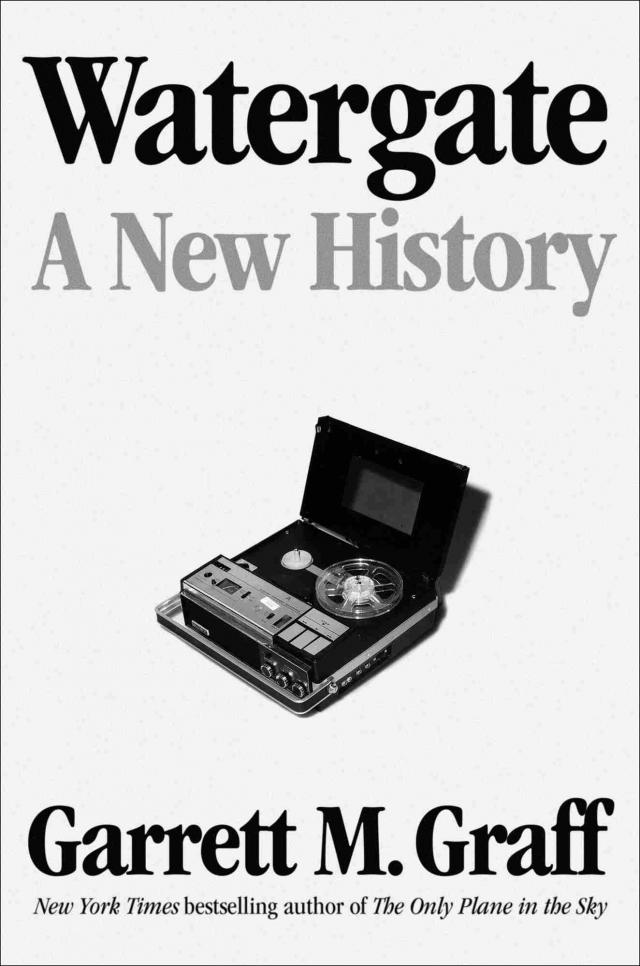
Jacket photograph: National Archives via AP
Author photograph © Andy Duback
Library of Congress Cataloging-in-Publication Data has been applied for.
ISBN 978-1-9821-3916-2
ISBN 978-1-9821-3918-6 (ebook)





