

The Lost Ticket, page 3


“He seemed pretty serious about it,” Libby said.
I’m so sorry, Simon had mumbled, not meeting her eye across the tiramisu. I can’t help feeling there should be more to a relationship than this . . . Our life has become so organized and predictable . . . I miss spontaneity.
“So, what are you going to do now?” Rebecca stood up and walked across to the kettle.
“Simon said he needs some time to figure out what he wants . . . a break, he said. And I was so thrown by it all that I agreed to move out for a bit, to give him space. But I’m thinking maybe that was a bad idea.”
“No, I think that’s a good plan. Give Simon one week of living on his own and he’ll see what a mistake he’s making.”
“But what if he doesn’t? What if—”
Libby was interrupted by a loud roaring sound as Rebecca turned on the coffee grinder. There was no such thing as instant coffee in this house; every cup was hand brewed—a process that took ages. Simon used to find it hilarious, watching the palaver Rebecca and Tom went through to make a simple hot drink, and would always try to catch Libby’s eye to make her laugh too. At the memory, Libby felt a stab in her chest. They were a team, she and Simon, always there for each other, especially around their crazy families. How could he want out?
“What were you saying?” Rebecca said, when the grinding had finished.
“I said, what if he really is serious? What if it’s not some midlife crisis and he actually wants to end it?”
“Come on, you two have been together for eight years. He’s not going to throw it all away just like that. He’ll see sense.”
“And if he does, do you think I should go back to him? I mean, what if he does this again in another few years’ time—how can I ever trust him again?”
“Of course you can trust him. This is Simon—the man is hardly Casanova. I swear, this is just some silly little blip, and in a few weeks’ time, you’ll be back in your little home, watching TV together like the pair of boring old farts you are.”
Before Libby could say anything, there was the sound of thundering footsteps down the hall.
“Auntie Lib!” Rebecca’s son, Hector, came charging into the kitchen, his arms spread wide as he threw himself at Libby. She scooped her nephew up into a hug, burying her face in his hair and inhaling his comforting scent of apple shampoo and rice cakes.
“I can’t believe how big you’ve got,” she said, releasing him. “What are you now, eighteen?”
“You know I’m only four,” he said, frowning at her. “Mummy says you’re going to look after me for the rest of the Easter holidays.”
“I am?” Libby looked at Rebecca, who was busying herself dripping hot water over the coffee.
“Can we go to the Natural History Museum? I want to see the dinosaurs.”
“Hector, why don’t you go and finish that drawing for Granny? And then you can show it to me and Auntie Libby,” Rebecca said.
The boy ran out of the room. There was a long silence as Rebecca focused intently on the coffee.
“So that’s why you offered for me to stay here,” Libby said eventually. “You need me to look after Hector for you.”
“No! I offered for you to stay here because I’m a kind sister who wanted to help you out.” Rebecca’s voice was full of indignation, although her ears had gone slightly pink.
“So you don’t need me to look after Hector, then?”
“Not if you don’t want to. But I thought you might enjoy hanging out with your nephew—you hardly ever see him, after all.”
“I thought you had a live-in nanny?”
“We do, but she’s had to go back home—family emergency, most inconvenient. That’s why we have a free room for you to stay in.”
So, there it was. Libby had known that there had to be an ulterior motive for her sister’s invitation; Rebecca never did anything unless there was some benefit for her.
“How long do you need help for?”
“Only a week or two, until Rosalita’s back. And it’s perfect timing, really, as by that point you and Simon will have got over all this nonsense and you’ll be home again.” Rebecca handed Libby a cup of strong-smelling coffee.
“I don’t know, Bex. Obviously I’d love to hang out with Hector, but I’m not sure my head’s in the right place. I mean, look at me. I’m a mess.”
Her sister let out a long sigh. “How many times have I asked for your help since Hector was born?”
“Well, never, but—”
“And do you or do you not have free time at the moment, given I assume you won’t be working for Simon while you’re on this break?”
“I do, but—”
“Well, there you go, then. Besides, it’ll do you good. Hector will be a distraction from wallowing over Simon.”
Rebecca had always been able to overrule Libby like this, ever since they were kids; no wonder she was so successful in her job as a corporate lawyer. Libby took a resigned sip of her coffee. “Mmm, this is delicious.”
“It’s Kopi Luwak, from Indonesia. The beans get eaten by civets, who then defecate them out, and they get fermented in the process. It costs a fortune because we only buy beans from totally free-living civets.”
Libby grimaced and put her mug down.
“So, will you look after Hector, then?” Rebecca said.
Libby paused before she answered. Maybe it wasn’t such a bad idea? It would be good to keep busy; besides, she loved Hector, who was the only member of her family who didn’t treat her like a complete moron. “Okay, sure.”
“Excellent.” Rebecca picked up a piece of paper that had been resting on the counter and handed it to Libby. “I’ve printed out his schedule for you. Every morning he’s got football club, and then there are various activities in the afternoon. His tutor comes on Tuesday. He has piano on Wednesday and you’ve got tickets for an exhibition at the Science Museum on Friday.”
“Wow.”
“What?”
“Well, you know I’m all for a schedule, but this sounds exhausting.”
“It’s not exhausting. It’s enriching,” Rebecca said. “And he needs to get ahead if he wants to get into the right pre-prep school.”
“Okay. Well, I’ll do my best with it all.”
“Tom and I don’t get home until six, so you’ll need to cook meals for Hector too. I order everything on Ocado, so all you’ll need to do is follow the meal plan. And remember, he doesn’t have red meat or dairy, and we try to only give him refined sugar at the weekends.”
“Righty-ho.” Libby was feeling sorrier for Hector by the second.
“I know what you’re thinking, Libby, and no sneaking him off to McDonald’s for chicken nuggets and milkshakes. You may not care about your body, but in this household, we treat ours with respect.”
“No Big Macs, I promise.”
Rebecca’s phone buzzed and she picked it up. “Oh, and no screen time either,” she said as she read the message. “I saw a report recently about the damage it can do to developing brains.”
Libby couldn’t help but roll her eyes at this, and at that exact moment Rebecca glanced up from her phone, catching Libby midroll.
“Is there a problem?”
“No.”
“Because that eye roll suggested you don’t agree with me.”
“It’s not that. But we watched loads of TV as kids, and I’m not sure it did our brains any damage.”
Rebecca was staring at Libby with a look she remembered from her childhood, a withering mixture of boredom and contempt. “Remind me, Libs—how many kids do you have?”
Oh, here we go.
“Exactly,” Rebecca snapped. “If and when you do have children, you’re welcome to let them spend all day staring at screens and eating crap. But while you’re looking after my son, I ask that you please respect my parenting rules. Okay?”
Libby started to reply, but Rebecca had already swept out of the kitchen, leaving her staring openmouthed at the civetpoo coffee.
CHAPTER
3
The following week was one of the most exhausting of Libby’s life. Hector woke her at quarter to seven each weekday morning by bursting into her bedroom and jumping on the bed, and from then until the moment he fell asleep, twelve hours later, he kept up an almost constant barrage of questions: What’s the capital of Mongolia? Why do girls have boobies but boys don’t? What’s the opposite of “hamster”? By the time Rebecca and Tom got home from work each evening, Hector was still bouncing off the walls, but Libby was ready to collapse.
The one upside was that Libby’s days were so full, she had no time to think about Simon. It was only when she went to bed, drained and desperate for sleep, that the reality of her situation came crashing back. Two days . . . Three days . . . Four days and still no word. Their conversation on Friday night played over and over in Libby’s brain like a bad pop song on loop. I still love you but I feel like we’ve grown apart . . . We’re more like housemates than lovers . . . You used to be such fun, but things have grown stale. And every time, Libby felt the same sucker punch of surprise crushing the air out of her lungs. How had she not seen this coming? All this time she’d been so content in their life together, their Friday night takeaway and Sunday morning sex, dreaming of the future they’d carefully planned for themselves, completely oblivious to the fact that the man she loved was deeply unhappy.
On Saturday morning, Hector woke his parents up instead of Libby and she slept in past nine. When she sat up, her whole body ached and she had a tight knot in her chest. She reached for her phone and flicked to Instagram. Libby had avoided it for the past week, not wanting to torture herself by looking at Simon’s feed. Now she clicked on his name, holding her breath for what she’d find. Thankfully, Simon had posted only one photo since she’d last checked, a shot on one of his runs. Libby studied the new image carefully. His skin was flushed and his hair disheveled, and he was squinting into the sun as he grinned at the camera. He looked so rugged and handsome it made Libby feel sick. Surely Simon should have been missing her by now, but he looked so alive and carefree in this photo. What if he’d already realized he was happier without her in his life?
Libby jumped out of bed, showered, and dressed, then snuck out of the house before her sister could give her any commands. She had no idea where she was going, only that she couldn’t spend the day moping in bed, staring at Simon’s Instagram and panicking. When she reached the main road, she went into a café and bought herself a cappuccino and a chocolate croissant. As she stepped back outside, she saw a bus pull up at the stop in front of the café and its door swing open. Libby watched for a moment as passengers disgorged onto the pavement. She had no idea what number bus this was or where it was going, and she didn’t have a coat or umbrella with her in case it rained. If she got on this bus, then she could end up anywhere, in one of the many dangerous areas of the city her sister was always telling her about. She was about to turn and walk past when she remembered Simon’s words. Our life has become so organized and predictable. Libby took a deep breath and jumped on board.
She found an empty seat in the back section of the lower deck and sat down. How’s that for spontaneous? she thought as she took a satisfied bite of her croissant. Although as she did, she glanced toward the electronic noticeboard to see where the bus was headed. 88 to clapham common, it read. Fine, Clapham Common it was, then.
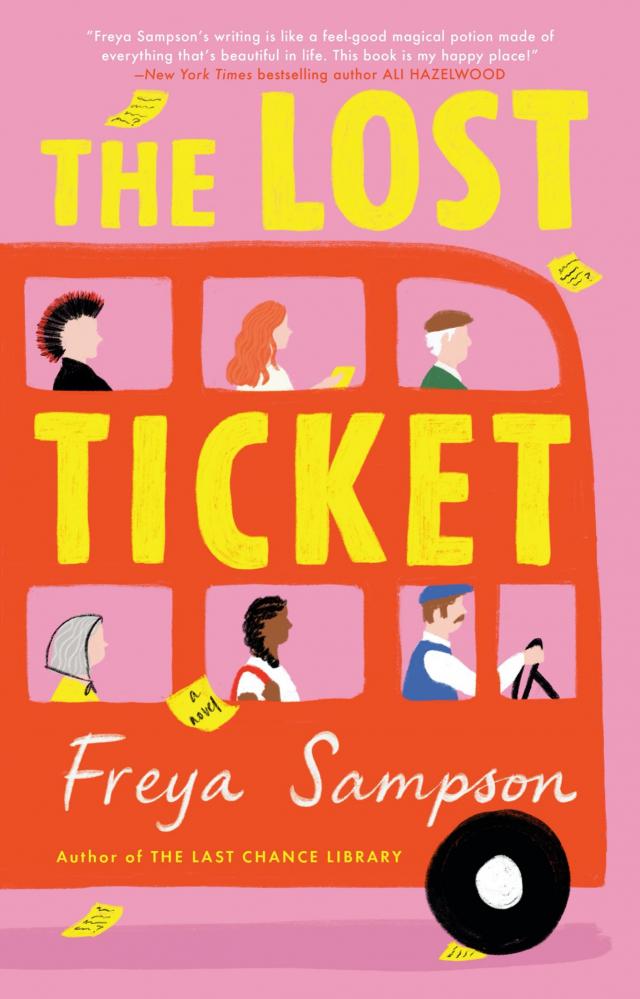
As the bus set off, Libby looked around her at the other passengers. In the row in front were two teenage boys, their heads bent together as they shared a pair of earphones, the tinny beat of their music leaking out. Across the aisle from the teenagers was an older lady with silver hair under one of those clear plastic rain hoods; she was gripping the handle of a wheeled shopper. Sitting behind the pensioner, directly across from Libby, was a young woman with her hair pulled up in a bun, her lips moving as her eyes scanned across the page of a battered copy of Pride and Prejudice. She was completely lost in the story, absentmindedly playing with a button on her cardigan as she read. As Libby watched her, she suddenly remembered Frank, the old man she’d met on the bus last Saturday. What had he said? A bus is the perfect place to practice life drawing because there’s always a choice of interesting models.
“Camden Town Station / Camden Street,” the automated voice announced. The reading woman stood up, not taking her eyes off the page, and made her way toward the exit. Libby watched her step off the bus, impressed to see she didn’t even look up from the book as she started to walk off down the pavement. More passengers were boarding at the front, and Libby glanced toward them and almost did a double take.
A tall, skinny man with a row of spiked black hair down the center of his head had boarded the bus and was making his way along the aisle in long strides. He must have been in his mid-thirties and was dressed in a black leather jacket, tight jeans, and Doc Martens boots, with a chain attached to his belt that jangled as he walked. Was this an actual punk? Libby hadn’t realized that was even a thing anymore. The two teenagers in the row in front were nudging each other and staring at the man, but he seemed oblivious to the stir he was causing. He slumped down in the seat that the bookish woman had vacated, his long legs jutting out into the aisle.
Frank’s words ran through Libby’s mind again. Here was someone who was definitely interesting enough to draw, but could she do it? She’d not drawn anything for years, and besides, she didn’t have a sketchbook with her and . . .
Spontaneous.
Libby opened her bag and rummaged through the contents. She usually kept it tidy, but after a week with Hector, it now contained several toy cars, a half-eaten box of raisins, a small notepad, and a pack of coloring pencils. Libby pulled out the notepad and a black pencil, then looked over at the man.
Because he was sitting directly across the aisle from her, Libby could see only the left-hand profile of his face. He had a strong, angular jaw and dark eyes, and his ear was lined with small silver hoops. A tattoo was creeping up his neck from under the collar of his jacket, although Libby couldn’t make out what it was. Aside from his Mohawk, his head was closely shaved, and it looked like it would be almost soft to touch. Unlike Libby, who tended to slouch, this man was sitting tall in his seat, with the confidence of someone who didn’t care what anyone else thought of them. He really was extraordinary-looking. Libby glanced down at the blank white paper on her lap, then took a deep breath and pressed her pencil onto the page.
When she next checked out of the window, Libby was surprised to see they were driving down a busy shopping street, and an underground station sign told her they were at Oxford Circus. She stared down at the sketch and inwardly groaned. She’d made the man’s body a weird shape and his hair looked like it had been stuck on with glue, and there was a big line across his chin where the bus had hit a pothole and her pencil had skidded across the paper. It was the kind of thing Hector would draw, and he was only four. Libby ripped out the page and was about to screw it up when she noticed the profile of his face. It was far from perfect, but she’d managed to capture the shape of his skull, the sharp jawline and brooding eye. It was very rough, but with more time maybe she could make the sketch better? Libby glanced back up at the man. He’d barely moved all journey, staring forward as if in a trance. But he could get off at any minute, and then her chance to finish the sketch would be over. If only there was a way she could get a photo of him so she could carry on working on it at home.
Libby looked around her. All the other passengers were in their own worlds, staring out the windows or at their phone screens. She reached into her bag, pulled out her phone, and as discreetly as possible, lifted it up and took a shot.
“What the fuck are you doing?”
At the sound of the camera click, the man she’d drawn had swung round in his seat and was staring at her. Libby stuffed her phone back in her bag.
“Were you taking photos of me?” His black eyes were fixed on her, and Libby could feel other passengers turning to look.
“No . . . I mean, yes, but sorry.”
The man scowled. “You think I’m some kind of tourist attraction, here for your entertainment?”
“No, I was . . .” Libby felt the color drain from her face. “I’m sorry. I’ll delete it.”
“Imagine if it was the other way round, and some random guy took a photo of you on the bus. How would you like that?”
The old woman sitting in front of the punk was looking at Libby and shaking her head. Libby felt a burn of shame, and she snatched up her bag and stood up to leave. As she did, the piece of paper slipped off her lap and, as if in slow motion, floated toward the floor in the middle of the aisle.
Shit! Libby watched as the punk leaned down and picked up the page as it landed by his feet. She closed her eyes, preparing to hear his roar of rage. But there was only the muffled sound of music from the two teens in front, and when Libby opened her eyes again, he was staring at the drawing with a look of disgust on his face.
“I’m so sorry,” Libby said, and she heard a tremor in her voice.
He didn’t say anything and carried on studying the piece of paper. She could sense the passengers around them were holding their breath, waiting to see what he would do.
“It’s a really bad drawing,” Libby said in a half whisper.
The man glanced up then and caught Libby’s eye. For a moment she stared back at him, unsure what to do. Then she ran toward the open door, humiliation coursing through her body.
CHAPTER
4
PEGGY
There’s nothing I love more than a bit of drama on the bus.


