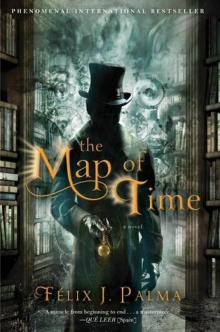
The Map of Time Collection, page 184


“We must go, Gilliam.”
“Go? Where?” replied Murray, bewildered.
“Listen to me.” Doyle stood squarely in front of him and looked him in the eye. “If you want to see Emma again, you must trust me. We have to save the world! And I know where to find the key that will help us do so . . .”
“The key? But what the devil are you—”
Without letting him finish, Doyle grabbed hold of Murray’s arm and, dragging him from the mirror circle, ordered him to run to the house, breaking into a sprint himself. Murray snorted and followed after him. As they crossed the lawn, one by one the hundreds of mirrors Murray had installed there began to shatter as though bombarded by invisible projectiles, smashing to smithereens and filling the air with broken glass. Doyle and Murray shielded their heads with their arms just as a shower of splinters fell on them. When the din stopped, Doyle looked around for a way out that was free from mirrors, but Murray had covered every corner. They would have to chance it. He dragged Murray down a path bordered by hedges while the mirrors on either side continued to shatter at random.
“Damn and blast . . . ,” Murray cursed, stumbling behind Doyle.
Doyle tried to spur him on. “Come on, Gilliam, stop complaining. What are a few bits of broken glass compared to a burning house?”
They managed to escape relatively unharmed from the death trap the gardens had suddenly become. Despite having used their arms for protection, their faces were covered in tiny cuts. Reaching the side of the house, now lined with broken mirrors, they saw the servants fleeing down the driveway and scattering into the gardens on either side, alarmed by the exploding mirrors and the bizarre images they had seen in them. Just then Elmer, who was clearly overwhelmed by events, emerged from the house and spoke to Doyle.
“Mr. Doyle, sir, thank goodness I have found you! Your secretary called. Apparently the telephone was ringing for some time, but with all this racket going on no one took much notice of it. I offer you my sincerest apologies, sir, and furthermore . . .”
“Cut out the excuses and get to the point, Elmer!” interrupted Doyle. “What did he want? Are all the mirrors at Undershaw shattering, too?”
“Er, yes, sir . . . But he wanted you to know that, despite being anxious, your wife, children, and servants are safe and sound.”
“Thank God . . . ,” Doyle sighed.
“There is one other thing, sir,” said Elmer. “It seems the kettle in your study started whistling shortly after you left and hasn’t stopped since. Your secretary can’t seem to make it stop and has asked for permission to silence it with a hammer, sir.”
“Curses!” Doyle exclaimed, visibly upset. “My kettle . . . Why does everything have to happen on the same day? Who the devil wrote this infernal script!”
Far from taking that remark personally, dear reader, I shall continue telling my story. Murray looked at him in astonishment:
“What the devil does a blasted kettle matter with all this going on!” he protested.
Ignoring Murray, Doyle commanded: “Elmer, call Miss Leckie. Tell her not to leave the house and not to worry; I will get to the bottom of this!” Then he seized Murray’s arm once more and dragged him toward the drive. “Come on, my carriage is waiting outside! We might still be in time . . .”
• • •
MURRAY AND DOYLE PUFFED and panted as they ran down the driveway, proving that neither was any longer in the flush of youth. Here, too, the mirrors had shattered, strewing the fallen leaves with shards of glass. Naturally, the servants had all abandoned their posts, leaving a row of empty chairs, many of them upturned. But then, as they got halfway down the path, they saw an army of horsemen appear in the distance. The two men stopped dead in their tracks, transfixed for a few seconds as a troop of cavalry bristling with pennants galloped toward them. As the riders drew closer, they could make out the horses, their flanks protected with engraved barding, their heads in sinister helmets that gave them a grotesque appearance. The riders were strange humanoid creatures with long, angular faces, pointed ears, and white hair, also sheathed in shining armor with spiked shoulder plates. Most were brandishing swords and lances, and three or four of them carried pennants bearing strange symbols. When he finally managed to rouse himself from this mesmerizing sight, Doyle turned and fled back toward the house.
“Run, for your life, Gilliam, or you’ll be trampled!”
Doyle’s booming voice stirred Murray, and he sprinted after Doyle. He gritted his teeth as the horsemen’s fierce battle cries, the clank of armor, the horses’ snorts, and the din of hooves on the trodden earth drew closer. He instantly realized there was no escape: run as hard as they might, the house was too far away. In a few seconds they would be crushed. They would die a ridiculous death, trampled by a ferocious army that wouldn’t even notice as they galloped over them. He prepared to be knocked down by the first horse and then trampled pitilessly by the rest.
“Forgive me, Emma,” he whispered as he felt the horses’ breath on the back of his neck.
However, the expected collision did not happen. Astonished, he looked on as the first rider passed straight through him as if he were made of smoke. First the horse’s forelegs emerged from his stomach, turning him fleetingly into a centaur, then its body carrying the rider, and finally its hindquarters. He felt no pain, only a slight shiver. A second afterward, the same thing occurred with the next rider, and the next. Yet he kept running and, glancing sideways, saw that Doyle did, too. Only when the army had finished going through them did the two men come to a halt, both astonished that they hadn’t fallen under the hooves. Murray’s lips broke into an uneasy smile. To his astonishment, he was still alive. At his side, Doyle was looking at him, his face glowing with a similar expression of bemused relief.
“I can’t believe they went straight through us!” Murray exclaimed. “They are like mirages!”
Doyle nodded, still panting for breath, and they both watched the alien army ride into the distance, leaving a cloud of translucent dust in its wake.
“But who were they?” asked Murray.
“An army from another world, it would appear. A world that at this very moment seems to be superimposing itself on ours,” Doyle reflected. “But I fear this is only the beginning.”
“The beginning?”
Doyle nodded solemnly. “At Brook Manor we glimpsed another world through the mirror. It was close, but not close enough, since our voices couldn’t even reach it.”
“But today I was able to speak to Emma . . .”
“That means the parallel worlds are now brushing against one another. And if that continues, we can assume that those seemingly harmless transparencies . . . will end up becoming flesh and blood.”
“Good God . . . ,” Murray whispered, terrified.
“There’s no time to lose, Gilliam,” said Doyle, striding back toward the main gate. “We must get to the city center as quickly as possible. I fear the whole universe—everything we know and everything we imagine—is about to explode. And only Inspector Clayton can prevent it.”
“Clayton?” Murray raised his eyebrows. “Why him?”
“That is what I have been trying to tell you since I got here. The Map of Chaos contains the key to saving the world, and Clayton has it . . .” Then Doyle remembered the accursed kettle whistling in his study. “Or at least I hope he does.”
36
AT THAT VERY MOMENT, DOCTOR Ramsey, Mrs. Lansbury, and Executioner 2087V were emerging onto the street, which was filled with a throng of people seized with panic and running frantically from something. They did not need to look far to see what the crowd was fleeing from. In the distance, St. Paul’s Cathedral looked as if it had been buried under layers of gauze veils. Ramsey supposed that this meant that other cathedrals from other parallel Londons were superimposing themselves on it. Everything that had occupied that space over the centuries was occupying it once more at that very instant, creating the illusion that the cathedral was encased in a gleaming chrysalis and had become a building with manifold hazy contours. Among the myriad layers, the doctor thought he caught a glimpse of the medieval cathedral that had been consumed by flames in 1666 and even the tiny wooden church built in 604, which was reputed to have been the first in England. The effect seemed to be spreading to the adjacent buildings, which were slowly vanishing beneath a similar misty veil. Amid the panic-stricken crowd, Ramsey also made out a handful of translucent people and carriages, escaped from another world, who were now colliding with their doubles in this frenzied escape. Ramsey sighed. There was no time to lose.
“We must head for Great George Street immediately,” he announced, looking at the Executioner, “to the headquarters of Scotland Yard.”
“Well, I fear we shall have to use more conventional means of transport, Doctor. If we try to go there via another world, I doubt my cane will find the right coordinates to return us to this one, amid all these colliding universes.”
“I see,” sighed Ramsey, “although finding a carriage for hire in London will be even more difficult, especially in these circumstances.”
They decided to head for the river Thames, trusting they would come across some means of transport that would spare them having to make the long journey on foot. Ramsey had offered his arm to the old lady, and the two of them were walking close together while the Executioner led the way. Amid all that chaos, no one gave them a second glance. Presently, in the next street, which was oddly deserted, they spotted a coachman sitting atop his carriage, transfixed by a diaphanous figure limping toward him.
“Hey, driver!” Ramsey cried when he saw the man.
His voice made the driver tear his eyes away from the apparition, and he gazed at them blankly.
“Could you take us to Great George Street?”
The man nodded silently, without giving it a moment’s thought, as if he sensed that the only way to keep his sanity amid the surrounding chaos was to stick to his routine. The Executioner lowered his energy potential so as not to alarm the horses and climbed into the carriage with the old lady. However, Ramsey paused for a few seconds to observe more closely the blurred figure about to walk past them. The creature seemed to be made up of bits of dead body sewn together, and when it came alongside him, the doctor thought he glimpsed a flash of lightning in the terrifying darkness of its eyes. When he reached his hand toward its face, which was crisscrossed with seams, he saw it pass straight through the creature’s head and come out at the back of its neck. He stepped aside so that the figure would not walk through him and watched it continue on its way with a swinging gait.
“Fascinating . . . ,” he whispered, examining the hand that had passed through the monster’s brain.
He climbed aboard the carriage and told the coachman to drive on. The whip gave a resounding crack, and they soon found themselves bowling along by the river on the Victoria Embankment. Through the carriage windows, they saw rows of buildings covered in that translucent shell and streams of shimmering ghosts darting this way and that. On the Thames, at Cleopatra’s Needle, Ramsey contemplated what looked like a scene from the Battle of Lepanto, in which one of the Holy League’s frigates was under attack by a Turkish galleon. A group of onlookers gazed, transfixed, at an event they only knew from the Encyclopædia Britannica.
When at last the carriage reached Great George Street, Ramsey felt as if they had journeyed through the mind of a madman. They climbed down and made their way to Scotland Yard, where similar scenes of chaos awaited them. Policemen were wandering around aimlessly, shouting contradictory orders at one another. Nobody paid any attention to the strange trio, and, after briefly assessing the situation, Ramsey was about to order the Executioner to accost one of the passing bobbies, when all of a sudden, a skinny, pasty-faced detective, striding purposefully toward them, bumped straight into the Executioner, who appeared not to notice the impact. The young man looked up at him uneasily, rubbing his sore chin.
“Er . . . I am afraid our friend here is no apparition, Inspector,” said Ramsey.
The young man glanced curiously at the doctor and the old lady and then, raising his head toward the Executioner, tried to make out his face, which was in the shadow of the brim of his hat.
“And what is he?” he asked suspiciously.
“He is . . . a foreigner,” replied Ramsey.
“I see,” said the inspector, visibly suspicious. Then he turned toward Ramsey, whose appearance was much less troubling. “And what brings you here? What strange miracle have you witnessed? I assure you we have received all kinds of reports.” And as if to prove it, he waved the bundle of papers he was holding in the air. “The world and his wife are bumping into characters from novels, fairy tales, and children’s stories.” He glanced at his notes. “One man says he saw Captain Nemo’s Nautilus on the Thames, and a woman claims there is a lion in her yard with the head of a man and the tail of a scorpion. As far as I know, that’s a manticore! There are several creatures we are unable to identify. Have you heard anyone mention a giant gorilla? We’ve been told there is one climbing up Big Ben . . .”
Just then, a phantom copy of the inspector walked toward them, also waving a bundle of papers, and passed straight through his double without flinching. In despair, the inspector raised his eyes to heaven.
“Not again . . . It’s impossible to work in these conditions!”
“If you please, young man,” the old lady’s sweet voice chimed in before he had time to resume his complaints, “we came here to see Special Inspector Cornelius Clayton. Could you kindly tell us where he is?”
The young inspector looked at her, astonished.
“I only wish I knew, dear lady!” he exclaimed. “Inspector Clayton has devoted half his life to chasing magical creatures, and the day they decide to throw a party, it seems the earth has swallowed him up!”
“Inspector Garrett!” someone yelled from the other side of the huge room.
“I’m coming!” he yelled back. Then, turning toward the old lady, he added, “I’m sorry, but I have no idea where Clayton is, or Captain Sinclair for that matter. In fact, everyone from the Special Branch seems to have vanished! Now, if you’ll excuse me . . .” And he made his way toward the officer who had called him.
“I fear it isn’t going to be easy finding him,” the old lady said despondently.
“Hmm . . . There might be a way,” Ramsey reflected. “Let’s find somewhere a bit quieter.”
He opened a nearby door, which happened to lead to an empty office, and they took refuge in there. After blocking the door with a chair so that no one—from that world anyway—could disturb them, Ramsey turned to the Executioner.
“Special Inspector Cornelius Clayton is a mental jumper,” he told him.
If this was a revelation to the Executioner or a simple affirmation, no one could have guessed.
“What is a mental jumper, Doctor?” the old lady asked.
“An individual who is infected by the virus, but for some as-yet- unknown reason cannot jump physically, only mentally,” explained Ramsey. “Until now, we haven’t detected any other jumper of this type, even among Clayton’s twins. The majority of them, including those bitten by the creature he had the misfortune to fall in love with, suffer from simple narcolepsy, which is completely unrelated to the incident in which they lost their hand. The symptoms appear sooner in some than in others, and some even die without ever developing them . . . However, the appearance of the disease in the Clayton existing in our world coincided with the attack by the natural jumper. And for some reason, which we still don’t understand—perhaps because his emotions were the strongest emotions possible, or due to some other peculiarity of his—his mind uses his disease to visit his beloved. In other words, he has become a mental jumper. Whenever he travels, his body is left behind like an abandoned shell, but his mind is able to reach her. And it so happens that his trail is the most luminous of all. Our Executioners have never hunted him down because he doesn’t cause any damage to the universal fabric and is therefore harmless. But they know his trail well. It resembles a shiny, golden flash of lightning . . .” His face took on a dreamy expression. “It is the molecules of the imagination, the ability to dream . . . those qualities that make this multiverse so special and that may be its only hope of salvation. After all, it was thanks to the blood of this mental jumper that we succeeded in synthesizing an effective vaccine! And his gift might help us to locate him now and so find your husband’s book. Do you think that would be possible, 2087V?”
“I feel hope,” murmured the Executioner without moving his lips. “His trail is very clear and powerful. It’s possible that, despite the chaos, I might be able to follow Clayton to the world he visits and then retrace his trail to where he has left his body.”
“Good, then all we need is for Clayton to suffer one of his fainting fits, although there is no guarantee that will happen before the universe—”
“Excuse me, Doctor Ramsey,” the old lady broke in, her face lit up with excitement. “Did I hear you say they had found an effective vaccine?”
“Yes. Except that we won’t need it now: thanks to your husband’s map, we could arrive a minute before the first infection and simply prevent it—”
“And use the vaccine on Newton!” the old lady interjected. “Then he wouldn’t need to be killed . . . would he?”
Ramsey smiled benevolently.
“We can try . . . ,” he replied cautiously. “The serum is certainly very effective. But you must understand, Mrs. Lansbury, that if there is the slightest sign that the virus has remained in the animal’s body . . . well, we wouldn’t be able to risk a repetition of all this.”
“Oh, of course not, I quite understand . . . but it would make a wonderful ending for my book,” said the old lady, and then, turning to the Executioner, she added, “And you could leave me, and my beloved Newton, in some tranquil world where I could finish it in my own time.”
After a moment, the Executioner nodded imperceptibly.
“Well, what are we waiting for?” said the old lady. “We must find the lovesick inspector.”
“Go? Where?” replied Murray, bewildered.
“Listen to me.” Doyle stood squarely in front of him and looked him in the eye. “If you want to see Emma again, you must trust me. We have to save the world! And I know where to find the key that will help us do so . . .”
“The key? But what the devil are you—”
Without letting him finish, Doyle grabbed hold of Murray’s arm and, dragging him from the mirror circle, ordered him to run to the house, breaking into a sprint himself. Murray snorted and followed after him. As they crossed the lawn, one by one the hundreds of mirrors Murray had installed there began to shatter as though bombarded by invisible projectiles, smashing to smithereens and filling the air with broken glass. Doyle and Murray shielded their heads with their arms just as a shower of splinters fell on them. When the din stopped, Doyle looked around for a way out that was free from mirrors, but Murray had covered every corner. They would have to chance it. He dragged Murray down a path bordered by hedges while the mirrors on either side continued to shatter at random.
“Damn and blast . . . ,” Murray cursed, stumbling behind Doyle.
Doyle tried to spur him on. “Come on, Gilliam, stop complaining. What are a few bits of broken glass compared to a burning house?”
They managed to escape relatively unharmed from the death trap the gardens had suddenly become. Despite having used their arms for protection, their faces were covered in tiny cuts. Reaching the side of the house, now lined with broken mirrors, they saw the servants fleeing down the driveway and scattering into the gardens on either side, alarmed by the exploding mirrors and the bizarre images they had seen in them. Just then Elmer, who was clearly overwhelmed by events, emerged from the house and spoke to Doyle.
“Mr. Doyle, sir, thank goodness I have found you! Your secretary called. Apparently the telephone was ringing for some time, but with all this racket going on no one took much notice of it. I offer you my sincerest apologies, sir, and furthermore . . .”
“Cut out the excuses and get to the point, Elmer!” interrupted Doyle. “What did he want? Are all the mirrors at Undershaw shattering, too?”
“Er, yes, sir . . . But he wanted you to know that, despite being anxious, your wife, children, and servants are safe and sound.”
“Thank God . . . ,” Doyle sighed.
“There is one other thing, sir,” said Elmer. “It seems the kettle in your study started whistling shortly after you left and hasn’t stopped since. Your secretary can’t seem to make it stop and has asked for permission to silence it with a hammer, sir.”
“Curses!” Doyle exclaimed, visibly upset. “My kettle . . . Why does everything have to happen on the same day? Who the devil wrote this infernal script!”
Far from taking that remark personally, dear reader, I shall continue telling my story. Murray looked at him in astonishment:
“What the devil does a blasted kettle matter with all this going on!” he protested.
Ignoring Murray, Doyle commanded: “Elmer, call Miss Leckie. Tell her not to leave the house and not to worry; I will get to the bottom of this!” Then he seized Murray’s arm once more and dragged him toward the drive. “Come on, my carriage is waiting outside! We might still be in time . . .”
• • •
MURRAY AND DOYLE PUFFED and panted as they ran down the driveway, proving that neither was any longer in the flush of youth. Here, too, the mirrors had shattered, strewing the fallen leaves with shards of glass. Naturally, the servants had all abandoned their posts, leaving a row of empty chairs, many of them upturned. But then, as they got halfway down the path, they saw an army of horsemen appear in the distance. The two men stopped dead in their tracks, transfixed for a few seconds as a troop of cavalry bristling with pennants galloped toward them. As the riders drew closer, they could make out the horses, their flanks protected with engraved barding, their heads in sinister helmets that gave them a grotesque appearance. The riders were strange humanoid creatures with long, angular faces, pointed ears, and white hair, also sheathed in shining armor with spiked shoulder plates. Most were brandishing swords and lances, and three or four of them carried pennants bearing strange symbols. When he finally managed to rouse himself from this mesmerizing sight, Doyle turned and fled back toward the house.
“Run, for your life, Gilliam, or you’ll be trampled!”
Doyle’s booming voice stirred Murray, and he sprinted after Doyle. He gritted his teeth as the horsemen’s fierce battle cries, the clank of armor, the horses’ snorts, and the din of hooves on the trodden earth drew closer. He instantly realized there was no escape: run as hard as they might, the house was too far away. In a few seconds they would be crushed. They would die a ridiculous death, trampled by a ferocious army that wouldn’t even notice as they galloped over them. He prepared to be knocked down by the first horse and then trampled pitilessly by the rest.
“Forgive me, Emma,” he whispered as he felt the horses’ breath on the back of his neck.
However, the expected collision did not happen. Astonished, he looked on as the first rider passed straight through him as if he were made of smoke. First the horse’s forelegs emerged from his stomach, turning him fleetingly into a centaur, then its body carrying the rider, and finally its hindquarters. He felt no pain, only a slight shiver. A second afterward, the same thing occurred with the next rider, and the next. Yet he kept running and, glancing sideways, saw that Doyle did, too. Only when the army had finished going through them did the two men come to a halt, both astonished that they hadn’t fallen under the hooves. Murray’s lips broke into an uneasy smile. To his astonishment, he was still alive. At his side, Doyle was looking at him, his face glowing with a similar expression of bemused relief.
“I can’t believe they went straight through us!” Murray exclaimed. “They are like mirages!”
Doyle nodded, still panting for breath, and they both watched the alien army ride into the distance, leaving a cloud of translucent dust in its wake.
“But who were they?” asked Murray.
“An army from another world, it would appear. A world that at this very moment seems to be superimposing itself on ours,” Doyle reflected. “But I fear this is only the beginning.”
“The beginning?”
Doyle nodded solemnly. “At Brook Manor we glimpsed another world through the mirror. It was close, but not close enough, since our voices couldn’t even reach it.”
“But today I was able to speak to Emma . . .”
“That means the parallel worlds are now brushing against one another. And if that continues, we can assume that those seemingly harmless transparencies . . . will end up becoming flesh and blood.”
“Good God . . . ,” Murray whispered, terrified.
“There’s no time to lose, Gilliam,” said Doyle, striding back toward the main gate. “We must get to the city center as quickly as possible. I fear the whole universe—everything we know and everything we imagine—is about to explode. And only Inspector Clayton can prevent it.”
“Clayton?” Murray raised his eyebrows. “Why him?”
“That is what I have been trying to tell you since I got here. The Map of Chaos contains the key to saving the world, and Clayton has it . . .” Then Doyle remembered the accursed kettle whistling in his study. “Or at least I hope he does.”
36
AT THAT VERY MOMENT, DOCTOR Ramsey, Mrs. Lansbury, and Executioner 2087V were emerging onto the street, which was filled with a throng of people seized with panic and running frantically from something. They did not need to look far to see what the crowd was fleeing from. In the distance, St. Paul’s Cathedral looked as if it had been buried under layers of gauze veils. Ramsey supposed that this meant that other cathedrals from other parallel Londons were superimposing themselves on it. Everything that had occupied that space over the centuries was occupying it once more at that very instant, creating the illusion that the cathedral was encased in a gleaming chrysalis and had become a building with manifold hazy contours. Among the myriad layers, the doctor thought he caught a glimpse of the medieval cathedral that had been consumed by flames in 1666 and even the tiny wooden church built in 604, which was reputed to have been the first in England. The effect seemed to be spreading to the adjacent buildings, which were slowly vanishing beneath a similar misty veil. Amid the panic-stricken crowd, Ramsey also made out a handful of translucent people and carriages, escaped from another world, who were now colliding with their doubles in this frenzied escape. Ramsey sighed. There was no time to lose.
“We must head for Great George Street immediately,” he announced, looking at the Executioner, “to the headquarters of Scotland Yard.”
“Well, I fear we shall have to use more conventional means of transport, Doctor. If we try to go there via another world, I doubt my cane will find the right coordinates to return us to this one, amid all these colliding universes.”
“I see,” sighed Ramsey, “although finding a carriage for hire in London will be even more difficult, especially in these circumstances.”
They decided to head for the river Thames, trusting they would come across some means of transport that would spare them having to make the long journey on foot. Ramsey had offered his arm to the old lady, and the two of them were walking close together while the Executioner led the way. Amid all that chaos, no one gave them a second glance. Presently, in the next street, which was oddly deserted, they spotted a coachman sitting atop his carriage, transfixed by a diaphanous figure limping toward him.
“Hey, driver!” Ramsey cried when he saw the man.
His voice made the driver tear his eyes away from the apparition, and he gazed at them blankly.
“Could you take us to Great George Street?”
The man nodded silently, without giving it a moment’s thought, as if he sensed that the only way to keep his sanity amid the surrounding chaos was to stick to his routine. The Executioner lowered his energy potential so as not to alarm the horses and climbed into the carriage with the old lady. However, Ramsey paused for a few seconds to observe more closely the blurred figure about to walk past them. The creature seemed to be made up of bits of dead body sewn together, and when it came alongside him, the doctor thought he glimpsed a flash of lightning in the terrifying darkness of its eyes. When he reached his hand toward its face, which was crisscrossed with seams, he saw it pass straight through the creature’s head and come out at the back of its neck. He stepped aside so that the figure would not walk through him and watched it continue on its way with a swinging gait.
“Fascinating . . . ,” he whispered, examining the hand that had passed through the monster’s brain.
He climbed aboard the carriage and told the coachman to drive on. The whip gave a resounding crack, and they soon found themselves bowling along by the river on the Victoria Embankment. Through the carriage windows, they saw rows of buildings covered in that translucent shell and streams of shimmering ghosts darting this way and that. On the Thames, at Cleopatra’s Needle, Ramsey contemplated what looked like a scene from the Battle of Lepanto, in which one of the Holy League’s frigates was under attack by a Turkish galleon. A group of onlookers gazed, transfixed, at an event they only knew from the Encyclopædia Britannica.
When at last the carriage reached Great George Street, Ramsey felt as if they had journeyed through the mind of a madman. They climbed down and made their way to Scotland Yard, where similar scenes of chaos awaited them. Policemen were wandering around aimlessly, shouting contradictory orders at one another. Nobody paid any attention to the strange trio, and, after briefly assessing the situation, Ramsey was about to order the Executioner to accost one of the passing bobbies, when all of a sudden, a skinny, pasty-faced detective, striding purposefully toward them, bumped straight into the Executioner, who appeared not to notice the impact. The young man looked up at him uneasily, rubbing his sore chin.
“Er . . . I am afraid our friend here is no apparition, Inspector,” said Ramsey.
The young man glanced curiously at the doctor and the old lady and then, raising his head toward the Executioner, tried to make out his face, which was in the shadow of the brim of his hat.
“And what is he?” he asked suspiciously.
“He is . . . a foreigner,” replied Ramsey.
“I see,” said the inspector, visibly suspicious. Then he turned toward Ramsey, whose appearance was much less troubling. “And what brings you here? What strange miracle have you witnessed? I assure you we have received all kinds of reports.” And as if to prove it, he waved the bundle of papers he was holding in the air. “The world and his wife are bumping into characters from novels, fairy tales, and children’s stories.” He glanced at his notes. “One man says he saw Captain Nemo’s Nautilus on the Thames, and a woman claims there is a lion in her yard with the head of a man and the tail of a scorpion. As far as I know, that’s a manticore! There are several creatures we are unable to identify. Have you heard anyone mention a giant gorilla? We’ve been told there is one climbing up Big Ben . . .”
Just then, a phantom copy of the inspector walked toward them, also waving a bundle of papers, and passed straight through his double without flinching. In despair, the inspector raised his eyes to heaven.
“Not again . . . It’s impossible to work in these conditions!”
“If you please, young man,” the old lady’s sweet voice chimed in before he had time to resume his complaints, “we came here to see Special Inspector Cornelius Clayton. Could you kindly tell us where he is?”
The young inspector looked at her, astonished.
“I only wish I knew, dear lady!” he exclaimed. “Inspector Clayton has devoted half his life to chasing magical creatures, and the day they decide to throw a party, it seems the earth has swallowed him up!”
“Inspector Garrett!” someone yelled from the other side of the huge room.
“I’m coming!” he yelled back. Then, turning toward the old lady, he added, “I’m sorry, but I have no idea where Clayton is, or Captain Sinclair for that matter. In fact, everyone from the Special Branch seems to have vanished! Now, if you’ll excuse me . . .” And he made his way toward the officer who had called him.
“I fear it isn’t going to be easy finding him,” the old lady said despondently.
“Hmm . . . There might be a way,” Ramsey reflected. “Let’s find somewhere a bit quieter.”
He opened a nearby door, which happened to lead to an empty office, and they took refuge in there. After blocking the door with a chair so that no one—from that world anyway—could disturb them, Ramsey turned to the Executioner.
“Special Inspector Cornelius Clayton is a mental jumper,” he told him.
If this was a revelation to the Executioner or a simple affirmation, no one could have guessed.
“What is a mental jumper, Doctor?” the old lady asked.
“An individual who is infected by the virus, but for some as-yet- unknown reason cannot jump physically, only mentally,” explained Ramsey. “Until now, we haven’t detected any other jumper of this type, even among Clayton’s twins. The majority of them, including those bitten by the creature he had the misfortune to fall in love with, suffer from simple narcolepsy, which is completely unrelated to the incident in which they lost their hand. The symptoms appear sooner in some than in others, and some even die without ever developing them . . . However, the appearance of the disease in the Clayton existing in our world coincided with the attack by the natural jumper. And for some reason, which we still don’t understand—perhaps because his emotions were the strongest emotions possible, or due to some other peculiarity of his—his mind uses his disease to visit his beloved. In other words, he has become a mental jumper. Whenever he travels, his body is left behind like an abandoned shell, but his mind is able to reach her. And it so happens that his trail is the most luminous of all. Our Executioners have never hunted him down because he doesn’t cause any damage to the universal fabric and is therefore harmless. But they know his trail well. It resembles a shiny, golden flash of lightning . . .” His face took on a dreamy expression. “It is the molecules of the imagination, the ability to dream . . . those qualities that make this multiverse so special and that may be its only hope of salvation. After all, it was thanks to the blood of this mental jumper that we succeeded in synthesizing an effective vaccine! And his gift might help us to locate him now and so find your husband’s book. Do you think that would be possible, 2087V?”
“I feel hope,” murmured the Executioner without moving his lips. “His trail is very clear and powerful. It’s possible that, despite the chaos, I might be able to follow Clayton to the world he visits and then retrace his trail to where he has left his body.”
“Good, then all we need is for Clayton to suffer one of his fainting fits, although there is no guarantee that will happen before the universe—”
“Excuse me, Doctor Ramsey,” the old lady broke in, her face lit up with excitement. “Did I hear you say they had found an effective vaccine?”
“Yes. Except that we won’t need it now: thanks to your husband’s map, we could arrive a minute before the first infection and simply prevent it—”
“And use the vaccine on Newton!” the old lady interjected. “Then he wouldn’t need to be killed . . . would he?”
Ramsey smiled benevolently.
“We can try . . . ,” he replied cautiously. “The serum is certainly very effective. But you must understand, Mrs. Lansbury, that if there is the slightest sign that the virus has remained in the animal’s body . . . well, we wouldn’t be able to risk a repetition of all this.”
“Oh, of course not, I quite understand . . . but it would make a wonderful ending for my book,” said the old lady, and then, turning to the Executioner, she added, “And you could leave me, and my beloved Newton, in some tranquil world where I could finish it in my own time.”
After a moment, the Executioner nodded imperceptibly.
“Well, what are we waiting for?” said the old lady. “We must find the lovesick inspector.”