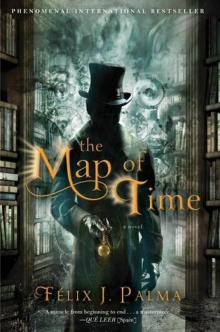
The Map of Time Collection, page 148


It was then that the balloon’s enormous shadow slid across the crowd, and a hundred faces turned and looked upward. Murray hurriedly recoiled from the edge. He didn’t want anyone to see him until the basket had touched the ground and he stepped out with the grandiose flourishes he had spent the past few days rehearsing in front of a mirror. His arrival must be triumphant, he reminded himself, as the acrobats began to perform pirouettes, descending the multicolored ropes and dangling gracefully from the ends. When the balloon had reached the place where it was supposed to land, next to the cylinder, the acrobats leapt to the ground and, like the most outlandish collection of footmen imaginable, spread out across the grass, genuflecting gracefully as they prepared to welcome their master. Then Murray took a deep breath, activated the vapor machine inside his hat, as well as the device operating his rotating bow tie, and mustered his most dazzling smile: the moment had arrived for him to make his appearance in the spectacle he had orchestrated to make the woman he loved laugh.
However, if that was Murray’s interpretation of the scene, Wells observed it through very different eyes. When the enormous shadow passed over their heads like the darkness of an eclipse, Wells and Clayton looked up and contemplated in silent awe the huge hot-air balloon descend toward the cylinder as it prepared to land. Wells, his mouth set in a pale line, watched the gigantic, brightly colored globe with its pompous, glittering “G.” Suspended from it was a small basket, rocking from side to side, and although for the moment only the underneath was visible, Wells knew perfectly well who was inside it. He gave a sigh as he saw the troupe of acrobats dressed as footmen dangling from the basket. There was only one man who could have planned such a vulgar, ostentatious entrance. What Wells remained unsure of was whether he would have the stomach to contemplate Murray’s contemptible face again after two blissful years of believing he was rid of him for good.
He was of half a mind to turn on his heel and leave, but finally he stayed where he was, because he wasn’t completely sure in what capacity he had requested that Clayton accompany him. That skinny detective with the fake hand, who registered his astonishment at the spectacle by raising his right eyebrow, had arrived at Wells’s house to tell him that a Martian cylinder had landed on Horsell Common exactly as he described in his novel. And had Wells not received a letter a month before announcing that madness, he would have taken him for a lunatic or a prankster.
The letter, the accursed letter . . . He had opened it tentatively when he saw the sender’s name, but after he finished reading it, an almost savage fury had erased any other sensation.
Dear George,
I imagine it will come as no surprise to you to receive a letter from a dead man, for we are both aware that you are the only man in all England who knows I am still alive. What will doubtless surprise you is the reason for my writing, and that is none other than to request your help. Yes, that is right, I am sending you this letter because I need your help.
Let me begin by not wasting time dissembling. We both know that our distaste for each other is unmitigated. Consequently, you will understand the humiliation I feel at having to write you this letter. However, I am willing to endure that humiliation if it means obtaining your help, which gives you some clue as to how desperate I am. Imagine me kneeling and begging at your feet, if it pleases you. It is of no consequence to me. I do not value my dignity enough not to sacrifice it. I realize the absurdity of asking for help from one’s enemy, and yet is it not also a sign of respect, a way of admitting one’s inferiority? And I fully recognize my own: as you know I have always prided myself on my imagination. But now I need help from someone with a greater imagination than mine. And I know of none comparable to yours, George. It is as simple as that. If you help me, I will happily stop hating you. Even though I don’t suppose that is much of an incentive. Bear in mind I will also owe you a favor, and, as you know, I am a millionaire now. That might be more of an incentive. If you help me, George, you may name your price. Any price. You have my word, George.
And why do I need your help? you must be wondering. Well, at the risk of rekindling your hatred of me, the matter relates to one of your other novels, this time The War of the Worlds. As your brilliant mind has no doubt already deduced, I have to re-create a Martian invasion. However, this time I assure you I am not attempting to prove anything to you, nor do I intend to profit from it. You must believe me. I no longer need either of those things. This time I am driven by something I need more than anything in the world, and without which I will die: love, George, the love of the most beautiful woman I have ever seen. If you have been in love you will understand what I am referring to. I daresay you will find it hard, perhaps impossible, to believe that a man like me can fall in love, yet if you met her it would seem strange to you if I had not. Ah, George, I was unable to resist her charms, and I assure you her immense fortune is not one of them, for as I told you, I have enough money to last several lifetimes. No, George, I am referring to her charming smile, her golden skin, the savage sweetness of her eyes, even the adorable way she twirls her parasol when she is nervous . . . No man could be immune to her beauty, even you.
But in order to have her, I must arrange for a cylinder to land on Horsell Common on August 1, and for a Martian to emerge from it, just like in your novel, George. And I don’t know how! I have tried everything, but as I told you, my imagination has its limits. I need yours, George. Help me, please. If I pull it off, that woman will be my wife. And if that happens, I promise I shall no longer be your enemy, for Gilliam Murray will be finally laid to rest. Please, I beg you, I implore you, assist this lovesick soul.
Yours,
G. M.
Unbelievable! How could Murray have the effrontery to ask him to help reproduce the Martian invasion from his own novel? Did he honestly believe there was the remotest possibility that he would agree? That was too much to expect, even for one as presumptuous as Murray. He went to throw the letter away, but before doing so decided to show it to Jane, assuming she would be overcome by the same anger as he and that the two of them could fulminate to their hearts’ delight against Murray’s pride and ingenuousness, over a glass of wine, perhaps, as the sun set lazily behind the trees. But no. Jane had considered Murray’s idea one of the most romantic gestures anyone could make and had even encouraged Wells to help him. People change, Bertie, she had said. You are a very inflexible person, but the rest of humanity is more malleable. And it is obvious Murray has changed. For the sake of love! Wells burst into a cynical laugh. For the sake of love! Murray couldn’t have chosen a better argument with which to convince Jane of that dubious conversion from Hyde to Jekyll. If Wells deigned to reply, it would merely be to inform him that nothing could expunge the loathing he felt for Murray, much less that outpouring of sentimental drivel. But he had no desire to embroil himself once more in a contest that brought him only bad memories, and so in the end Wells had decided it was best not to reply at all, convinced that indifference would be the greatest insult he could inflict upon Murray.
Indifference . . . Perhaps that should have been his posture three years earlier when that upstart had asked for his opinion about the little novel he had written. As some readers will recall, at that time Murray had not yet become the famous Master of Time but was an aspiring novelist with more delusions of grandeur than genuine talent, who sought the approval of the man he considered one of England’s greatest authors. And the fact is that Wells could have talked his way out of it with a few pronouncements as affable as they were vague. But instead he had opted for overrated honesty, not just because he didn’t think that ill-tempered ogre deserved any efforts at dissimulation, but because Murray’s whole being was clamoring for a dose of humility, which he himself had given Wells the wherewithal to administer. Who could resist such an invitation? Clearly not Wells, who with unnecessary brutality had told the poor aspiring author what he thought of his novel, curious to see his reaction, and had thus unwittingly thrown down a challenge that would ensnare the two men in an absurd duel for years to come. Murray’s attempt at a novel was a naïve futuristic love story set in the year 2000, where automatons had taken over the Earth and only a small group of humans led by the brave Captain Shackleton had the courage to defy them. The plot was preposterous and Wells had no trouble finishing off his merciless dissection of it by arguing that the future it described was totally improbable, and the work therefore a futile, forgettable pile of nonsense. Imagination was a gift that should always be at the service of truth. Any fool could imagine impossible things, but only a true genius could imagine the infinite possibilities that reality offered, and clearly Murray wasn’t one of them. After that dressing-down, Murray had vowed to himself as he left Wells’s house that he would show the author how wrong he was, and a few months later Murray’s Time Travel had opened to the public, offering the inhabitants of the nineteenth century a chance to visit the future, which, to Wells’s astonishment, was exactly as Murray had imagined it in his novel. And for two years afterward, Wells had been subjected to that humiliation, receiving regular invitations from an increasingly wealthy, powerful, and (if there was any truth in the rumors circulating in the stevedores’ taverns) dangerous Murray, to embark on one of his expeditions to the improbable future. Until one day the Master of Time decided to stage his own death, and at last Wells was able to breathe easily and try to pretend that the whole thing had been a bad dream.
But then, when he had almost succeeded, Murray’s ridiculous letter had arrived in his mailbox. And although he hadn’t replied to it, he hadn’t thrown it away either. It was too beautiful. He would occasionally slip it out from between the pages of the book where he kept it hidden and relish the bit where Murray acknowledged his superiority. Although Wells had never doubted that truth, he nevertheless delighted in the fact that Murray had finally accepted it. The last time he had read the letter was that very morning, the last day Murray had in which to fulfill his beloved’s wish. As Wells put the kettle on, he imagined Murray’s frustration when he realized that, despite all his money, he had failed to reproduce a Martian invasion and that some things were beyond even his reach. And that thought both reassured and pleased Wells, for imagination was a sublime gift that raised man above the level of animals, opened the doors to awareness, to the evolution and advancement of the human race, and consequently should be protected from crass impersonators, talentless upstarts, entrepreneurs, and above all lovers exposing themselves to public ridicule.
It was then that Clayton knocked on his door to inform him that a Martian cylinder had appeared on Horsell Common. And, cursing Murray for being unable to admit defeat, Wells climbed aboard the inspector’s carriage. What else could he have done? After all, if a Martian cylinder identical to the one he had described in his novel had landed on Horsell Common, it was only logical that Scotland Yard would require him to go there. What Wells found less logical was that the inspector seemed to believe this might be a genuine Martian invasion, possibly orchestrated by the author himself through his novel. Wells was obliged to show the inspector Murray’s letter to persuade him that the whole thing was a hoax cooked up by the ex–Master of Time, who was given to this sort of prank. But, to Wells’s surprise, the inspector had tucked the letter away in his jacket pocket. He confessed that whilst this opened up a whole new perspective on the matter, it was nevertheless the job of Scotland Yard’s Special Branch to leave no stone unturned, and he could not rule out the possibility that Wells himself had written the letter and was hindering the investigation by pointing the finger at a dead man. Wells had been rendered speechless by such a wild assertion, and the two men had spent the remainder of the journey in strained silence.
“It is absurd of you to think that I might be in league with Martians simply because I wrote a novel announcing their arrival!” he had protested at last, unable to contain his rage.
“As absurd as someone re-creating a Martian invasion to win a lady’s heart” had been the inspector’s disdainful reply.
You see, Wells now thought to himself, glancing away from Murray’s stupid steaming hat and grinning smugly at the inspector: apparently someone had orchestrated all this precisely to steal the love of a lady. Clayton clearly owed him an apology, and yet he seemed unwilling to do so.
“So the Master of Time is alive and kicking . . . ,” he said simply. Wells had grown weary of telling him that repeatedly on the way there.
The author rolled his eyes and raised his hands, as though expecting a pair of doves to land on them. No, Gilliam Murray hadn’t died. The brute who had stepped out of the hot-air balloon was certainly he—although Wells had to admit with all the weight he had lost, and that red beard obscuring his face, not to mention his ridiculous outfit, few would have recognized him. But those sly animal eyes capable of concealing anything, like a magician’s hat, had not changed. And Wells noticed the old animosity he felt for Murray stirring inside him. There he was, making a mockery of him again, turning his latest novel into a vulgar fairground attraction, this time to further his romantic interests. And there was Wells, dragged out of his house halfway through his cup of tea, his shoes caked in mud, forced to witness Murray’s pantomime in the midst of a deafening crowd—drawn as always by the magnetism of that man who snared everything in his path—and, furthermore, to defend himself against charges of espionage and treason on a planetary level. Would he never be rid of Murray? Would their lives be forever joined until one of them died, untangling the infuriating knot?
“Interesting, most interesting,” he heard Clayton reflect aloud, his eyes glued to the spectacle. “This resurrection is very timely, as I happen to have a few unanswered questions I’d like to put to Mr. Murray concerning his business, questions that are no doubt still pertinent. A great many questions, in fact.”
Wells looked in astonishment at Clayton, whose lips had twisted into a malevolent smile as he doubtless anticipated the moment when the Master of Time would finally be at his mercy, sitting in the interrogation room, forced to answer all his questions.
“I congratulate you on your good fortune, Inspector Clayton,” Wells remarked disdainfully. “And since the absence of any Martians clears me of all suspicion, I beg you to excuse me, but I have far more important things to do than stand around waiting for the dénouement of this ridiculous melodrama.”
Clayton nodded absentmindedly, hypnotized by the spectacle, yet Wells did not stir either. It was difficult for them to take their eyes off the sight unfolding before them. The crowd had begun to separate until a human corridor opened between Murray and the charming young lady with the parasol, doubtless the one for whom Murray had organized the whole charade. And as Wells looked at her more closely, he had to admit that, if anything, Murray’s description of her in his letter did not do her justice. The girl was astonishingly beautiful: she possessed the delicate lightness of a soap bubble, her skin seemed to be coated in gold, and her eyes, despite being wide-open with astonishment, expressed that perfect blend of charm and high-spiritedness capable of turning any man’s head. For a few seemingly eternal moments, Wells watched her remain motionless, nervously twirling her parasol, while at the other end of the corridor formed by the hushed crowd, Murray’s bow tie was also rotating. It was the only part of him that was moving, for the man appeared frozen, arms flung open, the hat he had just removed clasped in one hand, a broad grin on his face, waiting, like a suspended jellyfish, for Emma to breathe life into him with a loving eye. But that wouldn’t happen, Wells thought to himself, convinced the girl would turn on her heel and go back the way she had come, leaving Murray with his steaming hat and his rotating bow tie in the midst of the admiring crowd. What else could she do? Murray had failed to reproduce the invasion, no matter how hard he tried to make up for it with this gaudy display. And Emma Harlow seemed too intelligent to let herself be bamboozled by all that. But then, to Wells’s astonishment, a smile began to flutter on the girl’s lips, and although at first she tried to resist, she finally gave a charming giggle. A sigh of delight instantly spread through the crowd. Deflated, Wells watched the girl walk toward Murray amid the applause of the public, and he decided that he had seen enough.
He moved away from the throng, visibly annoyed, and went in search of a carriage that would take him back to Worcester Park, to the novel he was currently working on, and to that cup of tea abandoned on the kitchen table. To that ordinary, everyday life of his, so distant from the romantic nonsense Murray was accustomed to indulging in. Wells shook his head. He wished the couple all the luck in the world, he thought with disdain. The girl would certainly need it if she ended up married to that fellow. She couldn’t be very intelligent, after all, if she believed a sense of humor was a sound enough basis for a relationship, he told himself as a voice in his head asked him how long it was since he had last made Jane laugh like that.