Little Deaths, page 1


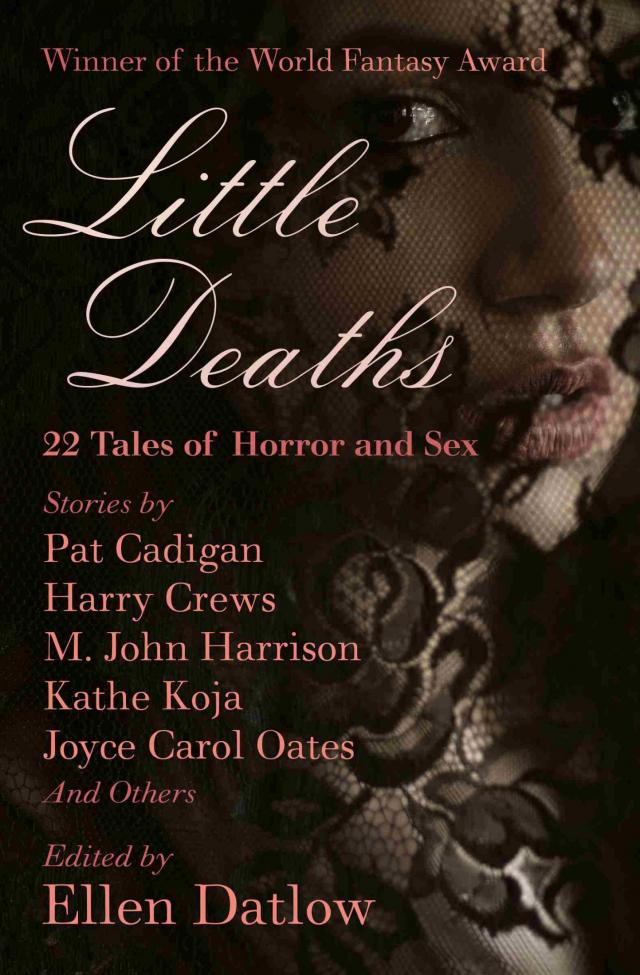
Little Deaths
22 Tales of Horror and Sex
Edited by Ellen Datlow
Dedicated to Deborah Beale
who came up with the idea in the first place
I would like to thank the following people for helping in various ways to make this anthology possible: Merrilee Heifetz, Liza Landsman, Deborah Beale, Charon Wood, Keith Ferrell, Rob Killheffer, Jeanne Cavelos, Lucius Shepard, and Pat Cadigan. And of course, all the contributors.
CONTENTS
Introduction by Ellen Datlow
The Lady of Situations by Stephen Dedman
Hungry Skin by Lucy Taylor
Becky Lives by Harry Crews
Lover Doll by Wayne Allen Sallee
The Swing by Nicholas Royle
Sahib by J. Calvin Pierce
The Careful Geometry of Love by Kathe Koja and Barry N. Malzberg
Yaguara by Nicola Griffith
Isobel Avens Returns to Stepney in the Spring by M. John Harrison
The Pain Barrier by Joel Lane
Sinfonia Expansiva by Barry N. Malzberg
Fever Blisters by Joyce Carol Oates
The Rock by Melanie Tem
And Salome Danced by Kelley Eskridge
The Disquieting Muse by Kathe Koja
Holes by Sarah Clemens
That Old School Tie by Jack Womack
Ice Palace by Douglas Clegg
Serial Monogamist by Pat Cadigan
Black Nightgown by K. W. Jeter
Ménage à Trois by Richard Christian Matheson
The Last Time by Lucius Shepard
About the Contributors
About the Editor
INTRODUCTION
The title, Little Deaths, comes from the French term ‘la petite mort’ a euphemism for ‘orgasm’ in popular use around the 17th century. Both William Shakespeare and John Donne regularly used a derivative of the expression, ‘to die’ as an orgasmic metaphor in their works. It was thought by many that for every climax attained, some of the male life-force was drained and therefore brought one that much closer to death. This idea can be traced to several sources including Aristotle, who believed that semen was drops of the brain and that the more a man ejaculated the smaller his brain became; Galen, the Greek physician and writer working in Rome, who thought that if Olympic athletes could be castrated in such a way that their reserves of heat would not be disrupted by the operation, they would be stronger; and Soranus of Ephesus, another Roman Greek who believed that men who remained chaste were stronger and healthier than those who did not. This idea is still popular in modern times as athletes often prefer to conserve their sexual energy before an important game or race.
But how did the connection between sex and death develop? According to Lawrence Osborne, author of The Poisoned Embrace: A Brief History of Sexual Pessimism, the linkage of sex and death so prevalent in Western civilization may have developed from some of the more extreme pre-Christian religious sects. Many Gnostic sects believed that everything material—that is of the world—distracted mankind from the spiritual, and that the human body epitomized the negative because its obvious physical needs (nourishment and sleep) defied this quest for spirituality. A few of the more extreme of these sects went even further, calling for self-castration. In 2nd century A.D., in a tract attributed to Hermes Trismegistus, the invention of sex was judged a cosmic disaster, which further stated, ‘He who has loved the body, which comes from the deceit of love, remains wandering in the darkness, suffering in his senses the things of death …’
But it wasn’t until Paul, the true founder of orthodox Christianity, copied and misinterpreted the more ascetic Gnostic sects of his time that one finds an actual gulf between male and female. Up to that time men and women could share ecclesiastic duties equally, and women had as much potential as men for spiritual enlightenment. St Paul’s fear of sex and antipathy toward women and sexuality unfortunately permeated mainstream Christianity.
But historically there have been reasons other than theological extremism to explain the association of sex with death. Sex has always been a high risk activity. Before efficient birth control and modern medicine, sex could kill women—many died in childbirth or from botched abortions. Syphilis was mutilating and incurable until the discovery of penicillin. And now sex can literally kill, with ‘AIDS, the pairing of love and death that has transformed our world … and which will continue to do so within the next century even if a cure were to be found tomorrow.’ (From the Introduction to Lovedeath by Dan Simmons).
Originally, Little Deaths was meant to be an anthology of erotic horror, but to my surprise and disappointment, very few stories submitted were actually erotic. I received stories with a sex scene obviously thrown in in order to sell me the story and I received stories with violent sex acts that, while integral to the plot, could in no way be considered erotic. And I began to see the same disturbing pattern I’d discerned in far too many anthologies of ‘erotic horror’—superficial vignettes featuring gross physical violence, more often than not, committed against women. I did receive some excellent horror stories in which sex was an important factor. This encouraged me to think about expanding the boundaries of the original theme. I suppose such a development shouldn’t really have surprised me. Each anthology I edit transmutes during the process of reading and choosing stories, becoming something at least slightly different from the original idea. Although I may jot down ideas as I read for the book, not until the anthology is almost finished does the real focus actually become clear.
Horror fiction generally deals with man’s confrontation with his own mortality and/or loss of control or loss of self. Interestingly, this characteristic dovetails nicely with Albertus Magnus’s observation that experiencing intense pleasure the human heart contracts in exactly the same way as it does in a state of fear. In both sex and at death, the body loses control, so it’s only natural that the two be inextricably linked in our minds.
Sex can sometimes be seen as transforming via increased awareness and self-knowledge. Yet such transformation exacts a price, and that price can be psychological and/or physical pain. The prudish protagonist of Lucy Taylor’s ‘Hungry Skin’ gropes toward an understanding of herself and of her relationship with an absent father, but the cost is nothing she could have anticipated. The titular character of M. John Harrison’s ‘Isobel Avens Returns to Stepney in the Spring’ seeks to make metaphor literal, with terrible consequences.
Ironically, the story that comes closest to the original theme for Little Deaths was the first story I bought, ‘The Lady of Situations,’ by Stephen Dedman. It is erotic and deeply disturbing yet has no onstage violence. This is not to say there is no physical or emotional violence in Little Deaths.
The stories herein range in tone from the deadpan iciness of Jack Womack’s urban tale to the hot sensuousness of Nicola Griffith’s tropical novella. I hope, in reading these stories you will find your own fears and desires aroused.
I’d like to thank the following for their input, suggestions, referrals, and research for this introduction:
Caroline Fireside, Terry Bisson, Justine Larbalestier, Lawrence Schimel, V. K. McCarty, the Rev Dr E. Barrett, Suzy Baker, Michael Kandel, Jennifer Ford. And special thanks to Anne Bobby, Beth Fleisher, Gregory Frost and Robert K. J. Killheffer. I’d also like to acknowledge Pat Califia’s nonfictional postscript to her collection of erotic stories, Melting Pot (Alyson Publications) and Lawrence Osborne’s The Poisoned Embrace: A Brief History of Sexual Pessimism (Pantheon).
THE LADY OF SITUATIONS
by
Stephen Dedman
‘The Lady of Situations’ was an unsolicited manuscript at Omni. My then assistant, Rob Killheffer, showed it to me as something more appropriate for the sexual horror anthology I was working on than for Omni Magazine. I agreed. It was the first story I bought for Little Deaths.
The lead story of an anthology can be the most important story in the book (if one assumes stories are read in order) because it gives the reader an idea of what the anthology is about—not just thematically but intent. All the stories in this book deal with relationships. ‘The Lady of Situations’ deals with several different ones—past and ongoing. I think the central one’s horrific nature is both subtle and surprising.
THE LADY OF SITUATIONS
It was raining outside, and the hostel very sensibly lacked a television; the dishes done, we all retired to the common room. Gwen has always loved meeting new people and, travelling as we were, we met new people every night and left them behind us each day: the sort of strangers with whom you might share sex, but never your toothbrush (okay, so I’m a cynic). Tonight, there were the inevitable pair of Germans; a New Zealander, furry and clumsy as a koala bear and about as ineffectual; an amiable Australian giant named Danny; Elliot, a mathematician from Cambridge (at last, someone I knew, thank God) … and Jacqueline.
Jacqueline was the most exquisite creation I can remember seeing outside an art gallery, as fine as cut crystal, and with a voice to match—clear, hard, and without any colour that it hadn’t stolen. You could not not watch her, and watching her, you could not help but imagine the body inside those carefully-worn sloppy clothes and the lily-gilding make-up, could not help but follow the lines and curves that converged between her thighs, could not help but be drawn deeper and deeper inside her … but never beyond the skin. Any deeper than that, and you would encounter the soul of a ninja. Rather than look at Gwen and risk comparing her to Jacqueline, I tried to distract myself by watching the chess ga
I wondered who Jacqueline was pretending to ignore, who it was she was really interested in, and decided that it had to be Elliot. He was, after all, the best-looking man in the room: slightly taller than I am, but barely half my weight, long legs and minimal hips, wavy blond hair, labyrinthine green eyes, a small mouth with generous lips, pianist’s fingers … remember Dennis Christopher in Breaking Away’? Best-looking, hell; he was beautiful. I tried to remember what I knew about him. An excellent student, of course, who should have been a fellow Oxonian; brilliant, but also extremely serious. Single, and had been so for as long as I’d known him. Unusually for a mathematician, he had no interest in music whatsoever. He had been beating me consistently at chess, go, and (to my vast irritation) ancient and medieval wargames, every holiday for three years, and for all I knew, I might have been the best friend he had. It took me three guesses to remember his Christian name: Charles. Hell, I know more than that about Myrddin or Pelagius.
Gwen smiled, thanked Elliot for the game, and backed away from the board. Elliot glanced at the German couple, who shook their heads simultaneously. There was no way to back out gracefully, so I dropped my seventeen stone (metricize me and I will break your heathen skull) on to the chair opposite him, and tried the Danish gambit.
Elliot’s king wasn’t where I expected it to be: damn. Jacqueline stretched, advertising a body so perfect, I’d be scared even to dream of it, and stifled a yawn. The New Zealander, as smitten with her as I was trying not to be, hastened into the kitchen to make her a cup of coffee which I knew she wouldn’t drink: he’d made the mistake, at dinner, of calling her ‘Jacky’ (I never did learn his name, but perhaps he didn’t need one). She took the mug from him without thanks, or even a smile, sipped to make sure he’d remembered how she liked it (she was used to getting exactly what she wanted), and then put the cup on the floor.
Within a few minutes the game was all over, and I was left staring glumly at the board. Elliot switched the computer on: no one else in the room was likely to challenge him. He was doing a better job of ignoring Jacqueline than I was; perhaps he wasn’t trying as hard. ‘What are you playing?’ I asked.
‘Modern Beroni,’ he replied. ‘Fischer vs. Spassky, third match game.’
‘How many games does it know?’
‘A hundred, plus variations.’
‘Wow,’ murmured Gwen. ‘You know, that’s what I’ve always wanted.’
‘A chess computer?’ I asked.
‘No; an eidetic memory.’
‘No, you haven’t,’ said Elliot, without looking up from the board. ‘I knew a girl with an eidetic memory, once. Better than eidetic, even: a perfect memory.’
Jacqueline closed her book. ‘No one has a perfect memory,’ she drawled.
‘She did,’ replied Elliot.
‘How do you know?’
‘I knew her very well.’
‘How well?’
‘She was the first girl I ever fell in love with,’ he said. Jacqueline looked as though she was about to comment, but didn’t. Gwen glanced at me, and I shrugged; it wasn’t a story I’d heard before. ‘I was nineteen,’ Elliot continued, leaning back in the chair and still not looking at Jacqueline, ‘and I had a pretty good memory myself: it came in useful. I was notorious, then, for keeping a harem; I could remember all of the names and most of the faces … only the bodies ever became numbers. I’m not proud of it, now … but looking back, I don’t remember that I ever lied to anyone, or broke any promises … but I digress.
‘It started with a game of chess, a tournament, at Trinity. I was defending my title as the King of Kings. I’d only made Rook in the Intercollegiates, the year before; the defending champion of Cambridge had come second for three years running, and was stuck with the title of Queen. I believe he now works for MI5.’ Gwen and I laughed; the others only looked puzzled.
‘There were four males for every female in the university, back then, and any alien being taking the chess club as a representative of humanity would derive some very strange theories about our reproductive processes. Of course, he would also drastically overestimate average human intelligence …’ He coughed slightly. ‘It was rather startling to discover a girl sitting opposite me who I didn’t recognize. I thought I’d gone through them all.
‘She was pretty, though not quite beautiful, but her eyes … Eyes don’t usually show very much, whatever the poets may say,’ and he stared across the room, straight into Jacqueline’s; she held his gaze for a bad five seconds, then looked away. ‘No,’ he said, softly. ‘Not quite beautiful. They were dark—not the darkest I’ve ever seen, but they should have been. They were like …’ He blinked, and then brightened. ‘Do you know how a pearl is created? Something sharp inside the shell hurts the oyster, and it coats it in a smooth, glossy material to hide the edges? And it grows a new layer every year … From the outside, it seems perfect; smooth, beautiful … And so were her eyes—when her guard was up. When it dropped, you saw a cross-section of the pearl; all the layers, all the years, and everything that had hurt her in the beginning.’
He smiled slightly, or as near as I’d ever seen. ‘Actually, it was several minutes before I noticed her eyes, and days before I saw them that open; she didn’t trust easily, and I can’t blame her. The first thing I noticed was her voice; she was born in Colorado and raised in Boston, and spoke perfect English—better than mine, anyway—with an accent that was … unique, for all I know. Later, when I heard her speak, other languages—she knew a dozen or more—the accent disappeared; by that time, I’d become quite fond of it.’
He paused. ‘After the voice, of course, I noticed the sort of things I routinely noticed in those days. She was tall, about five ten, and thin, very thin. Lovely legs—hidden by jeans and the table, alas—but no figure; a fashion model, early-adolescent sort of body. Beautiful hands; you watch the hands, and I was almost staring at hers. Her hair was as short as mine, and dark. Her face …’ His hands came up, gently sculpting curves in the air as though he were praying—I found myself thinking of the Dürer print—and then fell back to the chessboard. He picked up the white queen, almost caressing it. ‘No. I don’t have the words, or a photograph, and you don’t have the mathematics. Never mind. She was pretty, and female, and she could play chess. The perfect woman; what more could I ask for?’ He paused again, then said, wryly, ‘I could’ve asked her not to beat me.
‘I didn’t make any mistakes, I could swear to that … I didn’t really mind that she’d won,’ he sounded convincing, if not convinced, ‘but she did it so quickly! She watched my moves, but she barely glanced at her own pieces. Her game was defensive, but she was all attack.’
He glanced at Jacqueline, impassively, then stared into the fire. ‘Did she win?’ asked the New Zealander. ‘The tournament, I mean?’
Elliot shook his head. ‘No. Bradley beat her—you remember Bradley, Geoff? He beat you, too, the next year.’
I winced. ‘The maniac with the ponytail? Glasses like crystal balls?’
‘Yeah, that was him. I went to console the girl, and ended up inviting her out to dinner, and she ended up accepting. She was in Cambridge alone, on holiday from the Sorbonne. She’d won a scholarship, studying French Lit—’
‘Did she have a name?’ asked Jacqueline, in her bitten-glass voice.
‘Penelope,’ Elliot replied, ‘but she hated it. Call her Penny, and the room temperature would drop fifty degrees. I called her Sweetheart.’ He smiled, or maybe it was a grimace. ‘It was a trick I learnt from my sister: she was a teacher, and she had a lousy memory for names. If you can’t remember someone’s name, call them something flattering; it beats “Hey, you!”. I’d let it become a habit.