At Our Wits' End, page 29


3 BBC News (22nd December 2014) Pensioner jailed after ‘pedal confusion’ collision kills mother, [Online], http://www.bbc.com/news/uk-england-london-30578887.
4 Galton, F. (1904) Eugenics: Its definition, scope and aims, The American Journal of Sociology, 10, pp. 1–25.
5 Lynn, R. (2001) Eugenics: A Reassessment, Westport, CT: Praeger.
6 Salter, F. (2015) Eugenics, ready or not: Part I, Quadrant, 59, pp. 41–51.
7 Meisenberg, G. (2009) Designer babies on tap? Medical students’ attitudes to pre-implantation genetic screening, Public Understanding of Science, 18, pp. 149–166.
8 Australian psychologist Nathan Brooks found that as many as 1 in 5 corporate executives exhibited psychopathic personality, see: Brooks, N. (2016) Understanding the Manifestations of Psychopathic Personality Characteristics Across Populations, PhD Thesis, Bond University.
9 Scruton, R. (2000) Modern Culture, London: Continuum, p. 71.
10 Woodley of Menie, M.A. & Dunkel, C. (2015) Beyond the cultural mediation hypothesis: A response to Dutton (2013), Intelligence, 49, pp. 186–191.
11 Cattell, R.B. (1972) A New Morality from Science: Beyondism, New York: Pergamon, p. 86.
12 Cattell, R.B. (1987) Beyondism: Religion from Science, Westport, CT: Praeger, pp. 210–211, italics in original.
13 The Long Now Foundation, [Online], http://longnow.org.
About the Authors
Edward Dutton is a freelance researcher and writer. Born in London in 1980, he lives in Oulu in northern Finland. Dutton was educated at Durham University, where he graduated in Theology in 2002, and Aberdeen University, from which he received his PhD in Religious Studies in 2006. His thesis was a participant observation study of evangelical Christian students. Dutton has been a guest researcher at Leiden University in the Netherlands, guest researcher at Umeå University in Sweden, and he is academic consultant for a research group at King Saud University in Saudi Arabia. Dutton’s other books include: Meeting Jesus at University: Rites of Passage and Student Evangelicals (Ashgate, 2008; Routledge, 2016), The Finnuit: Finnish Culture and the Religion of Uniqueness (Akademiai Kiado, 2009), Religion and Intelligence: An Evolutionary Analysis (Ulster Institute for Social Research, 2014), and The Genius Famine: Why We Need Geniuses, Why They’re Dying Out and Why We Must Rescue Them (University of Buckingham Press, 2015; jointly with Bruce Charlton). Dutton’s research has been reported in newspapers worldwide and he has been interviewed on BBC Radio, on the French Channel Arte and in newspapers including The Telegraph, The Times, and Le Monde. He has written for such newspapers as The Guardian, The Telegraph, and The Times Higher Education. In his spare time, Dutton enjoys genealogy and has published widely on the subject, such as his book The Ruler of Cheshire: Sir Piers Dutton, Tudor Gangland and the Violent Politics of the Palatine (Leonie Press, 2015). He is married to a Finnish Lutheran priest and has two young children.
Michael A. Woodley of Menie, Yr. was born in Guildford, in the south of England, in 1984. He took his Bachelor’s degree at Columbia University, New York, majoring in Evolution, Ecology and Environmental Biology. His PhD work concerned the molecular characterisation of aspects of the life history ecology of the thale cress Arabidopsis thaliana, and was undertaken at the University of London (Royal Holloway). Shortly after completing this work, Woodley of Menie switched his focus from plant to human evolutionary and behavioral ecology. His interests include life history theory and personality, primatology, and the evolution of general intelligence. It is with respect to the last that he is perhaps best known, as he has conducted much of the research showing that average general intelligence is in decline, to the extent that the term ‘Woodley Effect’ has even been proposed to describe such trends in academic circles. Woodley of Menie is a Fellow of the Center Leo Apostel for Interdisciplinary Studies at the Vrije Universiteit Brussel in Belgium. He has co-written the academic monograph Historical Variability in Heritable General Intelligence (University of Buckingham Press, 2013), and its sequel The Rhythm of the West: A Biohistory of the Modern Era AD 1600 to the Present (Journal of Social, Political and Economic Studies, occasional monograph series, no. 37). Woodley of Menie has publically discussed this research in various media, including national and international newspapers such as The Times and The Telegraph and also in various radio, television, and internet formats such as BBC Radio, Al-Jazeera, and The Stefan Molyneux Show.
Also Available
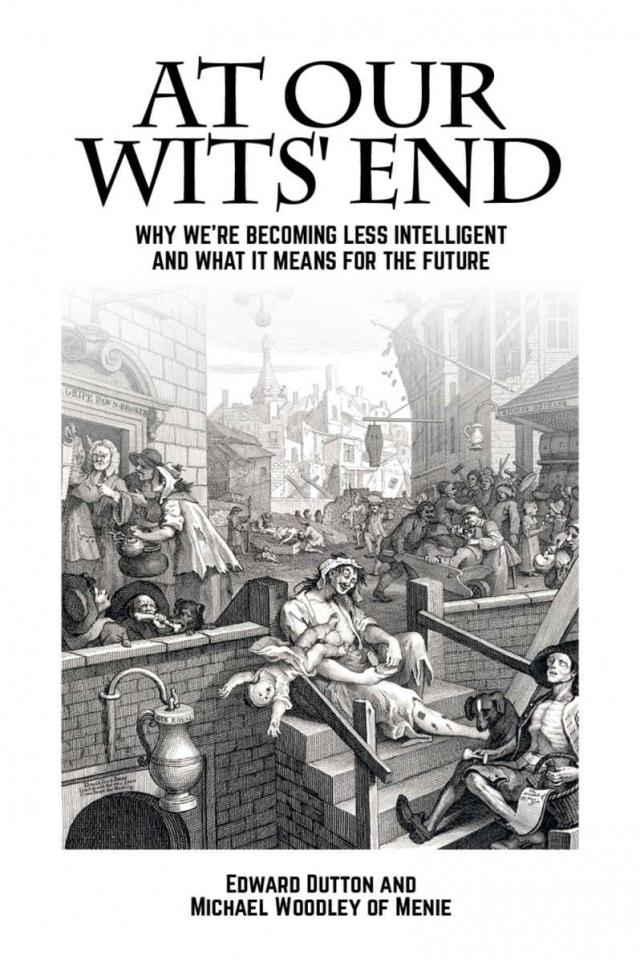
Edward Dutton, At Our Wits' End