The Ogre, page 1
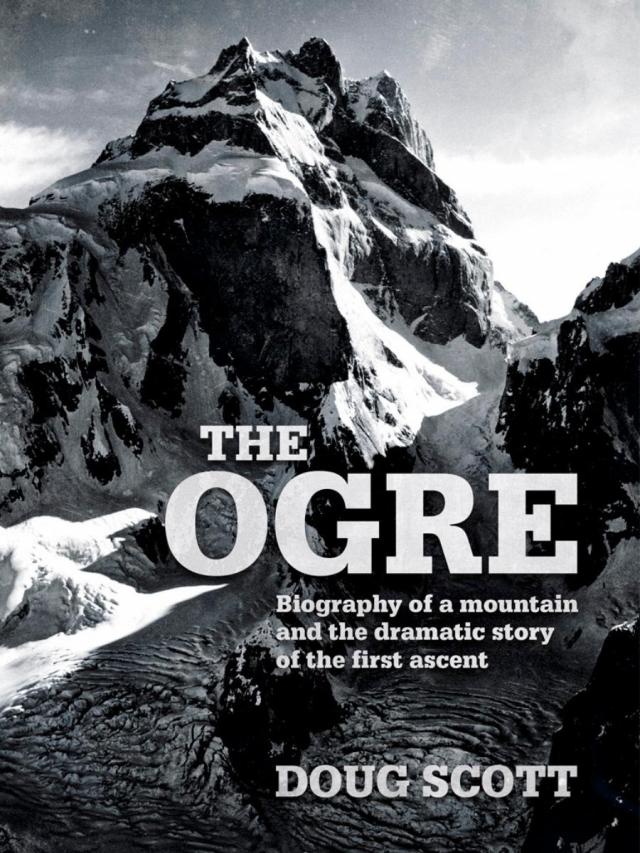


THE OGRE
Biography of a mountain and the dramatic story of the first ascent
DOUG SCOTT
www.v-publishing.co.uk
For Chris, Clive, Mo, Nick and Tut
– Contents –
Preface
Introduction
PART 1
Chapter 1 – The Mountain
Chapter 2 – Ancient History of Exploration
Chapter 3 – European Interest in the Region
Chapter 4 – The East India Company
Chapter 5 – Scottish Contribution to Empire
Chapter 6 – The Blanks on the Map
Chapter 7 – Early Mountaineering
PART 2
Chapter 8 – The Climbers
Chapter 9 – March to Base Camp
Chapter 10 – Climbing the Ogre
Chapter 11 – The Epic Descent
Chapter 12 – The Final Stretch
Afterword
Acknowledgements
Further Reading
The Author
More books by Doug Scott
Photographs and Maps
– Preface –
This book is a biography of the Ogre in two parts: the first part is concerned with the geological evolution and exploration from ancient times; the second part is more personal, covering the first ascent of the mountain and the drama of the descent with my two broken legs and Chris Bonington’s smashed ribs.
The first section of the book involved a good deal of research that I found immensely interesting: I had been to many of the places the European explorers first saw, during eight visits to the Karakoram, the Central Hindu Kush of Afghanistan and Pik Lenin in the Pamirs. Without doubt most of what I have written has been said before, but not many can write it down so well and convincingly as Conway and Shipton, and, more recently, William Dalrymple and Rory Stewart.
This is to be the first of a series of books of a similar format. Over the next few years I intend to produce books about Kangchenjunga, Makalu, K2, Nanga Parbat, Everest and Baffin Island. The books will cover the exploration that first brought men to the mountains right up to the summit. To that extent these volumes will be innovative in that most books on mountain travel and exploration go no further than traversing the adjacent glaciers and crossing nearby cols. The climbing is from a different era – before satellite phones, the avail ability of accurate weather forecasts on a daily basis and before super-lightweight equipment and plastic boots filled with closed-cell foam.
This series will cover a golden age of British Himalayan climbing between 1970 and 1985. These were brilliant days when I, for one, could have gone from one expedition to the next without a break, pushing the limits of climbing rock at great altitude and to climb the highest mountains without bottled oxygen and some without fixed ropes in complete alpine style.
In the last year new material has become available to me – I came across a bundle of letters I had written to my wife and family during the expedition to the Ogre that I had not read since first writing them. Nick Estcourt’s diary has become available since it is now lodged with the Mountain Heritage Trust; Clive Rowland has made available his draft memoirs; and the 8mm film, together with supporting cassette tapes, have just been found by Jackie Anthoine forty years after Mo put them together.
I hope the reader will have a better understanding of those times and the part played in the climbs by my companions and the local villagers who helped us first reach the mountain and, in the case of the Ogre expedition, carried me down from it on a stretcher back to their village.
Each of the mountains I have climbed has been unique, presenting my friends and me with a new set of challenges every time. During the course of an expedition, and in overcoming these challenges, we became far more aware of ourselves and of each other. We were, for a time at least, able to return home wiser men, usually more at peace with ourselves and with more enthusiasm to do all that had to be done back home.
– Introduction –
The one man that stands out when thinking back to the British Ogre expedition to the Karakoram mountains in 1977 is the Balti porter, Taki, who, after carrying a twenty-five-kilogram box throughout a four-day approach march, over loose moraine and slippery glacier ice, produced from the folds of his shirts and smocks on arrival at Base Camp thirty-one eggs – none of which were even cracked. It is hard to know how he managed that but he did for only thirty rupees a day (£1.75).
There is no way any of our expedition could have walked over that shifting chaos of moraine rock, stumbled across bare ice and waded through soft snow without breaking such a cargo. Eight weeks later eight more Balti came up the Biafo Glacier to Base Camp and, with as much consideration as Taki had for his eggs, carried me down that same rough terrain with hardly a jolt to my broken legs.
Forty years later it suddenly seems appropriate to record the significant events that brought the Ogre into being, into human comprehension, right up to the summit, and how the descent was achieved with two smashed ribs and two broken legs.
Doug Scott
September 2017
– PART 1 –
– Chapter 1 –
The Mountain
The mighty Karakoram has within the range some of the highest mountains on the planet making it the most formidable of the mountain barriers dividing the Indian subcontinent from Central Asia. The rivers draining the southern flanks of the Karakoram flow into the Indus whereas those to the north are channelled into the Yarkand to eventually disappear into the parched deserts of Xinjiang. Aeons ago this part of the earth’s surface was covered by an arm of the great Mesozoic Tethys Ocean that lay between the two contiguous continents of Gondwana and Laurasia containing all the land surface of the world. These two land masses split up, eventually forming the seven continents that exist today. I know this from reading Arthur Holmes’ Principles of Physical Geology (1944) when at school and later a revised edition (1965) when teaching geography. More recently, Colliding Continents (2013) written by a good friend and Professor of Earth Sciences at Oxford, Mike Searle, has brought me up to date.
These prehistoric continents drifted about like surface clinker on the molten core of the earth, propelled by the convection currents rising up to the earth’s mantle. Where two of these thermal currents came up together through the outer core and mantle to the surface and then diverged in opposite directions low mountains formed and tectonic plates were set in motion. Such activity still takes place on the ocean floor, as along the Mid-Atlantic Ridge, evidence of which is seen in Iceland. It is an island famous for its hot pools, geysers and dramatic volcanic activity sending huge plumes of ash into the atmosphere. It is also an island of increasing landmass as a result of the divergent, widening boundary between the North American tectonic plate and the Eurasian tectonic plate.
Movement of the continents resulted in an equal and opposite reaction where they collided, producing spectacular results. There the crust buckled and broke and was thrust up into huge mountain ranges. The drama is still in process in many parts of the world and none more so than in High Asia. Here the Indian plate, at the point of contact, was thrust beneath the Eurasian plate lifting Tibet to its current status – the highest plateau in the world. Further west, the result of one earth-shattering thrust after another was to produce corrugations in the form of a whole series of individual mountain ranges.
The modern-day rugby scrum provides a graphic analogy for colliding continents where one front row of muscular giants dips under the other to have to reform and push again, only next time both teams are so evenly matched the front rows rise up together. As the flow of the game is brought to a halt yet again, both teams push against each other, only now to swivel round and break from each other at which point the referee blows the whistle for this infringement or fault. The first stoppage we can equate to the subduction of the Indian plate under Tibet; the second to the great continental collision along the Himalaya; and the third to the formation of huge strike-slip faults like the Karakoram fault, Kunlun or Altyn Tagh faults in Tibet, along which continental plates have moved laterally against each other.
Right in the centre of all this activity at the ‘Roof of the World’ are the Pamirs, known to geographers as the ‘Pamir Knot’, from whence radiate out north-east the Tien Shan, south-east the Karakoram and Kunlun, south-west the Hindu Kush and the Pamir range itself to the west. South of the Karakoram, and running parallel to it, is the Ladakh range below which is the Indus River separating both the Karakoram and the Ladakh range from the western end of the great Himalayan range. The extent of the Himalaya is defined as lying between Nanga Parbat in the west and Namcha Barwa in the east.
The Himalaya is the longest of all the mountain ranges of Asia, but the greatest concentration of high mountains are north from the western end of the Himalaya. These mountains are the youngest and are still rising under the pressure of the Indian plate that for the last fifty-five million years has been pushing inexorably against the Eurasian plate. This is happening at an average rate of five centimetres per annum as the mountains along the line of contact are still rising, outpacing erosion by about seven millimetres annually.
This concept corresponds with the beliefs and mythologies of the people that now inhabit these mountains. Tibetan cosmology has it that the land (Mount Meru) emerged from a primeval ocean, and in the Hindu epic Mahabharata reference is also made to the watery origins of the Himalayan mountains. It is not easy to visualise geological time but we are reminded of it every few years when this mountain building manifests
The folded sedimentary and metamorphic rocks making up the majority of the newly formed mountain ranges of the world were later penetrated by massive injections of molten granites in the form of batholiths. These intrusions of magma cooled slowly within the country rock to form igneous rocks, the main one being granite. Over millions of years the granite is exposed to the surface as the overlying rock is removed through the process of erosion.
The granite itself is then subject to all the forces of nature, the wind and the rain and, in particular high in the mountains, the mechanical weathering of freezing and thawing, of glaciation and denudation by rivers loaded with grit and stone. The roughness of granite is due to the resistance of the quartz to decay. It has become the most cherished rock for climbing as it provides such good friction for hand and foot. Not only is this hard, rough granite an ideal medium for climbing, it tends to erode into shapely spires and formidable towers with huge rock walls that add to the challenge and satisfaction of reaching their summits. Just as the Western Alps have given rise to Mont Blanc granite and the famous Chamonix Aiguilles, so has the granite of the Karakoram eroded into the Baltoro spires and the Latok mountains, the highest of which is Baintha Brakk, known to the climbing world as the Ogre.
The Karakoram is considered to be the loftiest mountain range of all, with the highest concentration of peaks over 26,000 feet (7,900 metres) giving the range an average height of 6,100 metres/20,000 feet, along its 300 mile length. Another interesting statistic is that there are more than sixty peaks above 7,000 metres (23,000 feet) dotted about the Karakoram. They are the most spectacular and awe-inspiring mountains imaginable; they are literally breathtaking when they first impress themselves upon the eye.
The name Karakoram seems to have originally been applied to the range by merchants crossing over what is now the Karakoram Pass. The word kara in the Turkic language is the common word for black and kurum is the everyday word for stones as used to this day throughout Central Asia.
There is some logic in this since there are large areas of loose black shale lying all around the Karakoram Pass. The fact that the indigenous population, deep in these mountains, now call them the Karakoram is probably a result of the Survey of India adopting the name when first surveying the peaks in the mid-nineteenth century.
Tom Longstaff makes a valid point in his book This My Voyage (1950):
It is to be regretted that Karakoram is now the official spelling of this name. The mistake probably arose from following the rules for translation of Urdu into English. But the word is of the Turki language of Central Asia, and not Urdu. The name of the ancient capital of the Mughal Turks in distant Mongolia always has been and still is written Karakorum.
The only slight advantage of having it Karakoram is that it delineates the mountain from the ancient town.
The range is situated much further from the equator than the central Himalaya of Nepal. The highest mountain in the Karakoram, K2 (35 degrees 52' N), is nearly eight degrees north of Everest (27 degrees 59' N). The climate as a consequence is more severe with glaciation reaching down to lower altitudes than in the central Himalaya. Four of the largest glaciers outside of the polar regions wind their way down through the granite rocks of the Karakoram. There is the Siachen, forty-five miles long to the south-east of the range. Further west the Baltoro, including the Godwin-Austen Glacier, flows down from Windy Gap and Skyang Kangri for thirty-six miles. Again moving further west there are the Hispar and Biafo glaciers which are only separated by the icy Hispar Pass. Together they provide a continuous highway of seventy-six miles on ice and snow, making it the longest such journey outside the polar regions. Right at the north-west end of the Karakoram is the thirty-five-mile-long Batura Glacier, west of the Hunza River and the Karakoram Highway, that has dramatically opened up the region to coach loads of tourists.
There is a considerable climatic difference between the Everest region of Nepal and the Karakoram, not only because of the distance from the equator but also on account of K2 being at least 900 miles from the ocean and any maritime influence, whereas Everest is only 400 miles from the Bay of Bengal and receives the full force of the monsoon. K2 and the surrounding area on the other hand receives a diminished attenuated monsoon whereby much of the moisture is dissipated over the foothills and sub-Himalayan mountains before reaching the Karakoram.
– Chapter 2 –
Ancient History of Exploration
It was only during the last 200 years that the outside world came to know of the glaciers and the complex topography of the Karakoram. It is difficult, even now, to contemplate Karakoram geography without reference to modern-day maps. Two centuries ago there were no maps, only fragments of information gathered locally by itinerant travellers. Travel always was, for those who lived there, difficult and dangerous, for down in the valley bottom were raging torrents above which there were frequent landslides and avalanches of snow in winter. Crossing high passes remains to this day a challenge due to the problems of altitude. The valleys were so isolated that communities long ago divided into separate kingdoms, speaking different languages and often at war with each other. The villagers in their isolation always seemed suspicious of foreigners, especially those who came in from ‘over the mountains’ for they could reveal to enemies in other valleys unprotected ways to enter and rape and pillage.
There is a useful reference to the early history of this region in the Pakistan Trekking Guide. It is written by Isobel Shaw and her son, Ben, and is one of the most comprehensive trekking guides ever produced. Six thousand years ago there were hunters and herders in the mountains of northern Pakistan. In the eighteenth century BC the Aryans invaded the north of Pakistan to fight battles in the Swat valley. The high mountains of Asia were not only known to the ancients but also alluded to in Indian mythologies and with some accuracy as to their alignment. In the Mahabharata the Pandavas journey over small mountains, outer mountains and inner mountains corresponding to the sub-Himalayan foothills, lesser or middle Himalaya and the Great Himalaya on the watershed we know of today.
In the sixth century BC Darius the Great of Persia conquered the northern part of Pakistan. Three centuries later the Greeks gained first-hand knowledge of the Hindu Kush and possibly Baltistan as a result of Alexander the Great and his Macedonian invasion of India. Persian, Greek and also Roman scholars have all referred to the high mountains in the region of the Karakoram and have them stretching from west to east and they are actually drawn with that alignment by Ptolemy on the map of the world he produced in the second century.
Following on from the Greeks the next major influence upon this region of Central Asia was the increase in trade from east to west on a route that became known as the Silk Road. The ever-increasing trade, mainly in silk, began in China during the Han Dynasty (206 BC to AD 220) with Chinese merchants bringing their goods into central Asia to be moved on by middlemen. These entrepreneurial brokers were mainly Scythians and later Parthians, both of whom prospered from receiving and passing on merchandise to ancient Rome.
There was never any one single highway; no M1 across Asia into Europe, no single line of communication such as the Trans-Siberian railway that today connects the whole of northern Eurasia. The Silk Road was more like a wide corridor of scattered trading centres with offshoots north and south. One main route south went over the Karakoram Pass to Leh, Lahore and the Arabian Sea route to Mesopotamia and the Mediterranean. With the exchange of goods came cultural connectivity and the spread of ideas, inventions, religion, art and people themselves.
This global trade ebbed and flowed according to circumstance for it was always at the mercy of climate change, famine, war, economic reverses and, during the 1340s, the Black Death. This disease appears to have originated in Central Asia and so quickly spread along the Silk Road to eventually devastate Europe, where at least one third of the population perished.