

Why Good People Do Bad Things, page 1


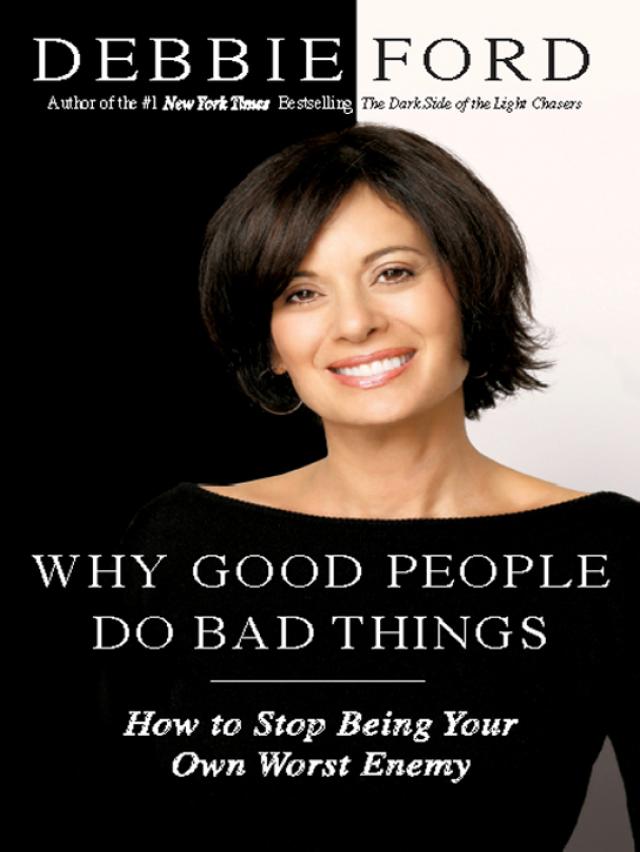
Why Good People Do Bad Things
How to Stop Being Your
Own Worst Enemy
Debbie Ford
Dedication
This book is dedicated to my amazing family,
my loyal friends, my brilliant staff, and the
Integrative Coaches who have given me their
hearts, time, love, and energy to make
this book possible.
Contents
Dedication
A Note to the Reader
Part One: The Never-Ending Battle
1 The Beach-Ball Effect
2 The Split
3 The Seesaw
4 Shame on You
5 The Fallout of Fear
6 The Ego Gone Bad
7 Cracking the Code of the False Self
Part Two: The Peace Treaty
8 The Masks
9 Waking Up from Denial
10 Healing the Split
11 The Strength of Forgiveness
12 Returning to Love
Acknowledgements
About the Author
Books by Debbie Ford
Copyright
About the Publisher
The Guest House
This being human is a guest house.
Every morning a new arrival.
A joy, a depression, a meanness,
some momentary awareness comes
as an unexpected visitor.
Welcome and entertain them all!
Even if they’re a crowd of sorrows,
who violently sweep your house
empty of its furniture,
still treat each guest honorably.
He may be clearing you out
for some new delight.
The dark thought, the shame, the malice,
meet them at the door laughing,
and invite them in.
Be grateful for whoever comes,
because each has been sent
as a guide from beyond.
—Rumi; translation by Coleman Barks
A Note to The Reader
Exploring why good people do bad things and why we turn into our own worst enemies is one of the most intense inquiries that any of us will ever embark upon. It is an eye-opening expedition to uncover the vast and often hidden darkness that influences our choices and pervades every facet of our human experience. This journey will take us into the heart of the duality of darkness and light that operates within each one of us. It’s a challenging yet compelling conversation because most of us are blind to the whole of who we are. We go to great lengths to continue to see the world through the perspectives we are familiar with and will do whatever we deem necessary to protect the person we believe ourselves to be—whether good or bad. That is why this inquiry requires us to step outside what we have long held to be the truth about ourselves and expose the hidden mechanisms that drive us to hurt ourselves and other people.
This investigation into the polarities, ambiguities, and hypocrisies of our humanity demands that we bring radical honesty to the places where we’ve been in denial, that we bring compassion to the parts of ourselves we’ve been ashamed of, and that we bring courage to the areas of our lives where we’ve been afraid to admit our vulnerabilities. It’s not a process of smoothing over, covering up, or pretending that the things we do to harm ourselves and others are not that big a deal. It’s a process that forces us to stop minimizing the impact of our self-destructive behaviors; admit what they are costing us and how they lead us to becoming our own worst enemy. To stop our self-sabotage we must be self-confronting and willing to understand how the primal split from our authentic nature caused us to create a fabricated self—what I refer to throughout this book as the false self. Our false self is the culprit that causes us to act out in inappropriate ways, destroy our relationships, sabotage our dreams, and place ourselves in harm’s way.
This path from darkness to light, from emotional pain to spiritual liberation, has been my journey for the past twenty-five years, and yet even after writing five previous books I am still aware of a deeper truth that I have yet to share. My goal with this book is to have you understand that your deepest pain arises as a result of the primal split between your higher nature and your human self. My intention is to lovingly support you in unraveling the lies and distortions, the guilt and the shame, that unwittingly turn you into your own worst enemy. I want to interrupt the internal mechanisms that cause you to turn your back on yourself, ignore your intuition, inappropriately cross boundaries, and give your power away to some person, thought, belief, addiction, or impulse that might lead you down a dark road to nowhere rather than the liberated path you were meant to travel. The information and processes you will find in this book will allow you to heal your deepest regrets, challenge your insecurities, befriend your self-doubts, confront your inner demons, and face up to the ways in which you participate in your own self-destruction. This book will provide you with a reliable path to defy the gravitational pull of your past and step into the infinite possibilities of your true and limitless self.
I know that the greatest gift I can give you is the benefit of all my experience as a workshop leader, coach, and educator. After struggling with my own darkness and destructive tendencies, I have come to understand the absolute perfection and absurdity of the human experience. I know the power, as well as the potential hazards, of our unprocessed pain. And I know what it takes to make peace with the past and integrate the unresolved conflicts of our conscious and unconscious minds. My absolute faith that the gold lies in the dark is what allowed me to heal my shame and help hundreds of thousands of other people heal theirs. It was my own journey through darkness that helped me build an intimate relationship with my authentic nature. It was not my good self but rather my evil twin that led me to heal my emotional wounds and ultimately launched my career. It’s not my quick wit or my perceived brilliance that has allowed me to transform the lives of hundreds of thousands of people, but rather the wisdom I gained as a result of integrating my anger, discontent, shame, fear, and insecurities. In fact, it was my inability to function well in the world that forced me to strengthen my spiritual connection and learn how to thrive, even after devastation. It is the very darkness that I didn’t want to be or experience that has driven me to become the woman I always longed to be.
All of my flaws and negative qualities—of which I have many—have brought me priceless gifts, for they are what have led me to become who I am today. I can no longer stand in judgment or disapproval of my human flaws, weaknesses, and dark impulses, because the integration and wisdom of my own humanity are what have led me to deliver my greatest gift and create a life beyond what I could ever have imagined for myself. Because of this, I believe I am the perfect person to guide and support you in understanding who you are and why you do the things you do.
When we come to understand that we are all both good and bad, light and dark, strong and weak, brilliant and oftentimes utterly stupid, we begin the profound process of healing the internal split that invariably takes place for most of us at some time in our lives. This is the only path I’ve found that actually relieves human suffering. We achieve peace not by learning new tricks or more strategies to hide our imperfections but by embracing more of our insecurities, more of our shame, our fear, and our vulnerabilities. When we heal the split between our darkness and our light, our Dr. Jekyll and Mr. Hyde, we have the resources to make better choices, think more empowering thoughts, and behave in ways that leave us feeling proud and inspired. We gain the courage and the confidence to see things exactly as they are, without any self-deception or illusion, and we understand that it is not by accident that each of us becomes the person we are today or that we struggle with the issues that we are faced with. With this priceless information in hand, we hold the key to unlocking our tendency toward self-sabotage, and we open up the door to living a life beyond the limitations of our false self—a life filled with passion, meaning, and purpose; a life graced by the very experiences and heartaches that brought us to our knees.
PART ONE
THE NEVER-ENDING BATTLE
1
THE BEACH-BALL EFFECT
Why Good People Do Bad Things is a powerful inquiry into the hidden forces that drive us to commit unbelievable acts of self-sabotage and self-destruction. We’ve all heard the stories; they show up on the evening news, on the front page of newspapers, and as headlines in the weekly tabloids: the Olympic sports hero who falls from grace after being accused of injecting steroids; the TV evangelist who gets arrested for soliciting prostitutes; the schoolteacher who carries on an affair with one of her students; or the baseball star who gambles on his own games. These are the public demonstrations of good people who have gone astray, and they have become our national obsession.
But countless other acts of self-destruction and unthinkable acts of cruelty take place, unbeknownst to us, in our own backyards: the successful eye surgeon who gambles his kids’ college tuition away; the public official who takes a bribe; the PTA mom who is having an affair with her best friend’s husband; the hospital administrator who commits insurance fraud; or the financial manager who embezzles money from his clients. These are people whom most of their peers would consider good people, not common criminals, psychopaths, or sociopaths whose histories might predict their unscrupulous behavior. These are people like you and me, people who started out with big dreams for their future. But despite their good intentions, these so-called
Our society is rampant with acts of self-destruction that leave most of us perplexed and asking, “Why did he or she do that? Why did I do this? How could this happen?” Self-sabotage is the proverbial hammer over the head that finally wakes us up, demanding that we pay attention. For most of us, it takes something devastating to crack us open, to get us out of our minds and into our hearts. It takes the pain of a broken heart and shattered dreams to push us beyond the limited realities we have created for ourselves.
We are spiritual beings whether we want to admit it or not, and inherent in our DNA is a design to return us home—home to our true essence, our greatest self, our limitless self. One of the ways we unconsciously ensure our return is through pain. Pain is the greatest motivator for change. It is the spiritual crowbar that pries open the door to new realities. Would we look into our deeper selves, dwell in them, grapple with them, inquire into them, and initiate change in our lives if everything was perfect? More than likely we would just continue living day by day in the comfort of our familiar worlds.
Self-sabotage is a catalyst that can change our world in an instant. We can go from arrogant and blind to humble and open—in just a matter of seconds. The pain we cause ourselves is a tremendous spiritual gift. When explored and understood for its true purpose, the pain of our own self-sabotage reveals new and uncharted territories that can change the course of our lives.
The Underbelly of the Human Psyche
The underbelly of the human psyche, what is often referred to as our dark side, is the origin of every act of self-sabotage. Birthed out of shame, fear, and denial, it misdirects our good intentions and drives us to unthinkable acts of self-destruction and not-so-unbelievable acts of self-sabotage.
Shame and denial feed our dark side for one simple reason. If we accepted our weaknesses, flaws, and shortcomings as a natural part of our humanity, we would have the ability to ask for help when we are confronted with an impulse that we don’t know how to deal with. We would recognize that these dark impulses—such as the urge to have sex with people other than our spouse, to take money that doesn’t belong to us, or to lie in order to better position ourselves—are a natural part of our humanity that needs to be understood and embraced. But because these urges are left unexplored and unexamined, they get wrapped in shame and denial and kept hidden in the dark. And it is there that our shadow self, the unwanted and denied aspects of ourselves, gathers more power until a blowup is inevitable.
Every aspect of ourselves that we’ve denied, every thought and feeling that we’ve deemed unacceptable and wrong, eventually makes itself known in our lives. When we are busy building a business, creating a family, or taking care of those we love, when we are too busy to pay attention to our emotions, we have to hide our dark impulses and shame-filled qualities, which leaves us at risk for an external explosion. In a matter of minutes, when we least expect it, a rejected or unwanted aspect of ourselves can pop up and destroy our lives, our reputations, and all of our hard work. This is what I call the Beach-Ball Effect.
Think of the amount of energy it takes to hold an inflated beach ball underwater for an extended period of time. The moment you relax or take your attention away from keeping it submerged, the ball will bounce back up and splash water in your face. The Beach-Ball Effect is at work when you have suppressed something deep within your psyche, stored it in the recesses of your subconscious, and then, just when you think everything is going your way, something happens: You send a slanderous e-mail to the wrong colleague. You get lured into betraying someone you love for a night of meaningless passion. You get behind the wheel of a car after having three drinks and get arrested for drunk driving. You get caught dipping into your family’s trust fund. You fly off into a rage in front of your new lover. You make an inappropriate comment that costs you your job. You blow an important deadline right before your big review. You haul off and hit your child in a moment of frustration…. In other words, the beach ball—your repressed urges and your unprocessed pain—pops up and hits you in the face, sabotaging your dreams, robbing you of your dignity, and leaving you drenched in shame.
How many more blatant acts of self-sabotage do we have to witness to understand the devastating effects of denying and suppressing our unprocessed emotional garbage? Don Imus is a perfect example. Here is a man who worked hard to become one of biggest radio and TV celebrities in the country over the course of thirty-five years—his entire career was based on communication. And in less than one minute the reputation he had spent years building was destroyed. The beach ball bounced up and hit him in the face.
Mel Gibson built the persona of someone who takes a moral and ethical stand for others and creates movies with strong spiritual messages. And although he vehemently denied accusations of anti-Semitism in his movie The Passion of the Christ, in one drunken tirade the attitudes and beliefs that were hidden in his shadow couldn’t be held down. When pulled over and arrested for driving under the influence, he shamed himself with a barrage of outrageous statements.
There are countless ways for the beach ball to pop up and smack us back into reality. It could be something as small as picking a fight with your husband right before you are about to go out on a long-overdue date, or criticizing your child in front of her friends after spending months trying to build her trust. It might be procrastinating on updating your résumé and missing a huge opportunity, or spending a night in front of the refrigerator after dieting for three months. Maybe it manifests itself as over-sleeping and missing your best friend’s bridal shower or calling your lover by the wrong name. Maybe it’s making a smart-ass comment to yourself while thinking someone had already hung up the phone when actually they had not. As long as we are unwilling to look at the beach balls that are lying just beneath the surface of our consciousness, we will unknowingly have to live in fear of the moment they will pop up and the effects they will have on our lives and the lives of others when they do. And believe me, it is a rare case when we are the only ones who get hurt; more often than not, our unprocessed pain will hurt many people. Many lives will be inconvenienced, many hearts will be broken, and some nearby innocent spectators will get caught in the splash.
Let’s think of our suppressed emotions and disowned qualities as human lava. Lava exists beneath the surface of the earth. If there are no steam vents at the earth’s surface to release the pressure of the powerful force that lies beneath, its only outlet comes in the form of an eruption. Likewise, within our psyches our dark urges and impulses build up, and unless we find safe, healthy ways to release them, they express themselves in inappropriate and potentially dangerous ways. By acknowledging, accepting, and embracing our dark side, we create natural steam vents within ourselves. By providing an opening, we eliminate the worry about an explosion because we are allowing the pressure to be released in a safe and appropriate way. But when it is concealed in darkness, repressed out of shame, and denied out of fear, the shadow has no choice but to erupt. The mental and emotional outpouring that follows has less to do with our circumstances and who is around us than it does with our need to release the pressure.
Our psyches naturally seek a release from the internal pressure caused by the repression of the disowned aspects of ourselves. This is why we are so obsessed with bad news, bad behavior, and especially the media’s stories that exploit the downfall of people who are at the top of their game. Each time we hear one of these shocking tales of greed, lust, perversion, stupidity, deceit, or betrayal, we unconsciously get some internal release and relief from the pressure of our own dark side. When we see someone famous who is accused of molesting a thirteen-year-old boy, suddenly our own fascination with porn seems to pale in comparison. When our city councilwoman is caught shoplifting, cheating on our taxes seems insignificant. This obsession with darkness and failure in the media allows us to take momentary shelter in the hope that we are not as horrible as those we see portrayed around us. Yet our fascination with their darkness tells a different story.


