Seeing Red, page 31


No such luck.
Since the organizer of the fete had gone several thousand dollars over budget and not delivered either of the above mentioned Steves in person, the poor guy was fired the very next day, and the Dimension Award was shitcanned, making it, I guess, one of the rarest awards in the field.
But mine still sheds a lovely light.
This was the first of two "Oliver Lowenbruck" stories to appear in TZ (see "Lonesome Coyote Blues"). For details on Oliver's subsequent demise, see the story "Dying Words" (available in Zombie Jam). Ollie's tombstone—sub-inscribed HE FOUGHT THE GOOD FIGHT—is visible in the cemetery scenes in The Crow (1994).
Actually, the original title of this story, which I shall never reveal to anyone (desperately hoping that the few who glimpsed it, having not turned to stone, will do me the courtesy of forgetting it altogether), wasn't as bad as the title I came up with (and quickly changed) for a novella that ultimately left no footprints in the sands of time, either. It, too, was a stinker. But I think I've kilt them both deader than gristle. Don't bother to thank me.
THE EMBRACING
…began as an experiment in completing a story front-to-back, in longhand, before letting it near the typewriter. It was more transcribed than revised.
Ares was a gaming magazine put out roughly from 1980-1984 by Simulations Publications, Inc., which also produced Strategy & Tactics. The Simulations hook was the incorporation of an actual game into each issue of each magazine, complete with die-cut cardboard tokens and pieces. After fending off a year of story submissions, editor Michael Moore (no relation to the guy who filmed Roger & Me) took me on as a the magazine's Media columnist; shortly thereafter he bought "The Embracing" the first story to appear in Ares having nothing to do with that issue's game. SPI's practice was to derive any fiction directly from an issue's game theme; a couple of early ones that were offered to me were "Barbarian Kings" and "Alien Contact." When Michael told me Ares was planning a "Nightmare Hotel" game and issue, I eagerly grabbed the premise and wrote "Visitation," in addition to so much peripheral material that Roger Moore (Michael's replacement) dubbed that issue the "Dave Schow Memorial Issue." By that time, SPI had been subsumed into TSR Hobbies (the Dungeons & Dragons people) under the Dragon Publishing imprint. Ares bit the dirt in early 1984.
Originally titled "Punkin" and aimed straight at the debut issue of Midnight Graffiti, this was probably the "newest" story in Seeing Red, including the previously unpublished tales. It was written in 1986, and my logbook informs me that, strangely, it has been reprinted more times in England than in America.
The title was an attempt to denote the story in purely visual terms and provide a link to the signature graffito mentioned in the narrative. This irritated many of the less adventurous, who persisted in badgering a "name" out of the story. What's it called? That's what it's called. You either get it or you don't. I think Gahan Wilson started this, with his story. I have perpetuated the phenomenon, to a lesser extent, in "DONt WALK" and
The Midnight Graffiti text of the story featured an extra paragraph at the end to better hint at, if not spell out, the kind of haunting that went down. The story appears here as originally written. Those readers who have seen the Midnight Graffiti paperback (Avon, 1990) will notice that this is the story blurbed on the back cover copy; my contribution was going to be a reprint, but at the last minute I completed "Bad Guy Hats" (available in Black Leather Required) and substituted that instead.
Strongheart, by the way, was a dog.
BLOOD RAPE OF THE LUST GHOULS
When I received a contract for this story from Montcalm, the parent company to Gallery, Twilight Zone and Night Cry, some chicken-shit had abbreviated the title to "Blood," explaining that Montcalm's legal department would sniff disdainfully at anything called "Blood Rape of the Lust Ghouls." I phoned the magazine and calmly suggested that the title should not be messed with. No one at the magazine even knew there was a problem, except for the gnome who had mucked over the contract to begin with. When I suggested spilling the gnome's own "Blood," up and down the corridors of Montcalm, I was confronted with a dismaying amount of support from his supposed coworkers, who confided more details about the gnome's personal hygiene and repulsive eating habits than I ever needed to know. Clearly, these people were seeking an ear in which to vent, and ultimately, the title went unmolested.
Jeff Potter whipped out a wonderful full-page illustration for this story, depicting the fake movie poster. It's hanging in my office, right now. James O'Barr did a pretty good comic adaptation for Horror: The Illustrated Book of Fear (1990).
NOT FROM AROUND HERE
By now, attentive readers will have noticed that a lot of bad stuff tends to take place around Point Pitt, a fictional Northern California seaside port-of-call I originally invented for a novella titled "Brass' but whose earliest appearance in print came in "Red Light."
When this story was written, The Amityville Horror was more or less the template for the populist horror novel—The Nice New Folks in Town run Afoul of Ancient Nastiness, Good Engages Eee-vil, and by the end, Family Values Prevail. Look around; you'll see the structure everywhere in the wake of The Exorcist.
I really didn't want to write that. But I did want to experiment with that too-sacred family structure, demonstrate it wasn't invulnerable, and tip it over into genuine dread. According to sources I trust, the attempt was mostly successful. It sure shook up Ted Klein.
A decade later, courtesty of Gordon Van Gelder, I received a wonderful academic paper titled: "Escaping the Creature-Text: An Iserian Analysis of David J. Schow's 'Not From Around Here" by Jennifer A. Fisher.
It was longer than the story but don't get me wrong; I love reading papers like this and finding out what I actually meant. On top of that, Ms. Fisher blended in some genuinely pointed observations about the "real" versus "implied" reader, the back-and-forth performance which sparks the "horrific effect," and the three principal types of horror—the "uncanny tale' the "terror fantasy' and the "horror thriller," just in case you think you need to know. The final verdict was that Ms. Fisher "experienced this tale as genuinely horrific," and, for me, a finer endorsement cannot he conceived.
ACKNOWLEDGMENTS
Welcome to Credit Roll Hell. A lot of people need to be thanked, so you might as well resign yourself to paying attention.
First and foremost, my thanks to T.E.D. Klein, who permitted both my fiction and my Outer Limits articles to sneak into Twilight Zone Magazine, and thus became Ollie L's unintentional midwife. He wrote the spiffy introduction at the head of this book.
Next, my corral of editors: Tappan King, Charles Ryan (the first to buy a story of mine for publication), Robert Sabat, Peter Emshwiller (hi, Stoney), Karl Edward Wagner, Stuart David Schiff, Michael Moore (no relation to Roger), Roger Moore (no relation to James Bond), Geoff Golson, Alan Rodgers, R.S. Hadji, Darrell Schweitzer, John Betancourt, David Sutton, Stephen Jones, and—naturally—Tor's own Melissa Ann Singer.
And not only them, but more pals: Robert & Elly Bloch, Tyson Blue, Edward Bryant, Ginjer Buchanan, Tim Caldwell, Nancy Cushing-Jones, Charles de Lint, John Douglas, Bruce Jay Friedman, Charles L. Grant, Beth Gwinn, Lea Harp, David G. Hartwell, Jo Jenson, David Kuehls, Beth Meacham, Keith Nelson, Marcus Nickerson, Lawrence Person, J.K. Potter (for the Night the Lights Went Out in Providence), Lauri Rodich, Jeff Rovin, Kathleen Sarquist, the Satanic Mouseketeers, David Sherman, Dave Silva, Peggy Sniderman, Brinke Stevens, Peter & Susan Straub, Michael Sumbera, Amy Thomson, Tony Timpone & J. Peter Orr, Jim and Elizabeth Trupin, Stan Wiater for the term cineteratology and the immaculate F. Paul Wilson. A special hello to the Scumbag, who let me quote him.
My gratitude goes to the readership of Twilight Zone Magazine—who voted "Coming Soon to a Theatre Near You" their 1985 Dimension Award for Best Short Story, and to the officials and judges of the 1987 World Fantasy Convention, who chose to honor "Red Light" with the World Fantasy Award for Short Story.
A toast to the memory of four great lost moviehouses: The Pix, the Gordon, the Holly Cinema (from the days of Manager Ramon and the green hot dogs), and to that tarnished triple-bill jewel of Hollywood Boulevard, the World.
Extra special thanks to Brock deSade and Stephen Grave. I know who you are; you know what you did.
—DJS March, 1989
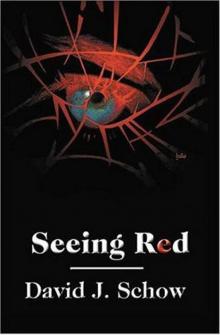
When Thomas Canty proposed artwork for the original edition of Seeing Red, based mostly around interpretations of the frog-eyed visage of Astaroth from Der Golem, he delivered—as was his habit—more than ten finished variations, most of which I was fortunate enough to accumulate. Seeing Red was also noteworthy as the first book that was laid out exactly as I specified, a consideration for which I remain thankful.
Christa Faust continues to prove to me that the impossible can be mastered, and simple stories cannot express the depth of my love for her.
For this edition of Seeing Red special mention must be made of Arthur Byron Cover and Lydia Marano of Babbage Press, without whom you would still be (A) looking for a used copy of that old Tor paperback, or (B) reeling in explosive-decompressive horror from the blasphemous EMR/Alexander Press edition, for which I deeply apologize. Above all, Art & Lydia will always have my gratitude for their perseverance and hard work.
—DJS December, 1998
Important consumer note:
Babbage Press was born of the ignominious ashes of EMR/Alexander, and repairing the spavined, crippled thing that was the abovementioned EMR edition from 1999 took two solid years (“EMR” stood for “Escapist Mind Rot,” wotta riot). It is mentioned here only in the interest of completeness; in no way do its flaws make it any kind of “collector’s edition.” If you bought it — or even got it for free — you were ripped off. The typography was nightmarishly unreadable and under-inked. During multiple phases of proofreading, the typesetter was so enamored of his PC that none of the oft-repeated corrections managed to survive. The cover was unvarnished; it arrived “pre-scuffed” from the blacking factory where it had been abused by Third World aborigines who had never experienced the English language firsthand, and toothless Appalachian hillbillies whose adversarial relationship with the printed word was painfully obvious in the finished “product.” Some disreputable outlets still hawk fugitive stock of this grotesquely derailed, book-like excrescence, which was not released, but escaped. By squandering your money on this abortion you support no one’s work.
Now, the splendidly overhauled Babbage edition (2002) — which looks almost the same, please pay attention — corrected all the shortcomings and typos. I only cost a buck more. It is the preferred text and format. On the remote chance you might care about the differences, here they are:
The Babbage edition is 1/8th inch thicker at the spine, 1/8th inch taller, with a varnished cover featuring a red “e” within the word RED on the front, back, and spine. The Babbage colophon is on the spine.
The cover graphic attributes the artwork to “lydia” in bright red on the EMR version. On the Babbage it is attributed to “LcM 03.02” in a more subdued shade.
The EMR version has completely generic titles and contents pages.
The Babbage edition includes a page of review quotes upfront. And a proper title page. And bullets to separate the contents, reflecting just one aspect of the meticulous design work brought to bear on the repair effort.
The Babbage edition features frontispiece artwork (a variation on the cover) before the Contents page.
The Babbage edition also bears an amended Afterword, with the extra stuff dated December, 1998.
So one more time: Babbage, not EMR. For autograph seekers, the EMR version is one of one of a very small leper colony of three books I absolutely will not sign under any circumstances. Go Babbage, Babbage, Babbage. You have been warned.
—DJS , April 2002
And here we are a decade later, “embracing the digital” with this wholly nonphysical resurrection of Seeing Red. Years of retrospection have revealed subtle themes for this and each subsequent collection — Lost Angels was about heartbreak and loss; Black Leather Required was the height of splatterpunk. This themology arrived as an afterthought, mostly via the observations of readers and reviewers, and not as a result of my own strategic brilliance or hubris. Seeing Red, I learned (and agree with), was a demonstration of the “conventional horror story” as interpreted through my various filters, or assorted takes on what constituted a scary story as the 1980s wound down, in defiance of (and sometimes abetted by) tropes that had come to be accepted as standard-issue furniture for any tale defined as “horror.” Fair enough.
You may consider it as a time capsule. Pre-Internet, pre-“mobile device,” when Ronald Reagan was still the Prez and $10 million was a huge budget for a movie.
All due praise for this edition should be directed to the elite Club of Other Daves: David Niall Wilson of Crossroads Press, and his intrepid co-editor and designer David Dodd.
—DJS , March 2012
Table of Contents
INTRODUCTION BY T.E.D. KLEIN
RED LIGHT
BUNNY DIDN'T TELL US
INCIDENT ON A RAINY NIGHT IN BEVERLY HILLS
THE WOMAN'S VERSION
LONESOME COYOTE BLUES
NIGHT BLOOMER
ONE FOR THE HORRORS
VISITATION
PULPMEISTER
COMING SOON TO A THEATRE NEAR YOU
THE EMBRACING
BLOOD RAPE OF THE LUST GHOULS
NOT FROM AROUND HERE
AFTERWORD: CRIMSON HINDSIGHT
CRIMSON HINDSIGHT
ACKNOWLEDGMENTS
David J. Schow, Seeing Red