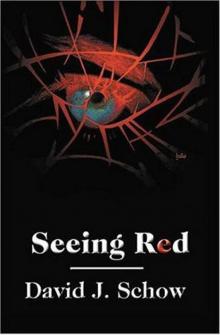
Seeing Red, page 30


"Come on, come on!" I lashed out at a fire-ravaged plank and it crumbled into brittle charcoal cinders. My voice echoed back from the treeline twice.
Lava-colored eyes emerged to assess me from behind the still standing brick chimney. Chatoyant pupils tossed back the street light in dual crosscut shapes.
A conventional defensive move would draw it out, confident of its own invincibility. I chambered a round as loudly as I could. "This is for you! Come on—it's what you want, right?"
Motion, hesitant, like Ross Delaney, unsure. There was a smear of bright bronze as the eyes darted to a new vantage.
"Come on, hag of shit!" Fuck reaction time. The gun went boom and a mean bite leapt out of the chimney. Pointed chunks of brick flew into the creature's face. It did not blink. The Remington's report settled debris all around.
I dropped the gun into the ashes.
Its outer tissue was pinkish, as though battened with blood from an earlier feed. The alien eyes blazed. When it saw me lose the shotgun it decided, and in three huge bounds the distance between us was reduced to nothing. I saw it in midair, rippling, its thorny claws extruded from their cowls and coming for my face.
I braced myself, the memory of grabbing Ross Delaney's deadly fist still hot. I spoke softly to the woods, to the forest in the distance, to the sea behind me.
"Help me. Mother."
It smashed me down like a truck pasting an old lady in a crosswalk. The opaque talons sank to their moorings in my shoulder. I grabbed, to keep the jaws from my throat, and its fangs pierced the palm of my hand, one-two.
"Mother! Help me!"
I got my other hand up and seized its snout, which was feverishly hot. Stale blood-breath misted into my eyes and the black lips yawned wide for me. Those lips had caressed my daughter's face as they engulfed her. They had made an intimate, ghastly smorgasbord of Suzanne.
I clenched my fist. It tried to jerk its paw back to slash me into confetti, but the claws were trapped in my muscle tissue and would not slide free. The X-shaped eyes dimmed in surprise. It backpedaled, preparing to dig in with its hind legs and free my intestines.
I sat up with its movement, taking a firmer grip and twisting until its lower jaw came away in my hand. Think of halving a head of lettuce; that was the sound it made. Think of pulling a drumstick from a whole tom turkey. It jammed, then wrenched loose, dripping, trailing ruptured tatters of sinew.
It shrieked. Without a mouth, in pain.
Purple blood, thick and gelid, splurted into my face. Under the vapor lamp it looked like chocolate syrup; it stank of vomit or hydrochloric acid. The eyes went from golden to dead ochre, the color of dry leaves.
"You're done here:" I rasped in its face. Still holding the snout, I punched my fist down the ruined wet maw of glottus. My fingers locked around something slick and throbbing and I tore it out. The body on top of me shuddered hideously and lost tension. The legs scrabbled, then went slack, pitching more feebly.
I stared fixedly into the eyes as their incandescence waned.
The residents of Point Pitt had come out at last, to watch. My new neighbors. They dotted the street, milling uncertainly, none daring closer than the mailboxes. They watched as their old god screeched and died. As with department store mannequins, it had been so simple for them to be led, to be arranged.
What difference? That was ended now.
When I extracted the claws from my shoulder, my own blood jetted briefly out. I was still that human. Eyes cold, the limp and stinking carcass slid as I rose. Another shedding. A steel rail of an erection was trying to fight its way out of my pants.
They all stood, nothing more declarative. Silently they waited. The last to arrive were Dunwoody and Ormly, coming down the trail from their home. No one else moved to attack, or assist, or anything. It was not their place to.
Thank you
Reflexively, the dead claws had folded in upon themselves. When I picked up the corpse, it crackled, still seeming to weigh too much for its mass. I remembered the awful sound its discarded skin had made. Purple goo dripped from the jawless mouth. The flat paws dangled harmlessly as I lifted the fatal wound to my lips and drank in long, soul-kiss draughts, quaffing with a passion almost primitive in its purity.
Thank you. Mother.
My communion raced through me to work its changes. My arm ceased bleeding and clotted up. I stopped shaking at last; all of me at once. My vision began to blur. Soon I would be able to see things imperceptible to normal, circular pupils.
I motioned to Ormly and he dutifully clumped forward. He had to be the first one. There was plenty for everybody, but Ormly had to he first.
Things evolve. Always have. Even in the country, things change when it's time. There was growth potential here.
Dunwoody nodded his old man's brand of approval. If I needed any indication that I was going to be benevolent, that was it.
AFTERWORD:
CRIMSON HINDSIGHT
Short story collections have always meant more to me as "books" than novels, mostly because of their ability to display many facets of a single writer under an umbrella more permanent than the scatter of magazines and anthologies in which short fiction generally appears and is soon forgotten. Seeing Red was my first short story collection, most of the stories having been written in the early to mid- 1980s. I gathered them into this home with as much relief as elation—at last these guys had a roof over their heads, or as Karl Wagner preferred to call it, "the sanctuary of A Book."
RED LIGHT
…derives its title from the Siouxsie and the Banshees song found on the Kaleidoscope album (1980), from which also come the terms "shutterslut" and "Kodakwhore," this latter also providing an early working title. It was my first sale to Rod Serling's The Twilight Zone Magazine (hereinafter, TZ) under the stewardship of Tappan King, who by 1985 had replaced the original editor, T.E.D. Klein.
"Red Light," won the World Fantasy Award in the category of Short Story for 1987. It is worth noting here that the story thrashed several competing stories from an anthology which had originally rejected "Red Light" from its august company.
As titles go, "Red Light" linked up conveniently enough with Seeing Red, which had also been used as the title of a crime novel by Nelson Ormerod (Scribner's, 1985), the "red" in that book being the color of a stoplight run by the protagonist as she mows down a pedestrian. Guilt ensues. Red Light also briefly became the name of a brand of diet beer churned out by Coors during the fleeting craze for "red" brews in 1995, and while this had nothing to do with the story, it's cool to have long-necks with foiled labels barking out one's title. The result of this titular train wreck is that "Red Light" is frequently cited as "Seeing Red: and, in one ironic cross-pollination thanks to TZ, "Red Zone."
The story also provided my first opportunity to adapt my own work from one medium to another. It was optioned by producer Jeff Fazio for the debut season of his Showtime TV series The Hunger. Rather than hew religiously to the text, I rethought the narrative in rigorously visual terms, gleefully twisting and turning it into a new shape before releasing a pretty damned good script to the merciless even-dozen hands itching to rewrite it ... who, at one point, top-loaded the story with voodoo and gouged-out eyeballs. To his credit, Fazio did his best to drag the story back toward where it started, and the end result, as directed by Christian Duguay, is a not-unworthy acquittal. Despite the sum of the mutations wrought, I got the definite feeling that the key personnel —everyone from Christian through the actors—had actually read the original story and grasped its essence, and how often can you say that about anything that appears on TV? While the exclusionary nature of the "Canadian Content" regs (which favor indigenous writers) prevented me from doing more scripts so long as the series was shot in Montreal, Jeff Fazio showed his gratitude by optioning a whole bagload of other tales either written or recommended by me.
BUNNY DIDN'T TELL US
The first thousand words of this story were written in 1979 or so—everything up to the point where Riff and Klondike realize they're digging up a limousine. The rest came in a flurry four or five years later. The fragment sat in the file all that time, fermenting (or gestating), and it was when "Bunny" was finally sold that I wondered, with terror, whether every new story might take this long to declare itself.
INCIDENT ON A RAINY NIGHT IN BEVERLY HILLS
…is essentially a one-act, one set play for two characters. A horror writer of modest notoriety once testified that this was his favorite of my early stories ... forgetting, I guess, that he had rejected it from one of his many anthologies when it was unpublished. That's okay, though.
THE WOMAN'S VERSION
…was originally titled "Sick Leave" and represents my only short fiction output to result from a bitter six months of life wasted in Chicago, mostly during the historic blizzard of 1978—the snowstorm that got Jane Byrne elected mayor the next year. Later, as I tore "Sick Leave" apart and rebuilt its bones, a windstorm blew out the power in my Hollywood apartment and I actually typed the middle section on a manual typewriter, by candlelight, in 1985. Later that year I got my first electronic typewriter.
Readers of my second novel, The Shaft (1990) may recognize certain aspects of the apartment building or the character of the landlord as familiar. The story was rejected from Twilight Zone by Ted Klein, who promptly referenced it so many times in subsequent letters that I polished it and sent it back. By the time it was bought, my TZ backstock was so piled up that the story was shuffled over to the third issue of Montcalm's digest-sized spillover venue, Night Cry, marking my debut in that short-lived little sister publication. Whereas TZ was garnished with articles, interviews, and entertainment fluff, Night Cry was all fiction, gently hyped as being an outlet for slightly more "intense" stories than would normally appear in TZ. No wonder it was doomed.
LONESOME COYOTE BLUES
…despite a few minor aspects which have dated, remains a special favorite of mine because it represented my first "clean" story sale that is, one without conditions. Ted Klein got it, read it, called me on the phone and said, "Sold." That feeling that you are finally firing on all cylinders is an important watershed for any writer.
It ran in TZ under the "Oliver Lowenbruck" pen-name for the reasons outlined by Ted in his Introduction.
The Bouffants never existed ... not until 1989, when a TV-movie called My Boyfriend's Back (no relation to 1993 teen zombie film of the same title) appeared, starring Sandy Duncan, Jill Eikenberry and Judith Light as members of a 1960 one-hit girl group.
NIGHT BLOOMER
…evoked the single most repulsive editorial "suggestion" I'd ever received, from a blowfish who thought it might be "rilly kewl" to have individual black seeds erupt from each of the protagonist's pores in a shower of pus. "Yeah, yeah," wheezed the blowfish, "it'd be rilly even more horrifying!"
The story was vilified when it appeared in an issue of Weird Tales devoted to my fiction, prompting editor Darrell Schweitzer to note: "I think it's a sound policy to print something really unwholesome once in a while, just to remind people that we can."
When Jeff Fazio read it, in search for stories for The Hunger's second season, I got an adrenalized phone call: "Why didn't you show me this earlier? It's as much of a natural as anything could be!"
Tastes mutate.
ONE FOR THE HORRORS
Shortly following my first-ever fiction sale to a magazine, in 1978, I immediately sold two more stories, both to anthologies which took an excruciatingly long time to collapse in utero. The torment of an acceptance which takes years to culminate in non-publication is the sort of emotional vision quest every writer suffers at one time or another—not that you're given any sort of choice, short of outright withdrawal. (If you plan on working in Hollywood, get used having your time wasted this way.) I didn't sell another story that saw print for three long years and finally sought other avenues of surviving by typing made-up stuff. The curse was broken when Stuart David Schiff took "One for the Horrors" for the venerable Whispers.
"One for the Horrors" turned out to be so suited to Whispers that Stuart bought the damned thing three more times, for various Whispers anthologies ... and never bought anything else. It has since become one of my most-reprinted stories, and also cracked another extremely important market at the time, DAW Books' The Year's Best Horror Stories, then being edited by Karl Edward Wagner.
Please keep in mind that this story was written before the dawn of video time (1980, sez Video Watchdog) and may seem quaint for that reason. It doesn't admit of cable TV; it is locked into an era when i6-millimeter film rental companies did brisk biz and one could still smoke cigarettes in anything called a "lobby." But quaint? The kicking my ass suffered by history was hardly quaint— Frankenstein's subsequent release on videotape and laserdisc with the Little Maria scene intact is just one humiliation, and it turns out I got the anecdote about Janet Leigh's tits all wrong. On the other hand, they did remake Psycho in 1998; that one I predicted correctly two decades before the fact.
Light tone is a neighborhood I rarely visit, but perhaps that was what made this a perfect Whispers story. All I know is those other two stories never sold, anywhere.
VISITATION
…was written-to-order in response to Ares editor Michael Moore's request for a story that would align thematically with their "Nightmare Hotel" issue. For the skinny on how my fiction came to appear in a gaming magazine in the first place, see the notes on "The Embracing."
Years later, in a column titled "The Horror Book of Clichés," I enumerated a list of telltales to earmark mediocre horror stories. Number Ten on that list was "Stories or Books that End just as Somebody Starts to Scream, Bleed, Black Out or Get Eaten."
Guilty.
At least Angus doesn't say "Noooooo!" as the curtain falls. Curiously, this unfortunate closer made the story seem more like a conventional horror tale ... resulting in its being bought for reprint quite a few times.
Nobody says "Nooooo!" Not ever.
One of these resales was to Weird Tales—neither the original nor the Terminus incarnations, but the dreaded (and mercifully short-lived) 1985 resurrection, which sounded like a great idea at the time, but was mismanaged and misrepresented into nonexistence by an inept, amateur publisher, leaving a tarry wake of burned readers, fleeced contributors, and—stop me if you've heard this one—distributors who didn't pay up. This magazine is now a fairly rare collector's item. If you locate a copy, you'll be able to see the elaborate, eldritch cuneiform frame Marcus Nickerson drew for the splash page. He was never paid, either.
PULPMEISTER
The first time I saw Twilight Zone Magazine's debut issue in 1981, I knew I had to get my work in there somehow. Ted Klein's resistance finally crumbled with "Pulpmeister," and from 1982 onward I had something in the magazine every year until it folded in 1989.
"Pulpmeister" is also the only story I substantially rewrote, front to back, before including it in the original edition of Seeing Red. Some of the phrasing still irritates me, but, after correcting the twists of language which grated the most, I decided to stop shuffling the story around before it began to hemorrhage. Having learned that lesson, I kept my mitts off the other stories in the book —except for minor repairs or outright mistakes —thus fixing them in time and form. I discovered then (and still believe) that trying to surf the fickle wave of topicality by constantly "updating" old stories is like playing a video game which you can never win; the only variable is how long you can forestall losing, which is inevitable.
When Twilight Zone: The Movie was released in 1982, I was pleased to see Carol Serling holding "my" issue during her cameo in the George Miller segment (the remake of "Nightmare at 20,000 Feet"). As of that issue (December 1982), I finally felt I had passed muster in the Zone.
"Pulpmeister"'s appearance in TZ was illustrated by Marcus Nickerson, who at the time lived mere blocks away from my Hollywood apartment, off Fountain Avenue, very close to the garage where Steppenwolf first rehearsed "Born to be Wild" in late 1967. The walking distance made for a lot of predawn brainstorming (and, once, my arrest). Marcus eventually illustrated "Lonesome Coyote Blues" and "Coming Soon to a Theatre Near You" for TZ and "Visitation" for Weird Tales. He did an excellent EC Comics parody "cover" for "Bunny Didn't Tell Us" that failed to see print. He was my on-call artist for a number of years and projects, and his ability to high-wire differing styles and deliver on ridiculous deadlines (like "by dawn") was never less than reliable, and —dare I say it?—illustrates the gulf separating tyro from pro. He also was (and still is, I presume) an interestingly disciplined guitarist.
COMING SOON TO A THEATRE NEAR YOU
…used to have the most embarrassing single title any so-called writer has yet dared to conceive. It was pretentious, obscure, ponderous, opaque, overlong, cryptic, and just plain stupid. As a title, it was such a nightmarish catastrophe that I went back and expunged it from every note, every scribbled reference, and every title page in the original file. It was a fucking howler, that title, and the only thing worse than making up a title that grotesque is having to listen to someone tell you, with horrid, wrinkly-faced, confidential disapproval, that it's, uh, kinda stanky.
Fragile, china-doll egos and writing do not blend harmoniously.
Because of this story, Ted Klein phoned me in early 1985 and asked if I'd mind coming to New York City. TZ had conducted a reader poll and was planning an awards to-do as a media event to amplify the magazine's visibility; "Coming Soon" had tied with Robert Bloch's "Pumpkin." The ceremony was a fairly lavish affair held in the Tower Suite of the Time-Life Building. I showed up in a three-piece suit with a Bob Bloch speech in my pocket, in order to dominate the short fiction category by pulling double duty, picking up Bob's award on his behalf as well as my own. Humorist Bruce Jay Friedman handed over my Twilight Zone Dimension Award, an etched glass creation that was amazingly dignified for a genre trophy, despite the fact it came with a built-in light (to refract through the glass, you see). The ceremony was covered by USA Today as well as local papers, and for one glorious moment it looked like TZ might have the juice to infiltrate chewy fantasy and horror writing into conventional newsracks and households already prepped by the likes of Stephen King and Steven Spielberg.