The Napoleonic Wars (1803-1815), page 1


Contents
Cover
About the Author
List of Maps
Title Page
Preface to the Pimlico Edition
Abbreviations
Introduction
1 The Belligerents
2 The Austerlitz Campaign
3 The War at Sea
4 From Jena to Tilsit
The Campaign in Poland
5 The Reformists
6 The Rise and Fall of the Fifth Coalition
The Austrian Campaign of 1809
The battles of Aspern–Essling and Wagram
7 Trade Patterns and Resource Constraints
8 The Peninsular War
9 The Road to Moscow: The Demise of the Franco-Russian Entente
10 The German War of Liberation, 1813–1814
The Campaign in France, 1814
11 Epilogue: The One Hundred Days
12 Conclusion
Index
Acknowledgements
Bibliographical Essay
Copyright
About the Author
David Gates is Deputy Director and Senior Fellow of the Centre for Defence and International Security Studies at the University of Lancaster. He is the author of The Spanish Ulcer, a history of the Peninsular War (also available in Pimlico), and lives in Lancashire.
List of Maps
1. The Battle of Austerlitz
2. The Battles of Jena and Auerstädt
3. The Battle of Eylau
4. The Battle of Friedland
5. The Danube Campaign around Ratisbon
6. The Danube Campaign on the Marchfeld
7. The Iberian Peninsula
8. Europe in 1810
9. The Battle of Borodino
10. The Battle of Lützen
11. The Battle of Bautzen
12. The Battle of Leipzig
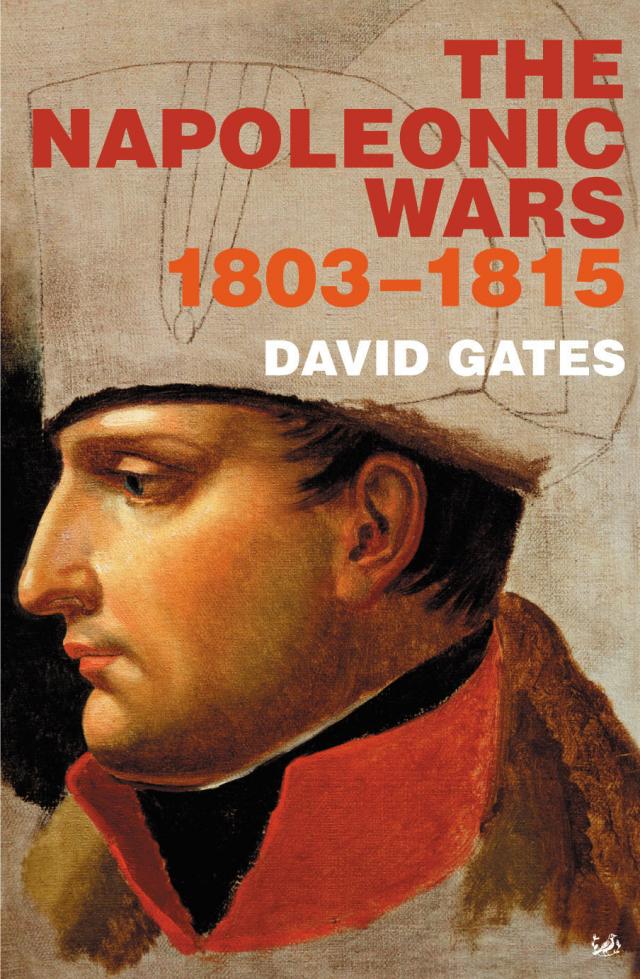
The Napoleonic Wars
1803–1815
David Gates
Preface to the Pimlico Edition
In May 1803, a little over ten years after Britain had first joined the war against Revolutionary France and just fourteen months after the conclusion of the Peace of Amiens, vessels of the Royal Navy fired the opening shots in what was to become the goriest, most expensive, wide-ranging and protracted armed conflict of the entire nineteenth century, the Napoleonic Wars. At this juncture, Britain lacked continental allies; and France, after a period of recuperation and reorganization, was more powerful and united than ever. Having put General Bonaparte’s protestations of peaceful intent to the test and found them wanting, however, Britain was resigned to renewing hostilities and maintaining them for as long as was necessary. She was to remain Napoleon’s most implacable foe until his final downfall some twelve years later.
Other states were to be less consistent in their behaviour, many of them changing sides in a succession of complex diplomatic manoeuvres, wars and customs unions. The three principal continental powers – Austria, Prussia and Russia – were all to spend periods as Napoleon’s allies, as were the Spaniards, Swedes and numerous lesser actors. Interstate conflict also spawned new – or intensified existing – internal divisions, notably in Spain and France itself, where various revolutionary and counter-revolutionary movements were to lock horns. Indeed, in many respects Napoleon was to reverse the changes wrought within France during the 1790s, most strikingly by returning her to enlightened despotism under an hereditary ruler. Though by no means unique to France, the sort of changes he made to her armed services and governmental machinery in particular went beyond anything found in any of the other leading states at this time. Not least because of the Revolution’s legacy and the inability of both domestic and foreign adversaries to incommode him too seriously, between 1801 and 1805 especially, he was subject to fewer of the financial, strategic and political constraints that hampered innovators in Europe’s other major polities.
However, just as the exigencies of his wars – notably conscription, requisitions, billeting, increased taxation in particular and economic sanctions in general – alienated many of Napoleon’s subjects, so too did his programme of enlightened reform, much of which had the ulterior motive of tapping as much of his empire’s latent military potential as possible. If, in substituting absolutism for the élitist parliamentary system of the Directory, he was supported by many within France’s military, political and propertied classes, his emphasis on order and legal rights at the expense of political liberties fuelled opposition both in France and further afield. Similarly, his penchant for dirigisme and the centralization of power might have enhanced French national unity and helped return the revolutionary genie to its bottle, but, like the reforms of earlier progressive monarchs, his imposition of values rooted in the reasoning of the Enlightenment was widely resented. This was not least because of the condescension and contempt that so many of the disciples of the Enlightenment evinced for the masses. With the rise of an administrative élite, the nucleus of which was located in Paris and which consisted of professional, educated, avuncular bureaucrats who were persuaded that they knew what was best for all, the Revolutionary ideals of open government and egalitarianism quickly faded.
This trend accounts for much of the popular opposition to Napoleon inside as well as outside France. It was not merely that, under him, France seemed to jeopardize the material interests and, in some cases, even the very existence of rival states, alarming enough though that was for their ruling dynasties and those who favoured a balance of power as a means of preserving peace. Many very ordinary people resented and resisted, sometimes passively, sometimes actively, the cultural assimilation that tended to accompany French military and diplomatic dominance. One exploiting tyrant is, after all, much the same as another; and, in a lot of respects, Napoleon’s imperial regime was indistinguishable from its counterparts in most of the polities that surrounded it. Few Europeans at this juncture possessed a developed sense of political consciousness, while notions of national identity, if in evidence at all, were essentially particularist loyalties derived from the ideologies and institutions of the old order, as in Britain and Spain. Nationalism of the kind that emerged much later in the nineteenth century was still in gestation, as was the concept of the nation-state, certainly in so far that the term would be generally understood today. Even prominent ‘nationalists’ of the Napoleonic era, such as the German Johann Fichte, were for the most part far less interested in political unification than in the preservation of a broader, cultural sense of nationhood. Indeed, many Europeans touched by the Napoleonic empire feared that the notion of a nation-state had become synonymous with that of a centralized one.
This is part of the dilemma confronting the modern European Union, which largely grew out of a reaction to the awful trials and tribulations of the Second World War and is now at something of a crossroads in its development. Napoleon’s empire, too, was smelted in the forge of warfare. His almost ceaseless campaigns made him an absentee ruler who seldom made use of the numerous palaces at his disposal. For the day-to-day implementation of his policies, he had, perforce, to rely upon the administrative machine that, largely in the first five years of the nineteenth century, he established. If one leaves aside the exceptional and mostly short-lived military governments that arose in parts of occupied Spain, this was essentially a civilian administration with an ideology founded on the Enlightenment’s precepts. It was, moreover, one that, in France at least, continued to function even after the fall of his dynasty, just as so many of the polities he either founded or recast outlived him.
The First French Empire effectively divided into inner and outer spheres, and the degree to which people’s lives were affected by it varied appreciably. It was at its most successful and its legacy proved most enduring wherever the superiority of French culture and of the principles of the Enlightenment was acknowledged, if only by a ruling élite. This acceptance did not take place uniformly even in France itself. Elsewhere – in northern Spain in 1810 and in the Kingdom of Holland the following year, for instance – deviation from the Parisian grand plan led to annexation and the imposition of direct rule. In his dealings with defeated enemies on the fringes of his empire, by contrast, Napoleon often observed the old principle of legitimacy. So it was that Prussia was reduced to a minor power in the aftermath of Jena but not wiped from the map completely, any more than the humbled Habsburgs were ousted after Wagram. On the contrary, Napoleon actually bolstered the latter dynasty by marrying into it.
There are those who insist on likening Napoleon to Hitler. This is as degrading to the former as it is flattering to the latter. One could draw very loose, superficial parallels between the careers of these two men, but anybody who appreciates the uniqueness of historical periods and experience would, if only for no other reason, be loath to do so. In any event, Hitler will be remembered for, above all, the suffering he caused and the destruction he wrought, not least his attempt at genocide. As he made clear enough, he had a vision of a German Reich that would achieve global hegemony and last a thousand years. Thanks to the bravery, sacrifice and determination of millions, this blood-curdling goal was never fulfilled. By contrast, one will search in vain for any comparable vision on Napoleon’s part. In fact, far from having a blueprint for the conquest of Europe, he was essentially an opportunist who reacted to events as they unfolded. Indeed, he often seems to have been taken aback somewhat by the extent of his own martial success and the political possibilities that it created. A child of the Enlightenment, his motives off the battlefield were often well intentioned, but inevitably alienated those who, with some justice, dismissed this school of thought as arrogant, intrusive and élitist, if not plain misguided. Having acquired new territories, he had to do something with them and, too often, his efforts to improve the inhabitants’ lot proved oppressive and self-defeating.
In any case, it is tempting to overstate the importance of the Code and Napoleon’s other domestic innovations, even though many of them continue to affect the lives of millions. After all, he was by no means the only reformer to emerge in this period. He was, however, a military commander of the very first rank, unlike Hitler, the self-styled ‘Leader’, who was neither much of a soldier nor the founder of an enduring legal system and educational institutions. Even those who disliked the ‘Corsican Ogre’ – and among them were great generals such as Wellington and the Archduke Karl, both of whom scored victories over him – unstintingly praised his martial prowess. Although, from around 1812, he became increasingly reluctant to acknowledge that war is, or at least should be, the continuation of policy by other, namely violent, means, Napoleon’s tally of military successes has seldom been equalled, let alone surpassed. This fact, together with his valuable legacy of domestic reform, was to console him in his last years. We should not lose sight of it. For all his faults – indeed, partly because of them – he remains one of the Titans of modern history.
David Gates
Lancashire, 2002
Abbreviations
The following abbreviations are used in the Notes that appear at the end of each chapter.
ASH Archives of the Service Historique de l’Armée de Terre, Château de Vincennes, France.
CREP Consortium on Revolutionary Europe Proceedings.
NC Correspondance de Napoléon Ier (32 volumes, Paris, 1858–69).
WD The Dispatches of Field Marshal the Duke of Wellington during his various Campaigns . . . from 1799 to 1818 (edited by R. Gurwood, 13 volumes, London, 1837–39).
WSD Supplementary Dispatches and Memoranda of Field Marshal Arthur, Duke of Wellington (edited by his son, 15 volumes, London, 1857–72).
Introduction
With the possible exception of the life of Jesus of Nazareth, Napoleon and his times have formed the theme of more literature than any other historical subject. All of 10 years ago, it was calculated that there were at least 220 000 works on them, and many new ones have appeared since. Biographies of prominent figures, notably military commanders, have proved a particular favourite with writers, as have studies of campaigns and individual battles. Many of these latter works, however, date from the nineteenth century or are based almost exclusively on studies that do. Indeed, many of our basic perceptions of the Napoleonic Wars need refining in the light of more recent scholarship. In particular, there has been little attempt in the past to present a ‘total’ approach to the history of the conflict, partly because methodologies have altered over time but also because there is so much material which one might legitimately include. War encompasses all of human experience; the parameters of its history are practically impossible to draw.
In endeavouring to produce a work of digestible proportions which, as far as is possible, provides an up-to-date account of the principal military operations and sets them in their political, social, economic and cultural framework, I have inevitably had to exercise a good deal of selection. My aim has been to give the reader an insight into what factors shaped the way these wars were conducted, who fought them, and why and how they influenced the development of warfare. In so doing, I have had to grapple not only with my own eclecticism and that of previous historians, but also with a number of other historiographical problems. For of all the areas of historical studies, none presents as many challenges to the scholar as the history of war. Not even the parameters of the subject can be easily defined, since the range of considerations which can be of relevance is immense: psychology, technology, economics and history itself are just some of the factors which have influenced the conduct of war. There is also the conundrum of what actually constitutes ‘history’. Whereas almost all history has a didactic purpose – it is merely a question of degree – so emotive a subject is warfare, so central to national honour and identity can the perception of past struggles be, that it is not a theme which lends itself to dispassionate treatment.
The Napoleonic Wars are unexceptional in this regard. Two of the most celebrated battles in history occurred in the conflict: Trafalgar and Waterloo. Their memory is perpetuated by, among other things, monumental pieces of architecture and, in the case of Waterloo, two dioramas, which were assembled by Captain William Siborne during the 1840s in the light of information given to him by British officers who participated in the battle.1
Siborne’s account became the basis of subsequent views of Waterloo. Yet he has been taken to task by one recent writer, for example, who observes that:
For reasons of sycophancy, veniality, and national prejudice, Siborne, in the model and history resulting from his researches, wilfully suppressed and distorted facts. He omitted whatever was unflattering about any of the officers who financed him during his work, or which did not accord with a hagiographic portrayal of the Duke [of Wellington], or was less than Homeric in its account of the actions of the British army.2
The same critic then proceeds to attack other writers on the subject of Waterloo for their failure to relay ‘the true picture’; in the course of his explorations, ‘it became evident that Siborne had not been alone in his selective approach to history. The eminent French fin de siècle Napoleonic historian, M. Henri Houssaye, had chosen his sources carefully to shed only a warm light on his hero.’
That there is a degree of veracity in these remarks cannot be denied. However, in making them, the author puts his faith in the notion that, somewhere beneath all this bias, deception and misunderstanding, there is a ‘true picture’, an objective version of history by which all others are to be judged. This is nonsense. ‘History’ is not ultimate truth, but rather an ineluctably incomplete portrayal of past experience which has been passed on by written or spoken word – media which are themselves capable of giving rise to ambiguity. Whereas the amount of evidence relating to recent events can be so enormous that we have to be highly selective if we are to come to any conclusions about it whatsoever, the dim and distant past is so often just that. Indeed, the history we do not know is of at least as much significance as that of which we are aware. In short, what we are presented with as ‘history’ is the unavoidably eclectic opinions of past historians, broadly defined. Furthermore, not only were their interpretations shaped by a host of subjective and objective influences, but also such variables continue to colour the perceptions of subsequent analysts, leading to ‘revisionist’ versions of this or that historical phenomenon.
Revisionism, moreover, is not always just a matter of seeking to put some fresh interpretation on the known ‘facts’; sometimes it involves changing them. Examples of this process abound, but, for illustrative purposes, the problems encountered by the author of a recent chronicle of Napoleon’s Russian campaign will serve our purposes. He discovered, as is often the case, that eyewitness accounts of the same incident do not always tally with one another. ‘It was often difficult to ascertain what was fact and what was the author’s bias,’ he complains. His method for overcoming this complication was, he goes on to say, that:
When several sources were reviewed, the most commonly reported and plausible account was more heavily weighted. . . . If none of the accounts agreed very closely in their detail, a composite account was developed and the most obvious nationalistic biases were removed.3
This demonstrates how historians are as much a part of the problem as they are of the solution. Some alter ‘history’ with, no doubt, the best of intentions, yet often attribute inconsistencies in the accounts of others to bias of one description or another. As far as eyewitness descriptions of Napoleonic battles are concerned, however, influences other than deliberate prejudice should be allowed for. Wellington himself, in an oft-quoted remark, observed that: