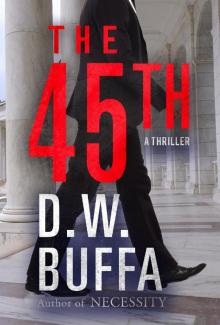
The 45th, page 31


“Means nothing?” asked Ismael, who thought from the abrupt way he had stopped that Julian’s mind had turned to something else. “You were saying that -”
“Means nothing, if it doesn’t mean that there isn’t any religion we believe in, because -” He saw that Ismael grasped the point, that a religion that tolerated others did not believe in itself. “What are we left with - what do we worship now? - Money, only that. It is the measure of everything we do. Think someone a success - how much is he worth? What I said tonight - it won’t have any effect on that audience; they aren’t going to change their minds. But I wasn’t speaking to them, I was speaking to the country. Everything we do here has to be done with just one thing in mind: the effect it will have on what people look up to, what they think the best way to live. And part of that, an important part of that, is what they think I look up to, what the president honors.”
Julian stopped at the side of the enormous, handcrafted desk, the one that had first been used a hundred years before, when the belief in America’s greatness, its ‘manifest destiny’ to lead the world, had first become an accepted article of the American creed. He rapped his knuckles on the same polished shining surface where Teddy Roosevelt had once taken pen to paper in his effort to convince Congress and the country of the absolute necessity to expand American power. Julian remembered the phrase, the perfect expression of Roosevelt’s belief in what a president was in a unique position to do.
“The ‘bully pulpit’ - T.R. was right, but its more than that. And he knew it. Everything he did - every time he spoke in public - all energy and even exuberance, the way to show strength, determination, eager always to do battle. It isn’t just what a president says; it is what he does - how he conducts himself; again, what he honors, what he lets everyone believe he thinks important. Even when he doesn’t,” he added with a quick, piercing glance.
He stood next to Teddy Roosevelt’s desk, his desk now, stood still as stone, staring straight ahead, lost in some thought of his own. There was a slight movement of his head, a kind of quiver, then his eyes opened wider, flashing with recognition.
“Yes, precisely,” he announced, turning to Ismael. “Music.”
“Music? What about it?”
“It was half of education - Plato…, never mind. Music, the kind of music, how it helps form the soul, brings harmony, if it is well-ordered. Let the press know, when they ask how the president spends his time, or how he does his work - tell them that I always have music on - classical music. When they ask for something more specific - tell them I prefer classical piano, and that I listen more than to anyone else, Glenn Gould playing Bach. I never get tired of it.”
“They’ll ask what other kind of music you like. What popular music. What should I say?” Ismael leaned forward, trying to hear everything Julian, who sometimes in his eagerness to say everything on his mind not only hurried through the words but whispered in a way that was at times inaudible, was telling him.
“Just tell them classical is all I listen to, and then add, as if this is a concession to what everyone else must like I also like jazz. Then announce that there will be a free concert on the White House lawn every Saturday - start it with the New York Philharmonic. And then,” continued Julian, intrigued by the possibilities, “we’ll have, every week or so, a White House event with someone famous, a great pianist, or a great jazz musician.”
“How soon do you want this to start?” asked Ismael, as he got to his feet. It was almost time for the president’s next meeting, the one that was on no one’s schedule.
“Immediately. As soon as it can be arranged. There is something else we can do,” added Julian, gesturing for him not to leave just yet. “Those we honor for their contribution to American life. Don’t make any announcement about this, don’t mention it at all, but we are only going to honor those who have made serious contributions - men and women who have done something great and lasting: physicists, educators - if there are any left - great classical composers. No more actors, no more movie people - no more athletes. This is the highest award we give. It should go only to the most serious people, people who have given us a better insight into the human condition. The Medal of Freedom should be our version of the Nobel Prize.”
He nodded twice, a sign he was finished, that Ismael could now take whatever steps ere necessary to see this was done. And then he added something that made Ismael stop in his tracks.
“Julian, the emperor Julian, ruled for only twenty-two months. I wonder if I’ll have even that long. Anyway - what time is it? I have that other meeting.”
“It’s almost twelve thirty.”
“See if the ambassador is here. Have him brought to the Cabinet Room.”
“You don’t want to meet with him here?”
“No,” he replied. His glance went to the well-worn cover of an old monograph that lay undisturbed and alone on the desk. “The ambassador and I have too much work to do.”
“Do you want me…? asked Ismael, tentatively. He had been told nothing about the meeting with the Saudi ambassador.
“No. He won’t be bringing anyone. Better if it is just the two of us.” He pulled his tie back in place and buttoned his coat. “There is still one thing we all look up to, isn’t there,” he remarked, as Ismael opened the door on his way to get the president’s late night guest. “The stars, the stars in the heavens, what first gave us the thought that there was an order to the world and that the order did not occur just by chance.”
Ismael had the feeling that Julian had more he wanted to say, that something important followed from that otherwise almost commonplace observation, but there was not time. One thing Julian would not tolerate was being late. The meeting had been set for half past midnight. The ambassador was waiting in the outer office, formal, polite and mystified.
“This seems a strange time to be…summoned -”
“Invited, Mr. Ambassador,” Ismael corrected.
“We’re not going into the -?”
“The president thought it would be easier to work in the Cabinet Room,” explained Ismael as he led him down the hall.
Nuri Feisal stopped him. “I’ve been the ambassador of Saudi Arabia for almost ten years,” he said in the clipped British accent he had assumed since his days at Oxford. “I’ve never been asked to come to the White House before in the middle of the night. Do you mind my asking what is going on? There isn’t any international crisis that I’m aware of. My government has not been apprised of any problem that might require immediate attention. So why, Mr. Cooper, this sudden request for…?”
“The president has his reasons. All I can tell you now is that he thought it best that the meeting be kept as private as possible.”
“So he thought that something after midnight….Tell me, Mr. Cooper - is it really true, what they say, that he never sleeps?”
“No, it isn’t true. He just doesn’t get that much of it. He is always awake at this hour.”
Feisal rolled his eyes in mild amusement and followed Ismael to the door of the Cabinet Room.
There were just the two of them, the president and the Saudi ambassador. Julian was sitting where he always sat, in the middle of the oblong table around which two dozen people could comfortably sit. Directly opposite, a chair had been pulled out. A white legal pad, a fountain pen, a glass of cut crystal and a silver water pitcher had been placed on the table. The lights had been cut so that only the center of the room was lit. Everything around them remained in shadow. When Feisal, dressed in a dark suit, had taken his chair, Julian nodded toward the pen and paper.
“In case you want to make any notes.”
Feisal smiled his appreciation. “I have a pen, but thank you, Mr. President.”
He paused, searching for the right way to begin. It was a habit, the brief hesitation that gave the impression that he never said anything without thinking first. Diplomacy, he seemed to say with each small, meticulous gesture of his hands and eyes, should never be in a hurry. Caution, careful deliberation, postponement, delay, anything that gave one time, because time settled most things that action usually only made worse.
“I heard your speech tonight at the Mayflower, and I must say it was one of the most interesting things I have heard from an American president.”
Julian studied the ambassador with a look of amused incredulity. “‘Interesting,’ as in ‘you must be crazy to give a speech like that to an audience that hated every word?”
Feisal was smiling before he knew it. “Yes, well, I suppose you could put it like that.”
“But you were really there? I wish I had known. Instead of quoting Plato in front of people, most of whom have never read him and barely remember the name, I would have quoted Averroes and Alfarabi in the knowledge that there was at least one man in the audience who not only studied both but once wrote about what he had learned.”
“How…? You couldn’t possibly have….?
With a knowing look, Julian reached inside his jacket pocket and pulled out the monograph with the faded greenish-gray cover. He held it up, examining the front as if the title itself signified something important.
“‘Studia Islamica,’ published thirty years ago by - let me see: ‘G.P.Maisonneuve-Larose’ in Paris, the paper you delivered to a meeting of the Middle East Studies Association, a paper entitled ‘Democracy in Islamic Political Philosophy.’”
Nuri Feisal grinned broadly, exposing a fine set of perfectly white teeth. In his early sixties, but easily mistaken for forty-five, his face was evenly balanced with dark brown, almost black, deep set eyes, black close-cropped hair and a brisk mustache under a slightly hawkish nose. Women often stared at him in the street, a fact he noted and approved, and ignored.
“I don’t know how you happened to come across that,” he said in a voice suddenly modest and self-effacing. “I doubt more than six copies were ever printed.”
“Which only proves how good it is. That isn’t just my judgment; it is what I was told by the man who sent it to me. He was there, when you gave the paper, in Paris, all those years ago. Marcel Dubose, an old friend, whom, I gather, is an even older friend of yours.”
“Marcel…! Yes, but I didn’t realize…, I didn’t know. But it all makes perfect sense. You studied with him, in Paris -”
“Not exactly. I lived in Paris for a while, almost ten years ago. That’s when we met. I went to a lecture he gave. And I knew right away that it was a turning point, that he could show me the way, help teach me - if I can put it like this - how to read.”
“I was in Paris just last month. We had dinner. He didn’t say anything about….But, no, of course he wouldn’t. He sent you my little monograph. He must have had his reasons.”
Feisal’s eyes were alive with curiosity, fascinated by what Marcel Dubose had done, fascinated even more that Julian Drake had the depth of understanding that allowed him to appreciate how remarkable, how unique, Marcel Dubose really was. It was unusual - unprecedented, really - for an American president to mention, much less quote, Plato, but that was something any serious graduate student could have done. But understand, grasp the meaning, read, as Marcel used to say, not just what Plato wrote but what he did not write, learn to find the missing thought, read a dialogue as if you were there yourself to witness all the gestures, the silent expressions, that give a different meaning to the spoken word - it was astonishing. More than that, it was the basis of a trust. That monograph, that paper he had once, in his youth, delivered was something he never spoke about. There was a danger in what he had done, raising questions about what others thought the essential teaching of his own religion.
“Not everyone would approve of what, in my careless days as a young scholar, I tried to write.”
Julian thumbed through the first few pages until he reached the beginning of the second part of Nuri Feisal’s long forgotten critique of ancient Muslim thought.
“Careless days of a writer who even then knew better than to be careless in what he wrote. ‘Of the falasifa’ - the philosophers - ‘two have addressed the subject of democracy directly: Abu Nasr al-Farabi, who died in 950, in various of his writings, and Ibd Rusd, who died in 1198, in his great commentary on Plato’s Republic. Both discuss democracy as a corruption of the virtuous regimes.’” Julian looked up. “I haven’t read Alfarabi. I have read Averroes, but not in Arabic.”
“The translation by Ralph Lerner of his commentary on the Republic is almost as good as reading it in the original.”
“Tell me if I am wrong. Alfarabi and Averroes - the two greatest philosophers in the history of Islam - thought Plato’s political philosophy the ‘true philosophy.’ Is that not what you wrote? And - let me find the place. Here, you quote Alfarabi - and it reads very much like what Plato wrote - who says of democracy that, ‘Everybody loves it and loves to reside in it, because there is no human wish or desire that this city does not satisfy.’ And you write, in describing what these two philosophers thought, what they, along with Plato, considered democracy’s weakness: ‘Democracy promotes to honor those who lead the people to freedom and to the things that would satisfy their passions and their desires. The guiding principle -’ And this I found remarkable, ‘- is not that of excellence or virtue but rather the wishes and whims of the citizens. The citizens are equal, no man thought to be better than any other. This, for Alfarabi and Averroes, is detestable and contrary to reason. All that can be said in favor of democracy, and it is something, is that precisely because it allows everyone to live in any way he chooses -’ How did you put it? - ‘from this great variety of human natures and ways of life, it is possible that, in course of time, men of excellence, including even philosophers, may grow up in it.’”
“Yes, that’s what I wrote…all those years ago, but….”
“And you still study - Alfarabi, Averroes…Plato?”
“Privately,” replied Feisal, his eyes full of nostalgia. “Like you, alone, late at night. Am I correct?”
“Late, early….As soon as Marcel Dubose sent me this, I put everything else aside and read it straight through, and then I read it again - slowly, until I was sure of what it meant. The summary - Albarabi’s summary of Plato’s philosophy: the attainment of happiness is through ‘A certain knowledge and a certain way of life. This knowledge,’” continued Julian, quoting from memory to Feisal’s delighted surprise, “‘is knowledge of the substance of each of the beings: this knowledge is the final perfection of man and the highest perfection he can attain.’ This knowledge, this final perfection - what only a philosopher in the true sense, someone like Plato, could ever hope to achieve -”
“Or know enough to want to achieve,” interjected Feisal before he remembered that he was in the White House talking to the president. He started to apologize. Julian stopped him with a look of impatience. The conversation - the dialogue - was everything.
“If democracy is, to say no more, questionable in the judgement of the greatest Islamic philosophers, it is impossible under any reasonable interpretation of Islam itself. Am I correct? Does this not follow from what you wrote? Here, near the end - ‘According to Alfarabi, every being “is made to achieve the ultimate perfection it is susceptible of achieving according to its specific place in the order of being.”’
The monograph in his hand, Julian stared into the middle distance, a look of wonder in his eyes. Slowly measuring each word, he repeated what he had just read.
“Your translation? - I envy you, able to read this in the original. But my point,” he said, with sudden energy, “or, rather, yours….”
“Alfarabi, I think you mean.”
“Both, not just the teacher, but the student. The next line: only a few have the capacity to ‘grasp the primary intelligibles,’ only a few ‘capable of happiness.’ Everyone else lives by opinion, persuasion; everyone else, the ‘majority of believers,’ accept what they are told by those who give the law, ‘a divine law that directs them to some form of knowledge of the truth.’ Then - and this explains everything - ‘What philosophy renders intelligible by demonstration, divine law represents by means of “corporeal and political things.” Religion is the instrument by which these representations are made.’
“Democracy has no place in Islam, because - if I follow what you write - the Sharia, the divine law, provides for everything needed, all the rules of conduct. Shiite political theory takes this a step farther: thee is no role for the participation of the community in legislation. Once there is divine legislation or inspiration through a descendant of Ali, every other opinion is, by definition, unenlightened and superfluous. And, you add, even though Sunni political theory allows for participation, it has to be within the framework of the Sharia. In other words,” concluded Julian, as he placed Feisal’s monograph on the table, “anyone who thinks western style democracy can be made to thrive in the Middle East is totally insane?”
The dark eyes of Nuri Feisal glittered with silent laughter. He tapped his slim, elegant fingers together, studying Julian the way he might have tried to find in the face of a long lost friend evidence of what he must have experienced in all the time that had passed.
“Do you know - except for Marcel Dubose - this is the first occasion on which I have had the chance to have a conversation, a serious conversation, in - what? - thirty years. And even then, when I was still that young scholar who wrote what you were so kind to read, there really wasn’t anyone who thought what I was doing anything more than a waste of time, a strange diversion, an attempt to understand ancient texts that could have no possible relevance to anything important for the present. And now, of all people - you!” He struck the side of his head with two fingers, twice, then, again, a third time. “Of course! That is why he mentioned it. Julian. Julian the Apostate. Marcel asked me if I had ever read him. I had to admit I had not. He said I should, that for more than the obvious reasons I might learn something useful. Useful! A word he never uses, never cares about. I hardly noticed. Only now, looking back….Another Julian! ” He bent forward, his elbows on the table. “I read a little about him, after Marcel…something Alexandre Kojeve wrote fifty years ago. Enough to know that….” There was something in the way Julian was looking at him that made him let the rest of it go unfinished, something that told him that Julian knew what he was going to say. “We are not going to be dealing with half-measures, are we, Mr. President?”