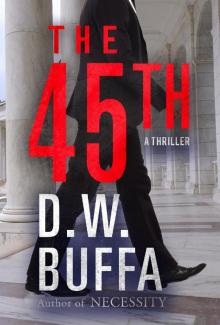
The 45th, page 25


Julian glanced at the clock on the mantelpiece. It was ten minutes past ten. He took a deep breath. “Are you ready for this?”
The hotel ballroom was jammed with people, but unlike other election nights when those who had worked on the campaign came to celebrate, eager to cheer all the expressions of gratitude of their candidate, all the glittering promises of how, thanks to them, the future was going to be so much better than at least the recent past, the room was filled with reporters, come to cover an event. It was the culmination of a campaign that had in ways most of them still did not quite comprehend depended on their willingness, their eager willingness, to convey directly to the public whatever Julian Drake had wanted to say. There had been no organization, no fund-raising, and certainly no speechwriters; there had been no ‘ground game,’ no effort to recruit thousands of volunteers to go door to door convincing people of what they had already heard directly from the candidate on television or the other electronic devices that had become almost as much a part of them as their own eyes and ears. Julian began with what Rachel Good, standing at the back, thought might have been ironic.
“I want to thank all of you for your honest reporting, for the way that through the questions you asked you allowed me to talk directly to the American people about the problems we face, the problems we now, together, need to solve.”
Few things give greater encouragement to enthusiasm than victory, even if, or perhaps especially if, it is a victory in which you have played only a minor part, if any part at all. The press had come almost to idolize Julian Drake. He had given them unprecedented access, had never failed to answer a question, even when they had been, as some had been at the beginning, hostile and even disrespectful. He had met them, as he had promised, at least once every week, and he had never once stopped their questions because of time. He was something new in their experience: a candidate who thought their questions deserved a serious response and because of that was more than willing to admit his ignorance when he was asked something he did not know. When it happened, when he could not answer someone’s question, he always came back to it at the next press conference, after he had had a chance, as he put it, “To remedy some of the deficiencies of my education.” They saw him as someone different, someone with wit and charm and an uncanny sense of what was relevant and what was not, what was at the heart of things and what was merely errant chatter. They saw in him - and this was the key to everything - someone who when he spoke seemed to be speaking directly, if not exclusively, to each of them. They were, almost all of them, in the conventional sense liberal in their politics, but more than half of them voted for him, and most of those who did not did not much mind that he won.
“What did you think, what passed through your mind, when the networks first declared you the winner?” asked an earnest young woman, batting her eyelashes as she struggled to control the nervousness in her voice.
“I’m afraid I wasn’t watching,” replied Julian, with a quick, apologetic glance. He had not wanted to make her question seem unimportant. “They say that in l948, Harry Truman went to bed and woke up in the morning to find that he had won an election everyone thought he would lose. I didn’t go to bed,” he added to the laughter of the crowd. “But I knew I would learn the result soon enough.”
“Well, if you didn’t watch,” yelled someone, “what did you do? Did you call anyone, talk to anyone? Weren’t you the least bit concerned about what might happen? Didn’t you think there was at least a chance you might lose?”
“Losing was a hope I never quite gave up,” replied Julian, with a look that seemed to invite a challenge. “But I’m not going to say with Sherman that if elected I won’t serve,” he said, laughter in his eyes. “Make no mistake. I am honored that the people of this country have given me their trust. That trust is a sacred responsibility.” His expression was now serious. He searched for the words to convey some sense of the burden he felt. “I did not seek the office, I never thought myself as someone indispensable, but now that it has happened all I can promise is to devote myself, heart and soul, to what is in the best interest of the country. This will require sacrifice and effort, not just from me, but from all of us. This country can do great things again, but only if we believe, as we used to believe, that great things are worth doing; only if we believe, as we used to believe, that it is not what we have that is important, but who we are; and that it isn’t wealth or fame, but human excellence, that is worth pursuing.”
Chapter Seventeen
Clutching the collar of his dark coat tight around his throat, Julian bent his head against the snow swirling in a glistening haze as he trudged along a Paris sidewalk soft as a white Persian carpet. The lights from the windows of the shops and restaurants, the muffled sounds of the voices inside, dozens of dinner table conversations, the passing sideways glimpse of eager faces, the quick easy laughter, the silent smiles, the sudden graceful gestures, the shared intimacies of friends and lovers, the polite familiarity of aging married couples, all of it part of the inherent charm of the place. Paris, anytime of the year, but Paris a week before Christmas, was irresistible.
Julian walked fast, laughing at the way he seemed to be following his own breath, visible in the frigid air inches in front of his face. He passed the tan stone facade entrance to Notre Dame, glowing with a melancholy warmth in the lights that surrounded the ancient cathedral from below. There were other people on the street and once or twice Julian could feel the look, the sense the surprise, and then the quick decision that they were wrong, that it could not have been who for a brief moment they had thought it was. Crossing the bridge to the Left Bank, Julian continued on his journey, threading his way through the narrow streets until, a few blocks from the Sorbonne, he found the building he was looking for. He climbed a narrow decrepit wooden staircase to the third floor where two doors faced each other across the landing. One of them was open, just an inch or so, but enough to tell Julian that he was expected.
A short hallway led past the only bedroom to a large book-lined living room that was also the library and study. An old man was sitting at a desk positioned sideways to a double-window through which Notre Dame could be seen on the other side of the river half a dozen blocks away. Marcel Dubose looked up from the book that lay open under a bronze lamp light on the desk. His lips, pressed tight together, gave the impression of great concentration. A few wisps of gray hair covered a small and almost perfectly round head, and the skin sagged a little beneath an unremarkable chin, but, along with most of the other features of his face, this was background, the vague outline of what might have been remembered had you never seen his eyes, eyes that seemed to be a reflection, a mirror, if you will, of the closest thing to perfect reason anyone had ever encountered. It was impossible to know their color, whether to describe them as blue or brown, or green, or any other single shade; they were every color, and every depth, drawing you deeper the closer, the longer, you looked. Those eyes told you that Marcel Dubose understood things few others could even begin to learn, and that if you were just willing to admit that everything you thought you knew might be wrong, he could help you find the truth.
“Julian!” he cried, taking both of Julian’s hands in his own. “How good of you to come!”
Marcel Dubonse spoke English with barely a trace of a French accent. Despite his rather fragile appearance, he had a rich, cultured voice that filled the room with such a sense of comfortable self-assurance that it would have been impossible for someone of intelligence to want to be anywhere but here, in this small Paris apartment, on a cold winter night, listening to whatever he might care to say.
He motioned for Julian to take one of the two slightly shabby armchairs that sat opposite the window and the desk. There was a small table with a lamp between them. A half dozen leather bound books, each with numerous scraps of paper marking pages waiting for another reading, were stacked beneath a white lamp shade.
“I was a little surprised….No, that’s not true,” he said, shaking his head in mild disapproval at beginning with a well-intentioned lie. “I thought I might hear from you; I certainly hoped I would. Perhaps a letter, a telephone call. I knew you were in Paris, but I couldn’t imagine you could ever get away. Everyone now knows who you are - your picture is in all the papers, meeting with the French president and other European heads of state - Julian Drake! Soon to be President of the United States! And all those security precautions! How did you ever manage it?”
Julian glanced around the room, remembering the times he had been here before, sitting in this same chair, listening to the quiet, unhurried voice of the wisest man he had ever known. Everything was exactly the same, nothing had been moved or changed, the furniture, the few pictures on the walls, the only difference the books on the lamp table, the ones Marcel Dubose was reading now.
“It wasn’t that difficult,” he replied, his gaze on the near wall where in an old black and white photograph a younger Marcel Dubose was standing with two other young men, obviously students, all looking as old and serious as they knew how. Even in his twenties he had the same, astonishing eyes. “I left the hotel by a back entrance,” he explained, with a brief, rather modest smile. “When no one expects to see you, when no one is looking for you, no one really notices if you happen to pass them on the street. A few people seemed to think I looked familiar, but decided I could not be who they thought I looked like.”
“So you hid yourself in plain view - like certain writers we used to discuss when you were here.”
“Like Machiavelli, say things that seem so outrageous nearly everyone will think you don’t really mean it?”
“Yes, precisely,” said Marcel Dubose, his eyes bright with recognition. “I have missed our conversations, our late night ventures into ancient and largely forgotten things. I still give my lectures at the Sorbonne, but that isn’t quite the same as having someone with whom I can talk. But never mind that now. I want to tell you that I am not surprised, what has happened; not surprised that you’ve been elected president,” he said in all seriousness. “Yes, I know - it is extremely surprising, the way it happened. But not surprising that it should have happened. Anyone who has ever known you would know that.”
He reached across and gently patted Julian’s arm and for a moment searched his eyes.
“Whatever you intend to do, you’ll need to do it right away. American history, I don’t need to tell you, is full of this example, although everyone seems to have forgotten it. Roosevelt’s Hundred Days, the first few months after you come to the office, that short period of time when the country wants its new president to do well and when everyone is too stunned by what has happened to have any thought about any alternatives, when there hasn’t been time for any serious opposition to form. This isn’t just the American experience. Remember what happened when Julian Caesar was murdered, or rather remember that anything could have happened, that if Brutus and the others - if Cicero - had had a better idea what to do, the republic might have been restored.”
A shrewd smile crossed his pale lips as he waited for Julian to pick up the thread, to continue, as it were, the conversation that had begun between the two of them years before, the conversation that though frequently interrupted had never been abandoned.
“A republic or an empire,” replied Julian, nodding in agreement that this was still the issue on which nearly everything else depended.
“When you called to tell me you were coming, I found the passage in DeGaulle’s Memoirs I wanted to make sure you knew.” He took a book from the lamp table and opened it to the page he had marked. “This is from DeGaulle’s account of the meeting he held with John F. Kennedy when Kennedy visited France early in his presidency. It is about what Kennedy was planning to do in Vietnam.
“‘John Kennedy gave me to understand that the American aim was to establish a bulwark against the Soviets in the Indo-Chinese peninsula. But instead of giving him the approval he wanted, I told the President that he was taking the wrong road.’”
Marcel Dubose looked up. “Without the Soviet empire, without the Soviet attempt to dominate Europe, there might not have been an American empire. Perhaps - though we can never know - if the Soviets had been content with only Russia, the Americans might have lost any desire to involve themselves in Europe and other places. That is a separate question from whether, having decided to expand its power throughout the world, it made sense to do what Kennedy wanted to do. DeGaulle, who knew something about Indo-China where the French had suffered a humiliating defeat, tried to warn him in words which can only be described as prophetic, and not just for what happened in Vietnam, but for what is happening now, today, in the Middle East.
“‘You will find,’ I told him, ‘that intervention in this area will be an endless entanglement. Once a nation has been aroused, no foreign power, however strong, can impose its will upon it.’ Then DeGaulle told him point blank what would happen. ‘I predict that you will sink step by step into a bottomless quagmire, however much you spend in men and money.’”
Marcel Dubose slowly closed the copy of DeGaulle’s Memoirs and held it for a moment in his lap as he thought about the lessons that should have been obvious to everyone and nearly everyone had ignored. He shook his head, put the book back on the table and turned to his guest.
“It is the virtue of Americans, and it is the vice of Americans, to believe that everyone wants to be like them. It is the reason for their remarkable generosity, their willingness to come to the assistance of people, of nations, that need their help; it is the reason why the think that anyone who doesn’t share their belief in the rights of the individual, who doesn’t believe that democracy is the only legitimate form of government, is the embodiment of evil. It is the reason why no one in America has the faintest understanding why nothing you do in the Middle East will ever work. It is the reason why, despite, or perhaps because, so many American politicians talk so glibly about sunni and shiite, none of them understands what Islam means.” A sudden, bright smile crossed his mouth. “All of them, except one. You know better than anyone what I mean.”
“I remember what you taught me,” replied Julian, grateful for the chance to remind him how much he owed to the time they had spent together.
“It is easy, too easy, to get sidetracked by those who want to make a religion, their religion, more acceptable to what the modern world demands - toleration, everyone free to think or believe anything they like. But what is toleration if not the insistence that you ignore the truth and encourage error? What is toleration if not the admission that you don’t believe in anything, that one belief is as good as any other, that nothing is worth dying for? This is possible only if you believe that religion, that faith, is a purely private affair. Islam has never believed that, never allowed that. Neither, remember, did Christianity when Christianity, for more than a thousand years, dominated Europe and the West. The Inquisition ought to be sufficient proof of that. How could the Church, God’s voice on earth, tolerate any teaching other than its own, how could it do anything except stamp out heresy whenever and wherever it could? The early Christians, the most devout Christians there ever were, were more than willing, eager, to die for what they believed. Hundreds of years before Mohammed was born, Christians gladly went to their death, martyrs to the faith, rejoicing that they were leaving this ‘vale of tears’ for eternity in heaven. That is what Christianity and Islam share at the core - the belief that life is nothing more than a test, a way to determine who deserves salvation, life in heaven, life in paradise, life forever, life that begins only with death.
“Islam took seriously the Christian teaching. If everything depends on the crucial question whether you have embraced the true religion, if the question is whether you will live forever in the joys of paradise or the torments of hell, then it would be intolerable not to do everything within your power to bring this truth to everyone. These misguided historians of ours sometimes talk about the toleration extended to Christians, to unbelievers, when Islam ruled all of North Africa and Spain. There is some truth in this. There was a kind of toleration. Christians were given three choices: convert to Islam, pay a poll tax, or be executed. Some no doubt paid the tax. It was substantial. Most converted, or pretended to.”
Folding his arms over his thin, sloping chest, Marcel Dubose crossed his right leg over his left and began to swing his foot back and forth, tracing, as it seemed, the rhythmic movement of his mind. A smile danced across his mouth.
“It isn’t just the question what you believe; it goes to the nature of religion. We forget our own history; we think that history is our history, that everything that has happened has led to us, the present moment, the modern time. We still believe, despite all the evidence to the contrary - the wars, the genocides, the revolutions of that most violent of all the centuries of which we have any record, the twentieth century - that history moves in only one direction, that we are, somehow, always making progress, that our lives are and will always be getting better, that each generation builds on the others. We may be dwarfs, but we stand on the shoulders of all who came before and, as someone once put it, we can do more than giants ever could. You will forgive me if I remind you what you have heard me say more than once before - the world is completely mad.
“There is more to it than this,” he went on, nodding twice to emphasize the importance, an importance he knew Julian understood, of what he was about to say. “It is the question what Islam really means, why it has such a hold, why so many are willing to martyr themselves for their belief, why American seem so incapable of understanding what is going on. We in the West, even most Catholics, think that religion, faith, belief, is a matter of conscience, what each individual chooses to believe. It was what the Reformation managed to accomplish: everyone could think that they could have a relationship, a direct relationship, with God. No need for a Church, no need for a priest, no need for a common authority to tell you what you needed to do for your salvation. Read Kierkegaard to see what happened as a result, how easy it became for everyone to make all kinds of accommodation with the requirements of the world, how success in the here and now became part, an important part, of how God would judge you. Islam has never thought anything like the same way. There is no room for individual choice - in anything. Islam is the closest thing we have to our own antiquity, before the modern experiment by which the state and the individual were seen as two things separate and apart. Simple formulation: in modern democratic countries anything the law does not prohibit is permitted, in ancient Athens, or ancient Rome, in the writings of Plato and Aristotle, anything the law does not require is prohibited. The distinction is lost among us; we have forgotten all our own beginnings. When we see those same things, that same teaching, among Muslims we think it backward, barbaric, the ignorant practices of people who have never been allowed the kind of education that would liberate them from their prejudices.