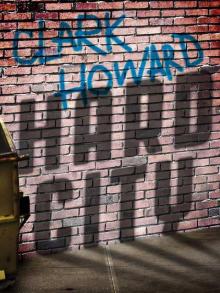
Crowded Lives, page 6


The noise of the crowd resounded in his head as he rolled over and began the long, unsteady climb back to his feet. The world around him was a fuzzy, slow-motion place, and from somewhere deep inside an echo chamber he could hear the referee’s hollow toll: “—four!—five!—six!—”
Just at nine, Handley made it up again. He was a beaten man: it showed in his eyes. But he was not frightened, he did not retreat. He was not a tanker, he was not a bum. He stood his ground, knowing that he had only seconds left.
Jackson’s final onslaught came: a series of half a dozen well-timed, well-placed punches that crashed squarely in Handley’s battered face. They took the last ounce of fight out of him and he tumbled to the canvas for the third time.
Dave Handley’s agony was over: a technical knockout in the second round.
In the dressing room, Handley was lying on a rubdown table, with Leo Marvel looking down at him. A doctor had just finished closing a cut over Handley’s eye and sealing it with clips. When the doctor left, Leo said, “Can you sit up?”
“Yeah.” The word came out slurred; Handley’s sinuses were so swollen that he had to breathe through his mouth. “Where’s Pink?” he asked as Leo helped him raise up and swing his feet over the side.
“I had one of the ushers take him to the gym. He was acting sick; said he thought he had food poisoning.” Leo looked at Handley’s abused face. “How do you feel?”
“Like I just lost a fight. Leo, that kid is good!”
“He’s better than good. He’ll have the title in three years.”
“All that training,” Handley said dismally. “And all I was good for was one fast round.”
“That’s the difference between being twenty and being thirty-four. But you put up a fight, pal. You didn’t go in the tank. You didn’t look like a bum. Incidentally, are you having trouble with your old lady?”
“Why?”
“Because some shyster divorce lawyer slapped a restraining order on me while you were in the ring. I got to hold up your purse.”
Handley stared incredulously at Leo. “I can’t believe Dora would do a thing like that.”
“Believe it,” Leo told him.
From the door, someone shouted, “Hey, Leo! They’re ready to take pictures of you and Jackson now!”
“Okay!” Leo yelled back. “I gotta go now,” he said to Handley. “Can you get dressed by yourself”
“Yeah.”
Leo started to walk away, then paused and turned back. “What are you gonna do now? Go back to the loading docks?”
Dave shrugged. “I guess. That’s about all that’s left.”
Leo stared at him for a moment, then walked on out. Dave slipped off the table, steadied himself, and made his way slowly back to a row of shower stalls. He stepped into one of them still wearing his new trunks, and turned the water on full-force. With bowed head, he stood under the rushing water.
Back at the gym, in the locker room, Pink was sitting on a bench and Teddy Falcon was helping him drink some steaming coffee.
“You ain’t kidding me, man,” Falcon said. “You ain’t got no food poisoning. You been doped, man. You know that?”
“I—know,” Pink said thickly. “They—tried to—dope Dave—but I ate the orange—instead—”
“Who?” Falcon asked. “Who tried to dope him?”
“Mr.—Jake—”
From down the row of lockers came another voice. “Did I hear someone mention my name?”
It was Mr. Jake. With Eddie at his side.
“Shove off, Falcon,” said Eddie. “And forget what you heard.”
Teddy Falcon went out into the gym. There were a dozen other fighters sitting on the bleachers, crowded around a portable black-and-white TV, watching the rest of the Stadium card. “Hey, Teddy, come and see this, man,” one of them said. “Charley Neal is killing Willie Edwards.”
Falcon hurried over to the group.
In the locker room, Eddie had dragged Pink off the bench and was holding him up against a locker. He had an open switchblade held dangerously close to one of Pink’s albino eyes.
“Do you have any idea how much money you cost me tonight?” Mr. Jake asked him coldly. “I had bets all over the country that Handley wouldn’t last one round.”
“You shouldn’t gamble,” Pink said with a silly grin.
Mr. Jake’s expression turned livid. “Do it,” he told Eddie.
But before Eddie could respond, Teddy Falcon hit him in the back of the head with a water bucket. Eddie dropped like a wet rope.
Falcon and the other fighters crowded around Mr. Jake. “Now wait a minute,” Mr. Jake said. “Don’t you guys know who I am?”
“You ain’t nobody, man,” said Falcon. “Not no more.”
The dozen fighters engulfed the old gambler, knocking him onto one of the benches, raining practiced blows on every part of his body. They kept hitting him until he was dead.
Leo Marvel arrived back at the gym an hour later. Falcon told him what had happened. “We ain’t sorry either,” he affirmed. “It’s tough enough trying to get along in this racket on the straight and narrow. Then guys like this Mr. Jake come along and try to make it even harder. It ain’t right, Leo. We ain’t sorry for what we done, even if we go to jail for it.”
“Nobody’s going to jail,” Leo said quietly. He had two of the fighters get a wet sponge and bring Eddie around. “Listen to me, punk,” he told the hood, “you were Mr. Jake’s bodyguard and you let him get killed. Your reputation is gonna be zilch around this town when the word gets out. The way I figure it, you got maybe eight, ten hours to make tracks. If I was you, I’d go somewhere very far away, change my name, and get a job pumping gas or something. You know what I’m saying?”
Eddie, staring down at the still form of Mr. Jake, looked sick. He could only nod nervously in reply to Leo’s advice.
“Okay, beat it,” Leo said. “If you come back around, we’ll all swear that you killed Mr. Jake.”
After Eddie was gone, Falcon asked about Mr. Jake’s body. Leo thought about it for a moment, then shrugged and said, “Take it downstairs and drag it down the alley. That’s where guys like him belong.”
While they were carrying Mr. Jake out, Leo went into his office to see how the kittens were doing.
It was a week after the body had been found that Sergeant Rubino, the homicide detective, came up to the gym to see Leo.
“Since this guy Jake is known to have had illegal gambling interests,” Rubino said, “I thought you might know something about his death.”
“Not me,” Leo replied. “I’m a sports promoter. I don’t have nothing to do with gamblers.”
“From the condition of the body,” Rubino said, “coroner figures he was either dragged down the alley by a car or stomped to death by a gorilla. He had bruises all over him.”
“Well,” Leo speculated, “a guy in his line of work probably had more enemies than friends.”
“Yeah.” The detective sighed wearily. “It sure would be a lot simpler if I could convince myself that it was a car instead of a beating. I could just close it out as another hit-and-run.” Rubino looked across the gym at a figure hanging up speed bags. “Isn’t that Dave Handley, the heavyweight?”
“Ex-heavyweight. He’s retired. He works for me now. He’s my gym manager.”
“Good fighter, Handley. I always liked him. Lost five bucks on him against Jackson.” Rubino lighted a cigarette. “I like the fights. Used to go all the time before I had a family. Can’t afford it anymore, not on a cop’s pay. Well, I won’t keep you any longer, Mr. Marvel.” He started to leave.
“How do you think this thing about Jake will turn out?” Leo asked, walking with him to the door.
Rubino shrugged. “I’ll probably call it a hit-and-run. Simpler that way.”
Leo nodded. “Listen, whenever you want to go to the fights, drop in and see me. I’ll give you a couple of ringside passes.”
“Terrific,” Rubino said, smiling. “I got a friend that works for the coroner’s office that I can take. He’s a big fight fan too. Well, I better go. Got to write up that hit-and-run report.”
After Rubino left, Leo went into his office and picked up the cat. Cradling her gently in one arm like a baby, he walked out to where Handley was working.
“Dave, I’m gonna take Queenie down to the vet to see if she needs vitamins,” he said, a note of concern in his voice. “You keep an eye on the place while I’m gone.”
“Sure, Leo,” said Dave.
“Would you like some coffee, Mr. Louis?” a voice asked.
Dave looked around. It was Ethel, the nervous woman who was Leo’s secretary. She was checking the top button of her blouse as she spoke.
“Yeah, I would, thanks,” said Dave.
He was going to have to tell her his name was not Joe Louis.
When, in 1845, Henry David Thoreau built himself a crude house on remote Walden Pond and went to live there alone for two years, his stated purpose was to meditate on the hidden meaning of man’s existence. Before long, however, the sounds of birds and animals in the woods had created an intense curiosity about the forest life that surrounded him, and soon his main interest had become the relationship between man and nature. Eventually he became the sole human in an environment of owls, squirrels, loons, fish, a variety of migratory birds, and many other living creatures. It was, for a time, a splendid life.
In the story that follows, another man seeks refuge and solitude in the woods, and also establishes a relationship with the wild things around him. Unlike Thoreau, however, he is not free to return to his former life. Not even when a strange woman reminds him of what he left behind …
Wild Things
Tree O’Hara lay prone on the ground and peered down at a little crossroads settlement through twelve-power binoculars. He was in a stand of tall pines six hundred yards or so up the mountain. The settlement, which did not even have a name, consisted of a Conoco gas station, a general store, and a roadhouse restaurant, each occupying a corner where the two mountain highways intersected. The fourth corner was unimproved and stood vacant except for a road sign which read: BUTTE 112.
It was Sunday afternoon and both the Conoco station and the general store were closed. The roadhouse restaurant was open but there was only one car parked in front of it: a five-year-old Cadillac with California plates.
Tree lowered the binoculars and got to his feet. He was a tall, once lean man, now beginning to flesh out with his age approaching forty; but still muscular, still quick. His most striking feature was his eyes; they were cold, and so black and flat they could have passed as sightless. He wore denim jeans and a Levi jacket over a faded work shirt; on his feet were lace-up lumberjack boots.
Leaving the edge of the pines, Tree walked briskly another hundred yards into the forest where he had left his horse. It was an Appaloosa, the horse: its foreparts white as a perfect cloud, its loin and shank spotted with round black markings. A mare, she stood just under fifteen hands high. When Tree had caught her, wild, in the Nez Perce National Forest four years earlier, she had been a fast and trim thousand or so pounds. Now he reckoned she weighed around twelve hundred. She had fattened out from their inactive life in the upper forest. Tree rode her on a regular basis only twice a month, when he came down to the settlement for supplies. But she was a happy animal, she loved the man who had captured her, and Tree guessed that if he ever had to do any hard riding, she would run her heart out for him.
The mare snorted and dug at the ground with one hoof as Tree approached. “Easy, Elk,” he said quietly. Elk City, west of the Bitterroot Range, was where he had roped her, so he had named her ‘Elk.’ He rubbed her throat now to calm her, then stepped back to the saddle and put his binoculars in a case hanging from the horn. From a blanket roll behind the saddle he removed a pair of telephone-pole climbers and buckled them to the inside of his legs. From one saddlebag, he took a telephone lineman’s intercept set—a receiver with a dial built into it and two magnesium clips for tapping into a wire—and hooked it onto his belt. “Keep still,” he said to Elk, rubbing her throat again.
Walking fifty feet to a string of telephone poles that went up and over the mountain, Tree put on gloves and climbed one of them to its cross-beam. He hooked one arm around the beam to steady himself. With his free hand he laid the intercept set on the beam, attached the magnesium clips to one of the telephone wires, and got dial tone in the receiver. He dialed the number of the restaurant at the crossroads. John Grey Sky, the Shoshone owner, answered.
“John,” said Tree without preliminary, “who’s the Caddy belong to?”
“Oh, Tree, it’s you. The Caddy? Nobody, man. A couple of sharpies and some bimbo passing through. They’re slopping down beer and arguing about which route to take to Chicago.”
“What do they look like?” Tree asked. “The men, I mean.”
“Losers,” said John. “Small-timers. Punks.”
“You’re sure? They’re not just pulling an act?”
“Listen, brother, I know rabble when I see it,” John assured him. “You’re safe. Come on down. I got your supplies.”
“Okay,” Tree said. He had hesitated just a beat before answering. He hoped John Grey Sky had not noticed. He and John had been friends for twenty-five years, since attending Caribou Indian School together as young boys. It would never do to insult a friend of such long standing by doubting his judgment. If Grey Sky said he would be safe, Tree had to assume he would be. All the same, when he got back to Elk and put his equipment away, he took a loaded forty-five automatic from the saddlebag, jacked a round into the chamber, thumbed the safety on, and stuck it in his waistband under the Levi jacket where it could not be seen.
Tree led the Appaloosa to the edge of the pines and tied her reins to a buffalobur shrub. The bush had just enough prickly spines on it to discourage Elk from nibbling the reins untied and following him, as she liked to do. “Be a good girl,” he said, scratching her ears. “I’ll bring you an apple.”
Tree made his way down the slope and came onto the highway around the bend from the roadhouse. He approached the crossroads from behind the closed Conoco station, aware with every step of the gun in his waistband. From the side of the station he studied the car with the California plates. The tires were fairly worn, there was some rust on the chrome, and a small dent in the right rear fender had been left unrepaired. It looked like a loser’s car, all right, just as Grey Sky had said. All the same, Tree was glad he had the gun.
Hurrying across to the rear of the roadhouse, Tree slipped through the open back door into the kitchen. John Grey Sky was scraping down his fry grill. “Hey, bro,” he said.
“Hey, John.” Tree’s eyes swept the room, looking for anything out of the ordinary. Through the service window he could hear the voices of Grey Sky’s three customers.
“Your supplies are there on the meat table,” Grey Sky said.
Tree stepped over to a butcher block and examined the contents of a burlap bag: cheese, coffee, tins of meat, dry cereal, powered milk, beef jerky, magazines, a dozen fresh apples for Elk. “You get my animal food?” he asked the roadhouse owner.
“Under the table.”
Tree pulled out a twenty-pound sack of processed dry animal food pellets. Similar to the food sold commercially to feed dogs and cats, it differed in that it contained flavors attractive to wild as opposed to domestic animals.
“You must be feeding half the wild things on that mountain,” Grey Sky commented. “They’re going to have to learn to scavenge all over again after you’re gone.”
Tree felt himself tense. “After I’m gone where?”
John Grey Sky shrugged. “Wherever.”
Tree stared at his friend’s back. Grey Sky could get a lot of money for betraying Tree O’Hara. Tree wondered if his friend was ever tempted.
The voices from the front of the restaurant grew louder. “You’re getting a free lift to Chicago,” a man’s voice said. “Least you could do is be a little more friendly.”
“Drop dead,” a woman’s throaty voice replied. There was a loud cracking noise then: the unmistakable sound of a face being slapped.
Frowning at each other, Tree and Grey Sky walked out from the kitchen. One of the men was standing, half bent over the table. The woman, seated, was staring up at him defiantly, one side of her face turning an angry red. “You kick dogs too?” she asked.
He hit her again, backhanded, on the other side of her face.
“Hey, man, no rough stuff in here!” Grey Sky said.
The man raised his hand again,
“Don’t do it,” Tree said. His voice, like his eyes, was flat and hard. It was clearly an order.
The man at the table turned around, one hand reaching for an empty beer bottle. “Who the hell are you?”
“Don’t matter who I am,” Tree said. He pulled back one side of his Levi jacket to expose the gun. “Don’t hit her again.”
“You gonna kill me if I do?” the man challenged with a sneer.
“No, just cripple you,” Tree replied matter-of-factly. “I’ll put one in your left instep. Blow your foot all to pieces.”
The other man at the table intervened. “Hold it, chief,” he said with a forced smile. “We don’t want no hassle.” He took the bottle from his friend’s hand and put it down. “Come on, Lou, forget it. It’s their patch.” Picking up the check Grey Sky had given them, he looked at it and put some money on the table. “You coming?” he asked the woman.
“Not on your life,” she said. Both sides of her face were now violently red.
“Please yourself. Come on, Lou.”
The two men started to leave.
“Wait a minute, I’ve got a suitcase in that car!” the woman said urgently.
“Come on,” Tree said. He went outside and stood with her while Lou opened the trunk and set her suitcase on the ground. The two men got in the Caddy and drove off.