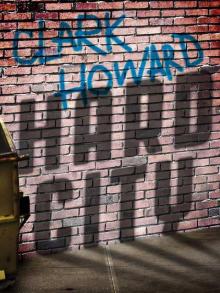
Crowded Lives, page 16


Spaak pulled open a narrow door and Holcomb followed him into the shack. Inside was an atmosphere of dull, greenish light, emanating from a large oil lantern suspended on the wall. Aside from the lantern, the shack was completely empty, totally bare.
“I’ll tell’em you’re here,” Spaak said. Holcomb nodded and Spaak left the shack.
When he was alone, Holcomb stood for a moment in the quiet emptiness, smelling the cold pungence of the freshly sawed lumber of which the shack was built. He breathed deeply of the smell, because it was pleasant to his senses, like the smell of fresh hay and of the high woods country where he hunted. He wondered briefly how it would feel to know that the new wood of the shack would be the last thing he would ever smell; to know that he was going to die with that rich, vigorous scent in his nostrils, a final reminder of just how precious life was.
There was a sudden flapping sound and Holcomb turned to the half wall that had the length of burlap stretched across its opening. A corner of the burlap had come loose from its nail and was being whipped back by a shaft of wind from the open courtyard outside. Stepping over to the partition, Holcomb forced the truant corner back tightly over the head of the nail. He did not try to look beyond the burlap; what was there he would see soon enough.
With a sigh, Holcomb turned and knelt beside the back wall, placing his rifle case on the floor and unzipping it. Removing his gloves, he spread open the wings of the case and began to assemble the rifle.
When Spaak returned a few minutes later, Holcomb was leaning against the wall smoking a cigarette. The fully assembled rifle rested, muzzle down, between his hip and one arm.
“’Bout ready,” Spaak said.
Holcomb nodded. He took a final deep drag on the cigarette, brushed the ash off with his thumb and put the butt in his pocket. He could as easily have dropped it on the floor, but he had a fetish about these shacks, this one and the other eight in which he had stood; he did not like to leave anything of himself behind.
The shack door opened and a small man wearing a hat and heavy overcoat entered.
“Holcomb,” he said, bobbing his head in brusque acknowledgment. He drew one hand out of his overcoat pocket and handed Holcomb five brass-colored, steel-tipped, 30-30 cartridges. While both he and Spaak watched, Holcomb slid them into a spring magazine and inserted it into the belly of the rifle. He loosened the sling, slipped his left arm into it, and tightened it across his muscle.
“Ready?”
Holcomb wet his lips and nodded. He turned and faced the partition as Spaak turned off the lantern and began removing the burlap. This was the worst part of it for Holcomb; not the actual squeezing of the trigger, but the two to three minutes between the time he was ready and—
The shack door closed behind him and he knew that he and Spaak were alone again. The burlap was all the way off now; an icy draft flooded the narrow room. In a moment, Holcomb thought, the floods will go on. He tried to close his eyes but could not. Always it was the same; he wanted to close his eyes, but his eyelids would never function.
This is the last time, he swore to himself. The last time—
The area beyond the partition was flooded with sudden light—stark, glaring light from powerful floodlights. Before Holcomb’s wide eyes a scene of horror was illuminated. A second three-sided enclosure, lumber-new like the first, stood a scant twenty feet away, its open side facing the floodlights and the half-wall behind which Holcomb waited. Within the structure a crude, heavy wooden chair had been built of the same raw timber, a chair of flat, hard planes, without contours, without dignity. A man was strapped to the chair, his forearms, thighs, calves and chest bound to the new wood with leather belts. A black hood covered his head and fell to his waist. Pinned to the dark cloth, over the man’s heart, was a four-inch target.
Last time, Holcomb vowed again. I won’t do it anymore.
He tore his eyes away from the hooded figure in the chair and nervously scanned the rest of the cold midnight scene. A dozen men, witnesses, stood still as statues to one side of the execution shack, their faces turned away from Holcomb, the wind whipping at their coattails and swirling gusts of powdery snow around their feet. Four guards armed with shotguns stood between the witnesses and the shack. A doctor, stethoscope in hand, huddled near the guards. A Mormon bishop, hatless, moved his lips silently.
Holcomb lowered his eyes and stared at the partition in front of him. He thought of home, of Lill, of Bonnie; Bonnie, growing up so quickly, so few years left for her to be daddy’s little girl. Suppose she found out someday …
Outside the shack, the man who had given Holcomb the bullets stepped into the side light of one of the floodlights. He put on a pair of glasses and held up a document from which he began to read aloud.
“Order of Execution. The Supreme Court of the Sovereign State of Utah, having found …”
The wind whistled into the shack where Holcomb stood. The sound of it muted some of the hurried, official words, but it did not matter to Holcomb; he had heard them all eight times before.
“… murder in the first degree, and having been duly sentenced in the Superior Court of the County of …”
The words droned on and the wind whipped and whistled while the guards stood erect, the doctor waited patiently, the bishop continued to move his lips, and the witnesses shuffled uneasily as death drew near.
Then it was silent, starkly silent; even the wind stopped. The little corner of the prison courtyard became for the men the stillest place in the world.
“Ready …”
Holcomb raised the rifle and dug its butt into his shoulder. A trickle of sweat escaped from his armpit and ran slowly, distractingly down his side.
“… aim …”
From beneath the black hood of the man in the chair, a sob escaped. It pierced the thin night air like the slash of a blade.
“… fire!”
Holcomb squeezed off the first round and saw a hole appear dead center in the target; the body behind the target lurched violently. Holcomb’s hand worked the bolt fluidly, ejecting the spent shell, throwing another one into the chamber.
Last time …
He flexed his sensitive trigger finger and fired again. And again and again and again.
In the car, with Spaak driving him back to the depot where he would have a three-hour wait for the morning train, Holcomb’s thoughts settled again on his little ranch and his little family. If he had a good year this year—that is if he did better than break even after all the expenses, if he could manage to put a few hundred in the bank—then at the end of the year he would write a letter to the prison bureau and tell them to find someone else for the job. He would quit; quit for good, and get out of it once and for all.
Settling more comfortably in the seat, Holcomb reached into his shirt pocket for a cigarette. His fingers brushed against the voucher for five hundred dollars that the warden had given him. If he mailed the voucher to the state paymaster that afternoon when he got home, he’d have his check in about a week. He had hoped to be able to use the money for a good stock bull to build up his herd, but thinking of it now, he did not see how he would be able to. The electric pump on his well was going bad and would surely need replacing by spring; a hailstorm had damaged the roof of the barn last month and he had to buy material to repair that; and Lill had mentioned a couple of times that maybe they should see about braces for Bonnie because a couple of her front teeth were turning crooked. So most of the five hundred would go for those things and probably a few others he hadn’t even thought of.
He could not help thinking, though, how nice it would have been to buy that bull. Just a little more good blood in his stock and he soon would have a prime line of beef. Then he wouldn’t have to sell through stock jobbers anymore and give away twenty percent of his profit; he could take a trip to the Chicago stockyards and get himself lined up with one of the top grade beef buyers and be able to sell directly for premium market price. Of course a trip to Chicago would take money too. Everything took money …
Holcomb rubbed his chin thoughtfully and turned to Spaak.
“How many more you got up there in the death house now?” he asked casually.
“Three,” said Spaak. “Probably be four pretty soon. Fellow over in Provo was convicted last week of killing an Indian woman; ain’t been sentenced yet, but he’ll probably get the max. Federal government’s touchy about their Indians getting murdered, and the state court knows it. Yeah, he’ll get the max for sure.”
“But right now you’ve got three?”
“Yep. Right now three.”
That was fifteen hundred dollars worth, Holcomb thought. A man could do a lot on a little ranch with fifteen hundred dollars.
Another story of camaraderie among returned combat veterans such as the ones in OLD SOLDIERS; but this time it concerns four ex-Marines in the days following service in Vietnam, where chemical canisters marked with an orange stripe had been used to defoliate the jungle before troops moved in.
Four men who have gone back to their respective lives, but who find that the grueling, obscene war they left behind is still with them: in their minds, their spirits, their personalities, and especially their bodies—and that it may even still be killing some of them …
The Color of Death
When the phone rang at four o’clock in the morning, Joe Page knew instinctively that it was Billy calling. He could not have explained how he knew—he just knew. The first several rings of the phone started bringing Joe’s mind up from the Quaalude nest in which it rested; the next several rings generated movement in limbs that were wasted from an earlier sexual marathon with a woman with fuchsia hair lying next to him; and somewhere around the eighth or tenth ring he sat up on the side of the open sleeper sofa and picked up the receiver.
“Yeah, hello—”
“Joe? Is that you, Joe? This here’s Billy.”
“Yeah, Billy—”
“Listen, Joe, you’member those lumps I had on my legs last year? Those ones that the doctor said was just fatty tumors that would prob’ly go away—”
“The ones that did go away,” Joe reminded him.
“Yeah, well, they’re back,” Billy said. A Tennessee twang made his voice go high-pitched sometimes, like when he was agitated. “When I woke up this morning, I had’em on both legs again. And I can feel some starting on my back.”
Joe did not say anything. He was trying to visualize Billy, trying to picture him on the Tennessee sharecropper farm, wearing overalls, sitting on a tractor in the sun. But the only image that came to mind was the other Billy; the Billy with a gun in his hand; the Billy who killed men.
“Joe? Did you hear me? I said—”
“I heard you, Billy. You’d better go back to the hospital.”
“I don’t like the hospital, Joe. They act like I’m some kind of nuisance or something. Anyhow, they don’t help me none.”
“You have to go back,” Joe said patiently. He massaged the back of his neck. The woman next to him stirred and expelled a heavy breath.
“Joe, I think Chief Charlie is dead,” Billy said, changing the subject. “I ain’t had a letter from him in two months. Only reason he’d quit writing me was if he died.”
“Maybe he’s on a drunk,” Joe suggested. “Maybe he’s in jail. You know how Indians are.”
“He’s dead, Joe. I can feel it.”
“Okay, have it your way. Now what about the hospital? When can you go back?”
“Will you come and go with me, Joe?” Billy asked. “That time you went with me, they didn’t treat me so bad.”
“I can’t, Billy. It’s too far. Besides, I’ve got a new job.”
“A new job? No bull? What kind of job?”
Joe thought fast. “I’m managing a string of parking lots. Couple of dozen lots. All over the L. A. area.”
“No bull?” Billy’s voice became excited. “Are any of’em in Hollywood?”
“Yeah, two or three.” The one at which he was a parking attendant was in Culver City, the pits.
“You ever see Ann-Margret?”
“Saw her just the other day.”
“She look as gorgeous in person?”
“Better.”
“No bull! Man—!” Billy’s voice trailed off. He was silent for several moments. Then he said, “I guess you couldn’t get a few days off and go to the hospital with me then?”
“I don’t think so. But I want you to promise me you’ll go anyway.”
“Oh, sure.”
“Word of honor?”
“Sure, Joe. Listen, I gotta get out in the patch and tend my crop. I’ll talk to you soon.”
Billy hung up and Joe sat in the dark holding the receiver, thinking about the lumps on Billy’s legs and back. He wondered why people at the hospital didn’t treat him any better. Goddamned doctors and nurses; coldest people in the world.
Hanging up the phone, Joe rose and moved a few feet across the room to a tiny alcove kitchen set behind a breakfast bar. Turning on a light over the sink, he ran cold water and washed his face, then drank some of it from cupped hands to irrigate the desert inside his mouth caused by the Quaalude. Why were those lumps coming back on Billy’s legs, he wondered. And why had Chief Charlie stopped writing to Billy? Could Billy be right; was the Chief dead?
A slant of light from the kitchen alcove fell across the woman on the sleeper sofa. Joe saw that she had dragged the sheet partly off to expose one flaccid breast. She was breathing nosily now through her open mouth, and there were bubbles of spittle collecting in one corner of her lips. During their earlier sexual ten-rounder, her breasts—her? What the hell was her name anyway? Her breasts had been tight with a high threshold of pain, her lips punk purple and forming a perpetual circle of desire. She had parked her Corvette on his lot that afternoon, they had talked, and she had picked him up at nine when he closed. Between the fuchsia hair, purple lips, those breasts, and the’ludes, he had made it though another night. Another night that would become meaningless in a week, forgotten in a month. Or perhaps it was already meaningless; if a man could not even remember a woman’s name—
Billy was scared, Joe realized, interrupting his own train of thought. Joe recognized the fear in the Tennessean’s voice; he had heard it before. Like everybody else, Billy feared the things he could not understand: the lumps that had returned on his body; the cessation of letters from Chief Charlie.
He won’t go back to the hospital, Joe decided. Billy’s sour Southern pride would not let him go back to a place where he thought he was considered a nuisance. Unless somebody went with him for support.
Joe walked back to the telephone and held the handset toward the light to dial, wondering if Billy had left the house yet. But Billy answered on the first ring and Joe thought: He was sitting there waiting for me to call.
“Listen, I can probably take a few days off—”
“You gonna be driving back?” Billy asked.
“Yeah—”
“Could you stop off and see what’s the matter with the Chief? It won’t be out of your way.”
“Okay.” Joe shook his head resignedly. Billy had taken it for granted that he would call; taken it for granted that he would find out for him about Chief Charlie. In Billy’s mind, Joe was still the leader. A follower had a right to take his leader for granted.
After he hung up the second time, Joe looked at the clock and calculated that there were a couple of hours before the morning rush began. Might as well get out of town ahead of the traffic, he decided. Ever since he got back from Vietnam, he realized, he had been getting out of town ahead of something: creditors, irate husbands, bench warrants. Lately he had developed the habit of never looking back, in case somebody was gaining on him.
Quietly, so as not to wake the woman with fuchsia hair, Joe Page began packing.
Heat rose from the Arizona highway in shimmering waves, and just outside Casa Grande a rattlesnake slithered across the asphalt in front of Joe’s car. Joe slowed down to let it get across his side, but in the rearview mirror saw a pickup truck swerve into the oncoming lane to run over it. Bastard, Joe thought. For the next few miles he entertained violent thoughts about the driver of the pickup.
A gravel road led from the state highway out to the Pima reservation. The reservation settlement was an accumulation of faded surplus government structures; mostly pre-fab Quonset huts with rusted corrugated roofs and porches that had tilted with the shifting of the desert. The only sign of life was a trio of Pima men in old jeans and tee shirts, sitting in the shade of a two-pump gas station playing cards on an upturned Valvoline carton. A thermometer nearby, also in the shade, registered one hundred-eight. Joe recalled Chief Charlie telling him that this was a place, the older Pimas believed, that long ago became so hot that the trees melted and formed cactus.
Parking, Joe let the dust settle before getting out of the car, then went up three wooden steps to a Quonset with a sign on the outside that read: TRIBAL OFFICES. At a badly scarred desk inside sat a Pima man of perhaps forty wearing a plaid shirt and a belt with a large silver buckle. He had a pot-belly and thick hips from too much sitting. On the desk in front of him was an open Dr. Pepper and a skin magazine; behind him on a table was a small black-and-white television turned to a game show he was not watching.
“What you need?” he asked when Joe entered.
“I’m looking for Charles Long,” Joe said. “I think he lives somewhere on the reservation.”
“What you want him for?”
The curtness of the question rankled Joe but he did not show it. “I’m a friend of his. I was driving through and thought—”
“Charlie Long’s dead, man.” The Indian said it without emotion, like he would say your battery was dead. “His old man and sister live a few miles down the road, if you want to see them. It’s a house on the left with an old Studebaker up on blocks out in front. You can’t miss it.” As Joe turned to leave, the man was suddenly inspired to ask, “Say, you don’t happen to know if he had insurance of any kind, do you? Half of it’s supposed to go to the tribal council if he had any. His old man said there wasn’t none, but he could be lying.”