

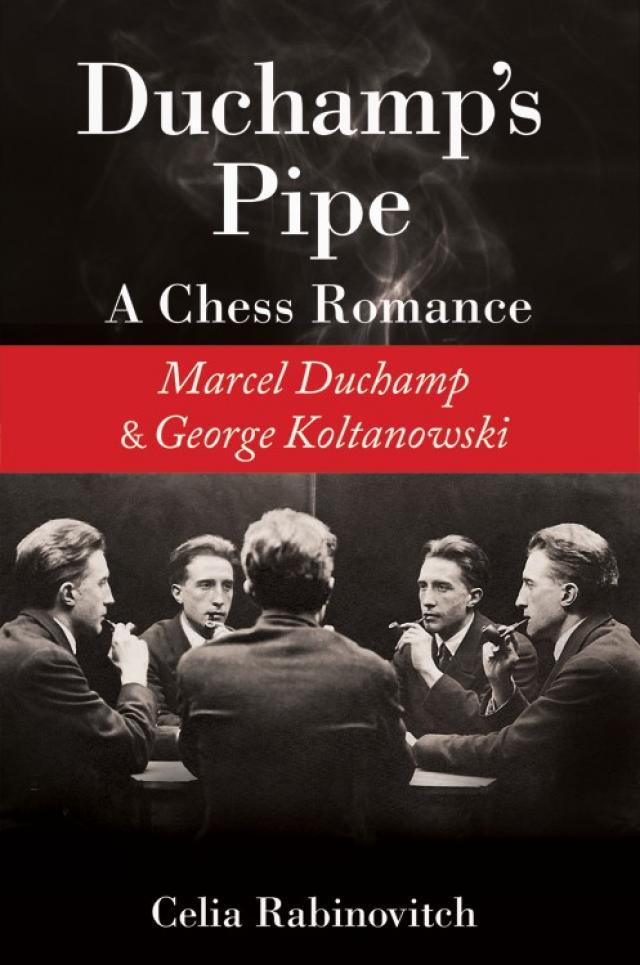
Duchamp's Pipe, page 1


CONTENTS
Title Page
Praise for Duchamp’s Pipe
Copyright
Illustrations
Les Personnages Artists and Writers of the Bohemian Domain
Thinkers: Ethnology, Myth, and the Psyche
Foreword: Marcel Duchamp—Chess Game and Endgame Tracking Duchamp
A Different Master of Chess
George Koltanowski—A California Chess Legend
Part I: A Smoking Pipe 1: The Gift
2: A Fairy Tale for Grown-Ups
3: Duchamp and Brâncuși—The Pure Pipe
Part II: A Chess Romance 4: The Players at the Art of Chess
5: Chess Painting, Chess Playing
6: Transatlantic Chess from Paris to New York
7: Diamonds and Chess
8: Duchamp and Koltanowski Meet—Le Cygne
9: Koltanowski Rising and the Creation of the World Chess Federation, 1924
10: Epiphanies in Chess and Art
11: The Match of 1929
Part III: A Beautiful Game 12: A Beautiful Game
13: Translucent Passages—Reading Between the Lines
14: Touring Chess Under Fascism’s Threat
15: Escaping France
16: Ethnological Excursions—Into a Dark Mood
17: Pocketing Chess—Chess for All
18: The Imagery of Chess, 1944–1945
19: Perhaps the Pipe, Even
Part IV: Objects and the Spirits Who Made Them 20: Rituals of Smoking and Breathing
21: The Form of Things Hidden—The Inframince
22: Another Romance
23: The Excess of Imagination
24: An Amiable Conjurer
25: Endgame—A Little Smoke Was Seen
26: The Exchange Redeemed
Epilogue
Afterword: Coffee House Chess Marcel Duchamp’s Love Affair with Chess Through the Looking Glass of the Twenty-First Century
Everything Old Is New Again
Memories of George Koltanowski
Chronology
Acknowledgments
Endnotes Foreword
Part I
Chapter 1
Chapter 2
Chapter 3
Part II
Chapter 4
Chapter 5
Chapter 6
Chapter 7
Chapter 8
Chapter 9
Chapter 10
Chapter 11
Part III
Chapter 12
Chapter 13
Chapter 14
Chapter 15
Chapter 16
Chapter 17
Chapter 18
Chapter 19
Part IV
Chapter 20
Chapter 21
Chapter 22
Chapter 23
Chapter 24
Chapter 25
Chapter 26
Afterword: Coffee House Chess
Chronology
References
Permissions
Index
About the Contributors
About the Author
About North Atlantic Books
Duchamp’s PipeA Chess Romance
Marcel Duchamp & George Koltanowski
Celia Rabinovitch
With a foreword by Ihor Holubizky, and contributions by Nikki Lastreto, Kerry Hamilton Lawless, and Irwin Lipnowski
Praise for Duchamp’s Pipe
“Duchamp’s Pipe is an utterly unique book. Recounting the friendship of French avant-garde artist Marcel Duchamp and Belgian chess master George Koltanowski, it reveals the central place that chess held in the mind of Duchamp, for whom this ancient game, along with art and tobacco smoke, was an instrument to open the gates of the imagination. Celia Rabinovitch has accomplished something wondrous here: a work of scholarship that is also a dream, one worthy of the Surrealist figures that populate its pages.”
—J. F. Martel, author of Reclaiming Art in the Age of Artifice: A Treatise, Critique, and Call to Action and cohost of the Weird Studies Podcast
“Celia Rabinovitch gives us a first-rate art historical detective story in Duchamp’s Pipe—a page turner that is hard to put down. What begins as an authentication of a pipe created by Marcel Duchamp for George Koltanowski enters into a chronology of two intersecting lives. We are riveted by the story of the blindfolded chess player, and a detailed history of Duchamp’s life in the chess world. I consider Rabinovitch to be one of the most brilliant and intuitive thinkers on Surrealism. This book is a marvel of scholarship and a delight.”
—Ann McCoy, artist, art critic, and editor-at-large at the Brooklyn Rail
“In the smoky world of coffee house chess, the facets of Duchamp’s Pipe perfectly reflect the light of audacious bohemia living in Europe’s wartime shadows. The pipe links the irony of Marcel Duchamp to the vaudeville showmanship of Koltanowski, tracing a mystery that is based on original material uncovered by the author.”
—Adina Kamien-Kazhdan, senior curator of Modern Art and of the Vera and Arturo Schwarz Collection of Dada and Surrealist Art at The Israel Museum, Jerusalem, and author of Remaking the Readymade: Duchamp, Man Ray, and the Conundrum of the Replica
“Duchamp’s Pipe offers a delightful and fascinating study of Duchamp’s career in a manner remarkably attuned to his sensibility. The book is very fine in deploying Duchamp’s concept of ‘inframince.’ It uncovers details, following Duchampian logic in associating various particulars—from a pipe offered specially for George Koltanowski, his chess rival, to art involving pipes and chess, to Duchamp’s themes of smoking and breathing. This book shows how the richest form of thinking in the arts may lie in attempting to match the mind to the matter of matter.”
—Charles F. Altieri, Stageberg Professor in English at the University of California, Berkeley, and author of many books, including Wallace Stevens and the Demands of Modernity: Toward a Phenomenology of Value
“Delightful and enlightening! Celia Rabinovitch investigates Duchamp as arbitrator in Giorgio de Chirico and André Breton’s duel, and Duchamp’s ‘wait for posterity’ rings out like a chess clock giving pause and reflection on one of modern art’s greatest tragedies.”
—Katherine Robinson, scientific coordinator of Metaphysical Art: The de Chirico Journals of the Fondazione Giorgio e Isa de Chirico
“Scholarly and lively, Duchamp’s Pipe chronicles the unlikely relationship between a surrealist master and a chess maestro, providing insights into the artist’s inner thoughts and motivations. This book will be enjoyed by chess players and art lovers alike.”
—Cecil Rosner, director of Investigative Journalism: Regions at the Canadian Broadcasting Corporation and author of Behind the Headlines: A History of Investigative Journalism in Canada.
“To prevail in the Duchampian universe, where books are published each month, requires a good story and the capacity to tell it. Rabinovitch’s book, like a play with a cast of characters led by George Koltanowski and Marcel Duchamp, delivers both.”
—Stephan E. Hauser, author of Kurt Seligmann, 1900-1962: Leben Und Werk and librarian at Schaulager, Laurenz Foundation, Switzerland
“The substantial ever-changing hues of a briar pipe; the subtle and precise movements of chess pieces; the camaraderie with George Koltanowski and his ring of friends—all held together as the ethereal smoke from the pipe, molding and embodying being and non-being, external gifts of exchange and imaginative consciousness of the materiality of the human world. Celia Rabinovitch’s insightful biographical study adds life to our understanding of Duchamp.”
—Charles H. Long, author of Significations: Signs, Symbols, and Images in the Interpretation of Religion and Ellipsis: The Collected Writings of Charles H. Long and emeritus professor of religious studies at University of California, Santa Barbara
“A remarkable, authoritatively researched account of the life and career of George Koltanowski and of artist and fellow chess fanatic Marcel Duchamp. Rabinovitch shines a light on these two unusual fellows as bright as the flame they used to light the small handcrafted pipe they shared.”
—Steve Rubenstein, journalist and personal friend of George Koltanowski
“A smoking reproach against staid scholarship—juxtaposing biography, industrial history, literary history, photography, and other disciplines to produce a fairy tale about chess and friendship, and a meditation on the contradictory role of the gift in the world of art.”
—Lindsey Banco, author of Travel and Drugs in Twentieth-Century Literature and associate professor of English at the University of Saskatchewan
“A richly illustrated chess odyssey that winds across three continents tracing the intertwined lives of two of the more cerebral characters of the last century.”
—Henry M. Sayre, Distinguished Professor of Art History Emeritus at Oregon State University and author of nine books, including The Visual Text of William Carlos Williams
Copyright © 2020 by Celia Rabinovitch. All rights reserved. No portion of this book, except for brief review, may be reproduced, stored in a retrieval system, or transmitted in any form or by any means—electronic, mechanical, photocopying, recording, or otherwise—without the written permission of the publisher. For information contact North Atlantic Books.
Published by
North Atlantic Books
Berkeley, California
Cover design by Jasmine Hromjak
Book design by Happenstance Type-O-Rama
Printed in Canada
All
Additional permissions begin on page 273.
Duchamp’s Pipe: A Chess Romance—Marcel Duchamp & George Koltanowski is sponsored and published by the Society for the Study of Native Arts and Sciences (dba North Atlantic Books), an educational nonprofit based in Berkeley, California, that collaborates with partners to develop cross-cultural perspectives, nurture holistic views of art, science, the humanities, and healing, and seed personal and global transformation by publishing work on the relationship of body, spirit, and nature.
North Atlantic Books’ publications are available through most bookstores. For further information, visit our website at www.northatlanticbooks.com or call 800-733-3000.
Library of Congress Cataloging-in-Publication Data
Names: Rabinovitch, Celia, author. | Holubizky, Ihor, writer of foreword.
Title: Duchamp’s Pipe—A Chess Romance: Marcel Duchamp & George Koltanowski / Celia Rabinovitch; with a foreword by Ihor Holubizky, and contributions by Nicole Lastreto, Kerry Hamilton Lawless, and Irwin Lipnowksi.
Description: Berkeley, California : North Atlantic Books, 2020. | Includes
bibliographical references.
Identifiers: LCCN 2019018198 (print) | LCCN 2019018281 (ebook) | ISBN 9781623173579 (e-book) | ISBN 9781623173562 (paperback)
Subjects: LCSH: Duchamp, Marcel, 1887-1968—Friends and associates. |
Koltanowski, George, 1903-2000—Friends and associates. |
Artists—Biography. | Chess players—Biography. | Tobacco
pipes—Anecdotes. | BISAC: ART / History / Modern (late 19th Century to 1945). | GAMES / Chess. | BIOGRAPHY & AUTOBIOGRAPHY / Artists, Architects, Photographers.
Classification: LCC N6853.D8 (ebook) | LCC N6853.D8 R335 2019 (print) | DDC 709.2—dc23
LC record available at https://lccn.loc.gov/2019018198
This book includes recycled material and material from well-managed forests. North Atlantic Books is committed to the protection of our environment. We print on recycled paper whenever possible and partner with printers who strive to use environmentally responsible practices.
Illustrations
Figure 1. Marcel Duchamp’s pipe for George Koltanowski, 1944 (view 1). Briar pipe ebauchon with Duchamp signature. Photograph courtesy of Nikki Lastreto, private collection.
Figure 2. Marcel Duchamp’s pipe for George Koltanowski, 1944 (view 2).
Figure 3. Marcel Duchamp’s pipe for George Koltanowski, 1944 (view 3).
Figure 4. Kaywoodie pipe shapes, 1936, S. M. Frank & Co., Inc. Courtesy of Bill Feuerbach.
Figure 5. Kaywoodie pipe shapes, 1947, S. M. Frank & Co., Inc. Courtesy of Bill Feuerbach.
Figure 6. Pipe for Enrico Donati, 1946, by Marcel Duchamp. Courtesy of the Estate of Enrico Donati, Museum of Modern Art, New York.
Figure 7. Marcel Duchamp, Constantin Brâncuși, Tristan Tzara, and Man Ray in the studio, 1921, photographed by Philippe Meliot. Courtesy of Musée National d’Art Moderne, Centre Georges Pompidou, Paris, France. © ADAGP, Paris / Artists Rights Society (ARS), New York 2019.
Figure 8. Brâncuși pipe, 1934, by Constantin Brâncuși. Formerly of the collection Dumitresco Natalia and Alexander Istrati, gift from the artist. By descent to the present owner. © Succession Brâncuși—All rights reserved, Artists Rights Society (ARS), New York 2019.
Figure 9. Marcel Duchamp, 1917, by Edward Steichen. Courtesy of Philadelphia Museum of Art, The Louise and Walter Arensberg Collection, 1950. © 2019 The Estate of Edward Steichen / Artists Rights Society (ARS), New York.
Figure 10. George Koltanowski in Belgian army uniform, 1924. Courtesy of the John G. White Chess Collection at the Cleveland Public Library.
Figure 11. Marcel Duchamp, Jacques Villon, Raymond Duchamp-Villon, and Villon’s dog Pipe in the garden of Villon’s studio, Puteaux, France, ca. 1913. Courtesy of Philadelphia Museum of Art, the Louise and Walter Arensberg Collection, 1950.
Figure 12. The Chess Game, 1910, by Marcel Duchamp. Courtesy of Philadelphia Museum of Art, the Louise and Walter Arensberg Collection, 1950.
Figure 13. Study for Portrait of Chess Players (Les Joueurs d’échecs), 1911, by Marcel Duchamp. Guggenheim Museum of Art. Estate of Katherine S. Dreier, 1953.
Figure 14. The Portrait of Chess Players, 1911, by Marcel Duchamp. Courtesy of Philadelphia Museum of Art, the Louise and Walter Arensberg Collection, 1950.
Figure 15. Nude (Study), Sad Young Man on a Train (Nu [esquisse], jeune homme triste dans un train), 1911–1912, by Marcel Duchamp. Courtesy of the Solomon R. Guggenheim Foundation Peggy Guggenheim Collection, Venice, 1976.
Figure 16. Bottle Rack, replica, 1921, by Marcel Duchamp. (Original version from 1914.) Courtesy of Fonds de dotation Jean-Jacques Lebel.
Figure 17. Fountain, 1917, by Marcel Duchamp. Photograph by Alfred Stieglitz at the 291 art gallery following the 1917 Society of Independent Artists exhibit. Courtesy of Philadelphia Museum of Art Library and Archives.
Figure 18. Marcel Duchamp in 1918, seated smoking, in Katherine Dreier’s apartment, 135 Central Park West, New York City, before leaving for Buenos Aires. Photograph by Katherine Dreier. Courtesy of Katherine S. Dreier Papers, Société Anonyme Archive. Yale Collection of American Literature, Beinecke Rare Book and Manuscript Library.
Figure 19. Marcel Duchamp seated on a balcony looking at a chessboard, Buenos Aires, January 1919. Photographer unknown, private collection.
Figure 20. Marcel Duchamp, 1923, by Alfred Stieglitz. Courtesy of Alfred Stieglitz/Georgia O’Keeffe Archive, Yale Collection of American Literature, Beinecke Rare Book and Manuscript Library, 2019.
Figure 21. Marcel Duchamp, 1922–1923. Courtesy of the Marshall Chess Club, 2019.
Figure 22. Edmond Lancel, editor of L’Échiquier. Reproduced from L’Échiquier: revue internationale d’échecs, vol. 1, 1925. Courtesy of the John G. White Chess Collection at the Cleveland Public Library.
Figure 23. Hotel Le Cygne, c. 1900. Reproduced from L’Échiquier: revue internationale d’échecs, vol. 1, 1925. Courtesy of the John G. White Chess Collection at the Cleveland Public Library.
Figure 24. Swan over entrance of Hotel le Cygne. Reproduced from L’Échiquier: revue internationale d’échecs, vol. 1, 1925. Courtesy of the John G. White Chess Collection at the Cleveland Public Library.
Figure 25. George Koltanowski, age seventeen or eighteen in London, 1920–1921. Courtesy of the John G. White Chess Collection at the Cleveland Public Library.
Figure 26. The Victorious Team in the Interclub Belgian Chess Tournament in Ghent, 1923. Included are George Koltanowski (third from right) and Arthur Dunkelblum (far left). Courtesy of the John G. White Chess Collection at the Cleveland Public Library.
Figure 27. Winners of the Olympic Tournament, 1924. George Koltanowski (circled) is in the middle row, third from the left. Marcel Duchamp (circled) is in the right corner in the top row. Courtesy of the John G. White Chess Collection at the Cleveland Public Library.
Figure 28. Poster for the Third French Chess Championship, 1925, by Marcel Duchamp. Courtesy of Staatliches Museum, Schwerin, Germany.
Figure 29. George Koltanowski’s scorebook for the 1929 Paris Chess Championship (view 1), which includes the handwritten record of the game he lost to Marcel Duchamp. Koltanowski’s personal scrapbook, private collection, 2016.
Figure 30. George Koltanowski’s handwriting in the original scorebook for the 1929 Paris Chess Championship (view 2), 2016.
Figure 31. Frank Marshall at the Hamburg Chess Tournament, 1930. Courtesy of the Marshall Chess Club, New York, 2019.
Figure 32. Marcel Duchamp, c. 1930. Documentary photograph possibly from the Hamburg Chess Tournament. Courtesy of Joaquim Travesset i Barba.
Figure 33. Duchamp and Vitaly Halberstadt with Chessboard, 1932, by Man Ray. This photograph appeared in Duchamp and Halberstadt’s book Opposition and Sister Squares Are Reconciled (L’Opposition et les cases conjuguées sont réconciliées); it was later reproduced as a photogravure in a booklet entitled Le Monde des échecs, published by L’Échiquier, Brussels, February 1933. Courtesy of a private collection, New York. © Man Ray 2015 Trust / Artists Rights Society (ARS), NY / ADAGP, Paris 2019 and © Association Marcel Duchamp / ADAGP, Paris / Artists Rights Society (ARS), New York 2019.


