The Tooth and the Nail, page 1


BILL S. BALLINGER
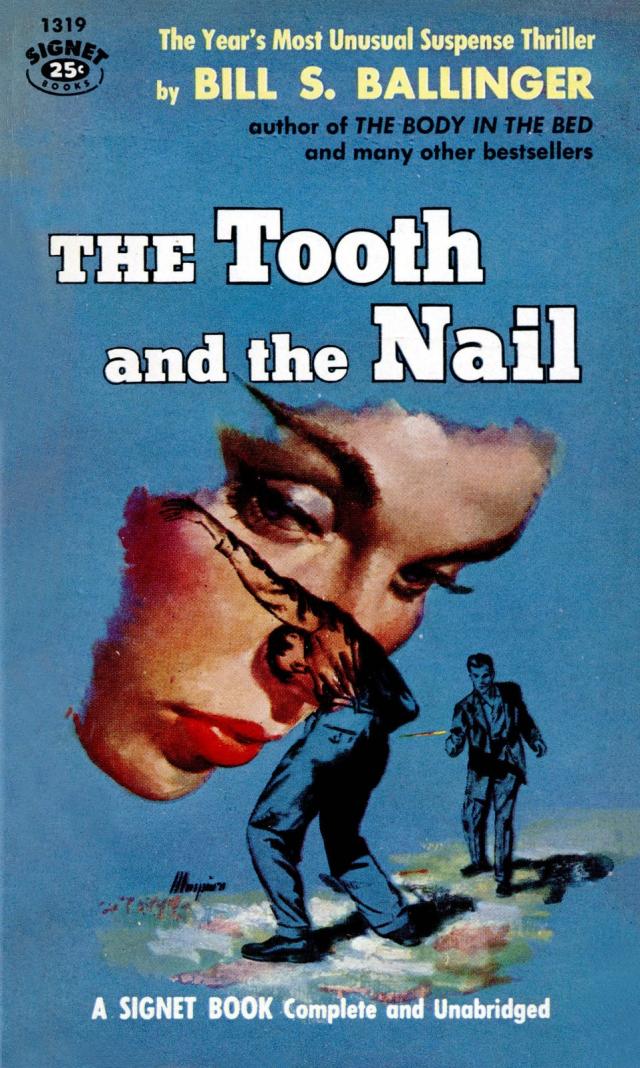
THE TOOTH AND THE NAIL
Copyright © 1955 by William S. Ballinger
This book is a work of fiction. Names, characters, places, and incidents either are the products of the author’s imagination or are used fictitiously, and any resemblance to actual events or persons, living or dead, is entirely coincidental.
The Tooth and the Nail
Prologue
His name was Lew; his second name is unimportant, except for one instance, which I shall tell you about later; and he had been known as Lew Austrian, Lewison Clark, and Patrick Paris. Actually, however, he’d been born Luis Montana, which is Spanish, and later Americanized it to Lewis Mountain—which means the same. His name, in itself, was peculiar in a way, because his family have been Americans for many generations and by the time he was born were not Spanish at all. But the old names remained, and that’s why he ended up with a name such as Luis Montana.
And, furthermore, he wasn’t born in California, or Texas, or Arizona or New Mexico—or any of the border states where you’d expect to find the descendants of the Spaniards. He was born in Iowa which is approximately in the center of the United States and where you may expect to find anyone. He was born on a farm, a good one with rolling acres of rich soil; it had been his grandfather’s farm, and after his grandfather died his father owned it.
When he was alive, he was a magician—a maker of miracles, a prestidigitator, an illusionist like Harry Houdini or Thurston. He had been a good magician, but because he died too soon he never became really famous like the others I’ve mentioned. However, he accomplished something that neither of these men ever attempted.
First, he avenged murder.
Secondly, he committed murder.
Thirdly, he was murdered in the attempt.
One
THE JUDGE OF THE COURT OF GENERAL SESSIONS, County of New York, smoothed down his black robe, deliberately arranged the papers before him, and nodded to the assistant district attorney. The attorney arose from the prosecution’s table and walked a few feet toward the jury box. In the somber austere room, with high ceilings, he was the center of attention and he paused confidently, for a moment, before he began the opening statement for the prosecution. As he turned slightly, his eyes swept the table where the defendant was seated beside the counsel for the defense, and the eyes of the jury followed his glance. In that exact instant, with the jurymen’s eyes on the prisoner, he began speaking. He spoke fluently and well, in an easy conversational voice, pacing slowly and deliberately before the jury box which seated nine men and three women.
The assistant district attorney was named Franklin Cannon. A man of middle age, of middling stature and undeterminable colored hair, he was a deliberate and unemotional man attempting to fulfill the obligations of his office. He disliked histrionics and prepared his cases carefully—presenting his logic, facts, and evidence to a jury with an honesty and sincerity that often was severely damaging to his opponents. Cannon appreciated the importance of the opening of a trial; at such a time, the jury often formed lasting impressions of both the prosecution and defense to which it clung with bias throughout the entire trial.
Cannon, talking now, was conscious of the scrutiny of the jury’s eyes. As he continued to talk in generalities, he felt the eyes probing his face, examining his clothes, observing his gestures; a dozen pairs of ears weighing the sound of his voice, sifting his words. With the minutes going by, he could sense the easing of tension among the jurymen, the visible disappearing of aloofness as each became accustomed to his appearance and the sound of his voice. It had been Cannon’s experience that all new juries are uneasy at the opening of a trial, and he was content to spend the additional time and words to build this first rapport between them. One by one, they would come to think… “He reminds me of Cousin Joe, the way he talks” or “he looks a little like Bob Elton out in the engineering department” or simply “Cannon talks like a pretty reasonable man.”
Whichever it was the jury thought—the familiar comparison or the sudden acceptance of him as a person—whenever the decisions were made the barrier would suddenly go down and then the prosecution would get on with the business of sending a man to the chair.
Abruptly, Cannon stopped and walked slowly toward the jury box. Pausing, he seemed to be searching in his mind. Slowly, almost kindly, he said, “You must remember that the man accused here is not bound to prove his innocence… it is the obligation of the state, my obligation… too, to prove his guilt.”
The chief counsel for the defense arose from his chair and stood beside the table. “Your honor,” he said, “would you instruct the jury that what the counselor has just said is a matter of law. It has nothing to do with his own particular magnanimity.”
Cannon turned and, in turning, seemed to bow to his opponent. “Certainly, it is a matter of law,” he replied courteously.
The eyes of the jury were fixed on the defense attorney, partly hostile, partly surprised by the sudden intervention. Cannon, sensing the jury’s sympathy for himself—which might quickly be dissipated when the defense made its presentation—turned now to the serious business before him.
“In many respects this is both an unusual case, and a very interesting one.” Cannon’s voice had assumed a grave note. “The defendant is accused of murder. The fact that he is so charged is the reason he is here, but it does not necessarily mean that he committed a murder. The State of New York will attempt to prove that he did kill a man known to him as Isham Reddick… an employee working for him as a valet and chauffeur.
“We will attempt to prove the accused had a motive, and the opportunity.” Cannon turned and walked to his table, pausing for a moment to pick up a sheaf of papers—through which he riffled. The silver-painted radiators, in the silent courtroom, released small puffs of steam. The rows of oak benches, the limply hanging flag, the green roller shades at the windows, the silent specters of other trials of other men, waited patiently.
Cannon was finished with his notes, and he replaced the papers and returned to a position a few feet from the jury box. “Undoubtedly each of you has heard the expression… circumstantial evidence. And most probably you have heard it referred to in a rather derogatory way… It’s not uncommon to hear a criminal, after conviction, maintain complete innocence and insist that all the evidence was circumstantial.”
The attorney smiled, and a number of the jurors returned it. “There are very few cases, particularly of murder, where the facts and evidence are not at least partly circumstantial. Possibly only in a case where there are eyewitnesses to the very act itself, where the witnesses can identify both the victim and the accused, do you find a case without some circumstantial evidence…”
The counsel for the defense interrupted. “Objection,” he said. “This is a matter for argument, and is theoretical to the point that it can neither be proved nor disproved.”
Cannon faced the judge. “If it please, your honor,” he replied calmly, “I feel this matter of evidence… particularly of circumstantial evidence… is of the utmost importance to the jury… and must be completely understood.” Turning to the attorney for the defense, he smiled, “I’m sure the counselor is planning to refer to it himself.”
“Gentlemen,” said the judge, “on points of law concerning evidence I will instruct the jury!”
Cannon nodded politely and returned to address the jury. “It is the obligation of both myself… and my associate,” he turned and indicated Deputy Assistant Attorney Rickers, “to prove the corpus delicti in this case. In a homicide this term refers to the death of the person alleged to have been killed. Occasionally, newspaper feature writers,” Cannon glanced with a quiet smile toward the press bench, “contribute to the myth that without a body, there is no conviction. This is not exactly the truth, although it makes excellent reading on a dull Sunday afternoon. What they mean to say, undoubtedly, is that without evidence of a body, there can be no conviction. But, ladies and gentlemen of the jury, that is something entirely different! In several no-table cases, which I can quote, verdicts of guilty have been found without the actual physical presence of a corpus delicti, although the evidence of a corpus delicti was proved beyond a reasonable doubt.
“In most jurisdictions, only direct evidence will avail to prove the fact of death, although circumstantial evidence may, of course, be resorted to in order to show that the death was produced through a criminal agency. Now, with these points in mind let us return to the night of November twenty-second of last year.”
The jury was listening intently. “It is the contention of the state,” Cannon continued, “that on that date, sometime preceding midnight, the defendant killed a man named Isham Reddick. Reddick was employed in his household, an establishment located on East Eighty-ninth Street, here in the City of New York. Evidence will be introduced to show that Reddick had become a thorn-in-the-side of the defendant, that Isham Reddick was blackmailing him, and the defendant had on at least one occasion… and probably on others… paid Reddick a substantial sum of money. On the night of November twenty-second, there was a meeting between the defendant and Isham Reddick ending in violence…”
“Objection,” stated the counsel for the defense. “That is a conclusion.”
“What are you attempting to establish, Mr. Cannon?” asked the judge.
“I’m attempting to outline the position of the case for the state, and to indicate what we will later prove.”
“Continue, Mr. Cannon,” s
“Thank you,” said the counsel for the defense. Returning to his seat beside the defendant, he continued to watch Cannon warily.
Cannon resumed, cautiously, the threading of his speech. He wanted no interruptions at this point. The afternoon shadows were filling the corners of the bleak, forlorn room and he glanced at the watch on his wrist. A little longer, and it would be time to adjourn until the following day. It would give the jury an entire evening to consider his remarks before the opposition took up its defense. “Sometime during the night of November twenty-second,” Cannon continued, “and into the early morning hours of the twenty-third, the body of Isham Reddick was dismembered and destroyed in an attempt to remove all evidence of the crime! And, in the possibility of detection or discovery, to circumvent conviction and punishment for the crime! Fortunately for justice, however, all traces of the crime were not removed. All evidence of the body was not destroyed beyond recovery… and other indisputable proofs of the crime were preserved by the early appearance of the authorities.
“This evidence will be presented to you. You will appraise it, weigh it, consider it. After you have heard the entire case, after you have seen the evidence with your own eyes, if you believe beyond any reasonable doubt that the accused is guilty… it is then your duty, your obligation… to return to this court your verdict attesting it.” For a moment he stood silently, then added, “Thank you.”
The judge, glancing at the old-fashioned Western Union clock on the wall, gaveled his desk once, and adjourned the court until the next morning. The court stood respectfully while he walked to his chambers.
Two
IT ALL BEGAN on the day I net Tally Shaw.
Meeting her, with due apologies to the poets, was not the same as listening to a nightingale sing in a garden, or finding a spring of cool water after thirsting for days in a desert. But the fact that she was, that day, a complete stranger both to me and to New York, standing on Seventh Avenue arguing with a cab driver, put into motion all the events that were to happen later. And, if one believes in inevitability, then it was inevitable that I acted the way I did. A cab had stopped in front of the hotel where I was living and its passenger did not have enough money to pay her cab fare. The cabby was adamant about keeping her luggage, and the girl was pleading with him, desperately, to let her have one small bag.
The Delafield—a small, not quite shabby hotel—which receives most of its business from show people, does not have a doorman, or the girl might have borrowed the money from him. As I pushed past them to go into the lobby, I heard the girl say, “It’s ridiculous! I only owe you a dollar!”
“I can’t help that,” replied the driver, “I’ll hold the luggage and you can have it when you pay me the buck.”
“I don’t know how it happened… I had the money, I don’t know where it went…” She rummaged through her handbag urgently. “It might’ve fallen out when I had lunch. I remember I had it then. At the station just before I took the train…”
I stood in the center of the doorway, holding open the door, listening to the argument. Urged on by my curiosity, I stepped back to the sidewalk letting the door close, still following the conversation. “Look, lady,” the cabby protested indifferently, “maybe you did, maybe you didn’t. I keep the suitcases till you pay me or… I’ll call a cop.”
The girl was frightened. “No, don’t do that! Keep one of them… keep the hatbox. Is that all right with you? I’ll just take the little handbag.”
He shook his head. “Nope! I keep both of them!”
“But I must have at least one… or I can’t get in the hotel. They won’t let me register without paying in advance…”
“I keep both of ’em.” The cabby’s voice was final.
I discovered I was standing by the girl’s side and, to my surprise, I heard myself saying, “If the lady will permit me, I’ll pay the bill.” The cabby swung his small suspicious eyes at me, and the girl turned wonderingly. “How much does she owe you?” I asked him.
He replied, “A buck.”
“Here it is… and give the lady her luggage.” He placed a large tan hatbox and a small leather satchel on the sidewalk. Circling around to the driver’s seat, he slipped behind the wheel and drove away. The girl remained silent. “Well,” I told her, “you now have your choice… either say ‘thank you,’ or I’ll take the luggage.”
“It was nice of you,” she gave me an embarrassed smile. “Thank you very much.”
“Lost all your money, huh?” I asked.
“Yes.” She regarded her purse, misery in her eyes.
“Any idea where you lost it?”
“It must’ve been at the station… in Philadelphia.” Her words began to tumble out. “I stopped in the station for a sandwich. Then I was on the train. I didn’t look again until I reached the hotel. I didn’t hire a porter… or buy anything else…”
“Can you wire back for more?” She shook her head hopelessly. “Anyway,” I said, “there’s no sense standing out here on the curb. Come on, I’ll buy you a cup of coffee while you decide what to do.” The Delafield has a small luncheon counter, which is open twenty-four hours a day, and I headed for it. Picking up her luggage, I received a surprise. The hatbox was neither any heavier or lighter than you might expect, but the small leather satchel could not have weighed more if it had been filled with fire plugs. “Don’t you find this a little heavy to carry around?” I asked politely.
She agreed, rather nervously. “Yes… but it’s good exercise,” and then smiling, she shrugged it off.
We climbed on stools and she ordered a cup of tea. The counter was nearly vacant although it was invisibly festooned with the ghosts of generations of cream cheese and jelly sandwiches. “Just as a beginning,” I asked the girl, “do you know anyone in town you can phone… any friends or relatives?”
“No. I’m a complete stranger.”
“Where’d you come from?”
“Philadelphia…”
“The answer is easy,” I told her. “I’ll lend you five dollars and you can go back. Catch a train tonight… they leave practically all the time.”
“I can’t do it,” her voice was very low.
“The five bucks? You can send it back sometime.”
“I didn’t mean that. I… just… can’t go back to Philadelphia.” Turning, she faced me, her eyes wide and set with determination.
“Why not?”
She didn’t reply. Abruptly I realized I was wrong. What made her eyes so wide was not determination, but fear! I said, “All right, let’s change the subject. Tell me about yourself; I’m not the Traveler’s Aid Society, but I’ll do until it comes along…”
It was then she told me her name was Tally Shaw. She had no family; her last relative, an elderly uncle, had died the preceding week. She had taken what little money was left and come to New York. And here she was—no money, no friends, no job. As I listened, I watched her and realized it was an extremely pleasant pastime. While she talked, she held her eyes to the bottom of the teacup—as if attempting to read the leaves. Occasionally she turned the cup slowly, around and around, in her fingers. There was an unconscious grace in the movement, her head arching on a slender neck, her profile lovely. She did not, however, possess what could be called a striking beauty although that was an asset in itself. Her charm depended on a shyness, a quietness—a blending of softness and repose.
Highlights danced on her hair. The regularity of her delicate features was contradicted by her mouth—warm, and a shade too wide—and high prominent cheekbones which lightly brushed an enigmatic expression… a gentle touch of the Oriental… across her face.
“What had you planned to do here in New York, before you lost your money?” I asked.
“I really didn’t have any plans,” she shrugged. “I would have to find a job… of course.”